
The short answer
For a Swiss firm's recurring multilingual matter production, we would evaluate Whisperit first. For drafting and revision inside Word, evaluate Legora. For contract-focused drafting from precedents, include Spellbook. For writing informed by legalis commentary, include Swiss-Noxtua.
No product on this shortlist has won a controlled legal-language comparison here. A list of supported languages is not evidence that the tool preserves legal effect.
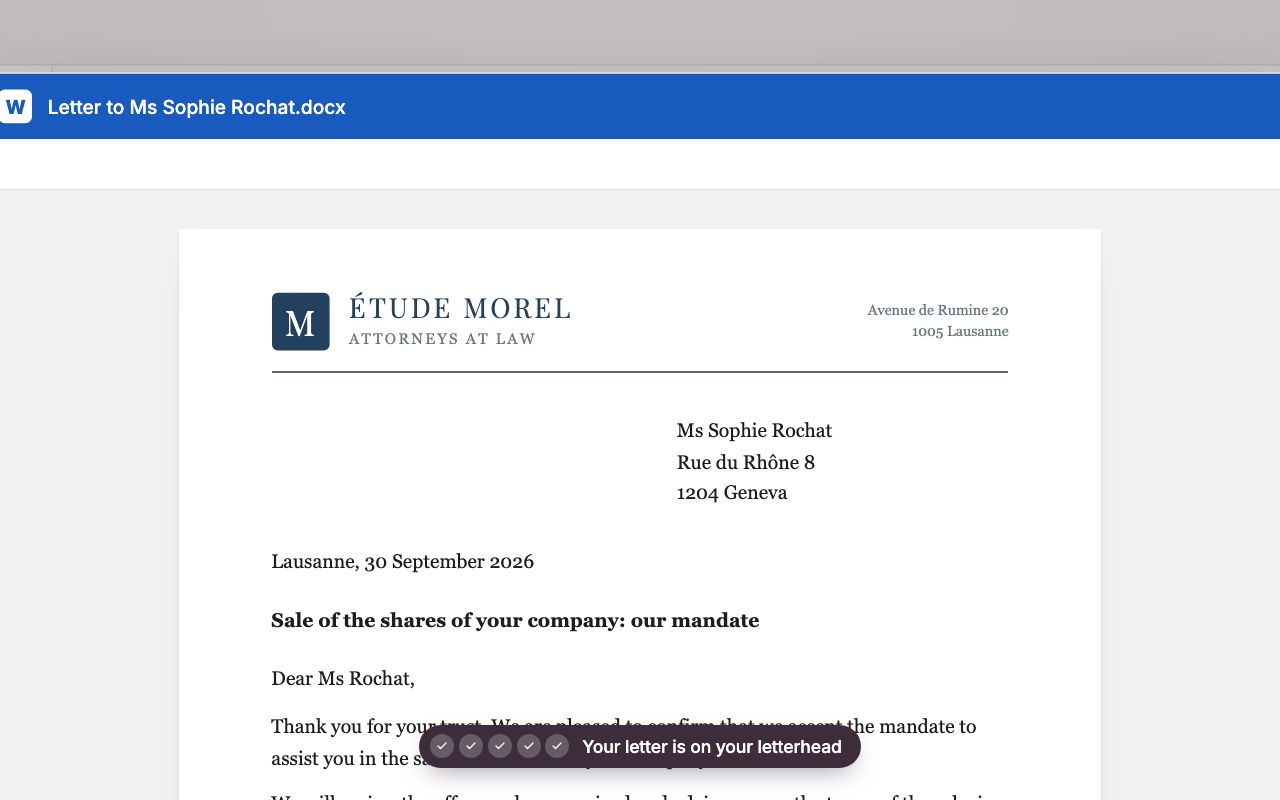
Illustrative product demonstration
Review the language and the finished document
A recreated demonstration with a fictional matter. A clean export shows the intended format; test legal meaning, names, dates and defined terms in every required language.
Source: Whisperit · Letterhead walkthrough
Open full-size imageThe picks at a glance
| Product | First evaluate for | Language test | Main boundary |
|---|---|---|---|
| Whisperit | Instructions and matter work across languages | Known facts to the required output language | Export and final formatting need checking |
| Legora | Drafting in the team's Word workflow | Revision while preserving document structure | Translation still needs legal review |
| Spellbook | Contract language based on precedents | Clause meaning and negotiating position | Broad language claims are not a benchmark |
| Swiss-Noxtua | Commentary-informed Swiss legal writing | Correct source proposition and terminology | Evaluate delivery workflow separately |
Multilingual drafting is more than translation
A firm may ask for four different things: drafting directly in a language, translating an existing document, revising a bilingual agreement or summarizing foreign-language material for a colleague. The products should be tested against the actual job.
The required output also has a jurisdiction and audience. A letter to a client, an internal memo and a negotiated agreement do not use the same register. Terminology can be locally specific even when the language is shared.
Write the brief accordingly: represented party, jurisdiction, source language, output language, intended reader and document type. Ask the tool to preserve defined terms and mark uncertainty. The easiest way to create an avoidable error is leaving the purpose implicit.
1. Whisperit: evaluate for the connected multilingual workflow
Whisperit advertises a workspace that connects instructions, documents and drafting. [1] It is worth evaluating when a Swiss team repeatedly produces different kinds of work from a mixed-language matter.
Use a French instruction, German source material and an approved example of the desired output. Ask for a client letter or internal briefing. Have a bilingual lawyer check the facts and the intended meaning before judging the style.
Choose a Word-focused product first if the requirement is to complete every revision inside the existing Word document. Also inspect exported numbering, tables and letterhead. A good first draft is not the same as a final deliverable.
2. Legora: evaluate for in-document work
Legora's Word offering includes drafting, review and translation. [2] That is a relevant advantage for a firm whose lawyers want to stay in the document through the final revisions.
Test an agreement with definitions, internal references and a bilingual annex. Make a substantive change and inspect whether corresponding passages remain consistent. Then open the document in the ordinary review environment.
Its boundary: preserving the layout does not prove preservation of legal meaning. Have a lawyer familiar with both languages inspect the actual change, especially where negation, conditions or exceptions are involved.
3. Spellbook: evaluate for multilingual contract drafting
Spellbook's drafting page advertises multilingual work and use of precedents. [3] It would be inaccurate to dismiss it as English-only.
Give it a contract type, the represented party and an approved precedent in the output language. Ask for a defined revision, not a full rewrite. Review whether the negotiating position and cross-references remain intact.
Its boundary: extensive language support does not establish equal legal quality in every language or jurisdiction. A contract-first candidate may be excellent for the agreement while another workflow remains better for the rest of the matter.
4. Swiss-Noxtua: evaluate for source-informed writing
Swiss-Noxtua publishes a legal-writing offering alongside its research product. [4] It is worth evaluating when the draft must reflect a proposition drawn from its relevant source collection.
Choose a completed memo and ask for an analysis in the required language. Open the authority, inspect the proposition and compare the terminology with the firm's accepted work.
Its boundary: a research-supported memo does not settle the entire daily production workflow. Test how the document is reviewed, corrected and delivered in the format your team needs.
Build a term list before comparing fluency
Prepare the terms your firm needs to keep consistent: party names, defined terms, court names, statutory references and preferred translations. Include terms that should remain in the original language because the translated phrase could change the intended meaning.
Give the same list to every product. A tool should not be penalized for a house preference it was never told. Conversely, repeated failure to follow the list is meaningful evidence about fit.
Use Swiss Standard German where required by the firm. Ask for the appropriate professional register in French, English and Italian wherever these languages are used in the practice. Have a reviewer check both concept and convention. A graceful sentence can still express the wrong position.
The evaluation: meaning before polish
Choose a document already reviewed in two languages and use it as a checked reference. Prepare a short source instruction and a specific revision. Include a conditional obligation, an exception, an amount and a defined term.
Ask every product for the same output. Have the bilingual reviewer mark three things separately: substantive change, terminology inconsistency and stylistic preference. This prevents attractive phrasing from hiding a meaningful error.
Then test the final document: headings, tables, footnotes, references and numbering. Give it to the person who normally delivers the file. Include their correction and transfer time in the comparison.
Repeat with a different document type, such as client correspondence instead of a contract. A tool that performs well on one genre may not be the best fit for every output the firm needs.
Pricing and processing need their own check
Confirm the offered account includes the workflow you tested. Ask whether translation or particular models require separate services. We have not obtained comparable quotes or audited the processing configurations.
For confidential material, review all relevant data paths, including external translation and research services. Evaluate the actual configuration rather than assuming a product's hosting label applies identically to every feature.
Our recommendation
For a Swiss team's varied multilingual matter work, start with Whisperit. For in-Word drafting, start with Legora. For contract drafting, include Spellbook. For commentary-informed writing, include Swiss-Noxtua. Keep a bilingual reviewer in the pilot and choose based on the finished work, not language counts.
For a native Word requirement, inspect Whisperit vs Legora before awarding an export-based tool the same workflow. For Swiss-source writing, the Swiss legal research guide separates commentary access from the fluency of the final draft.
Questions buyers ask
Does support for many languages prove legal quality?
No. Test the languages, jurisdictions and document types the firm actually uses.
Can we use a translated draft without further review?
This guide does not establish that. Review meaning, terminology, source propositions and the final document.
Should we use one prompt for every language?
Keep the shared facts and purpose consistent, but specify the output language, audience and local conventions explicitly.
Romain de Wolff