
An AI legal assistant that has actually read your file
Whisperit is an AI legal assistant for Swiss and European law firms, hosted in Switzerland. Ask in plain language: it answers from your own matters, documents and correspondence, cites every source so you can open it, and asks for approval before it changes anything.
A general chatbot has never seen your case
It cannot open your matter
A general assistant answers from what it was trained on. It has not read the contract signed last week, the correspondence sitting in the file, or the deadline you entered on Monday.
It cannot show its sources
Confident references to decisions that do not exist are the most reported failure of general AI in legal work, and nothing inside a chatbot is built to catch one.
It puts privileged material somewhere you did not choose
Pasting a client's documents into a consumer tool is a professional secrecy question before it is a technical one.
Built for work that has to hold up
Answers from your own workspace
Whisperit searches your cases, documents, files, emails, contacts, calendar entries and tasks, down to the individual passage, and answers from what it finds there.
Citations you can open
Every reference resolves to a real item in your workspace, so you can open it and check it. References the model invents are removed before the answer reaches you.
It asks before it acts
Drafting a document, renaming a file or moving something into a matter surfaces an approval card. Nothing lands in your files without your click.
It produces the work product
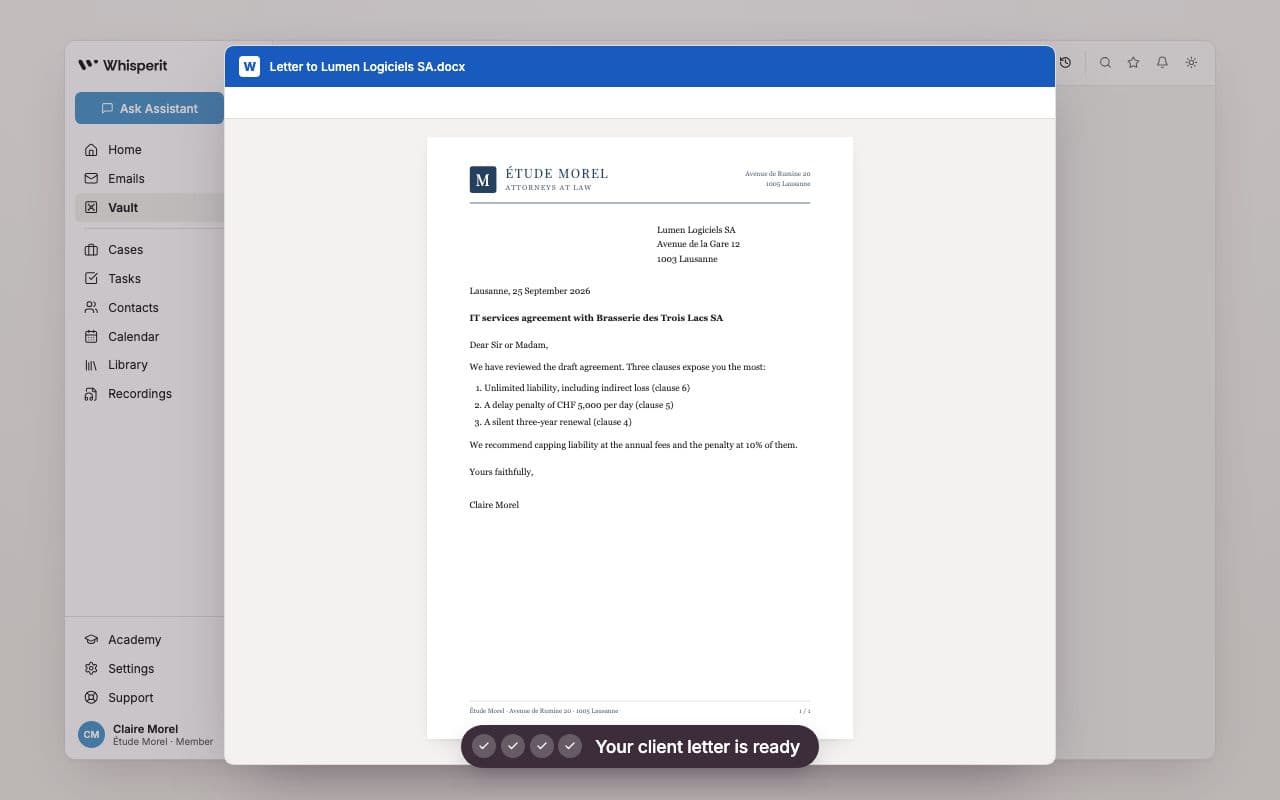
Ask for the memo, the chronology or the summary and you get a document, a spreadsheet or a set of slides in the matter, not a wall of text to copy out by hand.
It learns how your firm works
Written instructions and durable memories mean you stop restating how you draft, which language you work in, and what you never want the assistant to do.
Skills for the work you repeat
Save the prompts you rely on as skills and call them with a keystroke, so a good instruction is written once and reused across the firm.
Swiss by default
Your workspace runs on a Swiss region by default, with EU and global tiers available. No AI provider we use trains on your data.
From question to work product
Open the matter
Start the assistant from a case and it already has that matter in view: the files, the correspondence, the parties and the dates.
Ask in your own words
No operators and no syntax. Ask what you would ask a colleague who had read everything, and use @ to point the assistant at a specific document or contact.
Follow the citations
Each claim carries a reference back to the item it came from. Open it, read the passage in place, and satisfy yourself before you rely on it.
Approve what it changes
When the assistant proposes to draft, rename or file something, you see exactly what will change. Approve it, approve an edited version, or reject it.
Against the two tools you have already tried
| Capability | Whisperit | General AI assistant | Legal research tool |
|---|---|---|---|
| Reads your own case files | Yes, across the whole workspace | No | No |
| Citations that open the source | Yes, to your items and to legal databases | Often invented | Yes, to its own database |
| Writes back into the matter | Yes, once you approve | No | No |
| Where your data is processed | Switzerland by default | Usually the United States | Varies by vendor |
| Working languages | French, German, Italian and English | Strongest in English | Usually English |
| Asks before changing anything | Always | Not applicable | Not applicable |
What lawyers ask before they switch
What is an AI legal assistant?
An AI legal assistant is software that helps lawyers research, draft and review files in plain language. Whisperit's works from your own matters and documents rather than the open web, cites every source it relies on, asks before it changes anything, and is hosted in Switzerland.
How is this different from ChatGPT or Copilot?
Access and accountability. Whisperit reads the matter you are working on and cites the item each answer came from, so you can verify it. A general assistant has no view of your files and no way to show where an answer originated. Whisperit also processes your data on Swiss infrastructure by default, which matters when the material is privileged.
Can it invent a case or a citation?
A model can always produce a wrong sentence, but references are handled separately from prose. A citation is only shown when it resolves to a real item in your workspace, and references the model invents are stripped before the answer reaches you. Citations to external legal sources appear as links you open and check yourself.
Will it change my files without asking?
No. Creating, renaming and moving are all actions you approve. The assistant shows what it intends to do and waits. You can approve it, approve an edited version, or reject it outright.
Which languages does it work in?
French, German, Italian and English, including across them. You can ask a question in one language about documents written in another and ask for the answer in a third.
Where is our data processed?
On a Swiss region by default, with EU and global tiers configurable per workspace. No AI provider we use trains on your data, and the provider-by-provider detail is set out on our security page.
Put it on a real matter
The fastest way to judge a legal AI assistant is to open one of your own files and ask it something you already know the answer to.