
AI legal research that shows you where it got that
Whisperit is an AI legal research tool for Swiss and European law, hosted in Switzerland. Ask the question the way you would ask a colleague: it searches your own matter and published legal sources, and hands back every answer with a reference you can open and check.
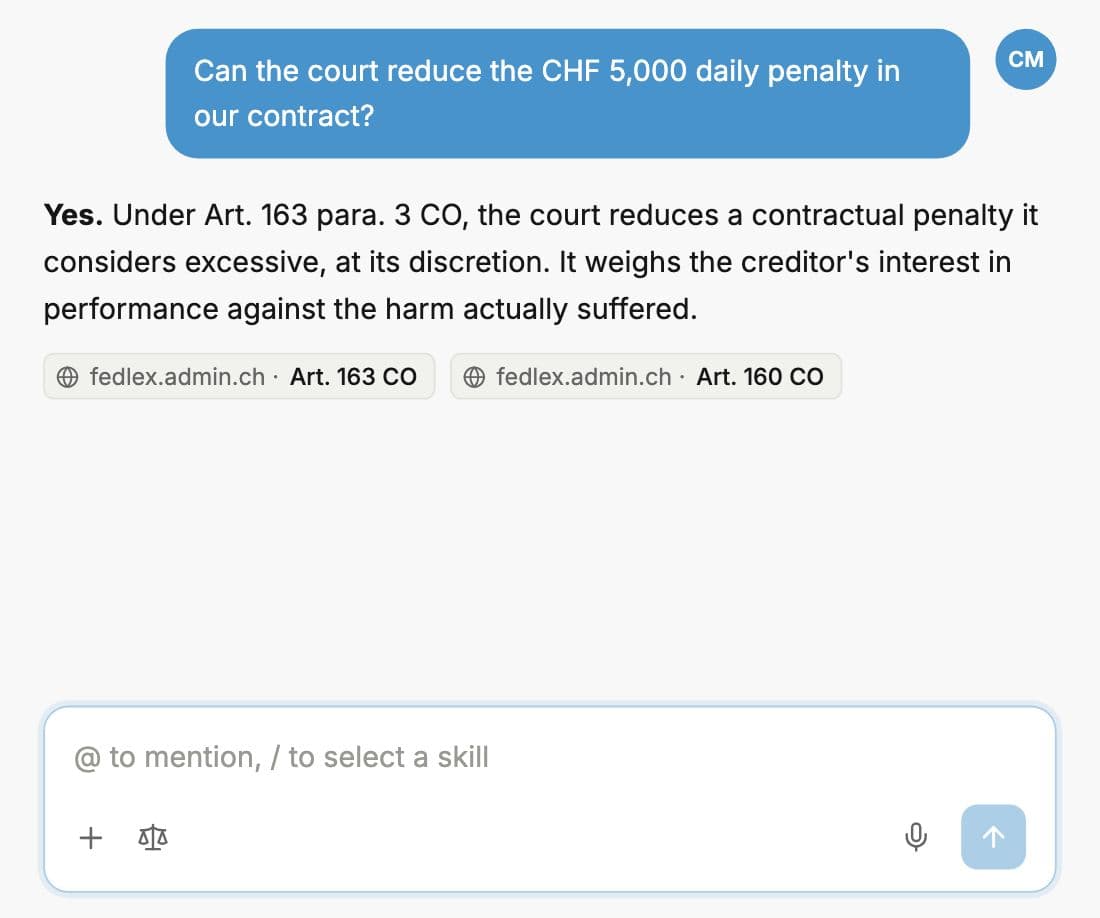
The failure mode here is not being wrong. It is being plausible
It invents decisions that read correctly
A fabricated citation has the right court, a plausible date and a convincing reference number. It survives a skim. That is precisely what makes it dangerous in a submission.
You verify everything anyway
If no answer can be traced, every answer has to be re-researched by hand. The tool has then cost you time rather than saved it.
Your own file is the missing half
Published sources answer what the law says. They cannot tell you what the contract in your matter actually provides, which is usually the real question.
Sources first, prose second
Your matter and the law, in one question
Ask about a clause in your file and the applicable rule in the same breath. Whisperit searches your documents down to the passage and queries legal databases alongside them.
Invented references never reach you
References to items in your workspace are only shown when they resolve to something real, and citations the model fabricates are stripped from the answer before you see it.
External sources stay links, not claims
A published decision or statute is cited as a link you open. We do not paraphrase a source and ask you to trust the paraphrase.
You choose which sources are on
Legal databases and web search are toggles you control per conversation. Turn everything off and the assistant answers strictly from your own file.
Pages get opened, not skimmed
When web search is on, the assistant is instructed to open and read the page rather than answer from a search snippet, because snippets are where quiet errors come from.
Plain language, no operators
No boolean syntax, no field prefixes, no proximity operators. Ask the question in French, German, Italian or English and read the answer in whichever you prefer.
Swiss federal and cantonal law, plus Europe
The legal databases Whisperit queries cover Swiss federal and cantonal legislation and case law, including the Federal Supreme Court and the specialised federal courts, alongside European and international sources. The full breakdown of jurisdictions and collections is published on our sources page.
See the full source listWhat lawyers ask about it
What is AI legal research?
AI legal research means asking a legal question in plain language and getting an answer drawn from published case law, legal sources and your own documents, instead of building boolean searches. Whisperit returns every answer with a reference you can open and check, covers Swiss and European law, and is hosted in Switzerland.
Can it cite a case that does not exist?
References are handled separately from the prose. A workspace citation is only rendered when it resolves to a real item, and fabricated ones are removed before the answer reaches you. External legal sources are cited as links rather than restated, so a bad link is visible the moment you open it. That is a materially better position than a chatbot, and it is still not a reason to file anything unread.
Does it replace Swisslex or Weblaw?
No, and it is not trying to. Those are subscription research databases with their own editorial apparatus. Whisperit answers questions across your own matter and published sources together, which is the part neither a research database nor a general assistant does.
Which jurisdictions does it cover?
Swiss federal and cantonal law and case law, plus European and international sources. The full list of collections is on our sources page, and coverage reflects what the underlying legal databases publish rather than a claim of our own.
Can I stop it from searching the web?
Yes. Legal databases and web search are separate toggles you control per conversation. With both off, answers come strictly from the documents in your workspace.
Is my research question sent anywhere?
Assistant traffic runs on a Swiss region by default, with EU and global tiers configurable per workspace. Where a query reaches an external legal database or a web search, that is the query itself and never your document contents. The provider-by-provider detail is on our security page.
Ask it something you already researched
The honest test of a research tool is a question you have already answered the hard way, where you can grade the citations rather than trust them.