
The short answer
The best Harvey alternative is the product that fixes the reason you are reconsidering Harvey. Start with Whisperit for daily matter production, Legora for a review-oriented alternative, CoCounsel for Thomson Reuters research, or Swiss-Noxtua for legalis-led Swiss research.
Keep Harvey on the shortlist if your organization already uses its knowledge and review workflows successfully. Switching is a project with a cost, not an automatic improvement.
Harvey also documents dictated queries and audio transcripts saved to Vault. Voice capture is not exclusive to Whisperit; compare the complete reviewed-document workflow. [1]
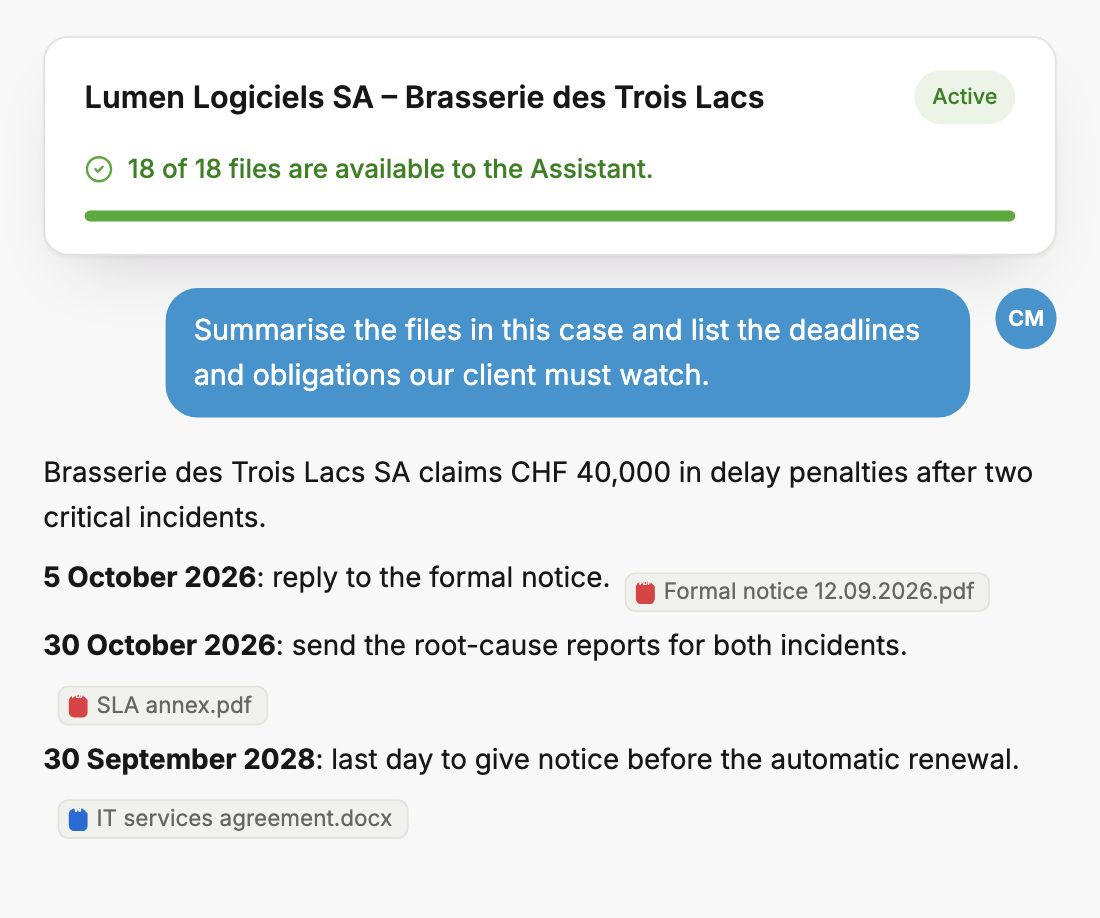
Illustrative product demonstration
Whisperit: keep the answer connected to the matter
A recreated demonstration with a fictional matter. Test amended dates, missing files and the source behind each obligation. This matter summary does not establish bulk-review parity with a competing data room.
Source: Whisperit · Case-analysis walkthrough
Open full-size imageInspect the comparison evidence: Harvey · Vault
These examples show different workflows, not a controlled comparison. The recommendation below explains when the competing product is the stronger choice.
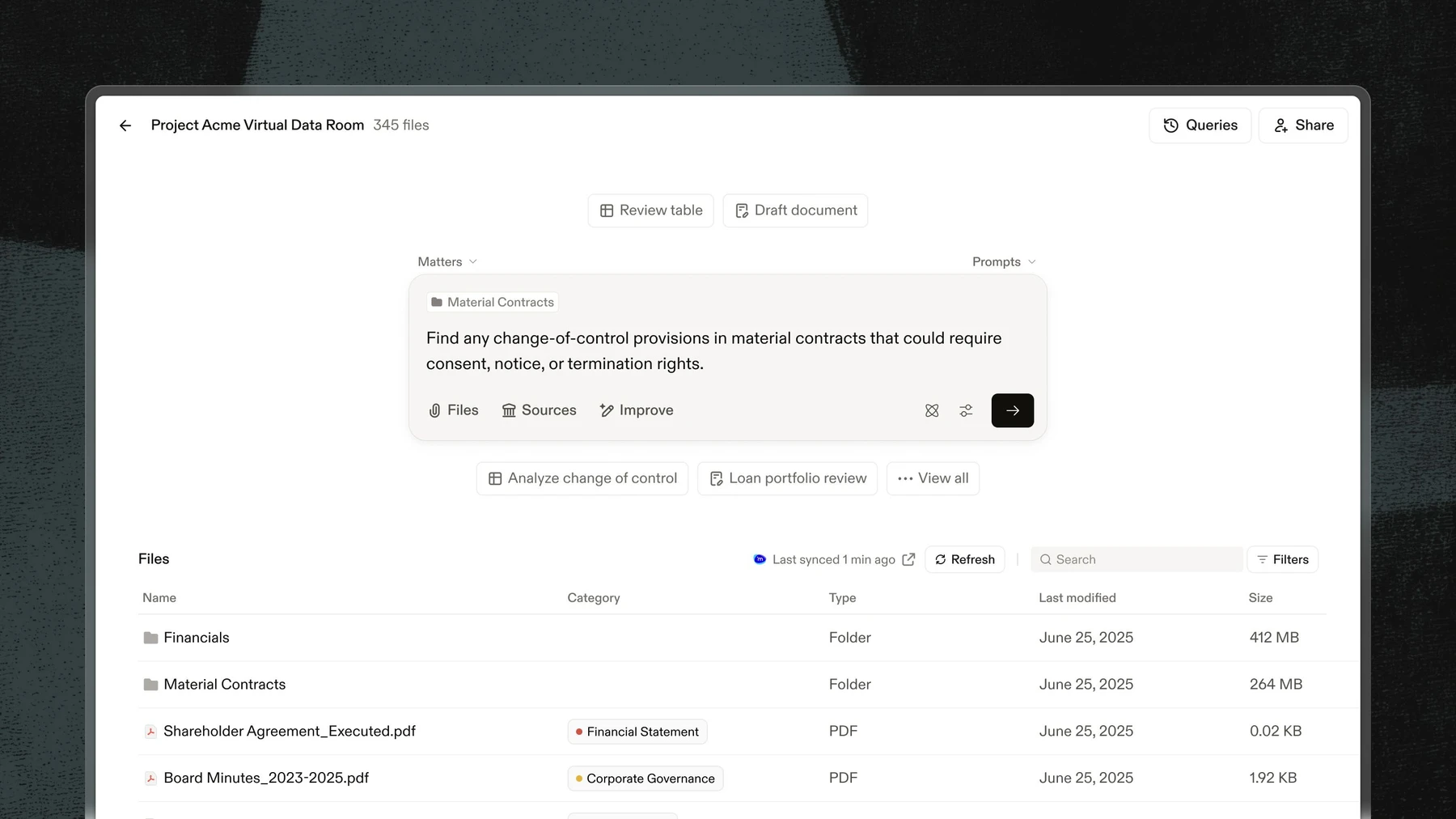
Public product image
A collection of documents, one review workflow
Vault illustrates collection-level review. In a trial, follow an extracted finding back to its clause and inspect the final deliverable.
Source: Harvey · Vault
Open full-size imageA shortlist by reason to switch
| Your reason | First alternative to evaluate | Why | What to protect |
|---|---|---|---|
| Daily instructions do not become usable work easily | Whisperit | Connected matter production [2] | Source visibility and team access |
| You want a different structured review workflow | Legora | Dedicated collaborative review offering [3] | Review history and controlled outputs |
| Westlaw content is central | CoCounsel | Thomson Reuters research ecosystem [4] | Exact content entitlements |
| Swiss commentary is essential | Swiss-Noxtua | legalis-led research [5] | Titles, editions and full-text access |
First diagnose the dissatisfaction
Before evaluating alternatives, write the problem in one sentence. “Our lawyers cannot get the required answer from these sources” is a useful reason. “We hoped adoption would be higher” needs more investigation. “The competitor's demo looked better” is a lead to test, not a purchasing conclusion.
Separate four possibilities: the product is wrong for the task; the configuration is wrong; the users have not learned the workflow; or the commercial terms no longer fit. A replacement may solve the first or fourth. It will not necessarily solve the second or third.
For an existing deployment, review the work people actually perform. Which tasks recur? Where do users abandon the tool? What do experienced users achieve that others do not? The answers prevent a costly switch that simply reproduces the same adoption problem elsewhere.
1. Whisperit: evaluate for the everyday matter
Whisperit belongs first when your team wants a spoken instruction, document set and drafting standard to come together in one matter workflow. Its published assistant uses matter context and reusable instructions. [2]
The buying case should be concrete: a lawyer leaves a usable instruction, an assistant prepares the work and a reviewer can inspect the facts. Measure the complete handoff rather than the quality of an isolated paragraph.
What you may lose: do not assume equivalent enterprise review, governance or institutional-knowledge functionality. List the Harvey workflows you rely on and require a demonstration of each essential replacement. If those workflows are the center of your practice, Whisperit may be an addition rather than an alternative.
2. Legora: evaluate for collaborative review
Legora is a credible alternative when you want to retain a broad legal AI approach but change the team's review experience. Its current product lineup includes structured review, Word work and research. [3]
Run the same review your team has already completed. Ask reviewers to inspect a known exception, correct a finding and show which result has been approved. The review process matters as much as the extraction.
What you may lose: saved prompts, knowledge structures and established habits will need rebuilding. Do not assume that document import transfers your team's operational decisions. Check the new commercial proposal and required modules before comparing cost.
3. CoCounsel: evaluate for a research-led practice
If the frustration is legal authority, start with the relevant research offering. CoCounsel's relationship to Westlaw gives it a different buying case from a general workspace replacement. [4]
It is particularly sensible to evaluate when you already rely on Thomson Reuters content. Give the proposed plan a completed research question and check the authorities yourself.
What you may lose: a research-centered offer may not reproduce every matter or organizational workflow. CoCounsel's plans also differ in included research and drafting capabilities. [6] Request the exact package and regional terms. Never compare a full enterprise platform with an entry package as if they were identical products.
4. Swiss-Noxtua: evaluate for Swiss commentary
For a practice that needs legalis commentary, Swiss-Noxtua deserves a direct research evaluation. Its published research offering addresses commentary and official Swiss sources. [5]
Use a question where the doctrinal discussion changed your advice. Require an exact passage and ask what the source does not establish. Source access is the advantage; generated interpretation still needs professional review.
What you may lose: do not assume its daily capture, integrations or organizational controls match the system you are replacing. Demonstrate the actual tasks and configuration rather than letting a research win settle every category.
When staying with Harvey is better
Keep Harvey if your required workflows already work, the team uses them and the alternatives have not shown a meaningful improvement. Its Vault offering addresses large collections and knowledge reuse. [7] Rebuilding a working review process to obtain a marginally nicer interface is rarely the first place to spend implementation effort.
Likewise, do not leave solely because of anecdotal prices. We have not verified comparable offers. Negotiate against the actual scope, usage and renewal terms, not a third party's reported quote.
Switch one workstream before moving the firm
Choose a representative task and a small team. Establish the baseline in the current tool. Then require the alternative to deliver the same reviewed result under the proposed plan.
Before transferring live matters, verify document exports, permissions, source references, retention and the ability to rebuild reusable instructions. Test an export by opening it in the destination; the presence of a download button is not proof of usable migration.
Keep the existing approved process available while the new workflow proves itself. Record what improves and what regresses. A successful pilot may justify moving one workstream and retaining Harvey for another.
Our recommendation
Make a shortlist from the specific dissatisfaction. For daily Swiss matter work, try Whisperit. For structured team review, try Legora. For Thomson Reuters research, try CoCounsel. For legalis commentary, try Swiss-Noxtua. If you cannot name the workflow that improves, keep the incumbent until you can.
A small team should also compare the small-firm workspace requirements: staff handover and maintenance can matter more than platform breadth. For Swiss-source priorities, use the Swiss legal research shortlist.
Questions buyers ask
Which alternative costs less?
That needs matched proposals. Include research, users, term, administration and migration. A cheaper licence can still create a more expensive process.
Can I keep Harvey while testing?
Operationally, a controlled parallel evaluation can be useful. Check your firm's approval and the vendors' contract terms before transferring material.
Where is the direct comparison?
Read Whisperit vs Harvey for the two-product decision and a practical side-by-side pilot.
Romain de Wolff