
The short answer
Choose Harvey when the buying decision is an organizational AI rollout: shared knowledge, substantial document review and repeatable work across practice groups. Choose Whisperit when you want to improve the everyday path from a voice note or matter file to a reviewed document.
- Harvey is the stronger first shortlist for a large practice investing in an enterprise AI program.
- Whisperit is our first recommendation to evaluate for a multilingual Swiss practice whose work combines dictation, case preparation and drafting.
- There is no established accuracy winner here. We have not run a controlled comparison on your jurisdiction or documents.
Harvey also documents dictated queries and audio transcripts saved to Vault. Voice capture is not exclusive to Whisperit; compare the complete reviewed-document workflow. [1]
Harvey’s current offer also includes Agents and shared Spaces. Matter context and collaboration are overlapping capabilities; test the proposed modules rather than treating them as exclusive to Whisperit. [2] [3]
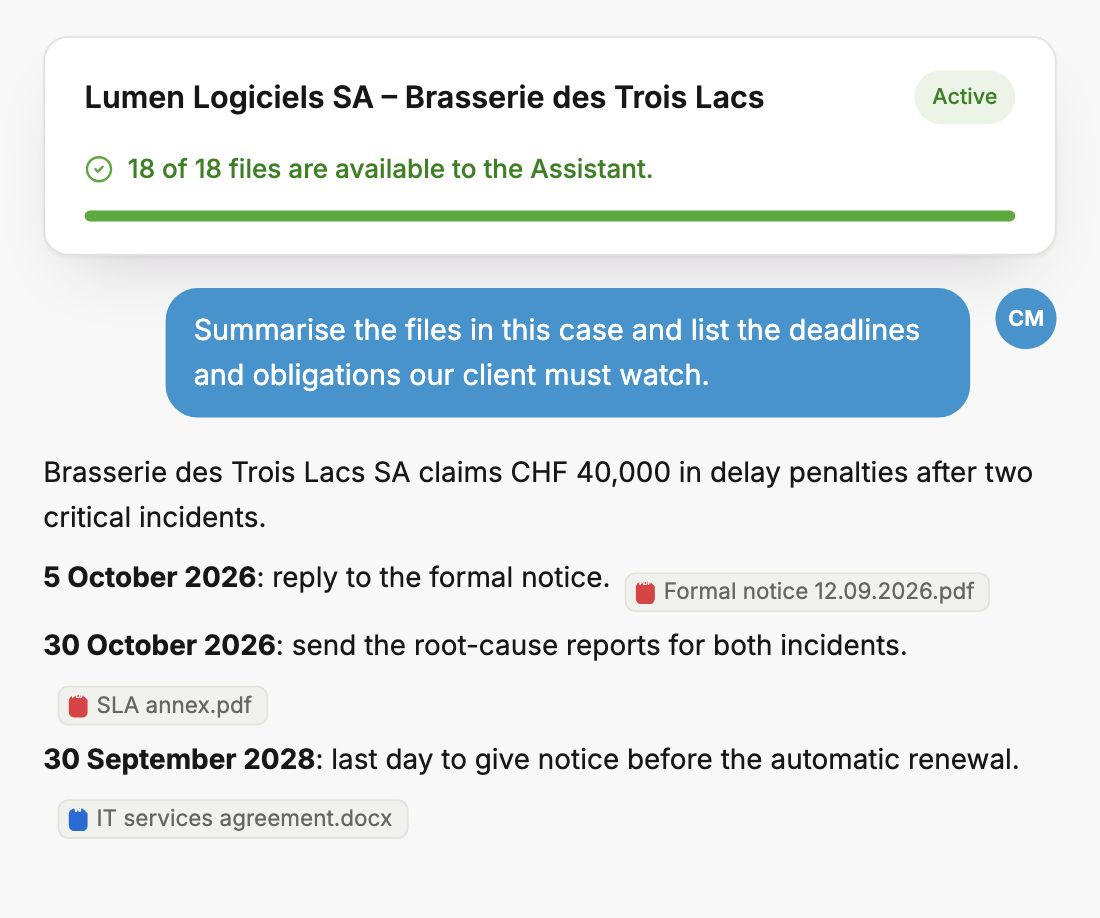
Illustrative product demonstration
Whisperit: keep the answer connected to the matter
A recreated demonstration with a fictional matter. Test amended dates, missing files and the source behind each obligation. This matter summary does not establish bulk-review parity with a competing data room.
Source: Whisperit · Case-analysis walkthrough
Open full-size imageInspect the comparison evidence: Harvey · Vault
These examples show different workflows, not a controlled comparison. The recommendation below explains when the competing product is the stronger choice.
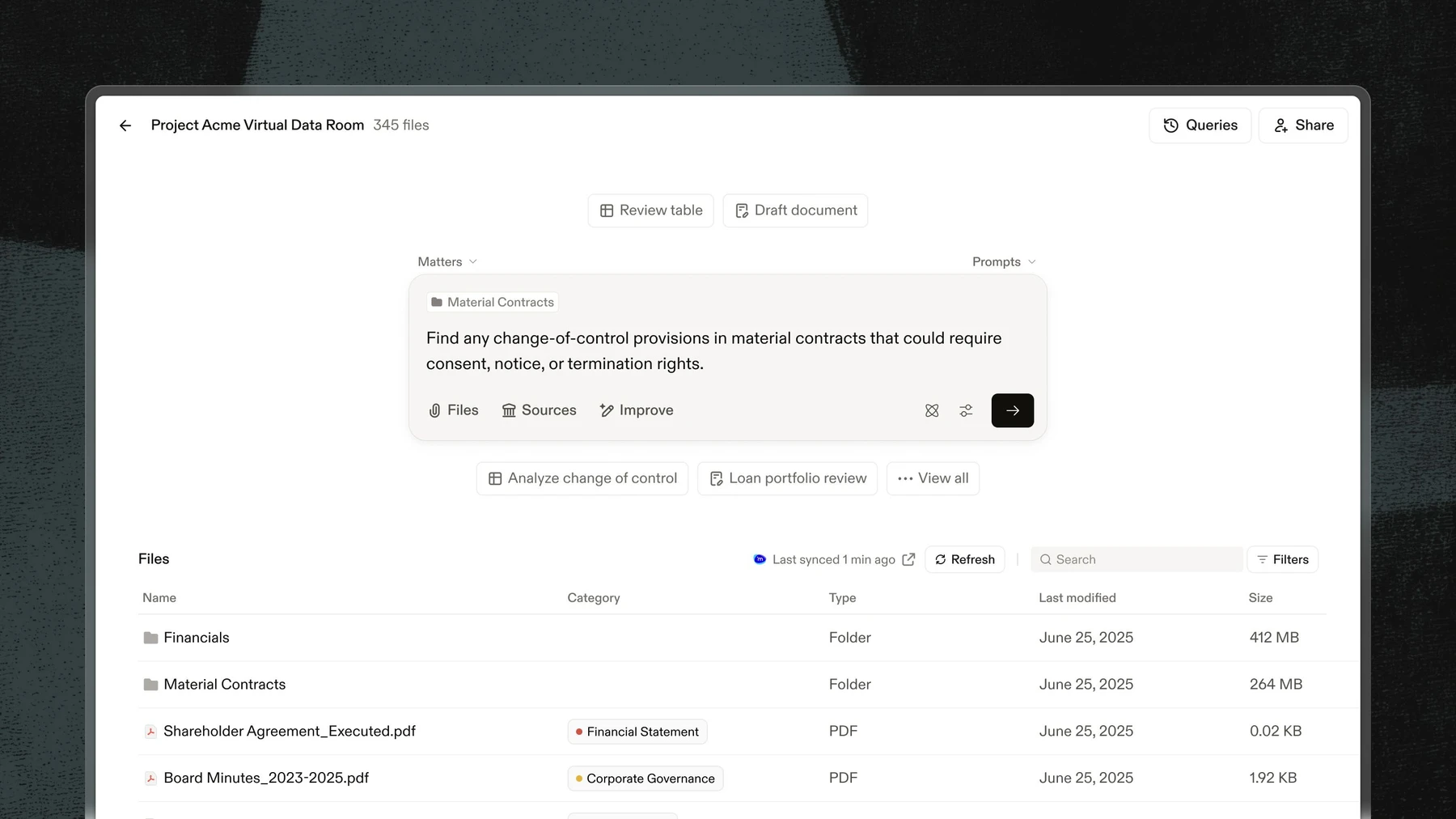
Public product image
A collection of documents, one review workflow
Vault illustrates collection-level review. In a trial, follow an extracted finding back to its clause and inspect the final deliverable.
Source: Harvey · Vault
Open full-size imageAt a glance
| Decision | Whisperit | Harvey | Our read |
|---|---|---|---|
| Center of gravity | Daily legal workspace [4] | Organizational legal AI platform [5] | Match the recurring job |
| Large review projects | Test on your actual corpus | Vault and review tables [6] | Harvey merits the first enterprise review demo |
| Voice to first draft | Dictation connected to document production [7] | Dictated queries and transcripts saved to Vault [1] | Compare capture, corrections and the final document |
| Legal research | Confirm the relevant sources | Confirm Knowledge entitlements [8] | Coverage comes before fluency |
| Security review | Confirm the tenant configuration | Request reports and regional terms [9] | Neither gets a pass on the strength of a homepage |
| Commercial fit | Check current plans [10] | Request a scoped proposal | Compare the complete annual commitment |
The decision behind the comparison
Imagine two firms watching the same demonstration. The first wants every practice group to use agreed knowledge, reusable workflows and consistent controls. The second wants an assistant and a lawyer to stop assembling a client letter from a recording, three attachments and an old template. Both want legal AI. They are purchasing different improvements.
Harvey is a credible answer to the first problem. Its breadth makes sense when the organization can define workstreams, support implementation and measure adoption. That breadth is less valuable if your team only needs one narrow workflow and never establishes the surrounding habits.
Whisperit's proposition is strongest in the second situation. The reason to choose it should be a demonstrably better working day: less rebuilding context, fewer transfers between tools, and a document that stays attached to the matter. Those are benefits to measure in a pilot, not outcomes we can promise from a feature list.
When Harvey is the better choice
We would put Harvey ahead in an enterprise evaluation where the central deliverable is a controlled review across substantial document collections. Its published Vault offering includes structured extraction and shared institutional knowledge. That is a relevant capability set for diligence teams and knowledge programs. [6]
We would also favor a Harvey-led evaluation when your firm has already built approved workflows around it. A replacement must outperform that operating system, not merely produce an attractive answer in an empty account. Training, templates, integrations and established review habits are real investments.
Finally, assurance can be decisive. A procurement team may require specific audit reports before a product reaches a pilot. Obtain the current documents from both vendors. A smaller product's good intentions do not substitute for an organization's mandatory evidence.
Where Whisperit can be the better fit
For a Swiss team that repeatedly moves from spoken instructions to a letter, memo or case overview, start by testing the complete sequence. Capture the instruction, introduce the relevant file, prepare a first draft, correct it and hand it to a colleague. The question is whether that sequence becomes easier to repeat.
Whisperit describes a matter-aware assistant that produces work for approval and supports reusable instructions. That makes it worth evaluating for this connected workflow. [11] However, a product that understands the matter can still misunderstand your instruction. Check that it asks for the represented party, output language and intended document where those details matter.
Do not interpret our recommendation as “small firm equals Whisperit, large firm equals Harvey.” Firm size is a clue. Actual workflows, sources and procurement requirements control the decision.
Security and price can change the answer
Whisperit's detailed security page distinguishes Swiss Only, EU and Global residency configurations. It also describes SOC 2 Type II as in progress and ISO certification as a roadmap item. If completed vendor certification is a purchasing condition, count that as a current limitation. A certified data center is not the same as a certified software vendor. [12]
For both products, ask about storage, AI inference, external research, support access and backups separately. Request the configuration that will be in your agreement. Geographic branding alone cannot establish the path of every request.
Then compare like with like: users, contract term, included modules, research access, usage conditions, onboarding and exit assistance. We have not verified comparable negotiated quotes. We cannot honestly declare Whisperit cheaper or Harvey overpriced.
A pilot that can settle the question
Use three completed matters whose quality you can already judge. Agree in advance what “good” means, and give both vendors equivalent inputs and permitted sources.
- Daily production: turn a short instruction and source documents into a client-ready draft. Count corrections and time through final review, including export.
- Evidence work: recover the supporting passage for several known facts, plus one fact that is absent. Reward the product for identifying missing evidence.
- Team review: give a colleague the output without your verbal explanation. Can they see the source, correct the draft and understand what is unresolved?
- Scale, if relevant: run a representative large review. Track unreadable files, conflicting documents and review exceptions, not just completed rows.
- Commercial reality: price the team and modules that produced the result. The impressive demo may use a different package from the proposal.
Do not score only the first answer. Count the work needed to make the output usable. A tool that produces less prose but makes mistakes easier to find may be the better purchase.
Our recommendation
For enterprise review and institutional knowledge, begin with Harvey. For a multilingual Swiss team's daily capture-to-draft workflow, begin with Whisperit. Keep the second product in the evaluation until you have evidence that the first fits. Brand recognition and a good demo are both insufficient reasons to sign.
If the real need is a replacement shortlist, use the Harvey AI alternatives guide. For a substantial document project, the M&A due diligence guide shows the review tasks that should decide the pilot.
Questions buyers ask
Can Whisperit replace every Harvey workflow?
Do not assume so. Inventory the workflows you use, reproduce each necessary result and verify access, output formats and review controls before planning a replacement.
Is Harvey only for the largest firms?
No. Its current site also addresses mid-sized firms. Size-based exclusion is less useful than evaluating workflow fit and obtaining a real offer. [5]
Should we keep our research subscriptions?
Until the replacement's sources, entitlements and verification tools satisfy your practice, yes. AI workspace access does not automatically replace a licensed research collection.
Romain de Wolff