
The short answer
For structured due diligence with a review team, Legora is our first evaluation choice. Harvey belongs alongside it for substantial document and knowledge workflows. Swiss-Noxtua is relevant to Swiss-law analysis informed by its source collection. Whisperit merits evaluation for smaller matter-based analysis and production.
Include CASUS for its structured AI Data Room extraction and export, particularly when that scoped workflow matches the project. [1]
We have not benchmarked diligence accuracy or speed. Do not buy an AI review system from a document-capacity claim alone.
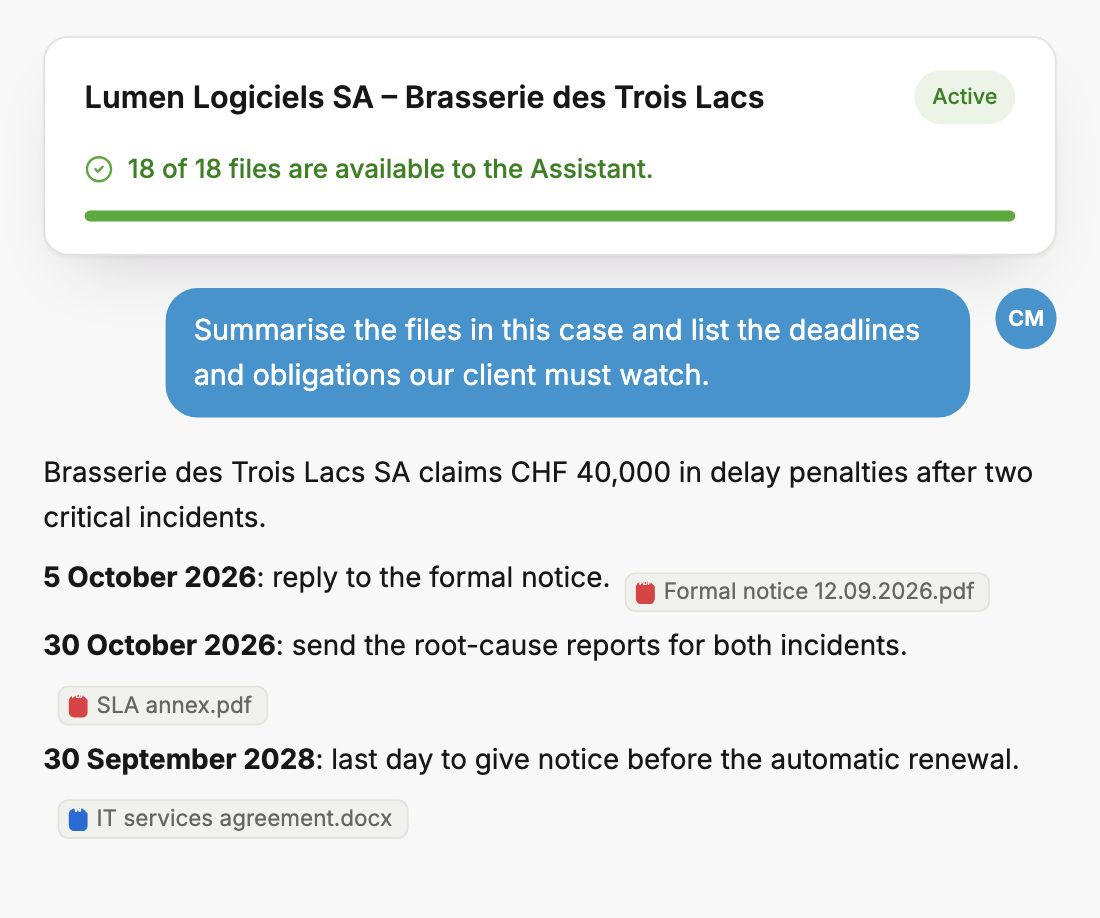
Illustrative product demonstration
Whisperit: keep the answer connected to the matter
A recreated demonstration with a fictional matter. Test amended dates, missing files and the source behind each obligation. This matter summary does not establish bulk-review parity with a competing data room.
Source: Whisperit · Case-analysis walkthrough
Open full-size imageInspect the comparison evidence: Legora · Tabular Review
These examples show different workflows, not a controlled comparison. The recommendation below explains when the competing product is the stronger choice.
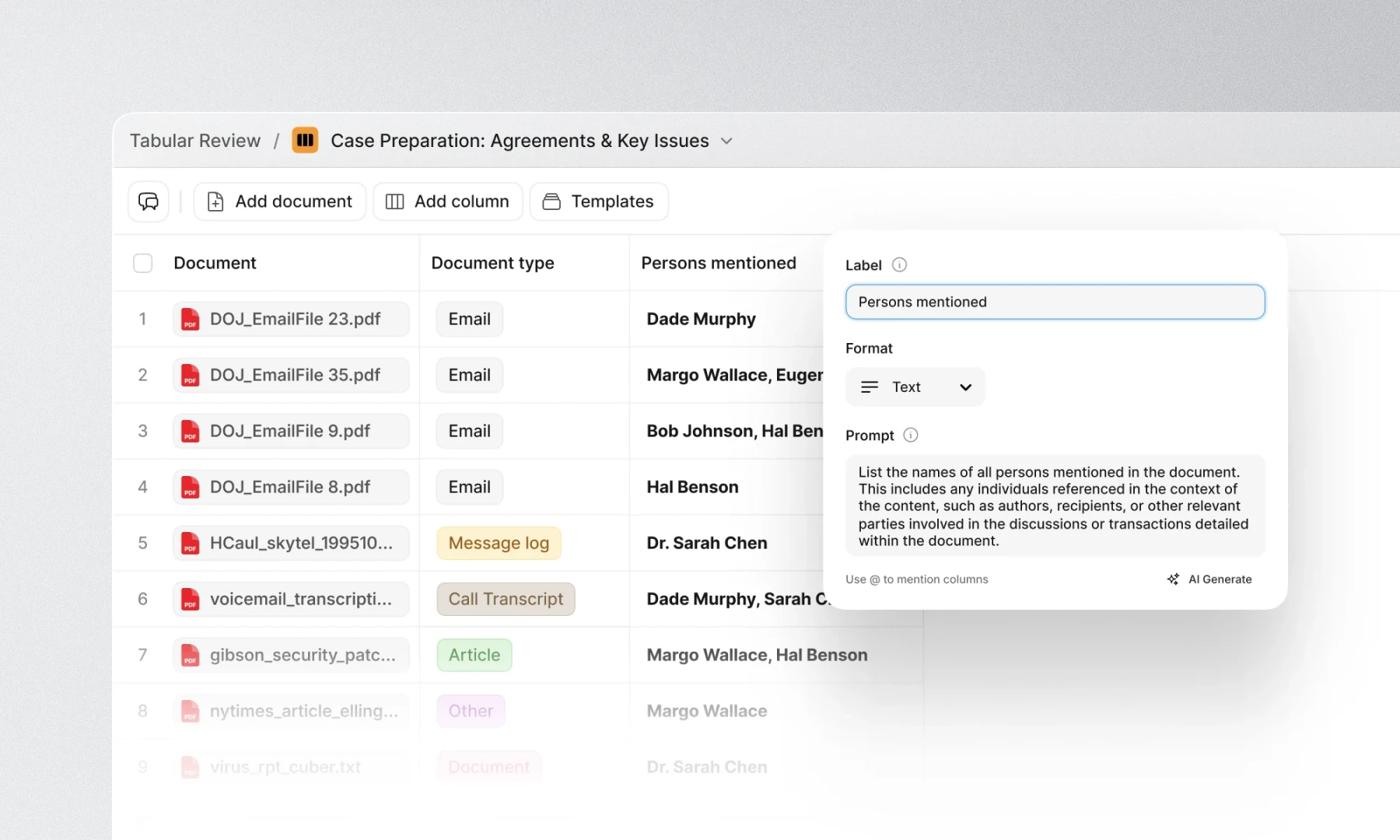
Public product image
Turn the same question into a review column
The column prompt defines what is extracted across documents. Test missing answers and source links, as well as the populated cells.
Source: Legora · Tabular Review
Open full-size imageThe picks at a glance
| Product | First evaluate for | Deciding proof | Main boundary |
|---|---|---|---|
| Legora | A controlled team review | Source-linked answers and review decisions | Your review schema still matters |
| Harvey | Broad document and institutional knowledge work | Coverage of the actual collection | Verify exceptions and export |
| CASUS | Structured Data Room extraction | Source-linked fields and usable Excel output | Confirm supported limits and reviewer controls |
| Swiss-Noxtua | Swiss legal questions alongside document analysis | Relevant sources and checked propositions | Test review logistics separately |
| Whisperit | A smaller matter and resulting work products | Documents to useful report and briefing | Do not assume specialist workbench parity |
A data room needs questions with consistent meanings
“Does this agreement have a change-of-control clause?” sounds clear until reviewers encounter indirect references, amendments and provisions that apply only to a particular party. A yes/no column may conceal more than it reveals.
Define the review schema before testing products. Specify the entity, document type, relevant provision, required output and treatment of absence. Separate a clause's existence from whether it creates a consent requirement for the contemplated transaction.
The tool should also distinguish document evidence from the legal conclusion. Reviewers need the passage, amendment and uncertainty behind a finding. A confident table with no useful trail is a weak foundation for a diligence report.
1. Legora: our first evaluation for structured team review
Legora's dedicated Tabular Review offering addresses document-level review and source inspection. [2] That makes it a strong first candidate when the team wants a shared workbench for the diligence questions.
Use a completed deal set with known issues. Ask one reviewer to check the source and another to inspect the accepted finding. Introduce a disagreement and confirm the team can resolve it without losing the evidence behind the decision.
Its boundary: the product cannot define your diligence standard for you. Ambiguous questions, an incomplete collection or poorly specified entity relationships can still produce misleading outputs. Advertised scale is a reason to test, not an established result.
2. Harvey: evaluate alongside it for broad collection work
Harvey's Vault offering includes document review and reusable knowledge structures. [3] We would include it in a serious evaluation where the firm wants diligence connected to broader institutional work.
Test a collection with related agreements and amendments. Ask for known exceptions and the supporting passage. Require an explanation when a question cannot be answered from the available material.
Its boundary: capacity and extraction claims do not establish completeness for your deal. Reconcile the documents processed, inspect unreadable files and check the final export. The issue is not how many rows appear, but whether the material risks can be defended.
3. Swiss-Noxtua: evaluate the Swiss legal analysis
Swiss-Noxtua publishes document and matrix-analysis capabilities. [4] It is worth considering where diligence findings also require analysis through the relevant Swiss legal source collection.
Choose a known issue whose treatment depended on doctrine or legal context. Ask the product to separate the contractual wording from the legal proposition. Have the appropriate lawyer inspect both.
Its boundary: a good legal analysis does not decide file ingestion, reviewer coordination and final-report logistics. Test those requirements directly. The research collection and the review system are distinct parts of the buying decision.
4. Whisperit: evaluate a narrower matter workflow
Whisperit's case-analysis offering is relevant to assembling the matter and producing a working analysis. [5] We would evaluate it where the project is smaller and the desired deliverables include an overview, client briefing and next-step documents.
Use the actual approved file and ask the team to complete the report. Measure context assembly, source checking and the effort needed to prepare the final briefing.
Choose Legora or Harvey first when the essential need is a dedicated, controlled diligence review across a large collection. This draft does not establish equivalent specialist workbench controls or large-scale results in Whisperit.
CASUS: evaluate the scoped Data Room workflow
CASUS's AI Data Room describes parallel extraction into a structured table with Excel output. This is a concrete reason to test it where the diligence deliverable is a consistent field set and an inspectable export. Its Dossiers also support broader multi-document work. [1] [6]
Use the same agreements, amendments and review questions as the wider platforms. Inspect each decisive field against its supporting passage, then build the actual report from the export. Confirm how missing or unreadable material appears.
Its boundary: the homepage and Dossiers page publish differing document limits, and the Data Room description does not establish parity with every review-control feature elsewhere. Obtain the current supported scope and demonstrate the needed reviewer decisions. [7] [6] Use the CASUS comparison for that distinction.
Test the collection before testing the report
Prepare an inventory and reconcile it with the files each product analyzes. Include scans, duplicates, missing attachments and amended documents. Ask how failed or unsupported files become visible.
The review must not treat an unread file as a clean result. Equally, an agreement absent from the collection cannot be assumed not to exist. Missing material belongs in the report as an unresolved request.
Then inspect document relationships. The same party may appear under different names. An amendment may change the clause in the main agreement. A later executed version may supersede a draft. The pilot should include all three situations.
A diligence pilot with an answer key
Select a completed project that the team is permitted to use. Prepare known findings without showing them to the product operator. Keep the set small enough to inspect every material result.
Define the review schema and run equivalent tasks in the proposed accounts. Include a few straightforward questions and several questions requiring context. Score missed material issues, unsupported positive findings and uncertainty that was correctly identified.
Have the second reviewer open the source behind every decisive finding. Then produce the final report. Check whether amendments, caveats and unresolved requests survive the transition from table to prose.
Record total reviewed time, review disagreements and transfer effort. If the tool only saves extraction time but makes verification or reporting slower, that belongs in the decision.
Buying and governance questions
Ask for the required modules, users, usage conditions and collection limits in the actual proposal. Check review access, permissions, external sharing, retention and export. Obtain the configured processing terms for confidential deal material.
Price implementation, review standards and retained research alongside the licence. We have not verified comparable offers or measured any vendor at its advertised maximum. Do not turn a trial's small sample into a promised deal-wide savings percentage.
Our recommendation
For a controlled team diligence review, begin with Legora and compare Harvey. Include Swiss-Noxtua when Swiss legal analysis is central. Evaluate Whisperit for a smaller matter and its production workflow. Choose the system that preserves the path from source to finding to reviewed report.
For the dedicated review-workbench distinction, use Whisperit vs Legora. For wider collection and knowledge work, use Whisperit vs Harvey. Both comparisons keep advertised capability separate from measured results.
Questions buyers ask
Is a missing answer a negative answer?
No. Distinguish not found, unreadable, absent and not applicable. They can lead to different follow-up work.
Should we evaluate the maximum document capacity?
Evaluate the representative collection first. Capacity does not prove handling of amendments, scans or material exceptions.
Can the report be accepted without inspecting sources?
This guide does not support that. The evaluation includes professional verification of material findings.
Romain de Wolff