
Our verdict: start with CASUS for native Word review
CASUS is a strong first-trial choice when the lawyer's main job is reviewing and improving documents in Word. Whisperit may be a better fit when capturing instructions, organising matter context and preparing reviewed work is the broader bottleneck. Run the same complete matter through both before deciding.
CASUS publishes native Word chat, proofreading, risk review and document benchmarking. It also offers research, Dossiers and an AI Data Room, so a fair comparison cannot reduce it to a single-contract tool. Its wider workspace overlaps with the legal production decision Whisperit addresses. [1] [2]
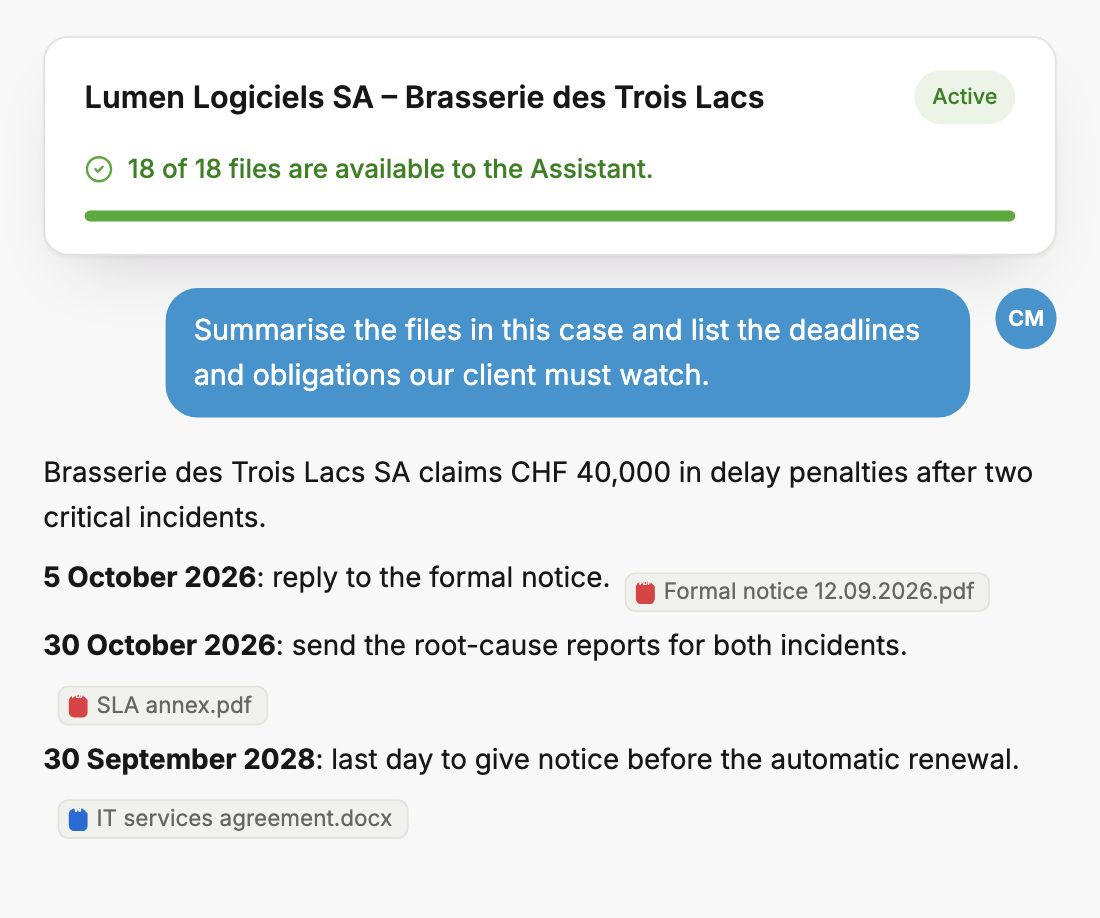
Illustrative product demonstration
Whisperit: keep the answer connected to the matter
A recreated demonstration with a fictional matter. Test amended dates, missing files and the source behind each obligation. This matter summary does not establish bulk-review parity with a competing data room.
Source: Whisperit · Case-analysis walkthrough
Open full-size imageInspect the comparison evidence: CASUS · AI Data Room
These examples show different workflows, not a controlled comparison. The recommendation below explains when the competing product is the stronger choice.
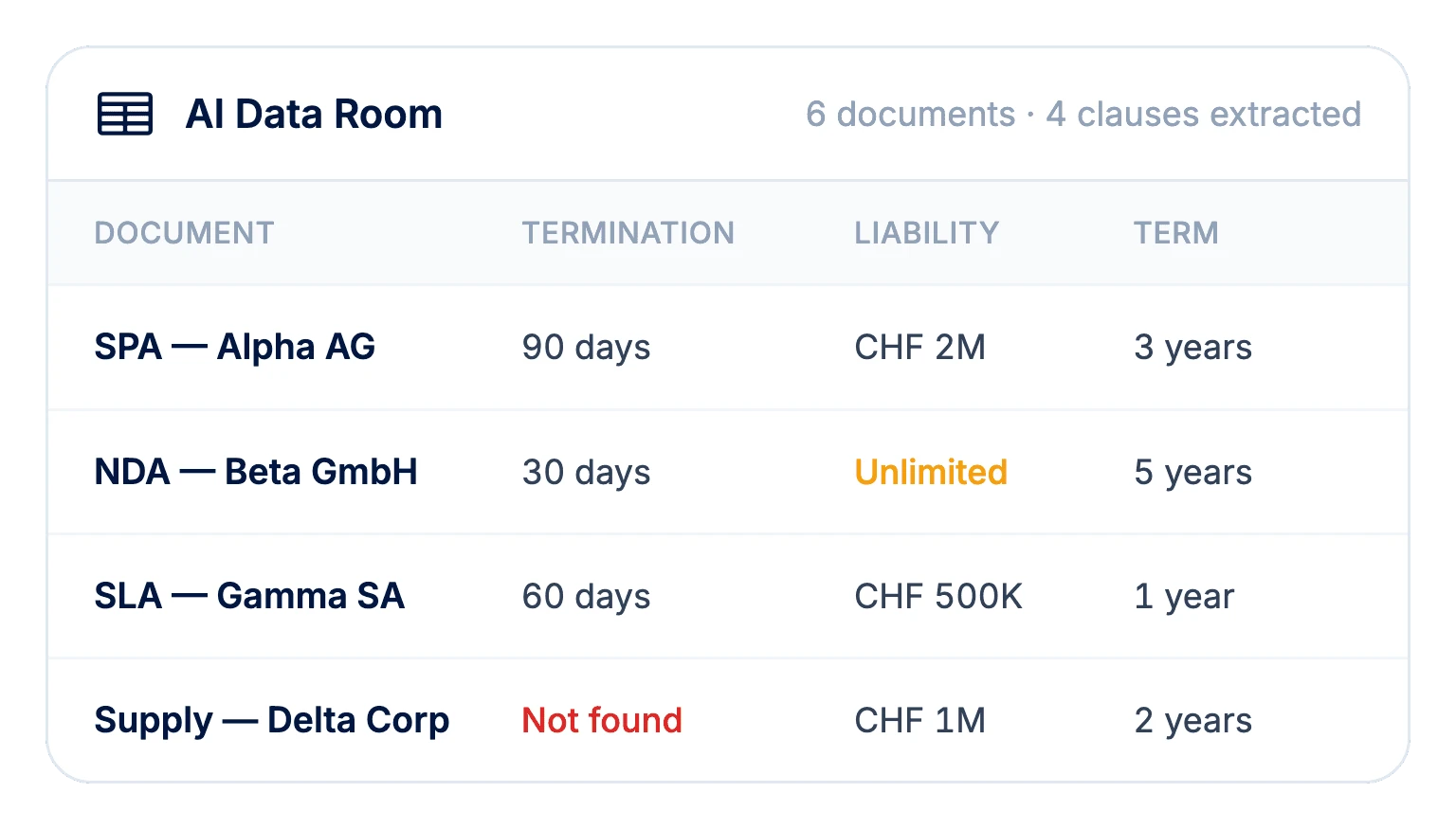
Public product image
Spot exceptions across a document set
CASUS illustrates clause extraction in a data room. Include absent clauses in your test: a missing answer must stay distinguishable from a verified finding.
Source: CASUS · AI Data Room
Open full-size imageCompare the output, not the category label
| Recurring work | CASUS evaluation | Whisperit evaluation |
|---|---|---|
| Review a negotiated agreement | Native Word changes, party position and review instructions | Current document review and usable exported revisions |
| Improve a legal draft | Proofreading, references and consistency in the document | Factual and legal consistency from matter to draft |
| Work across a file collection | Dossiers and source-linked answers | Demonstrated multi-document matter analysis |
| Extract a review table | AI Data Room fields and Excel output | Actual structured extraction workflow and limits |
| Prepare work from instructions | Broader workspace process on the firm's inputs | Capture, matter context and review handover |
Sources: CASUS product descriptions and Whisperit's assistant, case-analysis and integration material. These define trial questions; they do not establish comparative accuracy or capacity. [1] [3] [4] [5] [6] [7]
Why CASUS can win the document job
An agreement is a connected structure. Improving one clause can affect a definition, an exception and an obligation several pages away. A native Word tool is valuable when the reviewer can inspect proposed changes within that structure rather than reconcile a separate chat answer with the live document.
CASUS's published risk-review and benchmarking approach gives a contract-heavy practice a clear reason to evaluate it first. Test against the chosen party's actual instructions and precedents. A suggestion that is commercially wrong can be perfectly grammatical; count that correction as review effort. [1]
Include a document with deliberately inconsistent defined terms, an outdated cross-reference and an amendment that overrides the apparent main rule. Ask for useful edits and a short account of unresolved issues. Then inspect the entire document for changes made outside the request.
Whisperit's published Word export should not be sold as equivalent to that in-editor interaction. It may be sufficient when the task is generating a first draft for conventional review. It can be less suitable when the recurring work is iterative redlining inside an established Word process. [7]
The wider CASUS workspace deserves attention
Dossiers provide shared multi-document context. The AI Data Room describes parallel extraction into a structured table with Excel output. Those are meaningful reasons to include CASUS in a litigation preparation or due-diligence trial, not merely a contracts shortlist. [3] [4]
The current homepage mentions up to 1,000 documents for Dossiers, while the dedicated Dossiers page states up to 100. We do not settle that discrepancy by selecting the more impressive number. Confirm the current supported limit for the proposed plan and tenant before testing a large collection. [1] [3]
Capacity is also different from quality. A product accepting a file is not proof that it finds every relevant provision or incorporates every amendment. Include known exceptions, a poor scan and a missing attachment. Verify field-level evidence in the resulting table and preserve the complete input inventory.
CASUS's current offer includes legal research. This draft does not assume the research is limited to document uploads or establish a specific publisher-wide commentary entitlement. Ask for the required sources, jurisdictions and full-text rights separately from the document-review demonstration.
Where Whisperit may be better
A matter can begin with a client's spoken account, contradictory correspondence and a lawyer's instructions. The firm first needs a stable understanding of the facts before it needs a sophisticated redline. Whisperit's proposed advantage is the connection from capture and matter context to reviewed documents. [8] [5]
Test a small but complete matter. Create a factual summary, distinguish assertions from evidence, identify missing information and produce a client letter. Correct a date after the first draft, add another document and ask a colleague to continue. The benefit should appear in fewer reconciliation steps and less rechecking, not only a quicker first answer.
CASUS may also handle that process effectively. Select it if the trial shows the stronger result. Whisperit should earn the choice through demonstrated workflow value, not an assumption that competitors cannot work across matters.
Swiss storage and European inference
CASUS's security page specifies Google Cloud storage in Zurich, with inference through Google Vertex AI in Belgium and Azure OpenAI in Switzerland North and Sweden Central. It states no training and provider zero-retention arrangements. We have not audited the controls or private agreements. [9]
That is clearer than inferring Swiss-only processing from a Swiss address. If the firm's requirement excludes EU inference, obtain a specific alternative configuration or compare a documented Swiss Only option. Whisperit's residency tiers also require confirmation of the purchased configuration and actual data path. [10]
Infrastructure certifications should not be presented as certification of the software company itself. A buyer should request the relevant assurance evidence and scope, then assess whether it supports the controls required for the firm's matters.
Price the actual governance package
CASUS displays Standard at CHF 120 per user per month on annual billing, CHF 1,440 per year. It lists the core document and workspace tools. Advanced is quoted separately and adds SSO/access controls, advanced playbooks, workflows, integrations and rollout support. Do not assume all Advanced capabilities are included in Standard. [2]
Confirm currency, tax treatment, limits and contract terms in the live quote. Compare with a Whisperit offer for equivalent seats, administration and support. If a contract playbook is central, have the vendor demonstrate it in the offered package, rather than price a plan that omits the required setup.
The commercial decision should include implementation, retained research tools and measured reviewer effort. A document tool can be excellent value when it improves a large queue of recurring agreements; the same tool may be less valuable for a practice that mostly needs matter preparation.
A trial that respects both strengths
Give both vendors an approved negotiated agreement, its amendment, a party-specific instruction and a short client interview. Require a risk memo, an edited document and a colleague briefing. Keep the original and every output version so changes can be inspected.
Check whether the amendment controls the analysis, whether the edits reflect the party's position and whether missing facts remain visible. Have a second lawyer complete the review. Measure total correction and source-checking time. If the in-Word path is clearly better, choose CASUS; if the matter-to-document path delivers the more useful improvement, choose Whisperit.
CASUS was not in Weblaw's named June participant set. It has no attributable score in those public results; absence is not a negative result. [11]
For a contract-heavy in-house team, use the contract review buying guide. For a structured transaction project, use the M&A due diligence guide to specify extraction and reviewer requirements.
Frequently asked questions
Is CASUS only for individual contracts?
No. Its published workspace includes multi-document Dossiers, structured Data Room extraction and research. Trial the scope relevant to the firm.
Is its Dossiers capacity definitely 1,000 documents?
Public pages differ. The draft keeps the discrepancy visible and asks for the current supported capacity rather than inventing a settled limit.
When would CASUS be better than Whisperit?
When native Word review and its document tools reduce the effort to accepted work more effectively for the firm's recurring jobs, within the required governance and processing scope.
Romain de Wolff