
The short answer
The best AI legal research tool for a Swiss lawyer depends first on the authority the lawyer must be able to inspect. Start with Swiss-Noxtua for the required legalis commentary, Lawsearch AI for Editions Weblaw full texts, and Libra for the relevant Stämpfli module. Evaluate Jurata when source checking should happen in Word. Include Silex and Omnilex when Swiss research should carry into reusable matter work. [1] [2] [3] [4] [5] [6]
No comparative accuracy winner is established here. These are source and workflow shortlists from public documentation. Keep the firm's current licensed research process as the baseline and confirm the exact account's full-text rights.
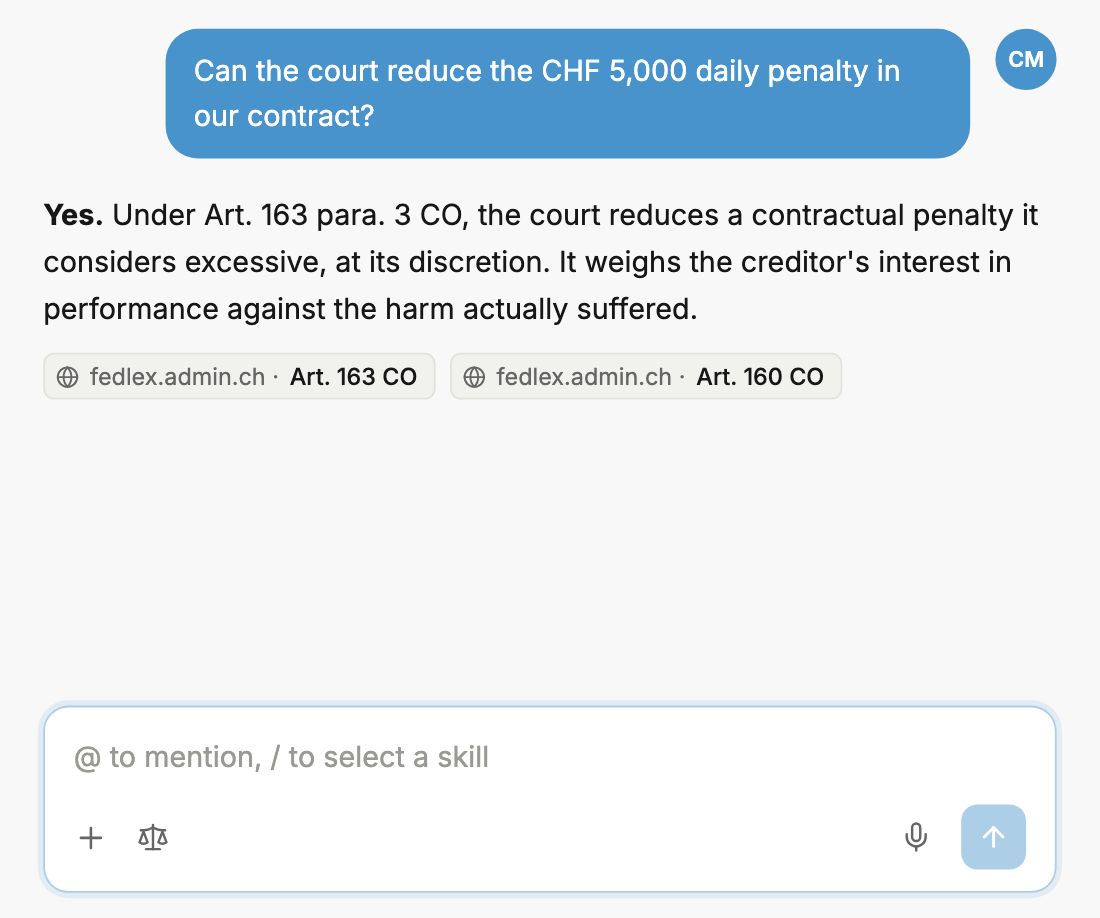
Illustrative product demonstration
Whisperit: a question with references to inspect
A recreated demonstration with fictional facts. Open the cited law and check whether it supports the answer. This example does not establish licensed commentary access or comparative accuracy.
Source: Whisperit · Research walkthrough
Open full-size imageInspect the comparison evidence: Weblaw · Lawsearch AI
These examples show different workflows, not a controlled comparison. The recommendation below explains when the competing product is the stronger choice.
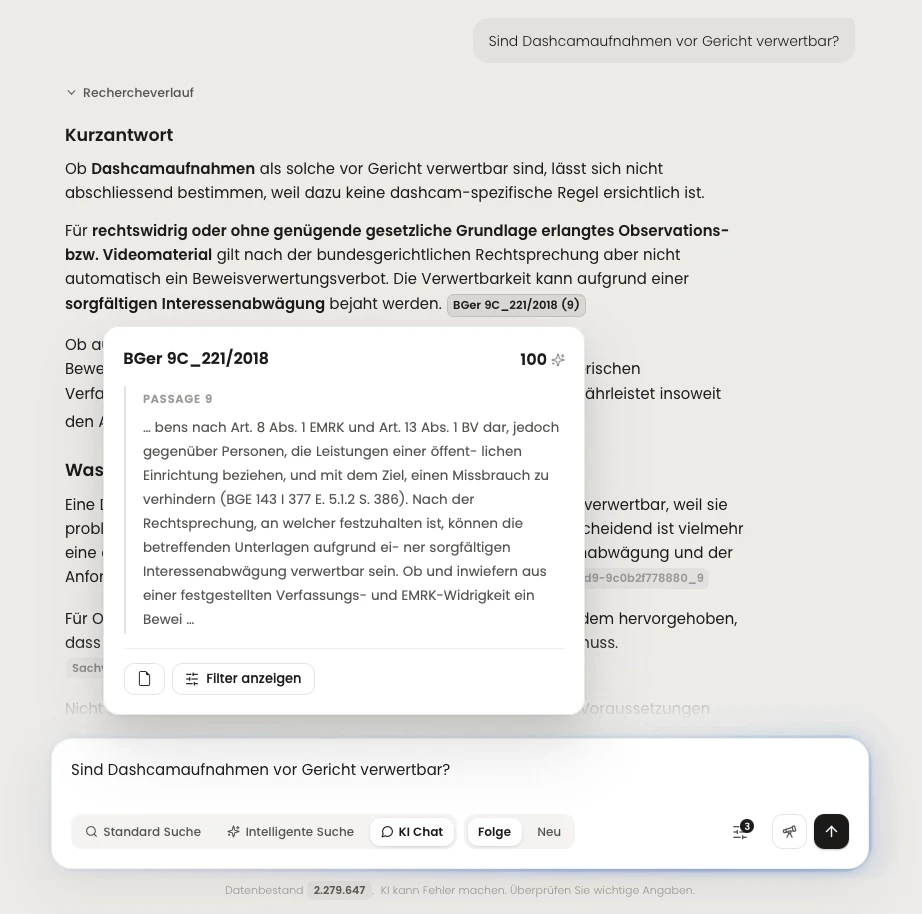
Public product image
Open the cited passage, not just the answer
The source preview makes verification visible. Open the full decision, read the relevant passage and check that it supports the proposition in context.
Source: Weblaw · Lawsearch AI
Open full-size imageCompare Swiss research tools by source requirement
| Research requirement | First candidate to evaluate | Strength worth testing | Boundary to confirm |
|---|---|---|---|
| Named legalis commentary | Swiss-Noxtua | Research grounded in the relevant collection | Included works, editions and full-text rights |
| Editions Weblaw publications | Lawsearch AI | Linked answers alongside classic source search | Weblaw's collection is not every Swiss publisher |
| Stämpfli commentary and Microsoft work | Libra | Publisher content and Word workflow | Legal Premium module and integration tier |
| Source validation inside Word | Jurata | Native add-in and passage checking | Pro/Max access; Orell Füssli content is a pilot |
The table maps purchasing requirements, not measured quality. A publisher relationship, a reference in an answer and a licence to read a full text are different things. [1] [2] [7] [8]
Compare research within the broader workspace
| Candidate | Reason to include it | What the trial must establish |
|---|---|---|
| Silex | Swiss-source research, drafting and permission-aware firm knowledge | Relevant authority remains inspectable through the draft |
| Omnilex | Swiss research, Cases and reusable agents | Source provenance and consistent use across matters |
| Whisperit | Research alongside the facts and documents in a matter | Accurate factual grounding and the required external sources |
Silex and Omnilex are substantial workspace candidates, not merely search interfaces. Whisperit explicitly distinguishes its research proposition from subscription databases; equivalent publisher-wide commentary rights were not established. [5] [6] [9]
Start with the source, not the fluent answer
Write down three sources that mattered in recent advice: a particular commentary, a decision and a date-sensitive statutory provision. Give the candidates a real question that required those sources. Ask to open the precise passage behind each material proposition.
Record the title, author, edition or update date, jurisdiction and account entitlement. Does the link open the full text, a citation record or a generated explanation? Could the reviewing lawyer inspect the authority without buying another subscription? These questions reveal more than the size of an advertised corpus.
Existence is only the first check. A genuine decision can be irrelevant, superseded or used for a proposition it does not support. The evaluation must test whether the conclusion follows from the cited passage and the facts.
Swiss-Noxtua: when legalis commentary decides the shortlist
Swiss-Noxtua's published research offering gives a concrete reason to evaluate it first when the required legalis works are central to the practice. [1]
Choose a completed question where doctrine changed the conclusion. Require the exact commentary passage, edition and contrary position. Confirm the purchased collection before crediting the tool with source access.
Trade-off: access does not establish the correctness of a generated synthesis or completeness of the account's collection. Its analysis and drafting capabilities deserve a separate workflow test; do not reduce it to a research box merely to favour another workspace. [10] [11]
Lawsearch AI: when the Weblaw collection is relevant
Lawsearch AI's documented offer combines AI answers, linked source passages, classic search and Editions Weblaw full texts. That is a useful starting point for a practice that needs those publications and wants to compare the generated answer with ordinary retrieval. [2]
Ask the reviewer to inspect a source that contradicts the first answer. Test how easily they can locate the text and explain the correction in the final note.
Trade-off: Lawsearch Enterprise and LawDocs have separate scopes. Do not assume a standard research subscription includes internal-repository integration or a separate document product. Read the Whisperit vs Lawsearch AI comparison for those boundaries.
Libra and Jurata: when research must reach Word
Libra's Swiss offer connects Stämpfli content with a Microsoft workflow. The full Legal Premium module and Word/Outlook access have their own packaging. Ask for the named content and demonstrated integration together in the proposal. [3] [7]
Jurata publishes source validation and a Word add-in in Pro and Max. Its Orell Füssli commentary access is described as a pilot subject to change. Test the current source and tier rather than treating the pilot as a permanent publisher entitlement. [8]
Trade-off: a good editing interface cannot repair missing authority. Have the lawyer verify the source first, then finish the actual Word memo, including references and revisions. Compare Libra's content and tier distinctions with Jurata's Word and pilot scope.
Silex, Omnilex and Whisperit: when facts and research must stay together
Silex documents research-to-draft work and Silos for firm knowledge, including permission-aware SharePoint indexing. Omnilex documents Swiss research, Cases and configurable agents. Those are reasons to test whether the same legal qualification survives into a client explanation and another matter. [5] [6]
Omnilex's own AI-assisted commentary should be checked by provenance and rights. It is not automatically access to a different publisher's named collection. Likewise, a corpus headline from any vendor cannot establish equivalent commentary access.
Whisperit is worth including when the question turns on a clause or disputed fact in the matter file. Require separate evidence for what the document says and what the law establishes. Keep a specialist source subscription when it remains necessary. [9]
Trade-off: a broader workflow should earn its place through the reviewed result. For a direct local choice, use Silex vs Omnilex; for the category decision, use the AI workspace guide.
International practice needs its own research test
Harvey and Legora publish broader research offerings; CoCounsel's relevant Westlaw or Practical Law package can be compelling where that ecosystem underpins the work. A Swiss-based international practice should test the actual jurisdiction and collection rather than exclude those tools by headquarters. [12] [13] [14]
Conversely, an international platform licence does not establish Swiss commentary coverage. Keep the Swiss and foreign-law acceptance criteria separate. A successful US task cannot settle a Swiss doctrinal question.
A five-question evaluation that reveals useful differences
Prepare checked answers before seeing the outputs:
- A statutory question whose applicable version depends on the matter date.
- A question requiring a leading decision's actual reasoning.
- A question where a named commentary materially changes the analysis.
- A question with conflicting or adverse authority.
- A question with a decisive fact intentionally missing.
For each material claim, record the exact source, passage, supported proposition and reviewer correction. Distinguish broken links, missing entitlement and wrong analysis. Ask a second lawyer to inspect the note without seeing the vendor's demonstration.
Use the blank Swiss evaluation scorecard to retain the findings. It contains no vendor results. The Weblaw public-results analysis explains useful research axes, but its anonymous columns cannot establish a named product winner.
Compare the purchased configuration and complete cost
Confirm users, named collections, full-text rights, usage, term, support and the subscriptions that remain. Compare the offered configuration, not an unusually well-equipped demonstration account.
Separate storage from inference, external queries, retention and support access. Published Swiss storage is not automatically Swiss-only processing. Review the exact arrangement before using confidential material. [15] [16] [17] [18] [19] [20]
Choose the product that reduces effort to checked authority while preserving the sources the lawyer needs. A strong answer with a weak verification path may create more work than it saves.
Questions buyers ask
Which Swiss legal AI tool has the best commentary?
There is no interchangeable commentary winner. Start with the named works your practice needs: legalis, Weblaw, Stämpfli or the current Orell Füssli pilot have different scopes. Verify editions and account rights.
Does Weblaw's challenge identify the most accurate provider?
The available public matrices are anonymous. They cannot assign a comparative accuracy score to Silex, Omnilex, Jurata or another named participant.
Should we cancel our existing research subscriptions?
Only after establishing that the remaining process supplies the necessary full texts, rights and verification methods. A different assistant can complement a retained collection.
Romain de Wolff