
The short answer
If Westlaw and Practical Law are central to your work, CoCounsel should be ahead of Whisperit in your research evaluation. If your main problem is turning a multilingual case file into organized, reviewed work, Whisperit deserves a separate workflow evaluation.
- Choose CoCounsel to evaluate first for research in the Thomson Reuters content ecosystem.
- Choose Whisperit to evaluate first for a Swiss practice combining dictated instructions, matter preparation and document production.
- Do not assume either subscription replaces the other. Research rights and workflow software can solve separate problems.
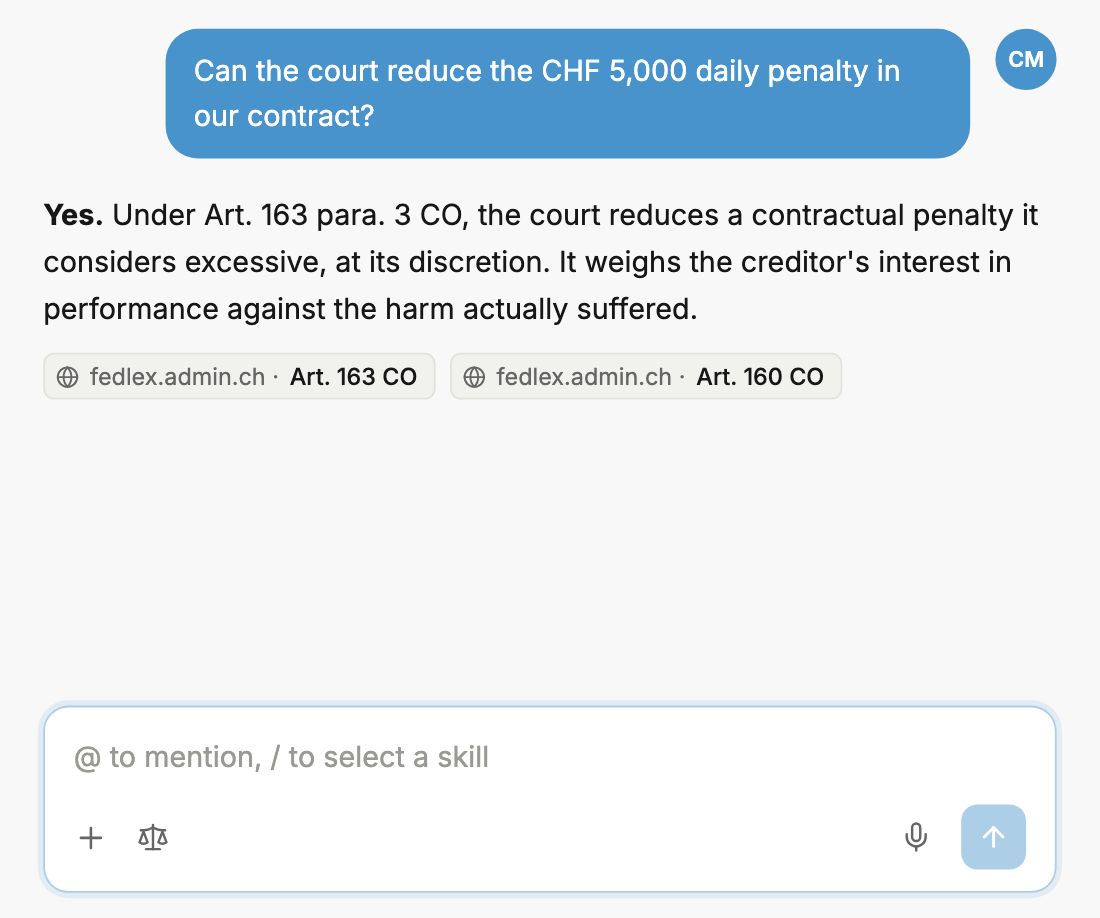
Illustrative product demonstration
Whisperit: a question with references to inspect
A recreated demonstration with fictional facts. Open the cited law and check whether it supports the answer. This example does not establish licensed commentary access or comparative accuracy.
Source: Whisperit · Research walkthrough
Open full-size imageInspect the comparison evidence: Thomson Reuters · CoCounsel Legal
These examples show different workflows, not a controlled comparison. The recommendation below explains when the competing product is the stronger choice.
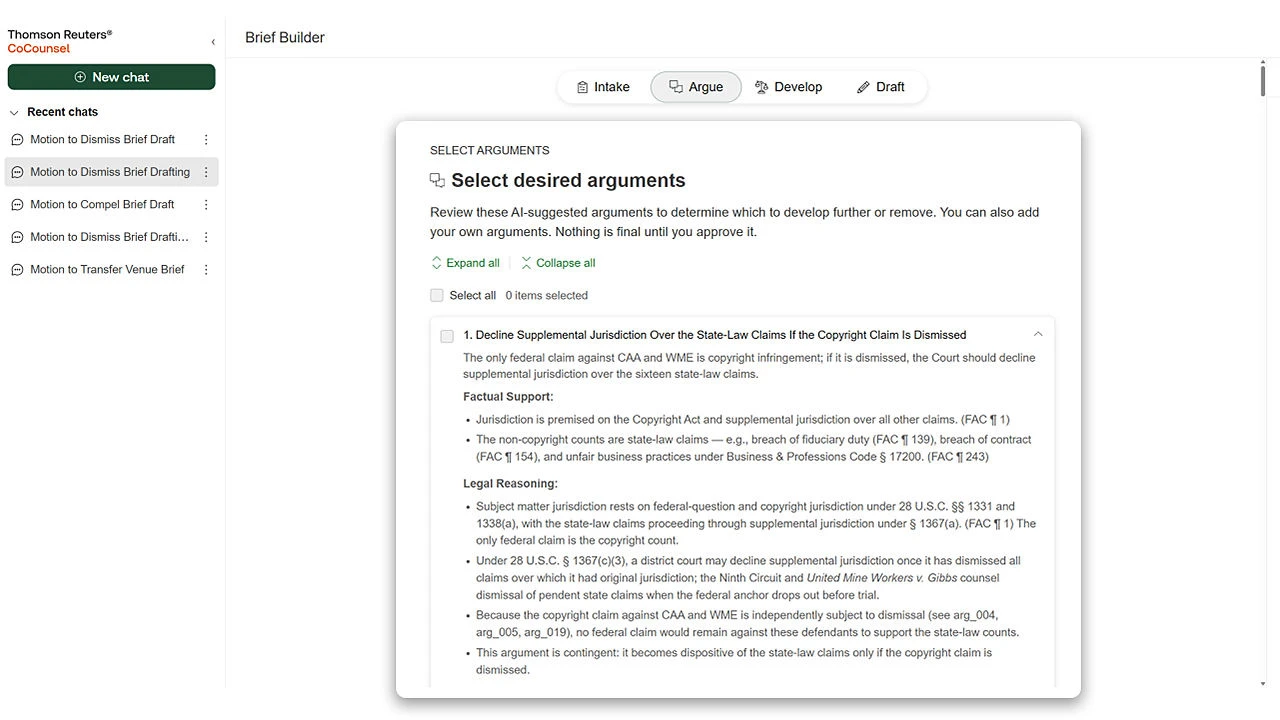
Public product image
Review the argument before drafting
This US-oriented Brief Builder example shows an argument review stage. It does not establish Swiss source coverage; verify jurisdiction and entitlements separately.
Source: Thomson Reuters · CoCounsel Legal
Open full-size imageAt a glance
| Question | Whisperit | CoCounsel | What matters |
|---|---|---|---|
| Where does research authority come from? | Check the jurisdiction and source list | Thomson Reuters legal content [1] | The right collection for your practice |
| Are all plans equivalent? | Check your offer | Research access differs by package [2] | Compare named products and entitlements |
| What about case-file work? | Matter-based analysis [3] | Document analysis offering [4] | Grade traceability on your evidence |
| Can spoken instructions become work? | Published dictation-to-draft flow [5] | Demonstrate the required capture path | Test the complete sequence |
| Is Swiss commentary included? | Do not infer it | Do not infer it | Request the actual titles and access rights |
| What is the price? | Check current local offer | Check region, bundle and term | A headline rate cannot settle this |
CoCounsel has a source advantage worth respecting
The strongest reason to buy a research product is access to the legal authority your work requires. That is different from asking which assistant writes the most convincing paragraph.
CoCounsel's relationship to Westlaw and Practical Law is the core buying consideration. [1] For a practice whose research is already organized around that ecosystem, we would recommend CoCounsel before recommending a new workspace as a research replacement. Familiar editorial materials and verification tools may matter more than reducing the number of open applications.
This does not establish that CoCounsel is universally more accurate. It means its source proposition is particularly relevant to those buyers. Quality still depends on coverage, entitlement, freshness, retrieval and how the lawyer checks the answer.
Check which CoCounsel you are buying
The current plans distinguish CoCounsel Legal, CoCounsel Essentials and packages that combine AI with different research offerings. They are not interchangeable descriptions of one identical subscription. [2]
A buyer can reasonably conclude that the drafting assistant is useful without purchasing the complete research package. Another buyer may need the content bundle more than the assistant. Ask for a demonstration using the exact plan and region in your proposal.
For a Swiss firm, do not carry assumptions from a US product page into a Swiss purchasing decision. Ask for jurisdiction coverage, commentary access, language support and the contract that applies locally. If these are unclear, the honest comparison has an unresolved row.
Where Whisperit can be the better fit
Consider a transferred file containing correspondence, scans and several drafts. The immediate job is to work out what happened, who is involved and what needs to be produced next. Whisperit's advertised case-analysis workflow addresses that sequence. [3]
If your team wants this context to carry into a dictated instruction, a draft and a colleague's review, evaluate Whisperit on those handoffs. The potential value comes from fewer repeated explanations and a reusable record of the work, not from a claim that it owns a better law library.
Whisperit's research page explicitly distinguishes its offering from subscription databases such as Swisslex and Weblaw. That is the right boundary to preserve in this comparison. [6] Recommending a workspace should not imply that it replaces a database's editorial apparatus.
When CoCounsel is the better purchase
Choose a CoCounsel-led evaluation when your required output is a research memo that must work within the Thomson Reuters source and checking environment. It is also sensible when your team already has the relevant access and the incremental workflow fits existing habits.
If most of the work is in a jurisdiction well served by your existing Westlaw subscription, introducing a second research workflow may add friction. Keep the product that makes the lawyer's verification easier, even if the competing assistant appears friendlier in a demonstration.
Conversely, if your team primarily needs Swiss commentary that neither tested plan includes, neither product wins that requirement. Consider a suitable licensed research collection and test how any assistant fits around it.
What to check about confidentiality
Ask both vendors to separate storage, inference, external source queries, support access and retention. Do this for the actual configuration offered to your firm.
Whisperit publishes different processing tiers and a vendor audit that remains in progress. [7] Your firm may regard a particular region or assurance report as mandatory. That requirement can decide the purchase before any usability comparison.
Avoid presenting a certificate, a Swiss address or an “AI does not train on your data” statement as a complete answer. Each addresses a particular part of the review. Ask for the evidence that answers your actual requirement.
Run two evaluations, not one vague demo
The research test: take three completed questions in the jurisdiction you practice. Include one with an adverse authority, one requiring commentary and one where the position is uncertain. Ask for the source, the date, the proposition supported and the material limitation. Open each reference and inspect the relevant passage.
The workflow test: take an approved matter file and ask for a chronology, a missing-information list and a draft client update. Include an amended date and an allegation contradicted elsewhere in the record. Measure the time to a reviewed result, including transfers and export.
Then compare the cost of keeping research and workflow together versus separately. Consider existing entitlements, additional licences and the training required. A combination may be the better answer; it should earn its place through recurring work.
Our recommendation
For Westlaw-centered research, we recommend evaluating CoCounsel first. For multilingual Swiss matter production, we recommend evaluating Whisperit first. Keep source depth and workflow convenience as separate criteria. A product can be excellent at one without being the right replacement for the other.
For several replacement paths, read the CoCounsel alternatives guide. If the required authority is Swiss, the Swiss legal research guide compares named collections before workspace breadth.
Questions buyers ask
Is CoCounsel only a research assistant?
No. Its published capabilities include analysis and drafting. Compare those workflows directly instead of defining the competitor too narrowly. [4]
Can I cancel my research subscriptions after buying Whisperit?
Only after verifying that your remaining tools provide the sources, rights and checking methods your practice requires. Do not cancel them on the basis of a fluent demo.
Which product is cheaper?
That remains unverified without comparable offers. Specify users, content rights, region, term, usage and implementation before comparing totals.
Romain de Wolff