
The short answer
For everyday Swiss case preparation, we would evaluate Whisperit first. For large collections and organizational review, include Harvey. For a shared evidence-review table, include Legora. For research and drafting centered on Westlaw, evaluate the appropriate CoCounsel package.
If the requirement is forensic collection, legal hold or formal disclosure production, keep those requirements separate. This guide does not establish any of these products as a replacement for a validated e-discovery process.
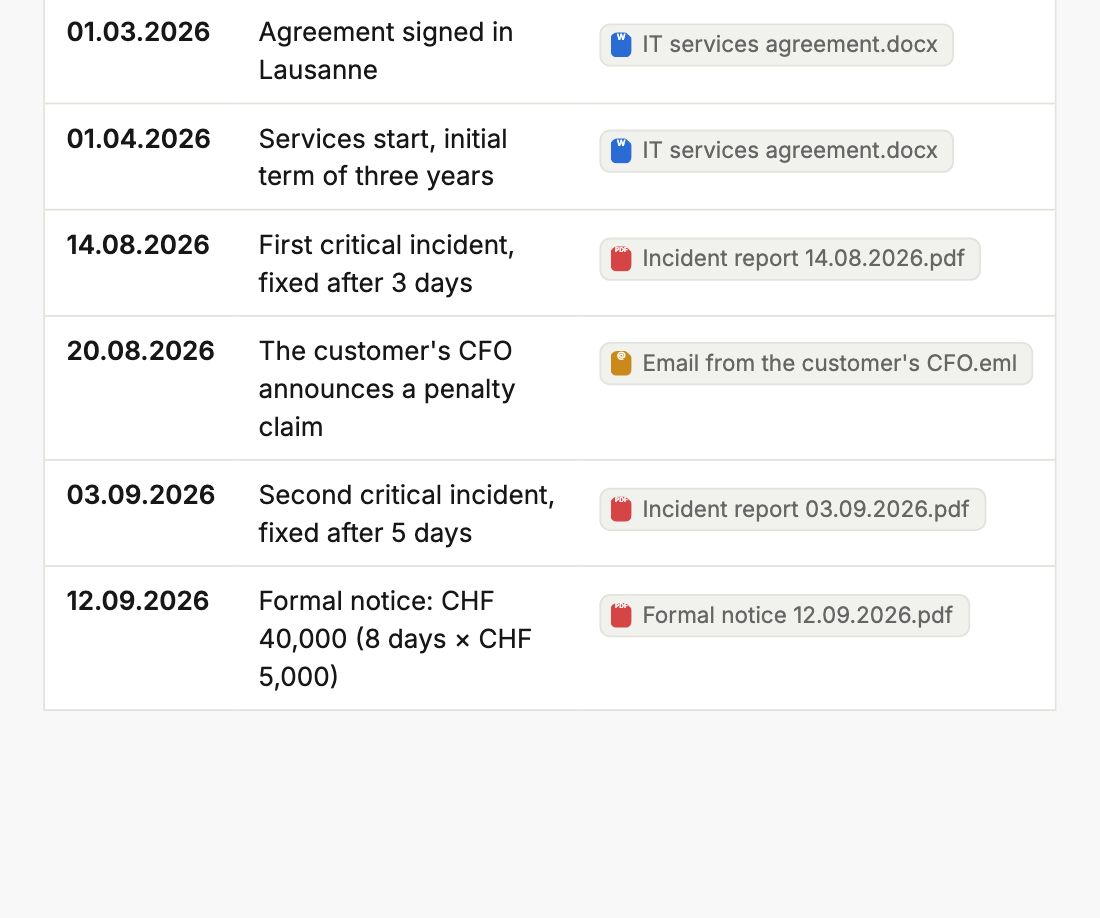
Illustrative product demonstration
Make every event traceable to a file
A recreated demonstration with fictional facts. The important check is the link between each event and its evidence, including conflicting dates and missing documents.
Source: Whisperit · Chronology walkthrough
Open full-size imageThe picks at a glance
| Product | First evaluate for | Essential test | Main boundary |
|---|---|---|---|
| Whisperit | Case orientation and daily work | Facts to referenced chronology | A generated timeline is not a verified record |
| Harvey | Substantial document collections | Known issues across the corpus | Advertised scale is not measured completeness |
| Legora | Collaborative structured review | Checked answers and exceptions | Good questions are required |
| CoCounsel | Research-linked analysis in its source ecosystem | Evidence plus relevant authority | Plan and jurisdiction control fit |
The useful analysis makes disagreement visible
A case file contains statements, allegations, contemporaneous records and later interpretations. Treating them all as equally established facts can make a smooth summary dangerous.
Ask the product to distinguish what each source says from what the lawyer concludes. A client account may conflict with an email. An attachment may have been superseded. A date on the face of a document may differ from the date of an event.
The right workflow should help a reviewer find those tensions. A chronology that acknowledges uncertainty can be more useful than one that fills every line with a confident narrative. Choose for inspection and correction, not simply for how polished the first output looks.
1. Whisperit: evaluate for daily case preparation
Whisperit's published case-analysis workflow produces an overview and source-referenced account of the file. [1] That is a relevant first test when the job is getting oriented and preparing the next piece of work.
Choose a completed matter with correspondence, a scan and contradictory statements. Ask for a chronology, an issue list and missing information. Open the references behind the important findings and correct the output.
Choose something else first if a controlled large-review workbench or specific research library is the primary requirement. Do not infer those capabilities from a strong everyday case overview.
2. Harvey: evaluate for broad collection work
Harvey's Vault offering addresses document organization, review and knowledge reuse. [2] It is worth evaluating when a litigation team works across substantial collections.
Prepare a known issue set and ask the reviewers to recover both supporting and adverse material. Check the handling of duplicate, incomplete and unreadable documents. Require the team to show the basis of a conclusion rather than simply read a generated report.
Its boundary: an advertised capacity is not proof that the relevant material was processed correctly in your matter. Keep an inventory and reconcile the files included in the analysis.
3. Legora: evaluate for the shared review process
Legora's structured review offering provides an evaluation route when findings need to be organized by document and question. [3] We would include it when several reviewers must maintain a checked issue matrix.
Ask one reviewer to correct an answer and another to inspect the evidence independently. Test whether the record shows which conclusions have been checked and which remain disputed.
Its boundary: the table's structure cannot rescue an ambiguous question. Specify the represented party, relevant period and difference between an allegation and a proven fact. Test what happens when the documents do not answer the question.
4. CoCounsel: evaluate where research and analysis meet
CoCounsel publishes research and document-analysis capabilities. [4] It is a credible first evaluation where the litigation work depends on the relevant Thomson Reuters source ecosystem.
Choose a task that requires both a factual record and a legal proposition. Ask the product to keep the supporting document separate from the authority. Then have the research lawyer verify the latter.
Its boundary: confirm the proposed plan and jurisdiction. Strong results in one content ecosystem do not establish coverage of every Swiss or European litigation question.
Keep four layers separate
Collection: what was obtained and whether the archive is complete. Extraction: what the file actually says. Analysis: why a fact matters to an issue. Argument: how the lawyer presents the position.
A product can help with extraction and analysis without replacing the controls around collection or formal production. This guide evaluates assistance with working material; it does not validate evidence integrity or procedural compliance.
Ask how a result links to the source and how the team records a correction. Keep the original archive available. If a generated report becomes the only convenient record, future reviewers may lose the ability to challenge it.
Build a pilot that contains known traps
Use a completed matter and prepare a checked issue list. Include six deliberate challenges:
- A client allegation contradicted by contemporaneous correspondence.
- A date corrected in a later document.
- An unsigned draft alongside the signed version.
- A fact that is genuinely absent from the provided file.
- A scanned passage containing a crucial name or amount.
- A relevant document in the second working language.
Ask for the chronology, evidence for each issue, adverse material and missing information. Inspect every decisive passage. Check whether the product explains uncertainty rather than turning absence into an answer.
Give the resulting work to a lawyer who did not run the task. Can they find the source and understand the conclusion without a separate explanation? Record time through this second review, plus factual corrections and missed issues.
Commercial and governance checks
Price the collection and review work you actually tested. Confirm users, modules, usage conditions, file handling, retention and export. We have not verified comparable commercial offers or performance at the advertised maximum scale.
For confidential material, approve the configured data flow and access model. Ask what leaves the environment during external research and what support personnel can see. Vendor documentation is useful evidence, but it is not an independent audit performed by this guide.
Our recommendation
For daily Swiss case orientation and production, start with Whisperit. For collection-scale review, include Harvey and Legora. For Westlaw-linked analysis, include CoCounsel. Keep the evaluation centered on contradictory evidence and a second lawyer's review. The best result is one the team can challenge.
If legal authority is part of the task, pair this trial with the Swiss research tools evaluation. If several reviewers need a dedicated workbench, inspect Whisperit vs Legora for the documented review-control distinction.
Questions buyers ask
Is a chronology automatically reliable?
No. Verify the event, date and supporting passage. A correct-looking order can still rely on a mistaken or superseded source.
Should we judge by summary length?
No. Judge by relevant coverage, traceability, uncertainty and effort to reach a reviewed result.
Does this establish an e-discovery replacement?
No. Collection, legal hold, production and evidence-integrity requirements need a separate evaluation.
Romain de Wolff