
Our verdict: Lawsearch AI can be the better research purchase
Choose a Lawsearch AI evaluation first when inspectable Swiss authority and Editions Weblaw publications drive the decision. Choose a Whisperit evaluation when the broader daily process—capturing instructions, assembling a matter and preparing reviewed documents—is the main problem. The two can also serve different jobs in the same practice.
Lawsearch AI combines semantic research and AI answers with linked sources. Its published source offering includes public legal material and Weblaw's own full texts. That is a concrete reason to prefer it when those publications are important to the lawyer's work. It does not establish that every Swiss publisher or commentary is included. [1]
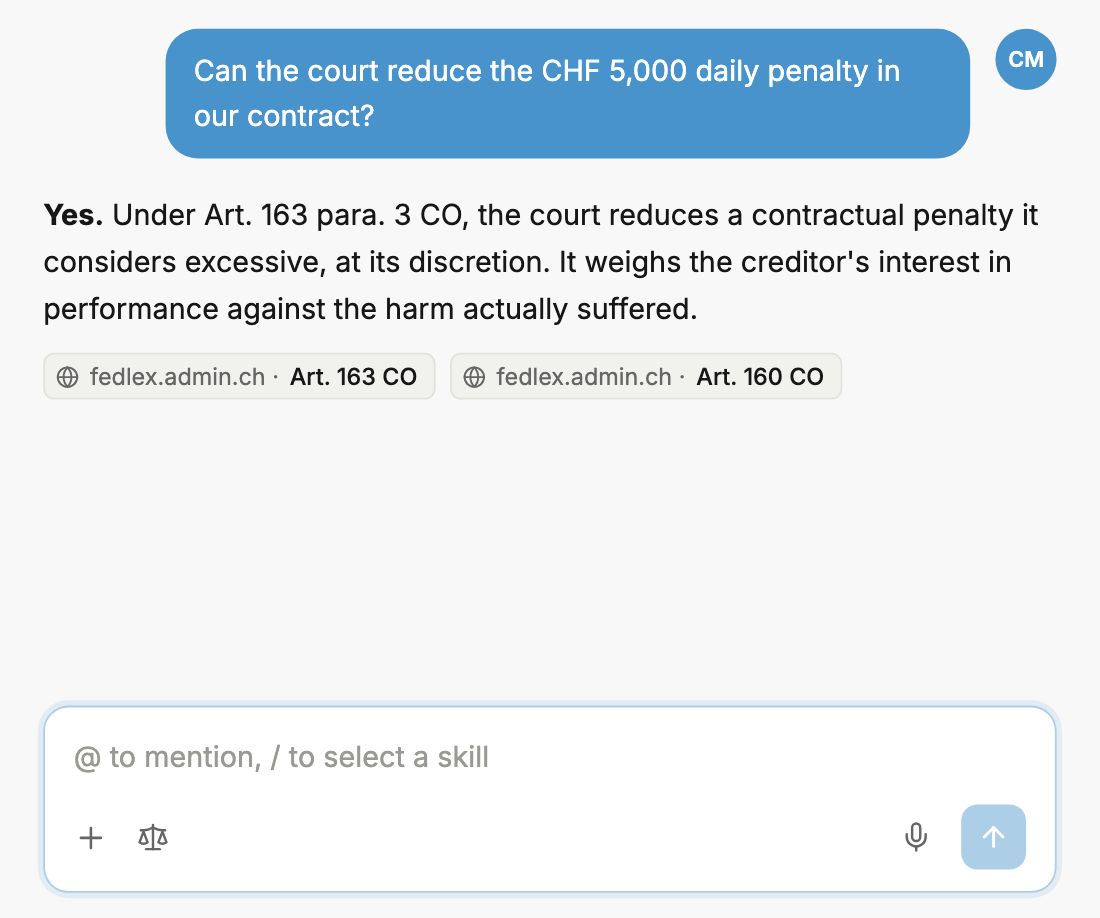
Illustrative product demonstration
Whisperit: a question with references to inspect
A recreated demonstration with fictional facts. Open the cited law and check whether it supports the answer. This example does not establish licensed commentary access or comparative accuracy.
Source: Whisperit · Research walkthrough
Open full-size imageInspect the comparison evidence: Weblaw · Lawsearch AI
These examples show different workflows, not a controlled comparison. The recommendation below explains when the competing product is the stronger choice.
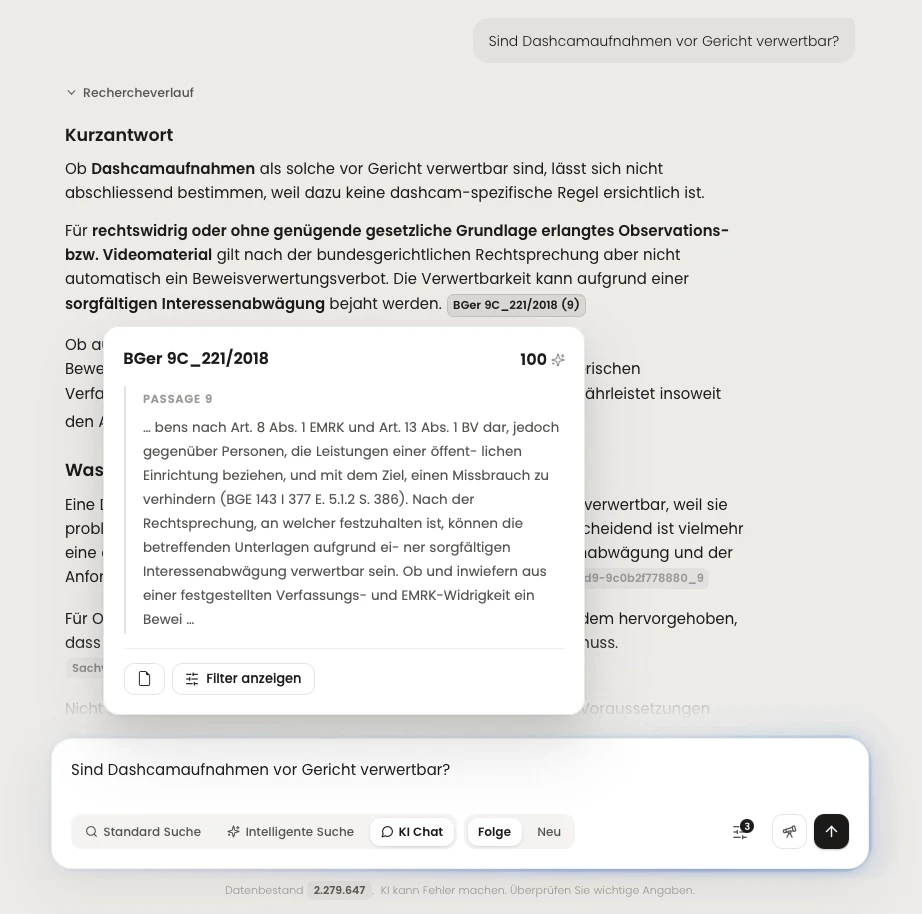
Public product image
Open the cited passage, not just the answer
The source preview makes verification visible. Open the full decision, read the relevant passage and check that it supports the proposition in context.
Source: Weblaw · Lawsearch AI
Open full-size imageCompare the right products
| Question | Lawsearch AI | Whisperit |
|---|---|---|
| What anchors the evaluation? | Source research, classic search and linked AI answers | Daily matter and document production |
| Which literature is verified in the offer? | Editions Weblaw full texts | No equivalent publisher-wide entitlement established here |
| How should a lawyer verify a result? | Open sources and relevant passages; compare classic search | Inspect references and original evidence in the demonstrated workflow |
| What about internal repositories? | Lawsearch Enterprise is a separate scoped offering | Validate current supported connections and permissions |
| What about Word work? | Weblaw also offers LawDocs; do not assume it is the same licence | Published Word/PDF export; native add-in parity not established |
Sources: Weblaw's Lawsearch product family and AI products, alongside Whisperit's research, assistant and integration documentation. These are advertised capabilities, not comparative performance results. [1] [2] [3] [4] [5]
Where Weblaw's approach can improve the work
A research answer needs more than a footnote. A lawyer must find the cited passage, understand what it actually says and distinguish a leading authority from a tangential reference. A product that keeps source inspection close to the answer can reduce the reconstruction effort.
Lawsearch's classic search alongside AI provides a useful evaluation baseline. Run the same issue through both modes. Can the evaluator find a known authority directly? Does the AI answer use it in the right context? If the prose is uncertain, can the lawyer continue through the source without abandoning the research environment? [1]
For a practice already using Weblaw publications, that continuity may matter more than a wider list of production features. A familiar source collection can make verification easier for the next reviewer too. The trial should show that benefit on the firm's actual questions, not merely on a preselected demonstration.
Full-text access should be explicit. Test a source inside the purchased collection, another outside it and an official decision. The software should make those boundaries understandable. A reference that cannot be opened is not equivalent to having the publication available for review.
Do not collapse Weblaw's product family into one subscription
Lawsearch, Lawsearch AI, Lawsearch Enterprise and LawDocs solve related but different jobs. The research product should not be criticised for omitting a capability offered through another Weblaw product. Equally, the buyer should not assume every capability is included in an entry research subscription. [2]
Weblaw describes Enterprise repository connections, permissions and optional local deployment. Treat those as a separate architecture and commercial discussion. The availability of a locally deployed enterprise system does not establish that the standard hosted Lawsearch AI subscription processes everything locally. [1]
Ask for a written list of modules, sources, integration work, support and deployment boundaries. That makes a comparison with Whisperit fair and prevents a seemingly inexpensive research offer from being compared against an unpriced suite of additional products.
Where Whisperit may be the better fit
A small team might already have an adequate research process but lose time collecting instructions, finding the relevant matter facts and producing the first usable document. Whisperit's proposed advantage is this broader daily workflow. The dictation and case-analysis material support evaluating it around that job. [6] [7]
Use a client instruction and an existing file rather than begin with a perfectly framed legal question. Ask for a factual summary, a list of unresolved issues and a draft client letter. Then change one assumption and ask a colleague to continue the work. Judge whether the system reduces avoidable re-entry and preserves the distinction between evidence and an inference.
That advantage must be demonstrated. If the firm spends most of its time establishing the applicable legal position, Lawsearch AI may improve the more important part of the process. A broad workspace that requires extra source checking can be less useful than a focused research environment.
Keeping both tools can be reasonable when they remove different friction. The commercial evaluation should include the combined cost and the effort to move verified research into the matter. Buying two products is justified only if the actual work benefits.
Security and pricing need a scoped answer
Weblaw's product page describes Swiss hosting and secured Azure infrastructure, plus scenario-dependent private, client-hosted and local options. The exact inference geography and scope of a standard offer are not established by those broad statements. Confirm the selected service rather than infer Swiss-only inference from hosting. [1]
Whisperit's published residency tiers likewise need configuration-specific confirmation. Compare the proposed data path, retention, access and assurance evidence. Neither a product description nor a research result proves the architecture used for a particular firm. [8]
We did not establish a comparable public CHF price for a fully scoped Lawsearch AI offer. Obtain a quote for the required seats, sources and modules, and compare it with the corresponding Whisperit offer. Leave unknown prices unknown; do not turn them into “expensive” or “cheap” editorial labels.
What Weblaw's own challenge contributes
Lawsearch AI participated in the organizer's June challenge. Weblaw also operates the product. That commercial relationship should be visible when the challenge is cited. Its public result matrices have anonymous columns and cannot establish that Lawsearch AI won or that it produced a particular error. [9]
Use our public-result analysis for the observed tasks and limitations. A four-case event is not evidence of the complete workflow, the selected deployment or the value of replacing another subscription.
A research-to-delivery trial
Pick a completed matter containing an expected leading decision, a plausible but irrelevant authority and a publication from the actual licensed collection. Ask for a concise note that explains the rule, counterargument and applicable date. Open each cited passage and record whether it supports the associated statement.
Next produce the document your practice actually needs. Have another lawyer verify it without being coached by the person who ran the search. Include their source-checking time, corrections and export effort in the result. Choose Lawsearch when it produces stronger research with lower total review effort; choose Whisperit when its complete workflow is the more useful improvement.
For a source-led buying shortlist, use the Swiss legal research comparison. For the wider vendor and package map, use the Swiss legal AI market overview.
Frequently asked questions
Does Lawsearch AI include all Swiss commentary?
That was not established. Its documented Weblaw collection is specific. Confirm named works, editions and full-text rights rather than assume every publisher is included.
Is Lawsearch Enterprise the same as hosted Lawsearch AI?
No. The published enterprise options involve a separate scoped integration and deployment discussion. Compare the exact purchased configuration.
Should Whisperit replace an existing Lawsearch licence?
Only if the replacement preserves the sources and verification process the firm needs while improving the complete job enough to justify change. A successful research system can remain part of the practice.
Romain de Wolff