
The short answer
For notarial preparation, correspondence and first drafts, Whisperit is our first workspace to evaluate. For legalis-led Swiss research, evaluate Swiss-Noxtua first. For local recorded transcription on a Mac, include MacWhisper. For a focused Word drafting task, include Spellbook.
Keep your established formal-instrument, register and filing processes as the baseline. This guide does not establish any AI assistant as a certified replacement for them.
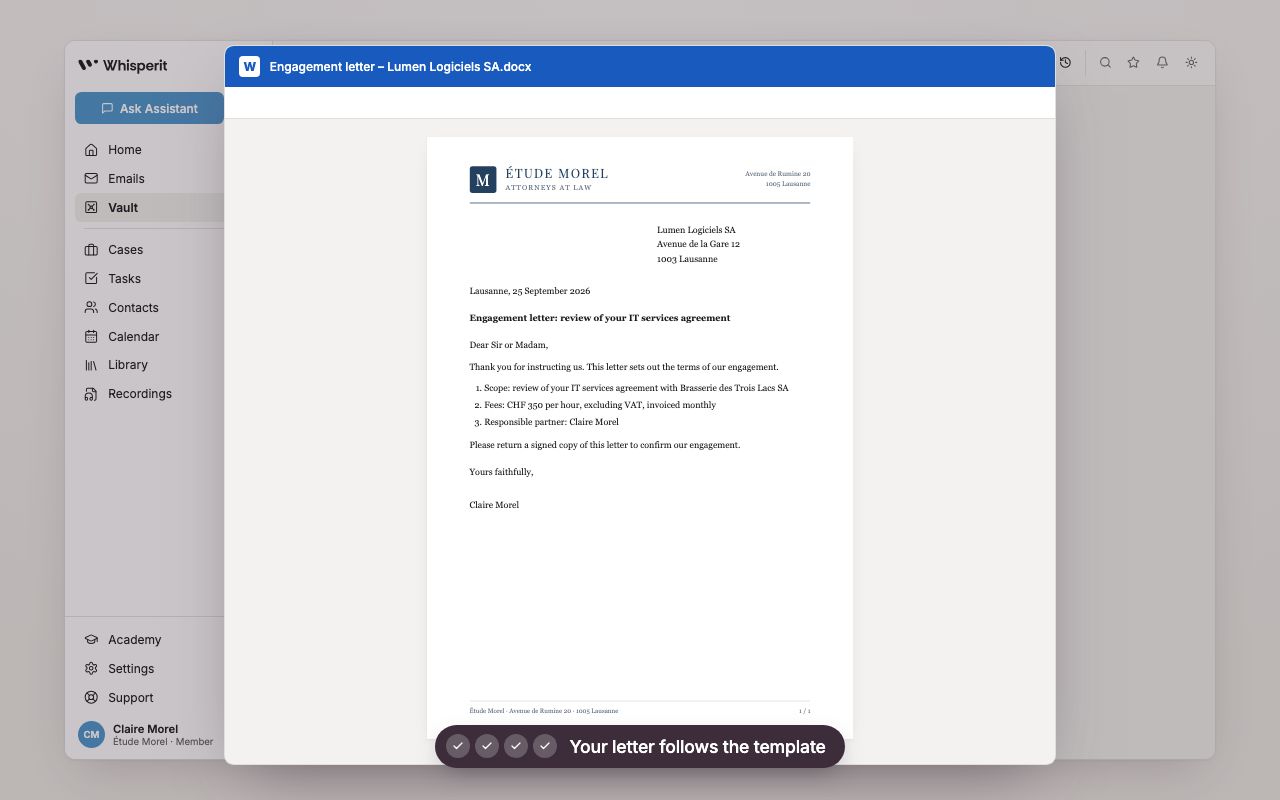
Illustrative product demonstration
Start from an approved template
A recreated demonstration of an engagement letter, not a notarial act. Test template fidelity and missing-field handling; apply the formal requirements of your own notarial workflow.
Source: Whisperit · Template walkthrough
Open full-size imageThe picks at a glance
| Option | First evaluate for | What to prove | Main boundary |
|---|---|---|---|
| Whisperit | Preparation and document production | Correct facts and reviewable first draft | No automatic formal-instrument validity |
| Swiss-Noxtua | Swiss legal analysis and commentary | Exact authority and supported proposition | Office process needs separate evaluation |
| MacWhisper | Recorded instructions to working text | Correct transcript under local settings | Optional cloud features change the data path |
| Spellbook | Drafting from an approved precedent | Preserved terms and usable document | Not a registry or filing system |
| Existing specialist process | Formal instruments and operational controls | Continue the accepted checks | AI should prove a specific improvement around it |
Start before the formal act
The most useful first AI task may be a client letter, a preparation checklist or a summary of supplied documents. These are recurring outputs where the office can inspect the result against known material.
A formal instrument is a different purchasing test. Jurisdiction, form, identification, representation and the office's required checks all matter. A plausible draft does not establish that those requirements have been satisfied.
Separate preparation from formal approval in the evaluation brief. Keep the reviewer responsible for the final decision and require the assistant to expose missing facts. An unfinished field is often more useful than a confident invented detail.
1. Whisperit: evaluate for preparation and daily production
Whisperit's published notarial offering addresses dictation, drafting and document organization. [1] That makes it worth evaluating for the work surrounding an appointment or instrument.
Use a completed, approved example. Ask for a preparation note, a request for missing documents and a first draft based on the office's precedent. Check every party name, capacity, amount and property or entity reference.
Choose another process first if the purchase must handle formal registers, filing or specialist calculations. This research does not establish that replacement. Also test the final document format; the office's established template may contain structural requirements a pleasant-looking draft does not preserve.
2. Swiss-Noxtua: evaluate for legal research
Swiss-Noxtua is a meaningful shortlist when the office depends on legalis commentary. [2] The relevant test is finding and checking the authority behind the legal question.
Choose a completed issue where the research affected the office's treatment of the matter. Ask for the exact source, edition and contrary position. Have the reviewer compare the output with the checked analysis.
Its boundary: useful research does not establish that the office's formal and administrative workflow has been replaced. Evaluate preparation, template handling and delivery separately.
3. MacWhisper: evaluate for a local transcript
MacWhisper documents a local transcription workflow and separate optional cloud features. [3] It is a relevant candidate when the approved task is converting a recording into working text on a Mac.
Test names, figures and corrected instructions. Listen back to the decisive passages. Keep the recording and resulting text under the office's ordinary access and retention process.
Its boundary: transcription is not legal drafting or verification. Confirm the settings for translation and AI processing if those features are used. A locally generated transcript can still contain an error and still needs appropriate handling.
4. Spellbook: evaluate a focused precedent-based draft
Spellbook's drafting offering uses existing documents and precedents. [4] It merits evaluation when the office wants help with a defined document task in its working editor.
Give it an approved precedent and a carefully checked instruction set. Ask it to change only the intended fields or provisions and to mark missing information. Inspect the effect on definitions, references and related passages.
Its boundary: a drafting assistant is not a notarial register, a filing route or proof of formal validity. Keep that boundary explicit when comparing the licence with a specialist office system.
Do not reward a draft for hiding the missing information
The office needs to know what it does not yet know. Prepare a test instruction that leaves one representation detail, identity fact or document reference unresolved. Tell the assistant to identify the gap rather than fill it.
Then introduce a correction. Does the finished work use the corrected amount or party name throughout? Does an old value remain in an annex, summary or letter? Consistency across outputs matters as much as the first draft.
For multilingual offices, repeat with a document already checked in both languages. Have a qualified reviewer inspect concepts, local terminology and the client's intended position. Fluent phrasing alone cannot decide the result.
A cautious starting point that still delivers value
Begin with three completed preparation tasks: a client document request, an internal appointment note and a covering letter. Use material the office has approved for the evaluation.
Run the ordinary process once as the baseline. Then have the same staff prepare the outputs using the proposed product. Record factual corrections, missing-information handling, final formatting and total reviewed time.
Only expand after the first tasks work reliably. Before testing formal instruments, define the additional requirements and approval procedure. Require the vendor to demonstrate the actual supported workflow rather than infer capability from a generic drafting example.
Compare the whole office cost
Price the actual users, including assistants and occasional reviewers. Include onboarding, templates, retained research and specialist systems that remain. We have not verified comparable commercial offers, so the guide does not declare a price winner.
Obtain the configured data flow and assurance evidence for confidential material. If a particular audit, location or access condition is mandatory, treat it as a purchasing requirement. Whisperit's public vendor audit remains described as in progress. [5]
The useful purchase is one the office can maintain, inspect and incorporate into accepted work. It should reduce repetitive preparation while preserving the checks that make the final work dependable.
Our recommendation
For daily preparation and first drafts, start with Whisperit. For commentary-led research, start with Swiss-Noxtua. For local recorded transcription, evaluate MacWhisper. For a focused precedent-based document, include Spellbook. Keep the established formal process until a separate evaluation proves the required replacement.
When spoken instructions are the main input, use the lawyer dictation guide to choose between working transcription and document preparation. When doctrine decides the advice, use the Swiss research guide to check the required publications.
Questions buyers ask
Can an AI draft be treated as an approved instrument?
This guide does not establish that. The office's applicable formal requirements and professional review remain part of the process.
Where should we start?
With a recurring preparation document that staff can check easily against a completed example. Expand only when the workflow earns its place.
Is the most capable platform the best purchase?
Only if its capabilities solve recurring work the office can actually use. A focused tool may be the better investment.
Romain de Wolff