
The short answer
Evaluate CASUS for a different native Word review approach; Legora if you need Word work plus structured team review; Whisperit if the job extends into voice-led matter production; CoCounsel if research and practical guidance drive the purchase; or Swiss-Noxtua if Swiss commentary is indispensable.
Keep Spellbook when your core task is contract negotiation and its current workflow already works. An alternative should improve something specific, not merely have more features.
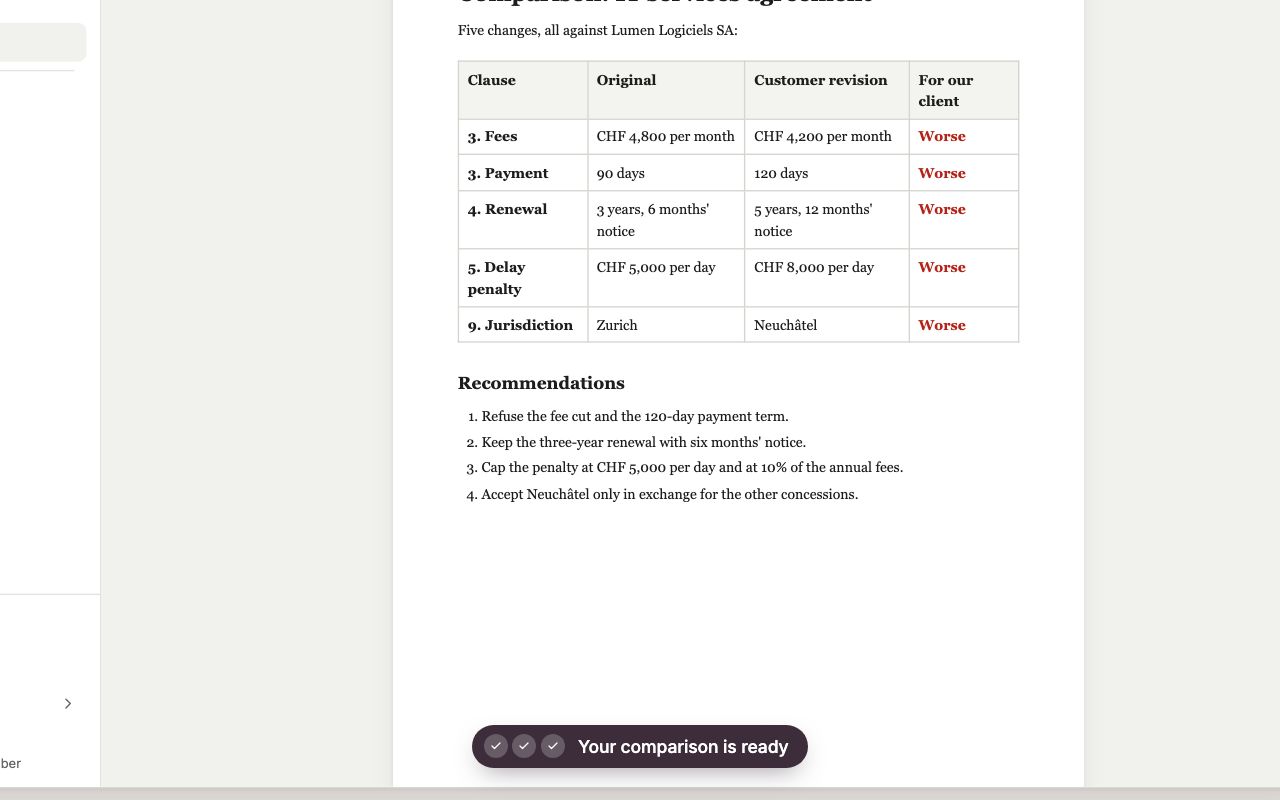
Illustrative product demonstration
Whisperit: turn document changes into a reviewable note
A recreated demonstration with a fictional agreement. Inspect the changes and finish the review in Word. An exported comparison note does not establish a native Word add-in or portfolio-review capability.
Source: Whisperit · Document-comparison walkthrough
Open full-size imageInspect the comparison evidence: Spellbook · Review
These examples show different workflows, not a controlled comparison. The recommendation below explains when the competing product is the stronger choice.
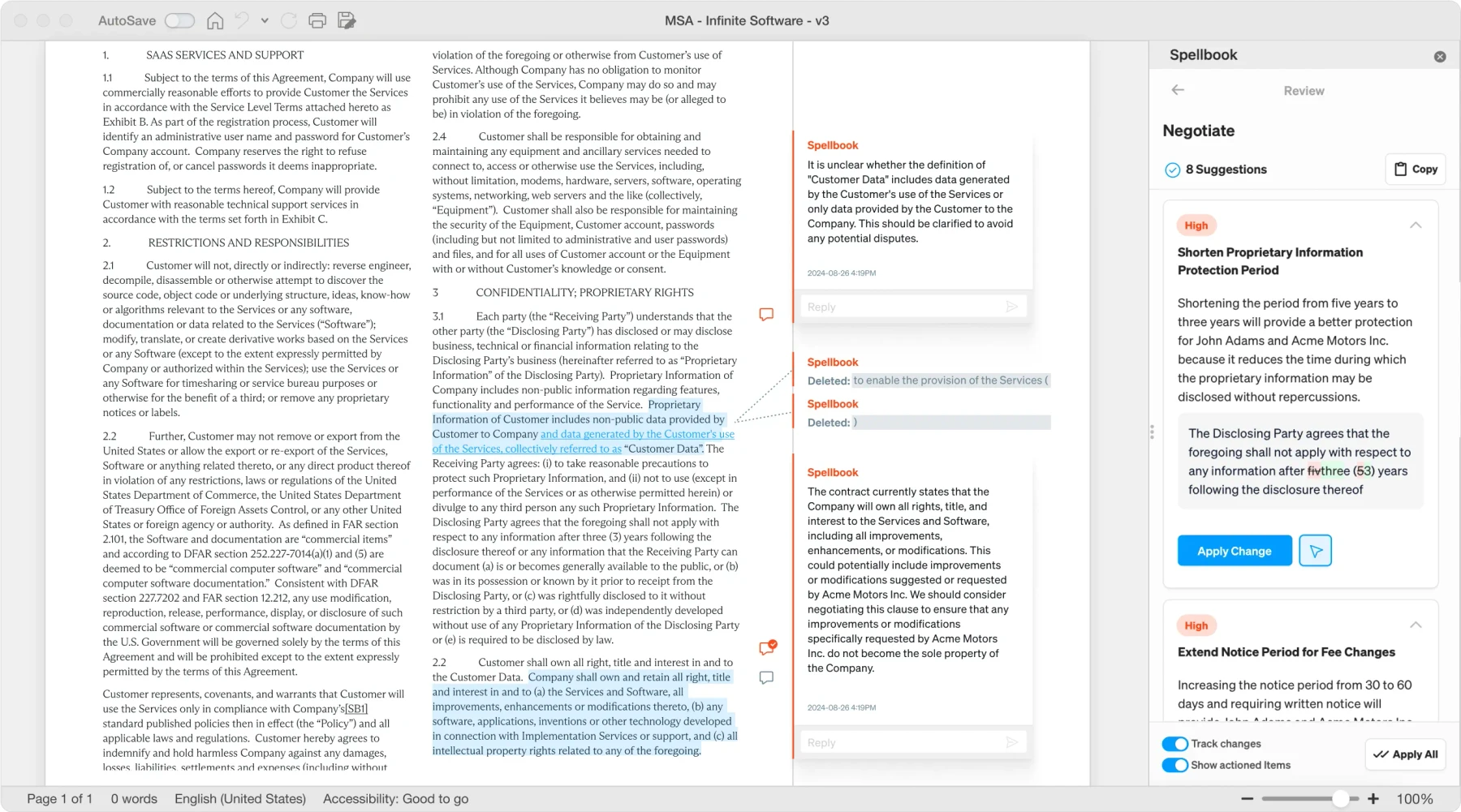
Public product image
Keep the proposed change beside the contract
Spellbook keeps suggestions and redlines in Word. Check whether each proposed change follows your playbook and remains usable when the document leaves the tool.
Source: Spellbook · Review
Open full-size imageThe shortlist
| Why you are looking | Alternative | First task to test | What may be lost |
|---|---|---|---|
| Need another native Word review path | CASUS | Risk review and document benchmarking [1] | Existing playbooks and review habits |
| Need a wider collaborative review system | Legora | Review table and final Word document [2] | Familiar contract review habits |
| Need the whole matter, not just the agreement | Whisperit | Case context to reviewed first draft [3] | Direct in-Word interaction |
| Need Thomson Reuters legal guidance | CoCounsel | Research-supported contract advice [4] | A focused negotiation experience |
| Need Swiss doctrinal sources | Swiss-Noxtua | Commentary-grounded analysis [5] | The existing Word workflow |
What are you really missing?
A contract team can dislike a product for very different reasons. The suggestions may be unhelpful. The playbook may be poorly specified. The team may want intake and approval routing. Or the actual pain may be searching for the right precedent before review begins.
Those problems do not point to the same replacement. Start by watching one agreement move from request to final delivery. Note where the work waits, where a lawyer repeats a decision and where information is lost.
Then define the purchase around that bottleneck. If the agreement still requires a lawyer to decide the negotiating position, changing assistants will not remove that decision. If the business has no agreed fallback standard, a better interface will not create one for you.
CASUS: for another document-centred Word workflow
CASUS is a direct candidate when you want to retain Word review while changing the tool. Its published offer includes chat, proofreading, risk review and document benchmarking inside Word, as well as broader Dossiers and Data Room work. [1] [6] [7]
Run the same completed agreement and represented-party instructions in both tools. Finish the actual redlined document, inspecting definitions, carve-outs, cross-references and formatting. Count the changes your lawyer accepts rather than all generated suggestions.
The trade-off: advanced playbooks and governance have a separately scoped offer. Do not assume a Standard subscription reproduces every rule and control used in the incumbent account. Compare the demonstrated package and actual processing path. [8] [9] Read the CASUS comparison for these boundaries.
Legora: for work that spans a review team
Legora merits evaluation when the job extends from individual redlines into a structured project. Its review offering emphasizes source inspection and collaborative controls. [2]
Give the team several related agreements with amendments. Ask reviewers to identify the exception, record the decision and carry the result into the final document. Add the Word add-in to the pilot if that is how the work is delivered. [10]
Choose it when: the broader review process is the real need. Keep looking when: the extra process does not improve your mostly individual contract queue. A larger platform can create unnecessary work if the problem is narrow.
Whisperit: for matters with many kinds of work
Whisperit is worth evaluating when the agreement is one part of a wider file. Its published case analysis addresses the documentary context surrounding the work. [3]
An employment matter, for example, may require a chronology, client correspondence, a draft agreement and a partner briefing. Test whether the workspace helps the team carry facts and instructions across those outputs.
Choose it when: the benefit of the wider matter workflow outweighs the transfer into your document editor. Keep Spellbook when: direct in-Word negotiation is the requirement and the alternative has not reproduced it. Whisperit's published Word export should not be presented as add-in parity. [11]
CoCounsel: for legal guidance alongside production
CoCounsel belongs on the shortlist when the contract task depends heavily on legal research and practical guidance in the Thomson Reuters ecosystem. [4]
Choose a matter where an unfamiliar issue changed the drafting. Require the source and the reason the suggested language addresses the issue. Then verify the source and finish the document.
Choose it when: content and research are central. Keep looking when: the offered package does not include the content you need or the contract interaction is less effective for your queue. Packages vary, so inspect the exact plan. [12]
Swiss-Noxtua: for Swiss-law analysis
Swiss-Noxtua is relevant when the contract question calls for legalis commentary. [5] A source-rich analysis can matter more than quickly inserting a clause when the underlying legal position is disputed.
Use a completed question and compare the cited passages with the answer your lawyer reached. Ask for contrary commentary and an explanation of uncertainty, not just a proposed clause.
Choose it when: the research collection is indispensable. Keep looking when: the main need is a contract-editing interface and the proposed workflow adds friction. The value of a collection and the value of an editor should be evaluated separately.
When Spellbook is better
If your lawyers work in Word, have clear review standards and get useful contract suggestions from Spellbook, keep it unless the alternative proves a better result. Its suite and multilingual claims are broader than a simplistic “English-only clause tool” description. [13] [14]
Also distinguish an available product from an announced expansion. The current site markets ACM through early access. [15] Ask which capabilities the proposed account can use today and which remain subject to availability. Do the same for every alternative.
Do not expect playbooks to migrate themselves
Take your five most important review rules and express them outside any vendor interface. Include starting position, fallback, escalation condition and the reason for the rule. That becomes the portable standard against which you test alternatives.
Use the same negotiated agreement in both tools. Check defined terms, exceptions, cross-references and the actual Word output. Have a lawyer review the redlines without knowing which product produced them if that is practical.
Before switching, verify clause-library exports, team permissions and the commercial terms of any overlap. We have not obtained comparable offers, so no price or savings winner is established here.
Our recommendation
For a focused contract queue in Word, Spellbook remains a strong first choice to evaluate. Switch to improve a particular broader need: team review, matter production or research depth. The right alternative earns its place by reducing reviewed work, not by winning a feature count.
Questions buyers ask
Is an AI contract tool also a full lifecycle system?
Not automatically. Evaluate intake, approval, signature, storage and obligations as distinct requirements.
Can we use two products?
A combination may be sensible if each solves a recurring job. Check duplication, handoffs and complete annual cost.
Where is the Whisperit comparison?
Read Whisperit vs Spellbook for the contract-specific decision.
Romain de Wolff