
The short answer
For a solo lawyer who wants help across the daily matter, we would evaluate Whisperit first. For contract work in Word, evaluate Spellbook first. For Swiss commentary, evaluate Swiss-Noxtua first. For local transcription of recordings on a Mac, evaluate MacWhisper in its local configuration.
If the recurring task is small and your existing process works, the best first move may be buying nothing. Choose a tool after identifying the work you want to stop repeating.
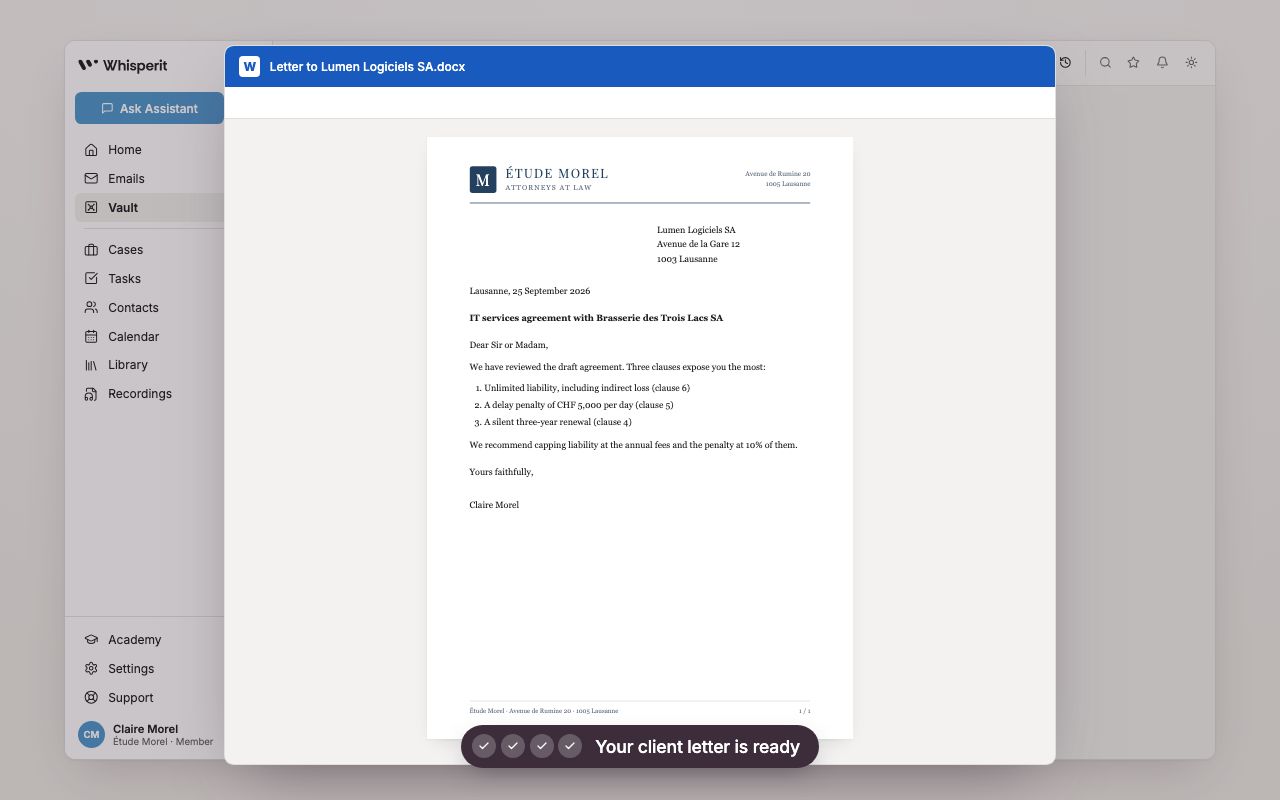
Illustrative product demonstration
The useful result is a letter you can review
A recreated demonstration with a fictional matter. Check the path from supplied documents to a client-ready draft, then verify every legal assertion before sending it.
Source: Whisperit · Client-letter walkthrough
Open full-size imageThe picks at a glance
| Option | Best first evaluation | Cost question | Watch for |
|---|---|---|---|
| Whisperit | Several daily matter tasks | Current individual offer [1] | Paying for breadth you do not use |
| Spellbook | Contract drafting and negotiation | Custom individual/team pricing [2] | Research and wider matter needs |
| Swiss-Noxtua | Commentary-based Swiss research | Professional configurator [3] | Exact source access and term |
| MacWhisper | Recorded audio to text on a Mac | Check current edition and purchase route | Cloud features need separate review [4] |
| Existing process | A small, occasional task | No new software commitment | Know when manual work becomes the bottleneck |
Buy for the job that follows you home
A solo lawyer does not have a spare colleague to organize the file while they prepare the advice. The most expensive task may be the one that repeatedly consumes the last hour of the day: writing up instructions, rebuilding a chronology or preparing the same kind of correspondence.
Name that task before comparing products. Count how often it happens and how much time goes into the final reviewed result. If the job occurs once a month, a platform may be difficult to justify. If it repeats throughout the week, a modest improvement can be meaningful.
Avoid buying a theoretical future team. Start with your present work, existing research rights and preferred delivery format. A useful assistant should reduce the number of things you have to remember and supervise, not create a second practice to administer.
1. Whisperit: evaluate for breadth across the matter
Whisperit markets a solo-practice workflow that combines preparation and document production. [5] It is worth testing when the same file generates notes, correspondence, research questions and several drafts.
Use a matter you know well and prepare three real outputs. Ask whether you can continue from the existing context without repeatedly explaining the client, represented party and purpose. Include the review and export in your timing.
Skip it as the first purchase if your only need is occasional transcription or a single in-Word contract task. A broad workspace should earn its place through recurring breadth, not through the attraction of having everything available.
2. Spellbook: evaluate for a contract-heavy practice
Spellbook's published drafting offering uses documents and precedents. [6] For a solo whose practice centers on agreements, that is a relevant starting point.
Give it an agreement you already negotiated and your accepted positions. Ask for the exact changes you would send to the counterparty. Inspect definitions, exceptions and how the result appears in the working document.
Choose another tool first if most of your work is evidence organization or case preparation. Contract fluency does not decide those tasks. Also keep your research subscription in the cost if the assistant does not replace its necessary content.
3. Swiss-Noxtua: evaluate for the commentary question
Swiss-Noxtua is a strong research shortlist where legalis material matters to your advice. [7] Without an associate to prepare the research, a tool that helps locate and check relevant authority may be more useful than a better drafting interface.
Choose a completed question where doctrine changed your analysis. Inspect the source and contrary position. Count the verification time rather than assuming a fluent answer saves work.
Choose another workflow first if the research collection is already sufficient and your main problem is capturing instructions or producing routine documents.
4. MacWhisper: evaluate for local recorded transcription
MacWhisper documents local transcription by default, while cloud transcription, translation and AI features introduce separate data paths. [4] That makes the local configuration a relevant candidate for a solo who mainly wants recorded audio converted to text.
Test a recording that contains names, amounts and a correction. Listen back to the important passages. Store and protect the resulting files under your ordinary document policy.
Choose a workspace instead if the real task is drafting in matter context and collaboration. A transcript still leaves analysis and document production to you. Local processing also does not remove device, backup or source-recording obligations.
A solo-friendly evaluation
Pick one tool at a time and one recurring task. Before the trial, complete the task once in your existing process and record the reviewed time. Define the quality threshold: correct facts, appropriate sources and a document you can actually use.
For the trial, use a completed matter and equivalent instructions. Check every name, amount, date and quotation. Give the tool an intentionally absent fact and see whether it asks, marks the gap or invents an answer.
Repeat the task later in the week without relying on the demonstration setup. This reveals whether the workflow is easy enough to become a habit. If you never return to it, the attractive feature list is not helping.
Finally, obtain the current individual offer and contract term. Add any research, storage, integration and setup costs. Your capacity to maintain the tool is part of the purchase price.
Know when to keep your current process
Stay with the existing method when the task is infrequent, the quality is already good and a new tool does not reduce reviewed work. You do not need an AI platform merely because competitors use one.
If the tool helps, write down the instruction that worked and the checks you performed. That repeatable process is the investment. More attention for the client is a better outcome than more generated text.
If recorded instructions are the main burden, use the lawyer dictation comparison before paying for a broad workspace. If named Swiss authority is the bottleneck, use the Swiss research guide to identify the necessary collection.
Questions buyers ask
Should I start with an enterprise platform?
Only if its actual scope and offer fit your recurring work. Evaluate the task rather than deciding from the label or the firm's size.
Can AI replace my own final review?
No. Choose a workflow that makes checking easier, and include that review in the time comparison.
Which tool is the cheapest?
No price winner is established here. Current offers and the content you still need determine the complete cost.
Romain de Wolff