
The short answer
Choose a Legora alternative around the workflow you need to preserve. Harvey merits evaluation for broad review and knowledge programs. Spellbook is a strong shortlist for contract negotiation in Word. Whisperit suits a daily matter-production evaluation. CoCounsel makes sense when Thomson Reuters research is the deciding requirement.
If your team already relies on Legora's review controls, make those controls a replacement requirement. A good answer in a new chat window is not enough.
Legora also advertises reusable Skills and editable deliverables in project workspaces. Matter context is not exclusive to Whisperit; compare the complete handoff. [1]
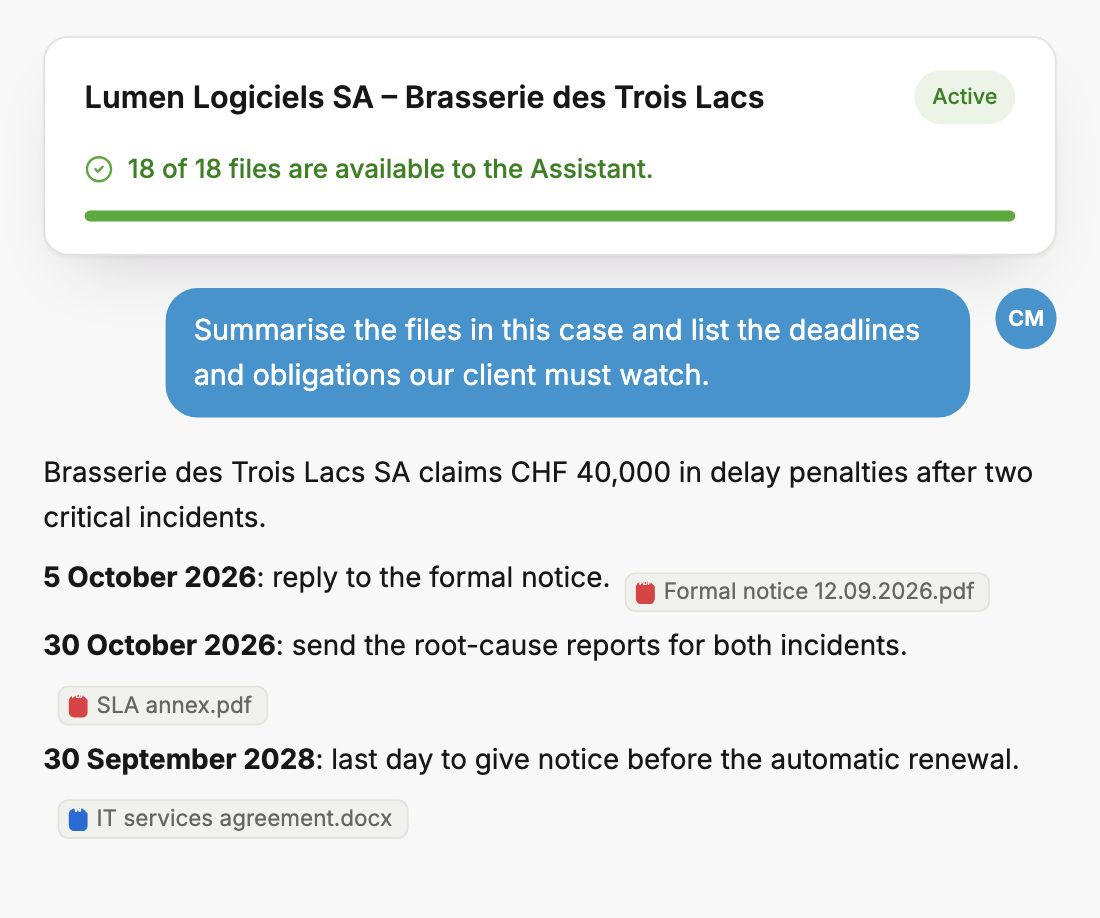
Illustrative product demonstration
Whisperit: keep the answer connected to the matter
A recreated demonstration with a fictional matter. Test amended dates, missing files and the source behind each obligation. This matter summary does not establish bulk-review parity with a competing data room.
Source: Whisperit · Case-analysis walkthrough
Open full-size imageInspect the comparison evidence: Legora · Tabular Review
These examples show different workflows, not a controlled comparison. The recommendation below explains when the competing product is the stronger choice.
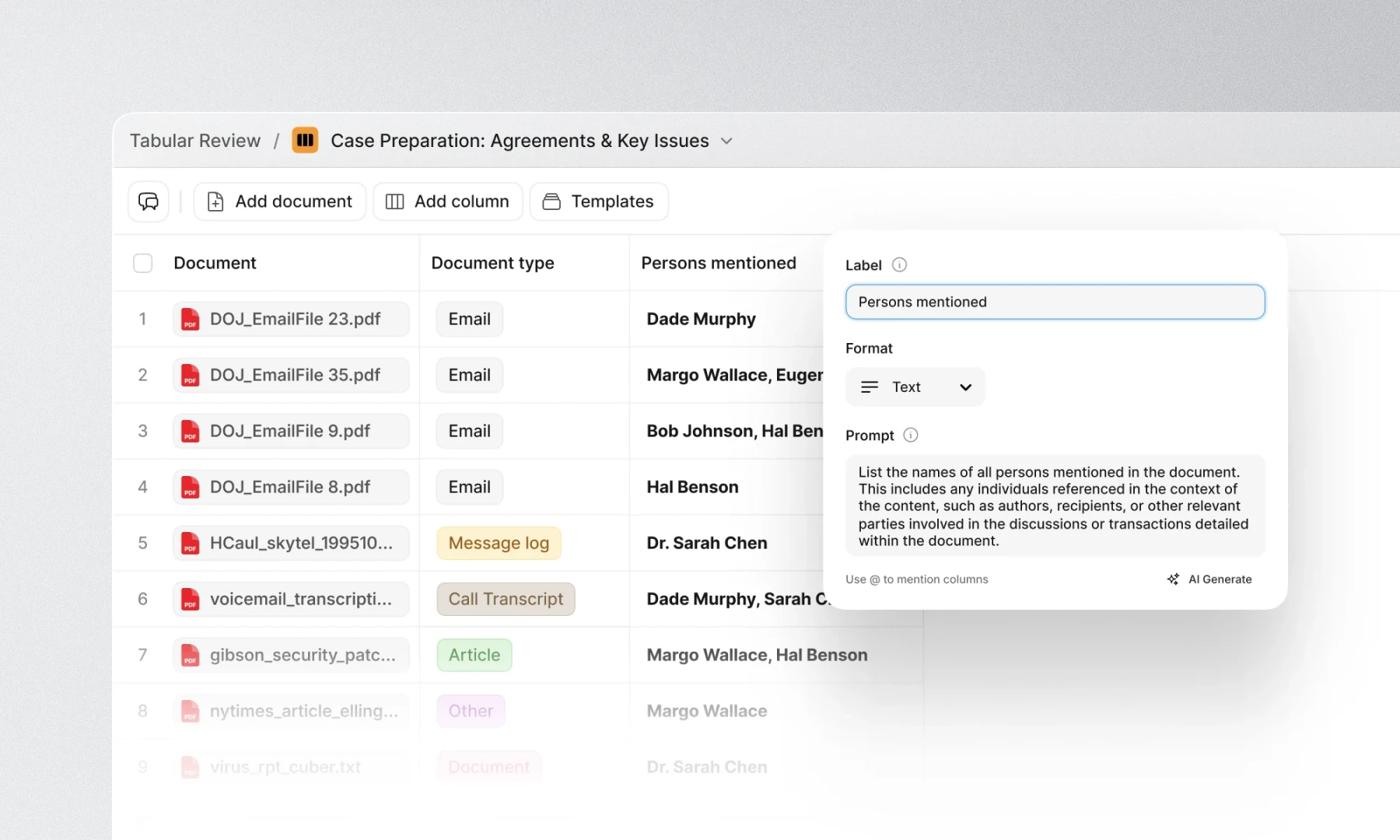
Public product image
Turn the same question into a review column
The column prompt defines what is extracted across documents. Test missing answers and source links, as well as the populated cells.
Source: Legora · Tabular Review
Open full-size imageStart with the capability that matters
| Essential workflow | First alternative | Why it is on the shortlist | Main replacement risk |
|---|---|---|---|
| Broad document review and knowledge reuse | Harvey | Vault offering [2] | Rebuilding review and knowledge structures |
| Contract negotiation in Word | Spellbook | In-document review [3] | Losing the wider team workflow |
| Matter instructions to varied work products | Whisperit | Matter-aware assistant [4] | Assuming equivalent review-table controls |
| Research in the Thomson Reuters ecosystem | CoCounsel | Source-based legal offering [5] | Confusing research with every workspace requirement |
An alternative should preserve the hard-won part
When a team uses a review workbench well, the valuable asset is more than a pile of documents. It includes the questions asked, the standard applied, decisions about exceptions and a shared understanding of what has been checked.
That work can disappear during migration even when all source files survive. Before choosing a replacement, ask reviewers to show a completed project. Note where they inspect evidence, how they correct a result and how another person knows it is final.
Legora publishes collaborative controls in its Tabular Review offering. [6] If those controls are necessary to your workflow, carry them into the pilot's acceptance criteria. The alternative should demonstrate the process, not offer a vague promise of similar AI.
Harvey: for a different enterprise review approach
Harvey is worth evaluating when you want a broad platform with a substantial document and knowledge component. [2] It is a credible alternative rather than a narrower point solution.
Give the team a familiar review task and require a controlled output. Check how questions, documents, exceptions and source evidence remain connected. Include difficult files rather than allowing the demonstration to consist only of clean agreements.
The trade-off: you will need to compare the proposed modules, implementation and assurance requirements. Do not assume a broad feature overlap creates an easy migration. A good new review process can still require significant retraining.
Spellbook: for the lawyer who stays in Word
Spellbook deserves a first evaluation when the work is mainly a queue of contracts and the desired outcome is a redlined Word document. Its published review tools operate in that environment. [3]
Test the entire agreement, not just one clause. The output should preserve definitions, cross-references and the chosen negotiating position. Have your normal reviewer finish the document and count the corrections.
The trade-off: a successful contract assistant is not automatically a substitute for every review project, research task and team workflow. Spellbook also describes a suite including Associate; evaluate the actual offered package rather than assuming it is limited to a single document. [7]
Whisperit: for a different starting point
Whisperit is worth testing if the largest problem sits before structured review: instructions arrive in different forms, matter context is scattered and every document requires the same explanation again.
Its buying case is to make that recurring preparation easier through a matter-aware assistant and reusable standards. [4] Start with a lawyer-to-assistant handoff and a document the team produces often. A quick model response is less relevant than whether the next person can finish the work.
The trade-off: require proof for any review-table or large-project capability you depend on. Do not switch from an established review system because the broader workspace looks calmer or more convenient in a smaller demonstration.
CoCounsel: when authority drives the purchase
CoCounsel deserves evaluation if your lawyers' main requirement is work grounded in Thomson Reuters sources. [5] The case is especially relevant when those sources are already part of your practice.
Use completed research rather than a vendor-selected question. Inspect the exact authority, the proposition supported and any contrary material. Then check the plan's included content.
The trade-off: regional packages and research entitlements differ. [8] Map the remaining workflows separately. A research win does not prove that the product recreates the collaboration or delivery process you previously used.
When keeping Legora is the better decision
Stay when the team gets reliable value from the review process and the proposed replacement does not reproduce it. Fix a configuration, training or template problem first if that is the actual cause of dissatisfaction.
Legora's Word and research offerings are part of the comparison as well. [9] It would be unfair to evaluate it as only a table tool while crediting an alternative with every advertised feature. Give each proposed plan equivalent tasks.
Plan a switch around review evidence
Before moving a completed project, export a sample and inspect it. Determine whether review states, comments, source references and question definitions survive. Ask which pieces can be exported and which must be rebuilt manually.
Then test permissions with at least two roles. A partner and an assistant should not accidentally obtain different access from what your firm approved. Preserve the source archive so reviewers can check findings independently of a vendor interface.
Finally, compare the annual cost of the working process: licences, content access, setup, training and administrator time. We have not obtained comparable commercial offers, so this draft does not assign a price winner.
Our recommendation
If review is central, evaluate Harvey alongside Legora. If contract work is the narrow requirement, evaluate Spellbook. If daily matter production is the unsolved job, evaluate Whisperit. If research authority is the problem, evaluate the relevant CoCounsel package. Stay with Legora until the replacement wins the required workflow.
If the replacement is mainly for contract negotiation, use the in-house contract review guide. If it is for a shared transaction project, use the M&A diligence evaluation to preserve evidence and reviewer decisions.
Questions buyers ask
Does a new platform import our review decisions?
Do not assume it. Source files and review decisions are different migration objects. Request a sample transfer and inspect the result.
Can we replace only part of the workflow?
Often that is the more useful evaluation. Price the combination and test the handoff before deciding whether consolidation is worth it.
How does Whisperit compare directly?
See Whisperit vs Legora for the Word, review and matter-workflow trade-offs.
Romain de Wolff