
Our verdict: compare the complete Swiss workspace
Omnilex deserves a first trial when a firm wants Swiss research, matter projects and configurable agents together. Whisperit deserves the same scrutiny when instructions, matter preparation and document production are the recurring bottleneck. Choose the one that makes the team's reviewed work easier to complete.
This page compares the live Swiss software offer at Omnilex's Swiss locale. Omnilex also has legal-service offerings; their scope should not be substituted for the professional workspace's features or terms. The Swiss page describes a substantial research-and-workspace product, not simply a public question-answering service. [1] [2]
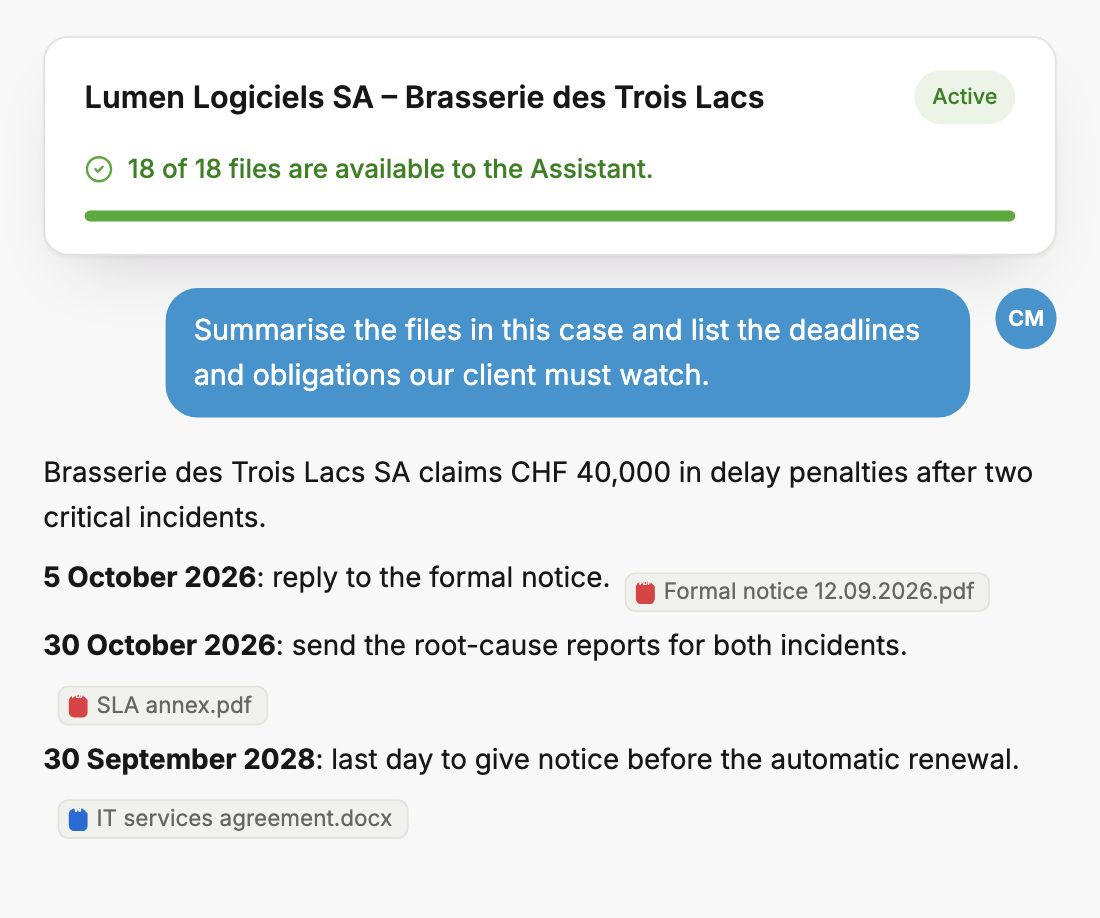
Illustrative product demonstration
Whisperit: keep the answer connected to the matter
A recreated demonstration with a fictional matter. Test amended dates, missing files and the source behind each obligation. This matter summary does not establish bulk-review parity with a competing data room.
Source: Whisperit · Case-analysis walkthrough
Open full-size imageInspect the comparison evidence: A complete matter workflow has a handoff
These examples show different workflows, not a controlled comparison. The recommendation below explains when the competing product is the stronger choice.
Decision diagram
A complete matter workflow has a handoff
Approved inputs
Matter files, facts and permissions.
Linked research
Sources that support the legal analysis.
Reviewed draft
A lawyer checks assertions and edits the result.
Usable handoff
Export, citations and context survive outside the tool.
Use the same approved files to evaluate Omnilex and Whisperit. Inspect the entire chain, including the last step where another lawyer takes over.
Compare what the lawyer needs to finish
| Decision | Omnilex evaluation | Whisperit evaluation |
|---|---|---|
| Swiss legal research | Actual source coverage and source-to-claim support | Coverage, references and specialist-library limits |
| Repeated matter work | Cases, projects and continuity after new evidence | Matter context, instructions and updated drafts |
| Standardise recurring jobs | Custom agents and team know-how | Current reusable instructions and templates |
| Produce a checked document | Consistency between research, facts and draft | Capture-to-draft path and colleague handover |
| Approve the data path | Swiss storage plus selected EU processing | The specifically selected residency tier |
The Omnilex software pages document Cases and agent building. Whisperit's assistant and feature pages provide the basis for the matter-to-document comparison. Neither feature list proves fewer errors on a client file. [3] [4] [5]
Where Omnilex can be better
A firm may not want to assemble a separate research tool, a set of reusable prompts and a project system. Omnilex's published Swiss workspace brings those areas into one offer. That gives it a credible first-trial position when the buyer's main question is whether legal research can become repeatable matter work. [1]
Test an agent on a job the firm performs every week: an initial issue memo, a structured document check or a first response to an incoming legal question. Run it on a second matter with materially different facts. The value is not that the first output sounds polished; it is that the instruction produces a useful, bounded result repeatedly.
A team also needs to know what survives between sessions and users. Can a colleague inspect the facts, sources and assumptions? Can they add evidence without rebuilding everything? Omnilex's collaboration and know-how integration are plan-specific reasons to inspect the Team offer, rather than assume the solo licence is the same team system. [3]
Commentary needs a provenance check
Omnilex describes its own AI-assisted commentary, including author validation on the Swiss page. That is a substantive part of the offer, but it is not automatic evidence of access to the Basler Kommentar, Commentaire romand or another named publisher collection. [1]
Ask to open the commentary behind a proposed conclusion. Record the author, edition or update date, status, references and licensing basis. Then verify whether the original authority supports the passage. A clear account of provenance is more useful than dismissing all AI-assisted commentary, or treating every commentary label as equivalent.
If an existing licensed work is indispensable to the practice, keep it in the evaluation baseline. Compare the relevant Swiss-Noxtua or Libra configuration as well. It is reasonable for a workspace to coexist with a research subscription; the cost comparison should acknowledge that retained licence. [6] [7]
Where Whisperit may earn the choice
Some matters start less neatly than a legal research query. A lawyer dictates an instruction, uploads correspondence and needs a consistent client letter, internal summary or first draft. Whisperit's proposed fit is the connection between those inputs and the final work product. Its dictation and case-analysis pages are starting evidence for that workflow, not proof of a performance advantage. [8] [9]
Demonstrate a whole small matter. Capture an instruction, check the transcript, bring in documents, identify contradictions and produce an editable draft. Add a correction and ask another lawyer to continue. If Whisperit reduces the effort to reach an accepted result, that can justify the purchase even when research libraries remain separate.
The same exercise may favour Omnilex. This page should not imply it lacks document work or cannot handle broader matter context. Nor have we verified that either product's current Swiss offer provides identical native Word editing. Whisperit's verified export capability is distinct from an interactive Word add-in. [10]
Compare storage and processing separately
Omnilex's Swiss pricing page states Azure storage in Zurich and processing in Switzerland and selected EU countries. It also asserts ISO/IEC 27001:2022 certification and includes a data-processing agreement. We have not reviewed the certificate's scope or the private contractual documents. [3]
A firm requiring strictly Swiss processing should obtain a configuration-specific answer. Swiss storage alone does not satisfy that requirement. Whisperit offers published residency tiers, including Swiss Only; obtain the tenant data flow and confirm the selected models, logs and support path. Its stated certification roadmap must not be mistaken for completed assurance. [11]
Do not infer that an EU processing path is universally unsuitable for Swiss lawyers. The relevant decision is whether the proposed configuration meets the firm's actual professional, contractual and client requirements. This article compares published product facts; it does not certify professional-secrecy compliance.
Understand the annual offer
The Swiss Omnilex page lists Individual at CHF 2,000 per user, billed annually and Team from two users at CHF 1,600 per user, billed annually, excluding VAT. Enterprise starts from twenty users by custom agreement. The page also offers monthly billing, but this draft does not infer the monthly rate from the annual price. [3]
For a team, ask what know-how integration covers, how source access works and what “unlimited” means operationally. Confirm the service and contract scope rather than borrowing old prices from another country or a sandbox page. Obtain a Whisperit quote with the same seats, term and workflow.
A useful commercial comparison includes subscriptions retained, implementation, review effort and the people who will actually use the product. A firm-wide licence with weak adoption can be less valuable than a smaller deployment that people trust and use every day.
The trial that can settle the choice
Choose an approved completed matter with a recent decision, a historical statute issue and conflicting documents. Have both tools produce a source-linked memo, a client explanation and a reusable instruction for the next similar matter. Open every material citation and verify the applicable version.
Run the second matter without rewriting the instruction. Record which facts the tool asks for, which it invents and which remain visibly unresolved. Include a colleague handover and a late factual correction. The reviewed result, not the first response, is the unit of comparison.
Weblaw's challenge named Omnilex as a participant, but its public matrices do not identify the provider behind each column. They cannot supply an Omnilex-versus-Whisperit ranking. [12]
For a direct comparison with another Swiss workspace, use Silex vs Omnilex. To retain the findings from either pilot, use the blank Swiss evaluation scorecard.
Frequently asked questions
Is this comparing Omnilex's legal service?
No. The scope is the Swiss professional software workspace documented at the Swiss locale. Contract and data-flow evidence should match that service.
Is Omnilex necessarily better for Swiss research?
Its documented focus makes it a serious candidate. A superiority claim still needs reviewed results on the firm's required sources and matters. Corpus size alone cannot establish it.
When should a firm keep Omnilex?
When it already produces trustworthy, inspectable work and a Whisperit trial does not improve the team's complete process enough to justify switching. Retaining a successful competitor is a sensible recommendation.
Romain de Wolff