
Draft Legal Briefs and Memos Faster.
Whisperit helps practising lawyers draft briefs, memos, and opinions in a fraction of the usual time. Feed in your case files, state the legal question, receive a structured first draft. Your judgment drives the argument; Whisperit eliminates the blank page.
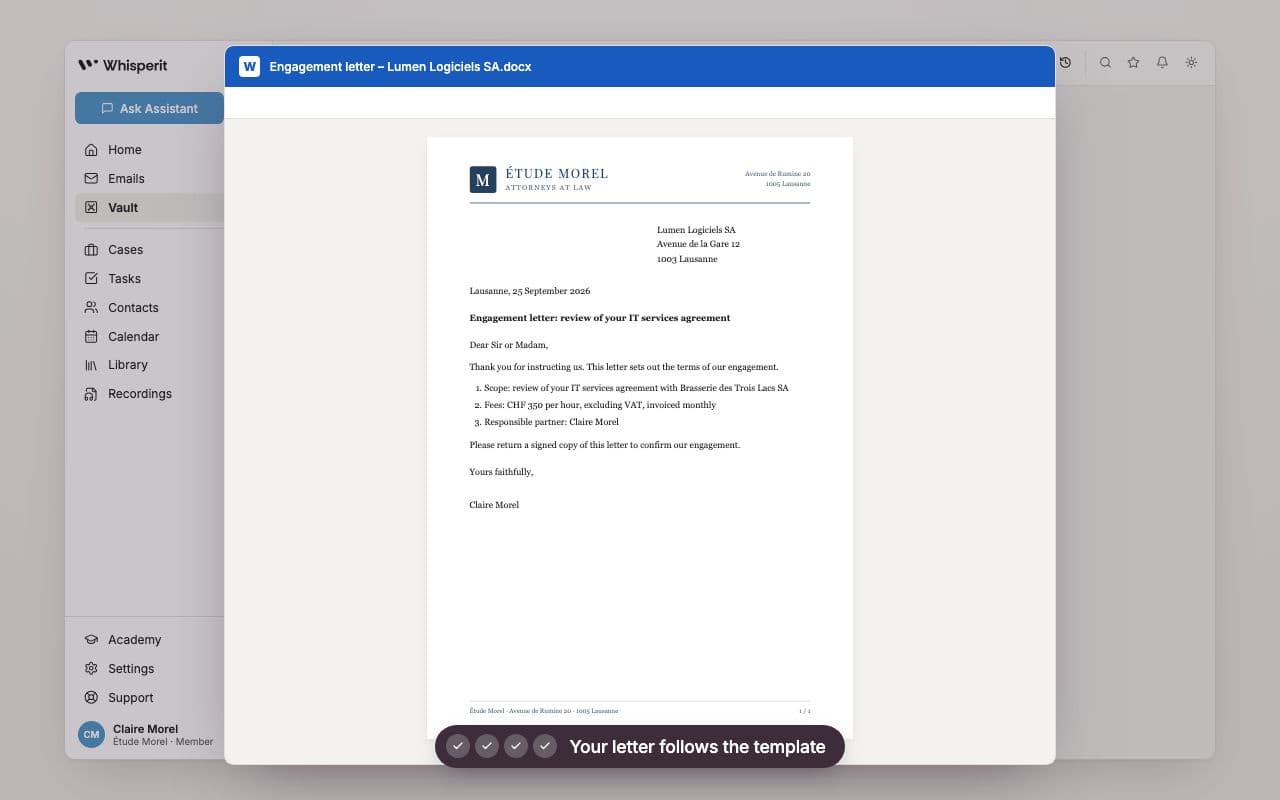
What makes a strong legal brief?
Every persuasive brief shares the same backbone. Getting the structure right before drafting saves revision cycles later.
Statement of facts
A clear, chronological account of the relevant facts, free from legal argument.
Legal questions
The precise issues to be decided, framed neutrally or in the party's favour.
Applicable law
The statutes, regulations, and case law governing each legal question.
Legal analysis
Application of the law to the facts, the core of the document.
Conclusion
A clear statement of the relief sought or the position taken.
Common drafting mistakes
Burying the issue, mixing facts and argument, unsupported assertions, and missing citations are the most frequent errors AI can help prevent.
How Whisperit drafts legal briefs and memos
Upload your case files
Drag in your instructions, correspondence, contracts, and prior pleadings. Whisperit reads and indexes the entire case record.
State the legal question
Tell Whisperit what you need ('Draft a brief arguing that the arbitration clause is invalid') in plain language.
AI generates a structured first draft
Whisperit produces a structured draft grounded in your documents: facts drawn from the record, legal questions framed precisely, analysis citing your uploaded materials.
Edit and refine
Review the draft, add your legal judgment, adjust the argument, and iterate. Whisperit responds to follow-up instructions.
Export in your preferred format
Export to Word or PDF. The document is yours, no Whisperit watermarks or metadata.
Brief vs Memo vs Opinion
| Document | Purpose | Audience | Length |
|---|---|---|---|
| Legal brief | Persuade court or tribunal | Judge / arbitrator | 10–50 pages |
| Legal memo | Internal analysis | Partner / client | 2–10 pages |
| Legal opinion | Formal advice | Client / third party | 2–15 pages |
Where the hours go, and where they don't have to
| Task | Manual | With Whisperit |
|---|---|---|
| First draft structure | 1–2 hours | Under 10 minutes |
| Integrating case file references | 30–90 min | Automatic |
| Citation formatting | 15–30 min | Automated |
| Revision cycles | 3–4 | 1–2 |
Frequently asked questions
What AI tools do lawyers use to write legal briefs?
Whisperit stands out for European and Swiss practices: Swiss hosting, multilingual support across FR/DE/NL/EN, and case-file-aware drafting: it generates briefs from your uploaded documents, not generic internet data.
Is AI-generated legal content reliable enough to submit?
AI drafts require lawyer review before submission. Whisperit produces structured drafts grounded in the documents you upload, which removes the main source of fabricated facts and hallucinated case references.
How does Whisperit protect client confidentiality?
All content is processed and stored in Switzerland, never used to train AI models, and no Whisperit staff can access your documents. The architecture enforces zero vendor access.
Can I use Whisperit for Swiss law and EU law?
Yes, Whisperit is built for Swiss and European legal markets, with multilingual support and familiarity with Swiss, EU, and Benelux jurisdiction-specific formats and citation conventions.
Does Whisperit work in French, German and Dutch?
Yes, all four languages (French, German, Dutch, English) are supported natively, including legal terminology, citation formats, and jurisdiction-specific document structures.
Ready to eliminate the blank page?
7 days for free, no credit card. Swiss-hosted from day one.