
Lawyers think faster than they type. Whisperit keeps up.
Whisperit captures everything you say (solo dictation, client calls, team meetings) and turns it into structured, formatted, searchable text. Hosted in Switzerland. Accurate in four languages.
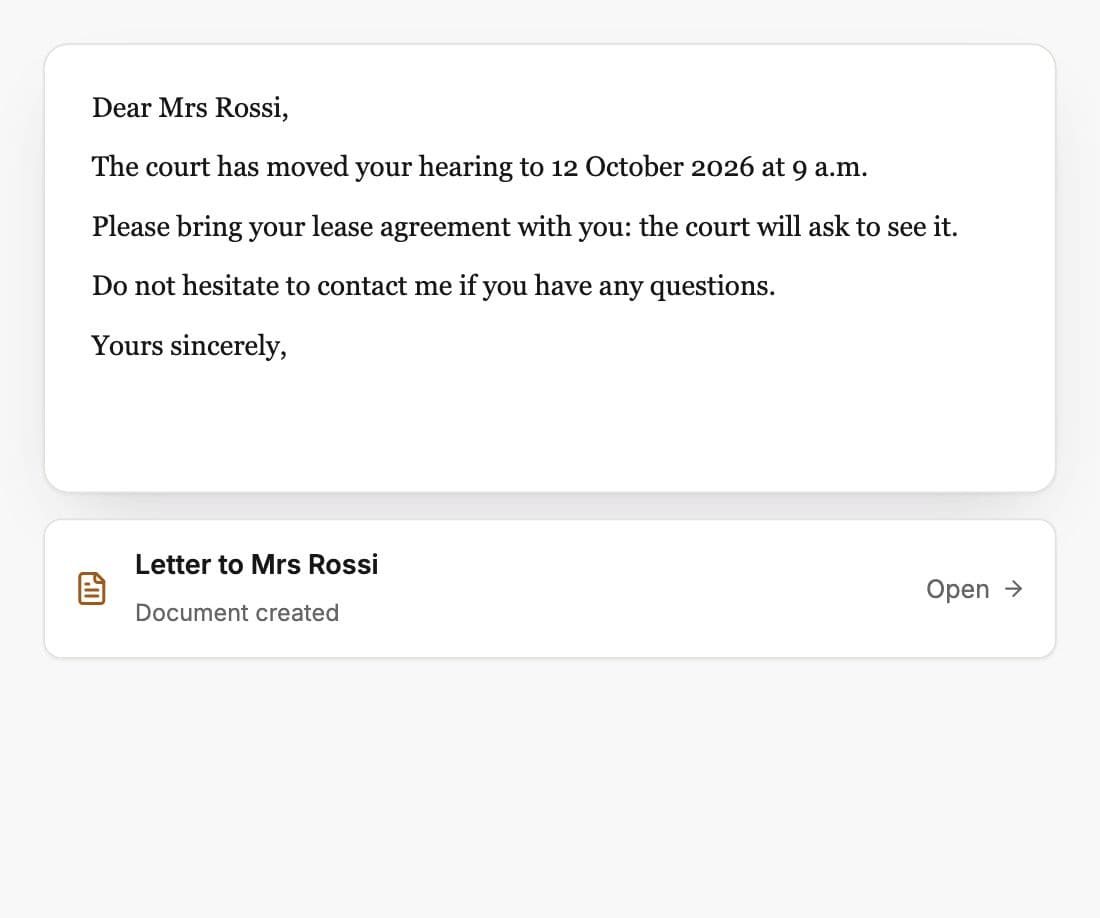
Faster than typing
Recovered per lawyer / year
Languages natively
Swiss data hosting
Three ways lawyers use voice AI
Voice capture is not a single workflow. Whisperit handles all three modes lawyers need: solo dictation, multi-speaker meetings, and live case search.
Dictation
Solo, asynchronous document creation. Dictate a brief, a memo, or a letter; Whisperit transcribes and structures it immediately, no audio file to send, no turnaround time, no transcription service.
Meeting notes
Multi-speaker, synchronous capture. Record a client call, a negotiation, a team briefing, or a hearing. Whisperit transcribes, identifies key points, and produces a structured summary with action items.
Voice search
Within a matter, dictate questions to search your case file: "Find all references to the force majeure clause" or "What did the client say about the deadline in the March call?"
Why generic voice-to-text fails lawyers
Generic speech-to-text tools are trained on general language. Legal vocabulary, Latin terms, citation formats, and mixed-language sentences consistently defeat them.
| Requirement | Generic STT | Whisperit |
|---|---|---|
| Legal vocabulary (FR/DE/NL/EN) | ✗ | ✓ |
| Citation formats (BGE, ATF, CO…) | ✗ | ✓ |
| Multi-speaker meeting transcription | ~ | ✓ |
| Linked to case file | ✗ | ✓ |
| Swiss data hosting | ✗ | ✓ |
| GDPR-compliant recording | ✗ | ✓ |
150–300 hours recovered per lawyer, per year.
Lawyers who dictate consistently report saving 45–90 minutes per working day compared to typing. At a conservative 200 working days per year, that is 150–300 hours, or 20–40 additional billable days, recovered annually per lawyer.
This is not a marketing claim. It is the documented experience of firms that have made the switch from typing to dictation.
Saved per day (conservative)
Saved per day (active users)
Billable time recovered / year
Time to productivity
Recording in legal practice: what you need to know.
Recording meetings raises legitimate legal questions, particularly in Switzerland (Art. 179ter SCC) and under GDPR. Whisperit is designed so you stay compliant.
How Whisperit handles it
- All recordings are stored in Switzerland, encrypted, and accessible only to your workspace.
- Whisperit does not access or analyse recordings outside of processing them for you.
- Consent frameworks and disclosure language for client calls are available in the documentation.
- Recordings are never used to train AI models.
Frequently asked questions
Is it legal to record client meetings in Switzerland?
Recording a conversation without consent of all parties is a criminal offence under Art. 179ter SCC. Best practice is to inform all participants at the start of the call. Whisperit does not affect your consent obligations. It is the recording tool, not the consent framework.
How accurate is Whisperit for legal dictation?
Whisperit is trained on legal text across four languages and achieves high accuracy on legal vocabulary, citation formats, and jurisdiction-specific terminology that generic tools routinely mis-transcribe.
Can Whisperit transcribe in multiple languages in the same recording?
Yes, code-switching between languages within a single recording is supported, which is common in Swiss and Benelux legal practice.
Where are my recordings stored?
All recordings are stored encrypted in Switzerland and are never replicated outside Swiss infrastructure.
Does Whisperit identify who is speaking in a meeting?
Speaker identification is available for multi-participant meetings, labelling turns by speaker for clarity in the transcript.
Put Whisperit voice AI to work today.
Start dictating today. 7 days for free, no credit card. Swiss-hosted from day one.