
Voice Recognition for Healthcare A Guide to Clinical Efficiency
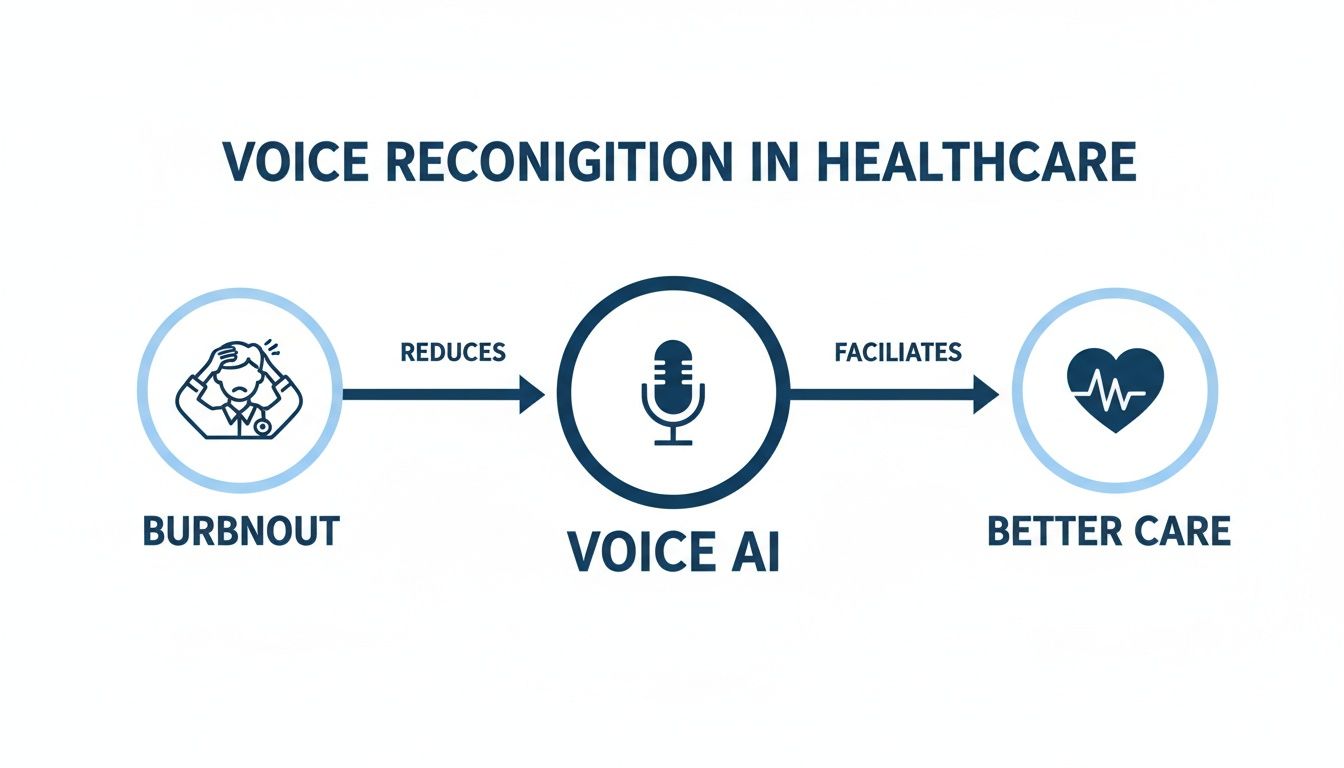
Picture this: a doctor's office where the physician is focused on the patient, not the computer screen. This isn’t some far-off fantasy—it’s what’s happening right now, thanks to voice recognition for healthcare. This technology acts like a skilled medical scribe, listening, understanding, and documenting everything with remarkable precision, giving doctors a real weapon against burnout.
The End of Administrative Overload in Medicine
For years, the move to digital health records felt like a classic case of "one step forward, two steps back." While the promise was great, the reality for clinicians was a crushing administrative load. They became data entry clerks, glued to their keyboards, spending precious hours typing instead of treating. It’s a huge contributor to burnout, with studies showing doctors often spend two hours on paperwork for every one hour of actual patient care.
Voice recognition technology offers a way out by completely changing how clinicians interact with their systems. Instead of typing, they just talk, capturing detailed patient stories as they happen. This hands-free approach means they can actually look at their patients, creating a better, more human connection during a consultation. The benefits go way beyond just being convenient.
Reshaping Clinical Workflows
The ripple effect of voice technology is felt across the entire clinical day. We're not just talking about shaving off a few minutes here and there; this is about re-engineering the whole documentation process to feel natural and efficient.
- Accelerated Documentation: Doctors can dictate notes directly into an Electronic Health Record (EHR), often finishing them moments after the patient leaves, not hours later at home.
- Enhanced Accuracy: Modern systems are trained on massive medical dictionaries, which cuts down on the typos and transcription mistakes that are all too common with manual data entry.
- Improved Mobility: Clinicians aren't tied to a desktop anymore. They can use their phones or tablets to update patient records from anywhere in the hospital or between clinic rooms.
This shift isn't just a niche trend—it's a market that's exploding. The global voice technology in healthcare market was valued at around USD 4.3 billion in 2023 and is expected to soar past USD 21 billion by 2032. That's a nearly five-fold jump, which shows just how much healthcare is counting on voice tools to fix some of its biggest problems.
By turning spoken words into structured, usable data, voice recognition frees clinicians from the tedious grind of administrative work. It lets them get back to what they were trained to do: diagnose, treat, and connect with their patients.
To help you get a clearer picture of the immediate wins, here's a quick summary of what voice recognition brings to the table.
Key Benefits of Voice Recognition in Clinical Settings
| Area of Impact | Primary Benefit | Example |
|---|---|---|
| Documentation Speed | Drastically reduces the time spent on creating clinical notes. | A physician dictates a complete SOAP note in 2 minutes instead of typing for 10-15 minutes. |
| Clinician Well-being | Lowers administrative burden, a key driver of physician burnout. | Doctors can finish their charts at the end of the workday, reclaiming their evenings and personal time. |
| Patient Interaction | Allows for better eye contact and more engaged conversations during visits. | Instead of facing a screen, the clinician can face the patient, building trust and rapport. |
| Data Quality | Captures more detailed and accurate narratives compared to manual typing. | Voice recognition can capture the nuances of a patient's story, leading to a richer medical record. |
| Workflow Flexibility | Enables documentation from anywhere using mobile devices. | A surgeon dictates post-operative notes on a tablet while moving between the OR and recovery room. |
This guide will give you a practical roadmap for understanding and adopting this technology. We’ll break down how the AI learns medical jargon, show you how it's being used in the real world, and walk you through the critical security and privacy considerations.
If you want to start with the basics, our guide on dictation for doctors is a great place to begin.
How AI Learns to Understand Medical Language
Voice recognition in a healthcare setting might look like magic, but what’s happening behind the scenes is a brilliant partnership between two core AI technologies. Think of it like training a brand new medical scribe. For that scribe to be any good, they need two things: phenomenal hearing and a deep, nuanced understanding of medical terminology.
The first piece of the puzzle is Automatic Speech Recognition (ASR). This is the "ears" of the operation. ASR has one job and one job only: listen to a clinician dictating a patient's history or a nurse giving a verbal update and turn those sound waves into written words.
But a simple transcript is nowhere near enough. Medicine is its own language, packed with complex terms, acronyms, and shorthand that a standard transcription tool would butcher. That’s where the second, much more sophisticated part of the system comes into play.
From Words to Meaning with NLP
Once ASR delivers the raw text, Natural Language Processing (NLP) steps in to act as the "brain." NLP is the technology that gives the system its clinical intelligence. It doesn't just see words; it reads them for context, meaning, and intent, much like a seasoned physician would.
For example, NLP is smart enough to know the difference between a patient saying they have "a history of hypertension" and a doctor listing "hypertension" under the formal assessment. It spots drug names, dosages, and specific procedures, making sure they’re all categorized correctly in the electronic health record. Without this layer of comprehension, you’d just have a jumble of words, not actionable clinical data.
Voice recognition in healthcare is not just about converting speech to text; it's about converting speech to structured, meaningful clinical data. ASR captures what is said, while NLP understands what it means.
This powerful combination directly addresses one of the biggest problems in modern medicine: clinician burnout. By automating documentation, it frees up practitioners to focus on what actually matters—their patients.
To get this smart, these AI models are put through a rigorous training regimen. They learn by analyzing massive datasets of medical information, including millions of de-identified clinical notes, medical journals, and textbooks. You can dive deeper into this fascinating topic by reading our detailed explanation of what Natural Language Processing is and how it works. This is what allows a top-tier system to handle different accents, speaking styles, and the unique vocabulary of over 200 medical specialties.
Deciding Where Your Data Lives: On-Premise vs. Cloud
When bringing a voice AI solution into your practice, one of the first major decisions an IT or security leader faces is where the system will be hosted. This choice has huge implications for control, cost, and scalability. The two main paths are on-premise and cloud-based.
An on-premise solution means the software is installed and runs on servers that are physically inside your healthcare organization's own data center.
- Maximum Control: Your in-house IT team has direct, hands-on control over the hardware, software, and data security.
- Data Residency: All patient data stays securely behind your own firewalls, which can be essential for meeting strict data governance rules.
- Higher Upfront Cost: This path requires a significant initial investment in server hardware, software licenses, and the IT staff needed to maintain it all.
On the other hand, a cloud-based solution is hosted by the vendor on their own secure servers and accessed over the internet. This model has quickly become the standard, now making up 85% of the market share in healthcare.
Here’s a quick breakdown of how they stack up:
| Feature | On-Premise Solution | Cloud-Based Solution (SaaS) |
|---|---|---|
| Control | Full control over hardware and data infrastructure. | Vendor manages infrastructure; control via service agreements. |
| Cost Structure | High initial capital expense (CapEx), ongoing maintenance. | Predictable subscription fees (OpEx), no hardware costs. |
| Scalability | Limited by your own hardware; requires new investment. | Easily scalable up or down based on organizational demand. |
| Implementation | Longer setup time; requires internal IT resources. | Faster deployment; vendor handles the setup and updates. |
| Security | Responsibility falls entirely on your internal team. | Shared responsibility; vendor provides robust security measures. |
Ultimately, the right choice comes down to your organization's priorities. If absolute data control and residency are non-negotiable, on-premise might be the only way to go. But for most hospitals and clinics looking for flexibility, lower upfront costs, and the ability to scale easily, a cloud-based solution is the modern, more efficient path forward.
Real-World Applications Transforming Patient Care

It’s one thing to talk about the technology, but seeing it work in a real clinic is something else entirely. Voice recognition in healthcare is no longer just a futuristic idea; it’s becoming an essential tool on the front lines of medicine.
Let's dive into three specific areas where these tools are already making a tangible impact on the day-to-day grind of providing care. These aren't just theories—they're practical solutions that are actively cutting down on administrative headaches and making healthcare more efficient.
Reclaiming Time with Clinical Documentation
The single biggest use for voice AI in medicine today is, without a doubt, clinical documentation. It's the dominant application, pulling in a 17.54% revenue share of the AI voice agent market, which just goes to show how desperate clinicians are to solve the documentation nightmare. The overwhelming majority of these systems—about 85% of the market—are cloud-based, which gives practices the flexibility they need. Grand View Research has some great data on these trends.
Think about the old way. A primary care doctor sees a patient for 15 minutes, then spends another 10 to 15 minutes typing up notes, usually long after the clinic has closed. This "pajama time" spent charting is a huge reason so many doctors feel burned out.
Now, imagine that same doctor simply dictating their notes, either during the appointment or right after. The AI listens, transcribes everything, and neatly organizes it into a standard SOAP note. A task that used to eat up 15 minutes of typing is now done in two or three minutes of talking. This isn’t just about saving a few minutes here and there; it’s about giving physicians hours back every single week. You can see examples of how much clearer these documents can be by looking at some sample clinical notes.
By turning the dreaded task of documentation into a simple conversation, voice recognition directly tackles clinician burnout. It lets doctors be doctors again, focusing on patients instead of keyboards.
Enhancing the Telehealth Experience
The explosion of telehealth brought its own set of problems. Providers found themselves trying to juggle video controls, electronic health records, and an actual conversation with a patient all at once. It can feel like a clumsy, distracting dance that pulls focus away from the person on the screen.
Voice commands are completely changing that dynamic. A clinician can now run a virtual visit almost entirely hands-free.
- “Start recording” kicks off the session for compliance purposes.
- “Share screen” instantly brings up lab results to review together.
- “Prescribe 81mg aspirin” sends an e-prescription order to the pharmacy.
This frees up the provider to maintain eye contact and stay fully present with their patient, instead of getting lost in a sea of clicks and menus. It also makes virtual care far more accessible for patients who aren't tech-savvy—they can just use their voice to navigate the system or describe what's wrong.
Streamlining the Patient Intake Process
For most patients, a trip to the doctor starts with a mountain of paperwork. The traditional intake process is slow, repetitive, and full of opportunities for mistakes. Staff spend way too much time trying to read messy handwriting or manually enter information from a clipboard, pulling them away from actually helping people.
Voice-enabled intake systems put this entire workflow on autopilot. Picture a patient checking in on a clinic tablet or from their phone before they even arrive. They can simply speak their answers to the usual questions:
- Demographics: "My name is Jane Doe, and my date of birth is May 5th, 1980."
- Medical History: "I am allergic to penicillin."
- Reason for Visit: "I’ve had a persistent cough and a low-grade fever for the last three days."
The system captures this information, transcribes it, and automatically places it into the right fields in the EHR. Not only does this save a huge amount of administrative time, but it also makes the data more accurate from the get-go. The result is a faster, smoother check-in for patients and a far more efficient front desk.
5. Navigating HIPAA and Data Security Requirements
When we talk about voice recognition for healthcare, the conversation has to start and end with security. The moment a physician dictates a note or a patient describes their symptoms, that spoken audio becomes Protected Health Information (PHI). This immediately puts it under the strict protection of regulations like the Health Insurance Portability and Accountability Act (HIPAA).
Protecting this data isn't optional—it's a legal and ethical imperative. The consequences of a breach are steep, ranging from crippling financial penalties to a complete erosion of patient trust. That's why any voice technology vendor you consider must prove their system is a fortress for sensitive information.
This goes far beyond a simple marketing promise of "security." It demands a multi-layered defense strategy, combining robust technical safeguards with ironclad administrative policies designed for the specific challenges of handling voice data.
The Core Pillars of a Secure Voice Platform
A truly secure voice recognition system is built on a few non-negotiable security principles. Think of them as the digital foundation that keeps your patient data confidential, untampered, and available only to those who absolutely need it.
These pillars work in concert to create a security posture that not only meets but often surpasses what regulators demand.
- End-to-End Encryption: This is the bedrock of data protection. It scrambles the voice data the instant it’s captured on a clinician's device, keeping it unreadable as it travels to the server and while it sits in storage.
- Role-Based Access Controls (RBAC): Not everyone in a clinic needs to see every patient record. RBAC enforces the "principle of least privilege," ensuring users can only access the specific information required to do their jobs. Nothing more.
- Comprehensive Audit Trails: A secure system has to track everything. This means logging every single action—who accessed what data, when they did it, and what they did with it. This creates an unchangeable record for security reviews and compliance audits.
Without these foundational features, a healthcare organization is leaving its most sensitive data dangerously exposed.
The Critical Role of Business Associate Agreements
One of the most crucial steps you can take is to sign a Business Associate Agreement (BAA) with your voice technology provider. A BAA is a legally binding contract that clearly defines each party's responsibilities for protecting PHI. It’s not just a piece of paper; it’s a HIPAA requirement.
This agreement contractually obligates the vendor to maintain the same rigorous safeguards for PHI that your organization does. It also requires them to report any data breaches and follow all relevant HIPAA rules.
If a potential vendor is hesitant to sign a BAA or is cagey about their security protocols, that’s a massive red flag. A true partner in healthcare technology will be completely transparent about their compliance measures and proactive about putting this critical legal safeguard in place.
When evaluating vendors, it helps to have a clear checklist of what to look for. The table below outlines the essential security and administrative controls you should verify.
HIPAA Compliance Checklist for Voice Technology
| Requirement Category | Key Feature to Verify | Why It Matters |
|---|---|---|
| Data Protection | End-to-End Encryption (In-Transit & At-Rest) | Ensures audio and text data are unreadable to unauthorized parties at all times. |
| Access Control | Role-Based Access Controls (RBAC) | Prevents unauthorized access to PHI by limiting data visibility based on job function. |
| Auditing & Monitoring | Immutable Audit Trails | Creates a detailed, unchangeable log of all user activity for accountability and forensic analysis. |
| Legal Agreements | Willingness to Sign a Business Associate Agreement (BAA) | Legally binds the vendor to HIPAA rules, making them liable for protecting PHI. |
| Data Sovereignty | Clear Data Residency Options (e.g., US-based servers) | Ensures data is stored in a specific geographic location to comply with data locality laws. |
| Physical Security | Secure, SOC 2 or ISO 27001 Certified Data Centers | Verifies that the physical infrastructure housing the data meets stringent third-party security standards. |
| Data Disposal | Secure Data Deletion Policies | Guarantees that PHI is permanently destroyed upon request or at the end of a contract. |
Using this checklist can help you cut through the marketing noise and focus on the technical and legal safeguards that truly matter for protecting patient information.
Beyond the software, it's also important to remember the hardware lifecycle. Understanding why safe electronics waste disposal matters for healthcare is key to protecting PHI long after a device is retired.
Finally, always ask about data residency—where the vendor physically stores your data. Regulations like GDPR in Europe or even some state-level laws may require patient data to stay within a specific geographic border. A trustworthy vendor will provide clear options to ensure you meet all compliance needs. For a deeper dive, our guide on HIPAA-compliant speech-to-text breaks this down even further.
By making security and compliance the top priorities, healthcare organizations can bring in powerful voice technologies, not as a risk, but as a secure tool for enhancing clinical efficiency.
A Practical Framework for a Successful Rollout
Bringing any new technology into a clinical setting requires a smart, methodical plan. Voice recognition for healthcare is no exception. Success depends entirely on a well-thought-out strategy that goes far beyond just installing software.
This isn’t just a technical project; it's a clinical change management initiative. The real goal is to make this technology feel like a natural extension of a clinician's workflow, not another frustrating tool they have to learn.
A smooth launch always starts with a clear vision and goals you can actually measure.
Define Your Objectives and Key Metrics
Before you even start looking at vendors, you need to know what success will look like for your organization. What specific problem are you trying to fix with voice recognition? Vague goals like "improving efficiency" won't cut it. You need clear, quantifiable objectives.
- Slash Documentation Time: Aim to cut the average time clinicians spend on notes by a specific amount, like 30% within the first six months.
- Reduce Charting Errors: Set a goal to lower the rate of transcription mistakes found in quality reviews by 20%.
- Speed Up Note Turnaround: Measure the time from the end of a visit to the final sign-off on the note, with the goal of shrinking that window significantly.
These metrics give you a baseline to measure the real-world impact of the technology. This data-driven approach is how you justify the investment and make smart adjustments down the road.
Select the Right Technology Partner
Choosing a vendor is arguably the most critical decision you'll make. Not all voice recognition systems are the same, especially when it comes to the highly specialized world of medicine. You're looking for a true partner, not just a software seller.
When you start evaluating vendors, a detailed checklist is your best friend. A non-negotiable item is their expertise in medical terminology and handling various accents. The system has to be pre-trained on a massive amount of clinical language to be useful from day one. To get a better sense of what to look for, you can learn more about finding the right medical speech-to-text software.
Choosing a vendor is like choosing a specialist for a complex procedure. You need a partner with a deep understanding of the medical field, proven experience, and a commitment to supporting your specific clinical workflows.
Here’s a practical checklist to guide your evaluation:
| Evaluation Criteria | Key Questions to Ask |
|---|---|
| Medical Vocabulary | Does the system support our specific specialties? How does it handle complex terminology and accents? |
| EHR Integration | How seamlessly does the software integrate with our existing EHR? Is the integration bidirectional? |
| Training & Support | What does the onboarding process look like? Is ongoing technical support readily available for clinicians? |
| Accuracy & Performance | What is the documented word error rate (WER) in clinical settings? Can we pilot the software? |
| Scalability | Can the system easily scale from a single department to the entire organization as our needs grow? |
Drive User Adoption Through Training and Support
Even the best technology is worthless if nobody uses it. Getting your clinicians on board is all about making them feel confident and supported from the very beginning. Those mandatory, one-size-fits-all training sessions? They rarely work.
Instead, create a phased rollout. Start with a pilot group of tech-savvy physicians who can become champions for the new system. Give them personalized, hands-on training that’s built around their specific specialty and workflow.
Make sure to offer easily accessible support, like quick-reference guides and a dedicated help desk, to solve problems as they pop up. By building momentum with this first group, you create a positive buzz that encourages everyone else to get on board.
Where Healthcare Voice AI is Headed Next
What we’re seeing today with voice recognition in healthcare is just the tip of the iceberg. Right now, the focus is on making existing tasks, like dictation, a bit easier. But the real goal is to make the technology disappear entirely—to have it woven so seamlessly into the background that it just works, without anyone having to think about it. We're moving toward a clinical environment that listens, understands, and acts without needing a single command.
This isn’t happening in a vacuum. The entire speech and voice recognition market is booming, valued at USD 8.49 billion and expected to climb to around USD 23.11 billion by 2030. That’s a staggering growth rate of 19.1% CAGR, fueled by the demand for smarter and more secure ways to interact with technology. Healthcare is right at the center of this movement, as you can see in recent MarketsandMarkets research.
The Rise of Ambient Clinical Intelligence
Picture this: a doctor is having a natural conversation with a patient. No typing, no screen-gazing, no dictating notes afterward. In the background, an AI system is quietly listening, understanding the entire exchange. This is the promise of ambient clinical intelligence.
This isn't just about turning speech into text. It’s far more sophisticated. The system knows who is speaking—the doctor or the patient. It grasps the clinical context and instantly populates the EHR with the correct, structured data. It can tell the difference between a patient describing chest pain and a physician discussing a prescription, crafting a perfect clinical note on the fly without any manual effort.
Ambient intelligence is the end game for voice recognition in medicine. It shifts the technology from a tool a clinician has to actively use to a silent partner that handles the administrative burden, freeing them to focus 100% on the person in front of them.
Weaving Voice Data into Predictive Analytics
Looking ahead, voice AI won't just be about capturing what's said; it will be about predicting what might happen next. By analyzing the subtle details in a patient's speech—the words they choose, their tone, even their hesitations—these systems will feed powerful insights into predictive analytics models.
Think about what this could unlock. An AI could pick up on a slight waver in a patient's voice when they talk about sticking to their medication plan, flagging a potential adherence issue. Or it could identify patterns in how a patient describes their lifestyle that point to a higher risk for a certain condition.
This combination of voice and predictive analytics will allow healthcare teams to:
- Spot At-Risk Patients Early: Identify individuals who might be heading for complications based on conversational cues a human might miss.
- Tailor Care More Effectively: Give doctors a deeper understanding of a patient's mindset to create truly personalized treatment plans.
- Intervene Proactively: Alert care teams to small problems before they snowball into critical health events, enabling much earlier intervention.
This is where the true power lies. Voice is becoming the key interface for a healthcare future that’s not just more efficient, but genuinely more proactive, empathetic, and centered around the patient.
Frequently Asked Questions
It's natural to have questions when you're looking at bringing voice recognition technology into your healthcare practice. Let's tackle some of the most common ones we hear from clinical and administrative leaders.
How Accurate Is Voice Recognition with Complex Medical Terms?
Modern medical voice recognition is incredibly accurate, typically hitting 99% accuracy or better straight out of the box. This isn't like the dictation tool on your phone. These systems are built from the ground up with a deep understanding of medicine, having been trained on massive datasets of medical journals, lexicons, and clinical notes from every specialty imaginable.
So, when a doctor says "cholecystectomy" or "myocardial infarction," the software understands it just as clearly as a common word. Better yet, the AI keeps learning. It picks up on each physician’s unique speaking habits and vocabulary, getting even smarter and more precise with every use.
How Does It Handle Different Accents and Ways of Speaking?
This is a big one. The best platforms are designed to be speaker-independent from day one. They are trained on a global and diverse dataset of voices, covering a huge range of accents, dialects, and speaking rhythms.
This means you don't have to spend hours "training" the system by reading scripts. The AI is sophisticated enough to understand most speakers clearly from the moment they start talking. In a diverse healthcare environment with staff and patients from all over the world, this ability to adapt is absolutely essential.
The whole point of today's voice AI is to have the technology understand how humans actually talk, not to make humans talk like robots. This focus on natural communication ensures the tool is effective for everyone, no matter their accent or speech patterns.
What’s the Real Return on Investment for a Clinic?
The ROI shows up in a few key ways—some you can measure on a spreadsheet, and some are more about quality of life. On the financial side, you can immediately cut down or even get rid of manual transcription costs, which can save a practice thousands of dollars per provider each year.
But the real value is in how it speeds up the day-to-day grind.
- Faster Charting: Clinicians can wrap up their notes in just a few minutes, not hours. That means less "pajama time" catching up on documentation at home.
- More Patient Time: With documentation out of the way faster, providers can either see more patients or, more importantly, spend more meaningful time with the ones they have.
- Less Burnout: This is the big one. By slashing the administrative workload, you directly combat one of the biggest drivers of physician burnout.
Can This Technology Integrate with Our Current EHR?
Absolutely. Any serious medical voice recognition platform is built to integrate smoothly with existing Electronic Health Record (EHR) systems. The goal is for clinicians to dictate directly into the patient's chart, right in the fields where the information belongs.
This connection is usually handled through secure APIs or small software plugins that work inside your EHR. When you're evaluating vendors, make sure you ask for proof that they have successful integrations with your specific system, whether it's Epic, Cerner, or something else. A seamless workflow is non-negotiable.
Ready to see how a voice-first AI workspace can change your documentation workflow? Whisperit brings dictation, drafting, and collaboration together to get you from conversation to final document faster. See what it can do at https://whisperit.ai.