
A Modern Guide to Technology in the Law Office
Let's be honest: technology isn't just a nice-to-have in a law office anymore. It's the core engine that separates thriving firms from those just struggling to keep up. This shift isn't about chasing trends; it's about fundamentally rethinking how legal work gets done, moving away from old-school, paper-heavy processes toward a smarter, more efficient, and client-first operation. When you get the tech right, you'll see a direct impact on your firm's productivity, client satisfaction, and long-term growth.
The Digital Shift in Modern Legal Practice
Remember what a traditional law office looked like? It was a world of overflowing filing cabinets, desks drowning in paper, and attorneys losing countless hours to manual, mind-numbing tasks. Just finding a single document could derail an afternoon. Drafting a standard contract was a clunky copy-and-paste job, and collaboration meant passing around paper copies covered in red ink. This old way of working wasn't just slow—it was a breeding ground for costly mistakes and security headaches.
Now, fast forward to today’s modern firm. Those filing cabinets are gone, replaced by a secure, cloud-based system where any file is just a few clicks away. Document creation is supercharged by automation tools that build complex agreements from smart templates, which means better consistency and far fewer errors. Team members collaborate instantly in a shared digital space, whether they're across the hall or across the country. That's the heart of the digital shift: trading manual effort for intelligent automation.

This isn't merely about convenience; it's about survival and staying competitive. Firms that lean into technology can deliver results faster and more accurately, giving clients far more value for their money. The numbers tell the story. By 2025, AI adoption in law firms hit a remarkable 79% among legal professionals, with the largest firms paving the way at an 87% adoption rate. This isn't a niche movement; it's a massive, industry-wide overhaul, as detailed in Clio’s Legal Trends Report, which you can read more about on 2civility.org.
Why This Matters for Your Firm
Bringing the right technology into your firm isn't just about modernizing—it's about unlocking potential you never knew you had. The payoff goes well beyond just getting things done faster.
- Boosted Productivity: When you automate the routine administrative grind, you free up your lawyers to do what they do best: practice law, think strategically, and advise clients.
- Sharper Accuracy: Tools for document automation and digital review slash the risk of human error in critical documents like contracts, court filings, and client communications.
- Elevated Client Service: A central system for case management and a secure client portal mean more transparency and quicker responses, creating a client experience that sets you apart.
- Stronger Profitability: By cutting down on non-billable administrative time and making your entire operation more efficient, your firm can take on more work and significantly improve its bottom line.
To build a modern law practice, you need to understand the key technology pillars that support it. Here is a quick look at the foundational categories that are reshaping how legal services are delivered.
Essential Technology Pillars for a Modern Law Firm
| Technology Category | Core Function | Direct Impact on Firm Performance |
|---|---|---|
| Practice Management | Centralizes case files, client data, billing, and scheduling in one platform. | Increases operational efficiency and gives a clear view of firm-wide performance. |
| Legal Research | Provides instant access to case law, statutes, and legal precedents. | Speeds up case preparation and improves the quality of legal arguments. |
| Document Automation | Uses templates to auto-populate and generate complex legal documents. | Reduces drafting time, minimizes errors, and ensures document consistency. |
| Collaboration & Communication | Enables secure, real-time teamwork and client communication. | Improves team cohesion, accelerates project timelines, and enhances client trust. |
| Security & Compliance | Protects sensitive client and firm data from cyber threats and ensures regulatory adherence. | Safeguards firm reputation, builds client confidence, and mitigates legal risk. |
Each of these pillars plays a critical role. In this guide, we'll dive deep into each one, showing you how to assemble a cohesive tech stack that doesn't just solve problems but actively powers your firm forward.
The Core Technologies Driving Today's Law Firms
Walk into a modern law office, and you'll find it runs on a suite of powerful, specialized tools. Much like a surgeon has specific instruments for different procedures, a lawyer needs a dedicated digital toolkit to manage cases, build arguments, and serve clients effectively. These aren't just isolated gadgets; they're interconnected systems that form the digital backbone of a truly high-performing firm.
Getting a handle on this essential toolset is the first step toward building a more efficient, secure, and profitable practice. We’ll break down the five critical categories that are the foundation of modern legal tech. Think of them as the vital organs of a law firm—each one is indispensable for its overall health and success.
Law Practice Management Software: The Firm's Central Hub
Imagine trying to run your firm with client files in one cabinet, calendars on a wall, billing info in a spreadsheet, and case notes scattered across a dozen legal pads. It’s pure chaos. This is precisely the problem that Law Practice Management (LPM) software was built to solve. It acts as the firm’s central nervous system, creating a single source of truth that connects every critical function.
An LPM platform brings everything together: case management, client contacts, document storage, deadlines, time tracking, and billing, all in one unified dashboard. This integration is key—it stops vital information from falling through the cracks. For example, when an attorney logs a client call, the time is automatically captured for billing, a note is saved to the case file, and any follow-up tasks pop up on their calendar. One action, multiple systems updated.
This centralized view gives partners a real-time snapshot of the entire firm’s operations, which means better-informed decisions about caseloads, finances, and where to put resources.
A great Practice Management system doesn't just organize your data; it transforms it into actionable intelligence. You get a complete picture of your firm's health at a glance.
AI-Powered Transcription: Your Instant Scribe
The legal profession is built on the spoken word—depositions, client interviews, court hearings, and quick dictated notes. Turning all that talk into text used to be a huge bottleneck, often involving long waits and high costs for human transcription. Today, AI-powered transcription and dictation tools have completely changed the game.
These platforms are like having an instant, tireless scribe on call, converting audio to text with incredible accuracy in just minutes. An attorney can dictate complex case notes while walking back from the courthouse, and the full transcript will be waiting in their inbox moments later. This isn't just a convenience; it fundamentally speeds up the entire workflow. For a deeper dive, check out our guide on how advanced technology for law firms is reshaping daily tasks.
The best modern solutions go far beyond basic speech-to-text. Key features include:
- Speaker Identification: The software automatically figures out who is speaking in a recording and labels the transcript accordingly.
- Legal Terminology Recognition: These AI models are trained on legal-specific vocabulary, so they accurately capture complex terms and jargon that generic tools would butcher.
- Actionable Outputs: The final text can be quickly edited, formatted, and dropped right into case files or document templates, cutting out tedious manual entry.
Advanced Legal Research Platforms: The Digital Law Library
Legal research is the bedrock of good lawyering, but the days of being buried in dusty reporters are over. Advanced legal research platforms like Westlaw, LexisNexis, and Casetext have become the essential digital libraries for modern attorneys. They provide instant access to a massive universe of case law, statutes, regulations, and legal analysis.
Their real power, though, is in their sophisticated search and analysis. Using AI and natural language processing, these tools understand the context of a query, not just the keywords. A lawyer can ask a plain-English question like, "What are the key precedents for summary judgment in a Ninth Circuit software breach of contract case?" and get a highly relevant, curated list of authorities in seconds.
This kind of technology allows lawyers to unearth obscure but critical precedents in a fraction of the time it used to take, leading to stronger arguments and better outcomes for clients.
Document Automation and Management: The Smart Drafter
So much of legal work involves drafting documents, but a lot of that work is repetitive and formulaic. Document automation tackles this inefficiency head-on. Instead of manually copying and pasting client names, dates, and case details into a standard template, the software handles it instantly and flawlessly.
The process is simple:
- Create a Template: The firm builds an intelligent template for a common document, like an engagement letter or a standard motion.
- Input the Data: The user answers a short questionnaire or pulls the information directly from the firm's practice management system.
- Generate the Document: The software takes that data and populates the template, producing a perfectly formatted, complete document in seconds.
This not only frees up a huge amount of non-billable time but also dramatically lowers the risk of embarrassing (and potentially costly) human error. Paired with a robust Document Management System (DMS), every version of every document is tracked, stored securely, and made easily searchable, creating a clean, organized, and auditable digital file for every single case.
Secure Collaboration Platforms: The Digital Conference Room
Legal work is a team sport. It demands constant communication between attorneys, paralegals, support staff, and, of course, clients. Secure collaboration platforms are the digital conference rooms where all this teamwork happens safely.
These tools provide a protected, centralized space for sharing files, sending messages, and keeping projects on track. What sets them apart from generic email or consumer file-sharing apps are features built for law firms: end-to-end encryption, granular access controls, and detailed audit trails. This is non-negotiable for protecting sensitive client communications and meeting ethical obligations.
By giving everyone a single, secure space to work, these platforms keep the entire team on the same page, ensuring that work moves forward smoothly and confidentially.
Building Your Integrated Legal Tech Stack
Picking the right technology for your law office is just the first step. The real magic happens when you move beyond a random collection of software and build a cohesive, interconnected ecosystem where every tool talks to each other.
Think of it like an orchestra. A world-class violin is incredible on its own, but its true power is unleashed when it plays in harmony with the cellos, woodwinds, and percussion. Without that coordination, you just have noise.
It's the same with legal tech. When your systems are disconnected, you create frustrating data silos. Your transcription service can't send a finished deposition straight to your case file, and your document automation tool can't pull a client's address from your practice management software. This forces your team into a painful cycle of manual data entry—a massive time sink and a breeding ground for costly mistakes.
Why Integration Isn't Just a "Nice-to-Have"
A truly integrated tech stack gets rid of that friction. It creates a logical, seamless flow that connects every part of a case, from the first client intake call to the final invoice. When your tools are properly linked, information moves automatically where it needs to go. This saves countless hours and, more importantly, ensures your entire team is working from the same, up-to-the-minute information.
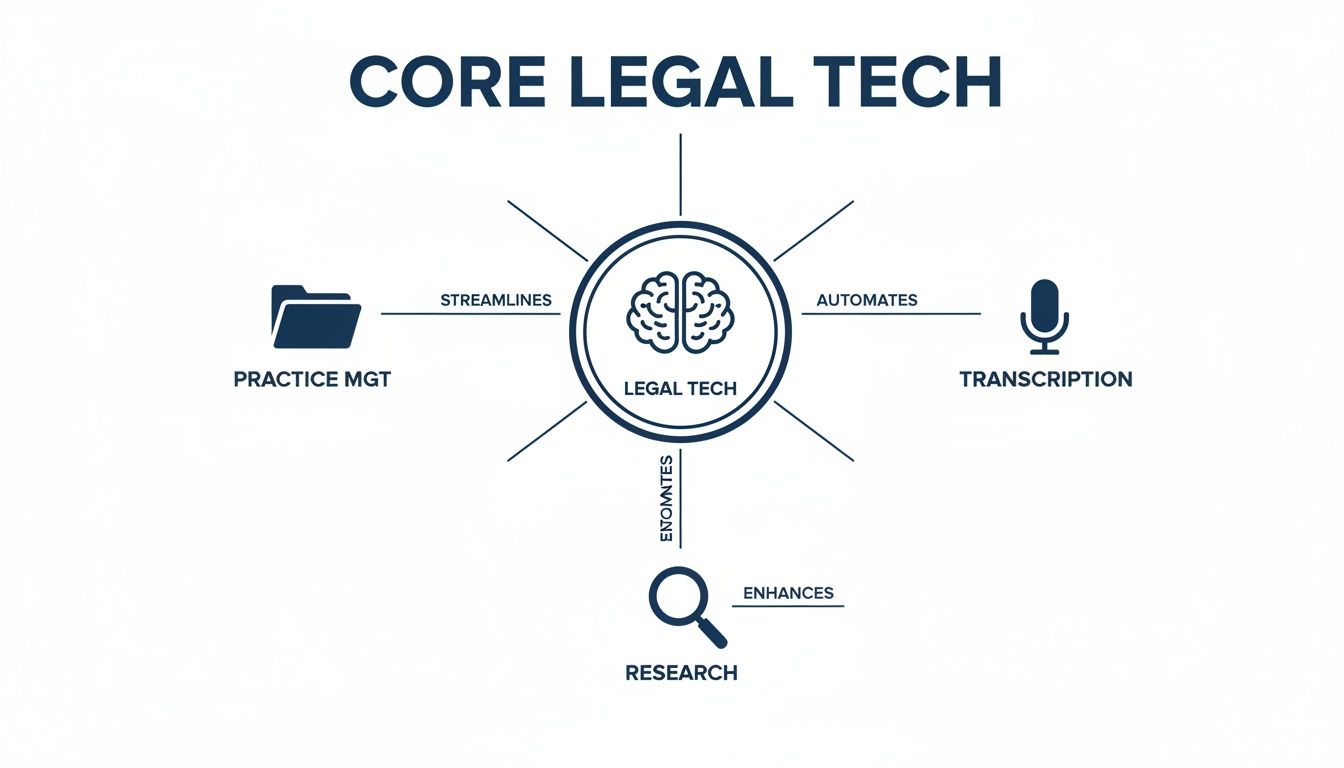
As you can see, a central practice management system should really act as the brain of the operation, coordinating the specialized work of research, transcription, and document creation into one unified workflow.
For the vast majority of law firms, the central nervous system of their daily work is the Microsoft ecosystem. This is a massive consideration when building out your tech stack. According to AllRize's 2025 Legal Technology and AI Adoption Report, a staggering 89.2% of law firms rely on Microsoft for productivity, while only 8.4% use Google Workspace. Why the landslide? It comes down to Microsoft's robust security and the simple fact that apps like Word and Outlook are the lifeblood of legal work.
The takeaway is clear: any new technology you bring into your firm must play nicely with these platforms. You can dive deeper into the findings in the 2025 Legal Technology and AI Adoption Report.
How to Spot a Good Tech Partner
When you’re vetting potential software vendors, integration can't be an afterthought. It needs to be one of your first questions. And don't settle for a simple "yes, we integrate." You need to dig into the specifics.
Here are the critical questions to ask:
- Tell me about your API: An Application Programming Interface (API) is the set of rules that lets different software programs talk to each other. A powerful, well-documented API is a huge green flag that a vendor takes integration seriously.
- Do you offer native integrations? Look for pre-built, out-of-the-box connections to the tools you already use every day, especially your practice management software and Microsoft Outlook. This makes getting set up infinitely easier.
- Will this system grow with us? The tech you invest in today needs to handle your firm's growth tomorrow. Ask how the system performs as you add more users, cases, and data.
- What are your security credentials? Any vendor worth their salt should be able to prove they meet the legal industry's strict data protection standards. This includes encryption, access controls, and compliance with rules like GDPR.
A vendor that prioritizes open architecture and seamless integration isn't just selling you a tool; they are providing a building block for a more efficient and future-proof firm.
Choosing software in a vacuum is a recipe for frustration and wasted money. The goal is to create a unified digital workspace where your information is an asset, not an obstacle. By putting integration at the center of your strategy, you’ll build a tech stack that not only solves today's problems but also gives you a solid foundation to build on for years to come. For a closer look at optimizing these processes, check out our guide to law firm workflow software.
Navigating Data Security and Compliance
For any law firm, client data isn't just an asset; it's a sacred trust. A data breach is far more than a simple IT headache—it's a catastrophic blow to client confidentiality and your professional reputation. That's why solid data security and compliance aren't just features; they're the absolute bedrock of any technology you bring into your practice.
Think of it as building a digital fortress around your firm's most sensitive information. This isn't optional. It's an ethical and professional necessity.
Building that fortress starts with a few key principles. The most critical is end-to-end encryption, which essentially scrambles data the moment it leaves your device and only unscrambles it for the intended recipient. It’s like sending a message in a locked box that only the recipient has the key to open.
Another crucial pillar is data residency—the actual physical location where your data is stored. For firms with international clients or those handling particularly sensitive cases, choosing a provider that stores data in a jurisdiction with tough privacy laws, like Switzerland or the EU, adds another powerful layer of legal protection.

Upholding Tough Regulatory Standards
Beyond just good security hygiene, law firms are bound by a maze of regulations designed to protect client information. These aren't just for massive corporations; they apply to any firm, regardless of size, that handles certain kinds of data.
Two of the big ones you absolutely have to know are:
- GDPR (General Data Protection Regulation): If you work with any clients in the European Union, you're on the hook to meet these strict privacy and security rules.
- HIPAA (Health Insurance Portability and Accountability Act): For any firm touching cases involving protected health information (PHI)—think personal injury, medical malpractice, or disability claims—HIPAA compliance isn't a choice, it's the law.
Following these regulations is a core business function, not a suggestion. The smartest way to manage this is to choose technology that already has compliance controls baked right in. It shows you're serious about protecting your clients.
Closing the Gap Between New Tech and Old Policies
Firms are moving to the cloud and adopting AI faster than ever for everything from billing to document management. The problem? There's often a huge gap between buying the shiny new tool and creating the rules to use it safely.
For example, while firms are jumping on the AI bandwagon, recent data shows that only 41% have bothered to create an AI policy, and just 40% offer any training on it. This is a massive blind spot. It's why having a single, unified platform is so much safer than trying to stitch together a dozen different tools, each with its own security vulnerabilities.
True security covers the entire lifecycle of your data. This even includes what happens when you get rid of old computers or servers. A proper strategy for secure data destruction is essential to prevent old files from falling into the wrong hands.
At the end of the day, being proactive about security is about more than just dodging fines. It's about preserving the trust that the entire attorney-client relationship is built on. To dive deeper, you can check out our full guide on https://www.whisperit.ai/blog/data-security-for-law-firms.
Putting Technology Into Practice and Managing the Human Side of Change
Getting new technology into a law firm is less about the tech itself and more about leadership. You can have the best software on the market, but if your team won’t use it, it's just a wasted investment. Real success comes from a smart strategy that focuses on people, your existing processes, and clear communication—not just hitting "install."
This whole process has to start long before you ever sign a contract. It begins by taking a hard, honest look at the friction in your firm's day-to-day work. Where are the real bottlenecks holding things up? What mind-numbing, repetitive tasks are eating away at billable hours?
Answering those questions gives you a solid business case for making a change. It's the groundwork you need to get partners on board and show everyone on the team how this will genuinely make their lives better.
Create a Phased Rollout Plan
Trying to do everything at once is a classic mistake and a surefire way to overwhelm your staff and cause complete chaos. A much better way is to roll things out in phases, introducing new tools and workflows in small, manageable steps. This gives your team a chance to learn and adapt without bringing the firm to a screeching halt.
A sensible, phased plan usually looks something like this:
- Run a Pilot Program: Start with a small group of people who are actually excited about the new tech. Let them kick the tires in a real-world setting, find any glitches, and become your internal cheerleaders for the project.
- Expand Team by Team: Once the pilot group is happy, roll the technology out to one department or practice area at a time. This lets you give each group focused training and support, making the transition much smoother.
- Go Firm-Wide: After you've worked out the kinks and gathered feedback, you can launch it across the entire firm. By then, you'll have success stories and internal champions to help lead the way.
This methodical approach minimizes disruption and actually builds momentum. You'll see skepticism turn into real enthusiasm as people witness the benefits for themselves.
Turn Resistance Into Empowerment
Let’s be honest—resistance to change is just human nature, especially in a profession built on precedent. The secret to getting past it isn't about forcing people to comply; it's about empowering them with the right training and support. Vague promises about "efficiency" won't cut it. Your team needs to see exactly how this new tool will make their specific job easier.
The point of training isn't just to check a box. It's to build confidence. When people feel competent and supported, they're far more likely to see new tools as helpful allies instead of threats.
Training needs to be hands-on and tailored to different roles. A partner's needs are completely different from a paralegal's. When you customize the training to fit each person’s daily tasks, the benefits become real and immediate. When it's time to bring in new legal technologies, partnering with the right information technology company can make all the difference in executing the project and managing the change.
If you're looking for a deeper dive on structuring this kind of firm-wide project, our digital transformation roadmap offers some great guidance.
Navigating the Headache of Data Migration
One of the biggest technical hurdles you'll face is data migration—the process of moving all your existing case files, client contacts, and documents into the new system. It's a tricky process, and if you don't handle it carefully, you risk losing or corrupting critical information.
To make sure things go smoothly, you need a clear plan.
- Clean Up Your Data First: Before you move a single file, use this as an opportunity for a spring cleaning. Archive old cases, get rid of duplicate documents, and create a standard naming system.
- Do a Test Run: Always, always perform a test migration with a small chunk of your data first. This lets you find and fix any formatting or mapping problems before you commit to moving everything.
- Validate the Final Product: Once the full migration is done, have your team members log in and confirm that their data was transferred correctly and is easy to find in the new system.
By treating implementation as a strategic change management project, you shift it from a simple IT task to a real opportunity to build a more efficient, agile, and modern law firm.
Measuring the ROI of Your Tech Investment
Bringing new technology into your law office is a big move, but it shouldn't be a shot in the dark. The real worth of these tools isn't just a list of flashy features—it's the measurable, dollars-and-cents impact they have on your firm’s bottom line.
Calculating the Return on Investment (ROI) shifts the discussion from vague ideas about "efficiency" to hard numbers. It proves that the right tech is a strategic investment, not just another line item on your expense report.
Think of it as a trade. You're swapping a predictable monthly software fee for a massive return in reclaimed time, fewer costly errors, and the ability to take on more clients. The whole point is to connect the dots and see how technology directly boosts your profitability.
Key Metrics That Matter Most
To get a clear picture of your ROI, you need to dig deeper than just feeling like things are running smoother. It’s all about tracking specific, quantifiable metrics that show you the money.
Here are the core areas to watch:
- Increased Billable Hours: This is the most straightforward win. When you automate grunt work like transcription, document formatting, and mind-numbing data entry, you give your attorneys and paralegals back their most valuable asset: time for billable tasks.
- Faster Case Resolution: Better workflows mean cases don't just sit there. Tech that speeds up legal research, document drafting, and client communication can dramatically shorten case lifecycles. This lets you close matters faster and increase your firm's overall capacity.
- Reduced Operational Costs: Start adding up the savings. Think about what you're no longer paying for—physical file storage, pricey courier services, and third-party transcription fees. These "small" expenses add up to a significant dent in your overhead.
Tying It All Together for a Stronger Firm
At the end of the day, the ROI of legal tech is more than just a simple calculation. A smart, integrated tech stack fosters a more sustainable and less stressful work environment, which is a huge factor in keeping your best people around. For a deeper dive into getting the most out of your team, our article on resource allocation optimization offers some great strategies.
Strategic technology is an investment in your firm's future. It proves to clients that you are efficient and modern, and it empowers your team to deliver their best work without being bogged down by administrative friction.
Happy clients, who see faster responses and more transparency, stick around longer and send more referrals your way. When you look at the whole picture, the initial software cost is easily overshadowed by the long-term gains in efficiency, profitability, and your reputation in the market.
Frequently Asked Questions
Bringing new technology into a law firm always stirs up a few key questions. It's completely normal to wonder about the budget, how it affects your team, and what it really takes to get everything up and running. Let's tackle these common concerns head-on.
How Can a Small Law Firm Afford New Technology?
It's a common myth that you need a huge capital budget for modern legal tech. Most of the best tools today are cloud-based and sold as a subscription, so you're looking at a predictable monthly or annual fee instead of a massive upfront investment. This model makes powerful technology in the law office accessible even for solo practitioners.
The trick is to start small and focus on return on investment (ROI). Pinpoint your biggest bottleneck—maybe it's document drafting or client intake—and find a tool that solves that specific problem. You'll often find the time savings and reduction in errors mean the software pays for itself surprisingly fast.
Will AI Technology Replace Lawyers or Paralegals?
Not a chance. The overwhelming consensus is that AI is here to assist legal professionals, not replace them. Think of it as the world's most efficient paralegal, perfectly suited for the repetitive, data-intensive work that bogs your team down.
AI crushes tasks like transcription, first-pass document review, and sifting through mountains of legal research. This frees up your human talent to focus on what they do best: strategy, negotiation, client relationships, and courtroom advocacy.
AI is a powerful tool that handles the "what"—the data, the documents, the research. This lets legal professionals dedicate their expertise to the "why" and "how" of winning a case. It’s about empowering your team, not replacing it.
What Is the Biggest Hurdle to a Successful Tech Rollout?
It’s not the software itself; it's the people. The single biggest obstacle is, without a doubt, user adoption. You can invest in the most incredible platform on the market, but if your team doesn't use it—or doesn't use it correctly—it’s worthless.
A smooth rollout depends entirely on strong leadership and great training. You need a clear plan that communicates the benefits to each person, hands-on training that’s relevant to their daily work, and visible buy-in from the partners. One of the best strategies is to identify a few "tech champions" on your team who can help guide their colleagues and make the new tools feel like a natural part of how you work.
Ready to unify your firm’s workflow with a voice-first AI workspace? Whisperit brings together dictation, drafting, case management, and collaboration to help your legal team work smarter, not harder. Discover how you can move from intake to export in fewer steps at https://whisperit.ai.