
Your Guide to SOC 2 Compliance Requirements
If you handle customer data, you've probably heard about SOC 2. Think of it less as a rigid checklist and more as a way to prove you’re a responsible steward of the information clients entrust to you. It's the industry standard for showing your systems and processes are secure, available, and trustworthy.
What Is SOC 2 and Why Should You Care?
In a world where data breaches make headlines almost daily, just saying you're secure isn't enough. You have to prove it. A SOC 2 report is that proof. It's an independent audit that verifies you have the right controls in place to protect sensitive data.
For many SaaS, cloud, and AI companies, it’s no longer optional. Enterprise clients often won't even start a conversation without seeing a clean SOC 2 report. Getting compliant isn't just about avoiding a "no"; it's a powerful way to build trust and stand out from the competition.
The 5 Pillars of SOC 2: The Trust Services Criteria
The entire SOC 2 framework is built on what the American Institute of Certified Public Accountants (AICPA) calls the Trust Services Criteria (TSC). These five principles are the foundation of your audit, defining the areas your controls need to cover.
To give you a clearer picture, here’s a quick breakdown of each criterion and what it’s really about.
SOC 2 Trust Services Criteria at a Glance
| Trust Service Criterion | Primary Focus |
|---|---|
| Security | Protecting systems and data from unauthorized access, both physical and logical. This is the one mandatory criterion for every SOC 2. |
| Availability | Ensuring your systems are up and running as promised in your service level agreements (SLAs). Think disaster recovery and performance monitoring. |
| Processing Integrity | Making sure data processing is complete, accurate, and on time. It's about data being processed correctly from input to output. |
| Confidentiality | Protecting data that is specifically designated as "confidential," like intellectual property or business plans, through encryption and access controls. |
| Privacy | Safeguarding Personally Identifiable Information (PII) through its entire lifecycle—from collection and use to its eventual disposal. |
While the Security criterion is the non-negotiable starting point for every SOC 2 audit, the other four are chosen based on the promises you make to your customers. Your auditor will evaluate your controls against the specific criteria you've included in your audit's scope.
SOC 2 is less about a rigid checklist and more about proving that you have effective, documented controls in place that align with the TSCs you've selected. It’s a narrative of your security story, backed by evidence.
Keeping Up With Modern Expectations
The pressure to achieve and maintain compliance is only growing. It's no longer a one-and-done project. In fact, a stunning 92% of organizations now conduct two or more audits annually, and 58% are running four or more. This shift shows just how critical continuous compliance has become.
These numbers explain why SOC 2 consistently ranks among the top three most vital frameworks for businesses of all sizes. To keep pace, you need more than a simple checklist; you need a modern compliance risk management framework that can adapt and grow with your business.
SOC 2 also doesn't exist in a vacuum. It often intersects with other regulations. To get a better sense of the bigger picture, you can learn more about other important https://www.whisperit.ai/blog/cloud-security-compliance-standards that might apply to your organization.
Understanding the Five Trust Services Criteria
At the heart of any SOC 2 audit are the five Trust Services Criteria (TSC). It's best not to think of these as a rigid checklist, but more as guiding principles that define what a secure and trustworthy system really looks like. Your path to SOC 2 compliance starts right here, with understanding these pillars and figuring out which ones actually apply to your business.
The whole TSC framework was built to be flexible. It lets you tailor your audit to the specific services you offer and the promises you make to your customers. While one criterion is always required, you choose the others based on your operational commitments and what’s important to your clients.
Security: The Mandatory Common Criteria
First up is Security, and it's the foundation of every single SOC 2 report. This one is non-negotiable. It’s often called the Common Criteria because its principles bleed into the other four. It all boils down to one critical question: Is your system protected against unauthorized access, use, or modification?
This criterion casts a wide net, covering all the controls you have in place to stop security incidents before they happen. It scrutinizes everything from your network firewalls and intrusion detection systems to the nitty-gritty of how you manage employee access and even conduct background checks. It’s the baseline for proving your organization is serious about its security posture.
A classic example of a control here is enforcing multi-factor authentication (MFA) for anyone trying to access sensitive systems. To prove this, you’d show an auditor system logs confirming successful MFA challenges and the internal policy documents that mandate its use.
The Security criterion is about building a strong perimeter and solid internal defenses. Think of it as the locks on the doors and windows of your digital house—it ensures only the right people can get inside and access your data.
Availability: Is Your Service Ready When Needed?
The Availability criterion is all about whether your system is up and running as promised. This is a huge deal for SaaS platforms, cloud providers, or any service where downtime means immediate customer pain. If your Service Level Agreement (SLA) promises 99.9% uptime, this is the criterion that proves you can walk the walk.
Controls for Availability typically include things like:
- Performance Monitoring: Having the right tools and processes to keep an eye on system health, hopefully catching potential problems before they cause an outage.
- Disaster Recovery Planning: A well-documented and—most importantly—tested plan to get service back online quickly after a major incident.
- Network Redundancy: Building in backup systems and failover processes so that if one piece of the puzzle fails, another is ready to take its place instantly.
Imagine a cloud storage provider. Its customers depend on 24/7 access to their files. That provider would have to show evidence of its data replication strategies, the results from its failover tests, and its incident response plans to satisfy the Availability criterion.
Processing Integrity: Accuracy and Reliability in Action
While Availability makes sure your system is on, Processing Integrity makes sure it works correctly. This criterion looks at whether your system processing is complete, valid, accurate, timely, and authorized. It’s absolutely vital for any application handling critical transactions, from financial calculations to medical data.
Think about a fintech app that processes payments or a healthcare platform that calculates patient dosages. A tiny error in processing could have massive consequences. This criterion digs into the entire lifecycle of a transaction to ensure data isn't accidentally or maliciously changed between input and output.
Key controls here often involve quality assurance checks, data validation at the point of input, and regular reconciliation of processing logs to confirm everything is accurate and complete.
Confidentiality: Protecting Sensitive Information
The Confidentiality criterion is focused on protecting data that is specifically designated as confidential. This is different from Privacy, which is all about personal data. Confidentiality can apply to any sensitive information your clients entrust to you, like their intellectual property, strategic business plans, or confidential legal documents.
If your service handles this kind of proprietary data, you'll almost certainly need to include Confidentiality in your audit scope. Controls here are all about data protection and locking down access.
- Encryption: Is sensitive data encrypted both at rest (when it's being stored) and in transit (as it moves across the network)?
- Access Controls: Is access to confidential information restricted to a "need-to-know" basis through strong permission models?
- Data Destruction: Do you have secure, documented procedures for getting rid of confidential data once it's no longer needed?
For a legal tech company like Whisperit, which handles highly sensitive case files and attorney-client communications, proving strong Confidentiality controls is non-negotiable for building client trust.
Privacy: Safeguarding Personal Data
Finally, the Privacy criterion deals with the protection of Personally Identifiable Information (PII). This is any data that can be used to identify a person, like names, email addresses, social security numbers, or health information. This criterion assesses how you collect, use, retain, disclose, and dispose of personal data in line with your own privacy notice and established standards.
This criterion lines up very closely with regulations like GDPR and CCPA. It’s about more than just securing data; it’s about proving your handling of PII is fair, transparent, and gives individuals control over their own information. To get a head start on this, you can explore our guide on Privacy by Design principles, a concept that sits at the very core of this TSC.
For instance, an organization that handles customer support tickets containing PII would need controls to automatically mask sensitive data, clear policies on how long that data is kept, and a defined process for handling user requests to delete their information. This demonstrates a commitment not just to SOC 2, but to respecting global data privacy expectations.
Choosing Between SOC 2 Type 1 and Type 2 Audits
One of the very first decisions you'll make on your SOC 2 journey is whether to go for a Type 1 or a Type 2 audit. They might sound almost identical, but they're worlds apart in what they prove to your customers. Getting this choice right from the start is crucial for managing your timeline, budget, and client expectations.
The easiest way to grasp the difference is with a simple analogy. Think of a SOC 2 Type 1 report as a blueprint. It's a snapshot in time where an auditor examines the design of your security controls. They're checking to see if you have the right policies and procedures documented to meet your chosen Trust Services Criteria. Essentially, it confirms you've designed a solid security system on paper.
A SOC 2 Type 2 report, in contrast, is more like a stress test video. It doesn't just review the blueprint; it watches your system run over a period of time—usually between three and twelve months. This audit tests the operating effectiveness of your controls, providing real proof that you don't just have good policies, but you actually follow them day in and day out.
What Does This Mean for Your Business?
A Type 1 report is faster and less intensive. It shows you've done your homework and have a well-designed security program ready to go. For a startup trying to land a foundational enterprise client, a Type 1 can be a fantastic way to show you're serious about security and are on the right track.
But let's be realistic. Most mature customers will eventually ask for a Type 2. Why? Because a blueprint doesn't prove the building is sound. They want to see that your security controls hold up under real-world conditions over time, not just on the day of inspection. The Type 2 report is what truly builds long-term trust.
The infographic below helps illustrate where this decision fits into the larger process. Before you even get to Type 1 vs. Type 2, you have to decide which Trust Services Criteria you're committing to.
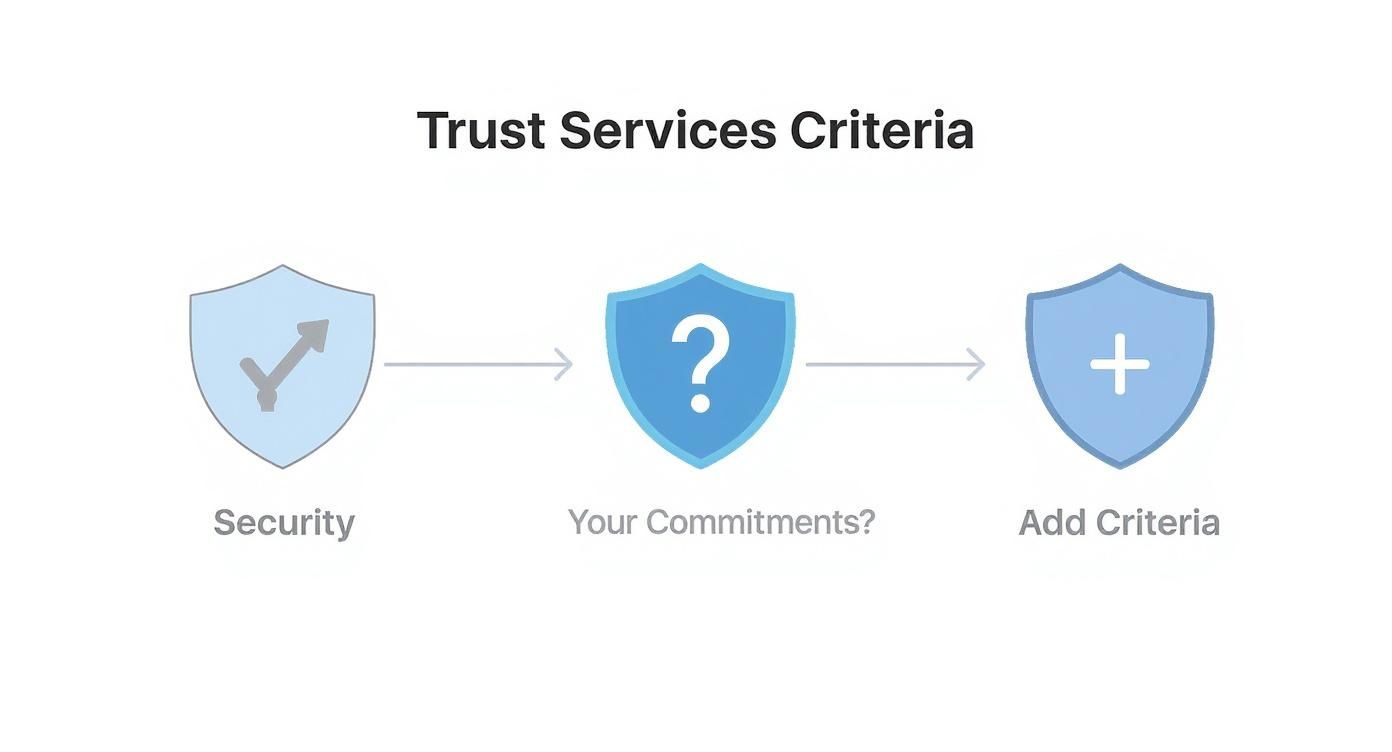
As you can see, once you've anchored your audit in the mandatory Security criterion and added any others relevant to your services, the next fork in the road is selecting the audit type that aligns with your business goals.
A Quick Comparison Table
To make the choice clearer, here’s a side-by-side look at what separates a Type 1 from a Type 2 audit.
| Attribute | SOC 2 Type 1 | SOC 2 Type 2 |
|---|---|---|
| Focus | Design of controls | Operating effectiveness of controls over time |
| Timeframe | A specific point in time (a "snapshot") | A period of time (typically 3-12 months) |
| Auditor's Goal | Are your controls designed correctly? | Do your controls work as designed, consistently? |
| Effort & Cost | Lower | Higher (due to longer audit & evidence gathering) |
| Best For | Startups needing a quick win; initial proof | Demonstrating mature, ongoing security practices |
| Customer Assurance | Good | The industry "gold standard" |
Ultimately, many companies start with a Type 1 to get on the board and then graduate to a Type 2 in the following year.
Diving Deeper Into the Audit Period
The difference in timelines really is significant. A SOC 2 Type 1 audit can sometimes be wrapped up in a few weeks if you're well-prepared. A SOC 2 Type 2, however, requires a formal observation period. You can't rush it. This extended period involves far more rigorous evidence collection.
For example, for a Type 1, you might just show the auditor your employee offboarding policy. For a Type 2, you'll need to pull logs from the entire 3-6 month period to prove you actually deactivated system access for every single employee who left the company, every single time. It's a much higher bar. To see exactly what kind of proof is needed, our guide on SOC 2 Type 2 requirements provides a detailed breakdown.
A Type 1 report answers the question, "Do you have the right controls designed?" A Type 2 report answers the more critical question, "Do your controls actually work as intended over time?" That's precisely why the Type 2 has become the benchmark for vendor security assurance.
Building Your Foundation with Essential Controls
Alright, let's move from the theory of the Trust Services Criteria into the real work. Getting SOC 2 compliant isn’t about making vague promises about security; it’s about implementing, documenting, and proving you have specific controls in place. These controls are the tangible, real-world proof that you’re actually protecting customer data.
Think of controls as the individual security measures that, when combined, create a powerful defense. They are the policies, procedures, and technical settings that turn your security goals into reality. For an auditor, these controls—and the evidence they create—are the only things that matter.
Mastering Access Control
One of the very first things an auditor will dig into is how you manage access to sensitive systems and data. This is all about making sure only the right people can get to the right information, and only when they absolutely need to. Strong access controls are the bedrock of preventing data breaches.
Your job is to demonstrate a clear and enforced policy for who gets access to what, and why. This isn’t just for your full-time employees; it covers contractors, third-party vendors, and any automated service accounts, too.
Examples of Essential Access Controls:
- Role-Based Access Control (RBAC): Set up predefined roles with specific permissions (like "Admin," "Editor," or "Read-Only") to ensure people only have the access they need to do their jobs. Nothing more.
- Multi-Factor Authentication (MFA): This is non-negotiable. Require a second form of verification for all critical systems. It dramatically cuts down the risk of someone getting in with just a stolen password.
- Regular Access Reviews: At least quarterly, you need to review everyone's access rights to verify they're still appropriate. If someone changes roles or leaves the company, their old access needs to be shut down immediately.
For every one of these, an auditor is going to ask for proof. They won't just take your word for it. Be prepared to show system configuration screenshots proving MFA is turned on, logs from your access reviews, and the official documentation for your RBAC policy.
Implementing a Strong Risk Management Program
SOC 2 demands that you have a formal way of finding, analyzing, and dealing with risks. A solid risk management program shows auditors you’re proactive about security, not just waiting for something bad to happen. You have to prove you understand the threats to your environment and have a game plan to handle them.
This entire process needs to be documented and repeatable. The centerpiece is the risk assessment, where you sit down and map out potential vulnerabilities, assess how likely they are to be exploited and the potential damage, and then decide how you’re going to fix them.
A documented risk assessment is your strategic map for security. It tells an auditor not only what you're protecting against but also how you prioritize your security efforts and resources based on the biggest threats.
The evidence here is straightforward but absolutely critical: a formal risk assessment report. This document needs to detail the risks you found, their scores, and the specific controls you’ve put in place to knock them down. Showing that this report is regularly reviewed and updated by management is key.
Formalizing Change Management
How do you handle changes to your production environment? Uncontrolled changes—like a developer pushing code straight to production without any review—are a massive source of security incidents and outages. A formal change management process ensures every modification is properly tested, reviewed, and approved before it goes live.
This applies to everything from software updates and new feature rollouts to tweaks in your network configuration. The whole point is to keep things stable and secure while still being able to evolve.
A Typical Change Management Workflow:
- Request: A change is formally requested, usually through a ticketing system.
- Review: The proposed change is looked at for any security or operational impacts.
- Approval: The right people (like an engineering lead or security officer) give the green light.
- Testing: The change is tested in a sandbox or staging environment first.
- Implementation: Once tested, it’s deployed to production.
- Verification: The team confirms the change is working as intended with no nasty side effects.
Auditors will ask to see your change management policy. Then, they’ll want to review a sample of change tickets from your system (like Jira or ServiceNow) to make sure you actually followed your own process. The paper trail is everything. Establishing a clear security control framework is a great first step to organizing these processes.
Preparing Your Incident Response Plan
Let's be realistic: no system is 100% hack-proof. SOC 2 knows this, which is why it requires you to have a documented plan for how you'll respond when a security incident inevitably happens. Your incident response plan is your playbook for detecting, containing, and recovering from a breach.
This plan should define what you consider an incident, spell out roles and responsibilities, and detail how you’ll communicate with internal teams and external customers. Most importantly, it has to be tested. An untested plan is just a piece of paper; a tested plan is a proven capability. Beyond SOC 2, organizations often consider other robust frameworks like achieving ISO 27001 accreditation to further demonstrate their commitment to information security management.
Your Roadmap to a Successful SOC 2 Audit
Getting through a SOC 2 audit successfully is all about preparation. It's not something you can cram for at the last minute. Think of it less like a surprise pop quiz and more like a final exam you've been studying for all semester. With the right approach, the audit becomes a simple confirmation of the good work you're already doing, not a source of dread.
The real work starts long before the auditor ever shows up. Your first, and arguably most important, step is defining your scope. This means making a clear decision on which of the five Trust Services Criteria matter for your service and drawing a firm line around the systems, people, and processes that are in-bounds for the audit. A fuzzy scope is a surefire way to create headaches and extra work down the road.
Conducting a Readiness Assessment
With your scope locked in, it’s time for a readiness assessment, sometimes called a gap analysis. This is your dress rehearsal. You can bring in a third-party firm or use a sharp internal team to measure your current controls against the specific SOC 2 compliance requirements you’ve chosen.
The whole point is to find the weak spots—the "gaps"—where your controls don't quite measure up. The output is a report that gives you a clear, honest look at where you're falling short. This document becomes your game plan for the next phase: remediation. For a deep dive into what to look for, check out our complete SOC 2 compliance checklist.
This prep work is a big deal, especially for smaller companies. A recent report found that 62% of small to medium businesses find it tough to get their arms around SOC 2 requirements, often due to tight resources. You can see more on this by reviewing the full report on CG Compliance.
From Gaps to Remediation
Your gap analysis will almost certainly turn up a few issues. They can range from small things, like a missing policy document, to more significant control weaknesses. Don't worry, that's completely normal. The trick is to build a structured remediation plan to tackle each item one by one.
A solid plan needs to spell out a few things:
- Specific Actions: What, exactly, needs to be done to fix this? Be precise.
- Ownership: Who is on the hook for getting it done? Name a person or a team.
- Timelines: When does it need to be finished? Set real, achievable deadlines.
Let's say the assessment found you don't have a formal process for employee offboarding. Your plan would assign HR to write a documented policy and task IT with creating a checklist to make sure access is revoked every time. This methodical approach ensures nothing gets missed before the official audit kicks off.
A common pitfall is underestimating how much time and effort remediation takes. Fixing control gaps isn't an overnight job—it can take weeks or even months. You absolutely have to build that buffer into your project timeline.
By breaking the process down into these manageable steps, you change the entire dynamic. The audit stops being a dreaded test and becomes the final, validating step in a well-run project—one that proves your commitment to security and builds deep trust with your customers.
Common Questions About SOC 2 Compliance
Once you get past the high-level concepts of SOC 2, the practical questions start popping up. It's one thing to understand the criteria and controls, but what about the real-world stuff—like cost, how long a report lasts, and how it stacks up against other standards? Let's clear up some of the most common questions that come up on the path to compliance.
How Much Does a SOC 2 Audit Cost?
Let's get right to it: the budget. Unsurprisingly, there’s no simple price tag for a SOC 2 audit. The cost swings pretty wildly based on your company's size, the complexity of your tech stack, and which of the Trust Services Criteria you decide to tackle. A bigger, more tangled environment just means more hours for the auditors.
For a smaller company just starting out, a Type 1 audit might land somewhere between $15,000 and $30,000. If you’re going for the more rigorous Type 2 audit, which involves a much longer observation period, you can expect the cost to start around $25,000** and easily climb past **$60,000.
And remember, that’s just what you pay the auditors. The total cost of ownership is a bit bigger. You also need to factor in:
- Readiness Assessments: Bringing in a consultant to do a gap analysis feels like an extra cost upfront, but it can save you a mountain of money and headaches by flagging issues before the real audit begins.
- Compliance Automation Tools: Platforms that help you track controls and gather evidence aren't free, but they can drastically cut down on the manual labor your team has to put in.
- Internal Resources: Don’t underestimate the value of your own team's time. They'll be spending hours on fixing controls, pulling evidence, and sitting in meetings with the audit team.
My advice? Always shop around. Get detailed quotes from a few reputable CPA firms to find a partner who not only fits your budget but actually understands your industry.
How Long Is a SOC 2 Report Valid?
This is a classic point of confusion. A SOC 2 report doesn’t come with a formal expiration date stamped on the cover. But in the real world, its shelf life is pretty short.
Most of your customers and partners won't even look at a SOC 2 report that's more than 12 months old. This turns SOC 2 into an annual exercise. The market expects you to get a fresh audit every year to prove your controls are still in place and working effectively. A Type 2 report covers a specific timeframe (say, October 1, 2023, to September 30, 2024), and as soon as that period ends, your stakeholders will start asking for the next one.
Think of it like a recent health checkup. A report from three years ago doesn't tell a potential partner much about your company's security health today. An annual audit is proof of your ongoing commitment to keeping things locked down.
Do We Need All Five Trust Services Criteria?
Absolutely not, and this is probably one of the most critical scoping decisions you'll make. The only criterion that is non-negotiable is Security. It's the foundation of every single SOC 2 audit and is often called the Common Criteria.
The other four—Availability, Processing Integrity, Confidentiality, and Privacy—are completely optional. You should only add them if they align with the specific services you provide and the promises you make to your customers. This is a business strategy decision, not just a technical one.
Here’s a quick way to think about it:
- If your service level agreements (SLAs) guarantee 99.9% uptime, you’d better include Availability.
- If your platform crunches financial numbers or handles data where accuracy is everything, you need Processing Integrity.
- If you're handling sensitive intellectual property or business plans for your clients, Confidentiality is a must.
- If you collect or manage personal information—names, email addresses, health records—you should seriously consider adding Privacy.
Choosing the right criteria makes your audit truly relevant to what your customers care about. It also saves you from the cost and effort of building and testing controls you don't actually need.
What Is the Difference Between SOC 2 and ISO 27001?
This question comes up all the time. Both are gold standards in information security, but they’re built for different jobs. While they cover a lot of the same ground in terms of controls, their focus and the final product are quite different.
ISO 27001 is an international standard that certifies your organization's entire Information Security Management System (ISMS). It's a framework for how you manage risk and run your security program as a whole. Getting ISO 27001 certified proves you have a mature, comprehensive system in place, and it’s recognized all over the world.
SOC 2 is an audit report created by the AICPA that drills down into the specific controls you’ve put in place for the Trust Services Criteria you chose. A SOC 2 report is a detailed narrative from an independent auditor, describing how your controls were designed and, for a Type 2, how well they actually worked over time. It gives a much more granular look at the testing and effectiveness of individual controls.
So which one do you choose? Many companies, especially those with a global footprint, end up getting both. ISO 27001 shows you have a well-managed security program, while the detailed SOC 2 report gives customers the deep assurance they need for their own due diligence, especially in North America.
For legal teams navigating the complexities of SOC 2, managing sensitive client data is paramount. Whisperit provides a voice-first AI workspace built with security at its core, offering Swiss/EU hosting, robust encryption, and GDPR-aligned controls to help you meet your compliance goals. Learn more at https://whisperit.ai.