
A Guide to Recorders and Transcribers
It's easy to get these two terms mixed up, but the distinction is actually pretty straightforward. Recorders capture audio; transcribers turn that audio into text.
Think of it like this: a recorder is like a camera for sound. It captures the raw event—the conversation, the meeting, the deposition—exactly as it happens. A transcriber, on the other hand, is the artist who develops that raw recording into a finished, usable product: a written document.
What Are Recorders and Transcribers?
At their heart, recorders and transcribers are two sides of the same coin. A recorder's only job is to create a high-fidelity audio file of whatever is being said. The end product is just that—a sound file.
A transcriber takes that sound file and gets to work, meticulously converting the spoken words into a written record. This is where the magic happens, turning a stream of conversation into structured, searchable, and shareable text. While a lot of modern tools bundle these functions together, knowing how they work separately is key to building a workflow that actually makes your life easier.
For a quick breakdown, here’s a simple table to see the differences at a glance.
Recorder vs Transcriber At a Glance
| Aspect | Recorder | Transcriber |
|---|---|---|
| Primary Function | Captures and stores audio | Converts audio into written text |
| Output | Audio file (e.g., MP3, WAV) | Text document (e.g., DOCX, TXT) |
| Common Use Cases | Interviews, meetings, lectures, personal notes | Creating meeting minutes, legal depositions, video subtitles, interview notes |
This table neatly sums it up. You need the recorder first to create the source material, and then the transcriber to give that material a new life as a written document.
Two Halves of a Whole
You can’t have one without the other if your goal is an accurate written record. The quality of your recording directly impacts the quality of your transcript. It’s a classic "garbage in, garbage out" situation.
A great recording is the foundation of an accurate transcript. Without a clean audio source, even the most advanced transcription tools will struggle, leading to errors and wasted time in the editing phase.
This is why professionals think carefully about both ends of the process. A journalist conducting interviews in a noisy café will need a recorder with excellent noise cancellation. A paralegal handling sensitive client depositions needs a transcription service that can guarantee accuracy and security. If you're looking to improve your own process, this guide on how to record and transcribe meetings for maximum productivity is a great starting point.
The Rise of Smarter Tools
It's no surprise that the demand for better audio capture and documentation is exploding. The global digital recorder market was valued at USD 1.86 billion and is expected to climb to USD 2.99 billion by 2035. This growth is being fueled by huge leaps in technology and a growing need for reliable record-keeping across all industries.
Today, AI is blurring the lines between these two tools. Many platforms now offer live transcription, effectively doing both jobs at once. Your device isn't just recording; it's creating a usable document in real-time. To get a better handle on the tech behind this, you can dive into our guide on voice-to-text AI.
2. Exploring Your Modern Toolkit
Trying to pick the right recorders and transcribers can feel a bit overwhelming. There are so many options out there. The best way to cut through the noise is to break them down into simple categories, which makes it much easier to find exactly what you need. After all, the perfect tool depends entirely on your situation—what you're recording, where you're doing it, and how fast you need the text.
The gear we use to capture and convert audio today is incredibly varied. You've got everything from specialized hardware to really smart software. Each comes with its own pros and cons when you look at things like portability, accuracy, cost, and turnaround time. Getting a handle on these differences is the first real step to building a workflow that actually works for you.
Think of it as a simple, two-step process: first you capture the sound, then you turn it into a document.

The recorder’s job is done once the audio file is created. That’s where the transcriber steps in to take that file and convert it into words on a page.
Hardware Recorders and Software Solutions
First up, let’s talk about the tools that actually capture the audio. They generally fall into a few key camps:
- Digital Voice Recorders: These are the workhorses. They’re dedicated devices built for one thing: getting a crystal-clear audio recording. Think of popular models like the Sony ICD-series. People love them for their top-notch microphones, long battery life, and simple button controls, which are perfect for formal interviews or legal depositions where you just can't compromise on sound quality.
- Smartphone Apps: For pure convenience, you can't beat the phone in your pocket. Is the built-in mic going to compete with a high-end recorder? Not a chance. But for personal notes or a quick meeting in a quiet room, it’s often more than good enough.
- Software-Based Dictation: This is where you speak directly to your computer and watch the words appear. These tools are built right into your workflow and are brilliant for drafting emails, documents, or quick notes without ever having to type.
These options all handle the "recording" part. Once you have that audio file, it's time to get it transcribed.
The World of Transcription Services
This is where the magic happens—your audio file is transformed into a useful, editable text document. Transcription has come a long way, and today's services offer a wide spectrum of options that let you balance speed, cost, and accuracy.
The big trade-off in transcription usually comes down to this: do you want the instant, low-cost results from an AI, or the precise, nuanced work of a human professional? The hybrid models try to give you the best of both worlds.
Let’s look at the main players:
- Automated AI Transcription: Using incredibly powerful algorithms, AI services can turn audio into text in just a few minutes. It’s by far the fastest and most budget-friendly option, making it a great choice for internal meeting notes or getting a rough first draft. You can dig into guides on the best AI transcription software to see what’s out there.
- Human Transcription: Here, a professional transcriber actually listens to your recording and types everything out by hand. This approach delivers the highest level of accuracy—we’re talking over 99%—and is the only way to go for really complex audio with multiple speakers, thick accents, or background noise. The downside? It’s also the slowest and most expensive.
- AI-Human Hybrid: This is a clever middle ground. An AI generates the initial transcript, and then a human editor reviews and polishes it to perfection. You get a great mix of speed, affordability, and accuracy, which is why it’s become so popular for business and legal work. And for those who work a lot with video, many of today's toolkits also include dedicated YouTube transcription services to pull text directly from video content.
How AI Is Transforming Audio Workflows
The biggest leap forward in audio documentation has nothing to do with better microphones. It's all about artificial intelligence. AI is completely changing the game for recorders and transcribers, blending what used to be two separate, time-consuming steps into one fluid process. The wall between capturing audio and having a written record is crumbling.
Modern tools don't just hear sound anymore; they understand it. This evolution turns a simple recorder into a smart documentation tool that can deliver a near-perfect, searchable transcript just moments after a conversation wraps up.
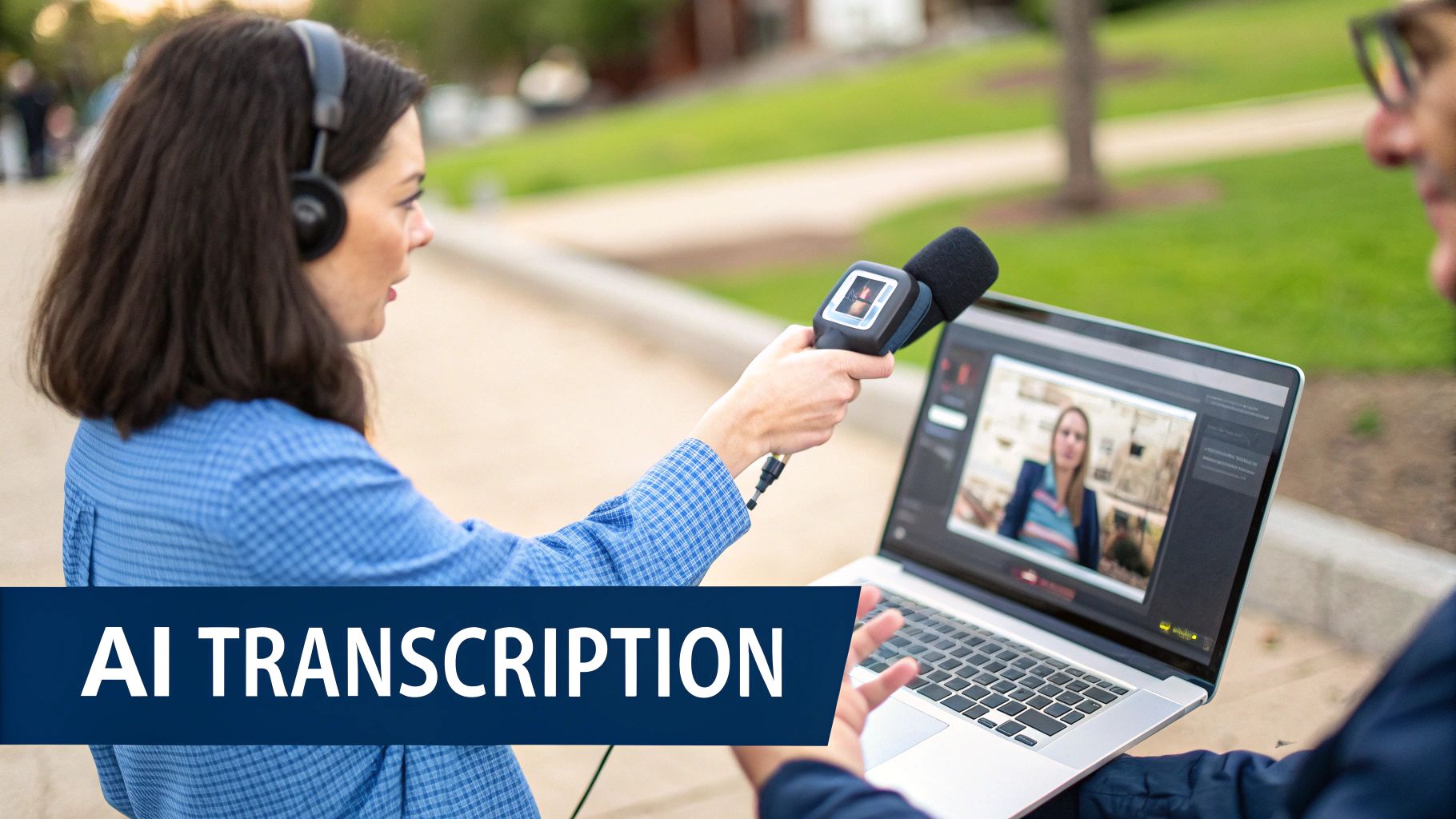
This process is a lot more complex than just simple voice-to-text. Sophisticated models analyze raw audio, filter out noise, and interpret speech patterns to produce a clean, readable document. It's a fantastic illustration of technology doing the heavy lifting that once took hours of focused human effort.
The New Standard of Efficiency
Picture a journalist wrapping up an important interview. In the past, they’d send the audio file to a transcription service and wait—sometimes for days. Now, thanks to AI, a complete, time-stamped transcript is often ready and waiting before they even get back to their desk.
This immediate access to information is a massive boost for productivity and significantly slashes operational costs. It’s no surprise that the global AI transcription market is expected to explode from USD 4.5 billion to around USD 19.2 billion by 2034, growing at a 15.6% compound annual rate. This isn’t just a passing trend; you can discover more insights about the AI transcription market growth to see just how deeply AI is reshaping the industry.
Key AI-Powered Advancements
AI does more than just turn spoken words into text. It adds layers of intelligence that make the final transcript genuinely useful right out of the box.
Three game-changing advancements really stand out:
- Real-Time Transcription: AI can generate a live text feed as a conversation unfolds. This is invaluable for getting instant minutes in a meeting or for immediate review during a legal deposition.
- Automated Speaker Identification: Forget manually labeling who said what. Advanced AI can distinguish between different voices and automatically tag them in the transcript (e.g., "Speaker 1," "Speaker 2"), saving a ton of tedious work.
- Intelligent Noise Filtering: Modern algorithms are incredibly good at isolating human speech from background chatter, street noise, or poor acoustics. The result is cleaner audio and a far more accurate transcript, even when the recording conditions are less than perfect.
The real magic here is the technology’s ability to understand language, not just hear sounds. It’s not simply matching phonetics to letters; it’s interpreting context, grammar, and intent to create a document that makes sense.
This is all powered by a field of AI called Natural Language Processing (NLP). At its core, NLP is what gives software the ability to read, comprehend, and make sense of human language. If you want to dive deeper into the nuts and bolts, our guide on what Natural Language Processing is and how it works is a great place to start. It’s this very technology that allows platforms like Whisperit to move beyond simple transcription and become a true partner in drafting, research, and analysis.
Navigating Security and Compliance
When you're working with sensitive client or patient information, getting the words right is only half the battle. A data breach can be absolutely catastrophic, which is why security and compliance have to be your top priorities when picking a recording or transcription tool. Protecting that data isn't just a good idea—it's your legal and ethical duty.
The stakes couldn't be higher. A single slip-up can result in crippling fines, permanent damage to your reputation, and a total loss of the trust you've worked so hard to build. That’s why your entire audio documentation process has to be built on a rock-solid security foundation.
The Pillars of Data Protection
Keeping your audio and text files safe requires much more than just a strong password. You need a security strategy with multiple layers, one that protects your data from prying eyes at every single step.
Think of end-to-end encryption like a digital armored truck. The moment you hit record, it locks your audio file in a scrambled, unreadable format. It stays that way until it reaches the authorized recipient, who has the only key to unlock it. Even if someone managed to intercept the file, it would just look like gibberish.
Just as important is secure data hosting, which dictates where your files actually live. You need to know that the physical and digital location is safe. For example, platforms like Whisperit offer hosting in highly secure locations like Switzerland or the EU, which means your data is guarded by some of the strictest privacy laws on the planet.
Meeting Strict Regulatory Standards
If you work in healthcare or law, you live and breathe regulations like HIPAA and GDPR. These aren't just suggestions; they are complex legal frameworks, and ignoring them comes with serious consequences.
- HIPAA (Health Insurance Portability and Accountability Act): This is the cornerstone of patient data protection in the United States. Any software or service that handles patient health information—from a simple recording to a full transcription—must be HIPAA-compliant.
- GDPR (General Data Protection Regulation): The EU's tough data privacy law protects the personal information of its citizens. If you handle data for anyone in the EU, GDPR applies to you, no matter where your office is located.
For anyone in healthcare, one of the most crucial steps is getting your technology partner to sign a Business Associate Agreement (BAA). This is a formal, legal contract that makes the vendor just as responsible as you are for protecting patient data under HIPAA rules.
Choosing a partner who understands and meets these standards is non-negotiable. To get a better handle on this, check out our guide on what it truly means to be HIPAA-compliant for speech-to-text. It will arm you with the right questions to ask, ensuring any vendor you consider can back up their security promises with real, contractual guarantees. Without that due diligence, you’re putting your practice, your clients, and your patients at risk.
Choosing the Right Solution for Your Needs
Picking the right recording and transcription tool isn't just about comparing price tags. A truly smart investment fits into your workflow like a missing puzzle piece, actually helps your team, and delivers a real return. You have to look at the total cost of ownership—that means everything from the initial purchase to training, support, and even the cost of potential downtime.
Think about it: a powerful tool that doesn’t play well with your other systems is just a headache waiting to happen. For a legal team, if your new transcriber can't sync with your case management software, you're creating frustrating data silos and forcing people into tedious manual entry. That doesn't speed things up; it slows everything down. The goal is to find something that feels like a natural extension of how you already work.
Evaluating Key Criteria
To make a good decision, you need a framework. A clear checklist helps you cut through the marketing noise and focus on what really matters for your day-to-day operations. This kind of structured approach ensures you pick a tool that solves today's problems and supports tomorrow's goals.
Here's a table to guide you through the essentials when comparing different options.
Key Evaluation Criteria for Recorder and Transcriber Solutions
| Criteria | What to Look For | Why It Matters |
|---|---|---|
| Total Cost of Ownership (TCO) | Look beyond the subscription fee. Factor in setup costs, per-user licenses, necessary training, and ongoing support contracts. | A low initial price can hide expensive long-term costs. Understanding the full financial picture prevents surprise bills down the road. |
| Integration Capabilities | Does it have a solid API or pre-built connections to your must-have tools (CRM, case management, document storage, etc.)? | Seamless integration prevents data silos and eliminates manual work, which is a major source of errors and lost productivity. |
| Security & Compliance | Check for end-to-end encryption, secure data hosting (e.g., in-country), and compliance with GDPR, HIPAA, or other relevant regulations. | A breach isn't just an IT problem; it's a business-ending catastrophe. Your tool must protect sensitive client and company data. |
| Data Retention Policies | Can you easily configure rules for how long data is stored and when it's deleted? Does it meet your industry's legal requirements? | Proper data management is crucial for compliance and risk mitigation. You need full control to avoid legal trouble. |
| User Experience (UX) | Is the interface intuitive? How steep is the learning curve for your team? A free trial is a great way to test this. | A clunky, hard-to-use tool won't get adopted, no matter how powerful it is. Simplicity drives usage and ROI. |
Thinking through these points moves the conversation from "what does it do?" to "what can it do for us?"
Selecting a platform is a long-term commitment. The most important question to ask is not "What does this cost today?" but "How will this tool support our growth and adapt to our needs over the next five years?"
Making the Final Choice
Once you’ve got a shortlist, it’s time to dig deeper. Ask vendors the tough questions. Where is my data hosted? What are your security protocols? If you handle protected health information, will they sign a Business Associate Agreement (BAA)? Don't be shy.
Putting in the effort now will pay off massively later. By focusing on workflow, total cost, and compliance from the get-go, you can confidently choose a solution that genuinely empowers your team.
For a detailed breakdown of different options on the market, our speech-to-text software comparison provides a valuable overview to guide your decision.
Frequently Asked Questions
Is It Actually Legal to Record and Transcribe Conversations?
Yes, it is—as long as you have the proper consent. The legality really boils down to one simple question: does your situation require one-party or all-party consent?
In one-party consent states, you're in the clear as long as at least one person in the conversation (and that can be you) agrees to be recorded. But in states like California and Florida, the law is much stricter, demanding that everyone involved gives their permission.
When in doubt, especially with participants in different states, always play it safe and operate under the all-party consent rule.
How Does AI Transcription Stack Up Against a Human?
Modern AI has gotten remarkably good, frequently hitting over 95% accuracy on clean, clear audio. For quickly getting internal meeting notes or a rough first draft down, it's a fantastic and speedy solution.
However, a human transcriber still has the advantage when things get messy—think heavy accents, people talking over each other, or lots of background noise. In those cases, a professional can deliver that 99%+ accuracy that complex legal matters demand.
Think of it as a trade-off. Need speed and efficiency for a straightforward recording? AI is your best bet. But if it's a high-stakes conversation where every single word is critical, nothing beats the nuance of human review.
Can't I Just Use My Phone Instead of Buying a Recorder?
You could, but for any kind of professional work, a dedicated digital voice recorder is a much smarter choice. Your phone's microphone is built for calls, not for capturing high-fidelity audio, and it really struggles to filter out background noise.
Investing in a good recorder pays off immediately by giving you cleaner audio, which is the single most important factor for getting an accurate transcript.
The U.S. transcription market is valued at a massive USD 30.42 billion and continues to grow, especially in the legal field where precision is everything. As you can see from market trend reports, starting with quality recording equipment is the first step professionals take to ensure they get the quality they need.
Ready to see how a tool that combines dictation, drafting, and secure teamwork can change your legal workflow? Find out how Whisperit simplifies everything from client intake to final export.
Learn more at https://whisperit.ai.