
Physician burnout solutions: Practical, evidence-based paths to recovery
Lasting physician burnout solutions go way beyond suggesting another yoga class or a mindfulness app. They have to tackle the systemic problems that are driving the crisis in the first place. The most effective strategies blend big-picture organizational changes—like cutting down the ridiculous administrative load and fixing broken workflows—with support that empowers individual doctors to build resilience.
It's a critical distinction: burnout is a workplace problem, not a personal failing.
Confronting the Physician Burnout Crisis

Physician burnout isn't just about feeling tired after a long week. It's a much deeper, more corrosive syndrome that manifests as profound emotional exhaustion, a growing sense of cynicism and detachment from the job, and the nagging feeling that your work just doesn't matter anymore.
Think of it like a smartphone battery that not only drains way too fast but, over time, completely loses its ability to hold a full charge. That’s what’s happening to countless doctors today.
This isn't some niche issue affecting a handful of people. It’s a full-blown crisis that’s siphoning the energy and passion out of our healthcare system. The fallout is massive, impacting patient safety, the quality of care, and whether we can even keep doctors in the profession. A physician running on empty is more likely to make a mistake and far less likely to connect with patients in a meaningful way, which erodes the very heart of medicine.
The Alarming Scope of the Problem
The numbers don't lie. The statistics paint a grim picture of a profession in deep distress, with burnout rates hitting historic highs and creating an unsustainable environment for the people we trust with our health. This is a widespread problem that cuts across nearly every medical specialty, though some fields are getting hit harder than others.
A 2023 Medscape report on physician burnout found that emergency medicine doctors had the highest rates at a staggering 65%. Right behind them were primary care physicians (60%) and internal medicine specialists (59%). These figures are a five-alarm fire for frontline care, where the pressure cooker environment is at its most intense. For more on these trends, CTI Leadership offers some powerful insights.
To really get a handle on this, you have to understand the three core dimensions of burnout. It’s not just one thing, but a toxic combination of factors.
The Three Core Dimensions of Physician Burnout
The table below breaks down the key components of burnout. Recognizing these signs is the first step toward finding real solutions.
| Dimension | Description | Real-World Example |
|---|---|---|
| Emotional Exhaustion | Feeling completely drained and emotionally depleted. You simply lack the energy to face another day at work. | A primary care doctor who feels utterly spent after a day of back-to-back appointments, dreading the next day's schedule before it even begins. |
| Depersonalization | A cynical, detached, or numb attitude toward your job and the people you care for (patients and even colleagues). | An oncologist who starts referring to a patient as "the lung cancer in room three" instead of using their name, creating emotional distance just to cope. |
| Reduced Accomplishment | A sense of incompetence and a nagging feeling that your work is no longer effective or meaningful. | A surgeon who, despite a string of successful operations, feels zero satisfaction and starts to believe their work doesn't really make a difference anymore. |
This framework helps clarify that burnout isn't just "stress"—it's a specific and destructive professional syndrome.
Moving from Blame to Systemic Solutions
For far too long, the default response to burnout was to put the onus on the physician. "Be tougher." "Manage your stress better." This approach was doomed from the start because it completely ignores the organizational chaos that’s actually causing the problem.
Burnout is not a personal failure. It is a predictable consequence of a healthcare system that places immense, often unsustainable, demands on its clinicians without providing adequate support or resources.
Real, lasting solutions require us to attack these systemic flaws head-on. That means we have to address:
- Organizational Failures: Inefficient workflows, mountains of administrative tasks, and chronic understaffing that stretches everyone to the breaking point.
- Technological Friction: Clunky Electronic Health Record (EHR) systems that add hours of "pajama time"—charting late into the night—to a physician's day.
- Cultural Pressures: A deeply ingrained professional culture that often stigmatizes asking for help and pushes an unhealthy, unsustainable ideal of perfection.
By confronting these root causes, we can start to make meaningful changes. Thinking about https://www.whisperit.ai/blog/healthcare-process-improvement is a critical piece of the puzzle, as it helps create work environments that support clinicians instead of breaking them. This guide will walk through the actionable, evidence-based strategies that can finally help us turn the tide on this crisis.
Getting to the Root of Physician Burnout
Before we can even talk about solutions, we have to play detective. Tackling physician burnout means tracing the problem back to its source. Just offering a wellness seminar or a yoga class is like slapping a bandage on a gaping wound—it might look better for a moment, but it does nothing to stop the bleeding. To create real, lasting change, we first need to diagnose the systemic issues that are fanning the flames of exhaustion and cynicism.
You can really group these causes into three main culprits: a mountain of administrative tasks, broken and inefficient workflows, and a professional culture that often does more harm than good. Each one acts like a steady, corrosive drip, slowly eating away at a physician's passion, resilience, and ability to simply do their job. While they all feed into each other, that administrative beast is often the most ferocious.
The Crushing Weight of Administrative Tasks
The reality for most physicians today is that their day is filled with work that has very little to do with actually caring for patients. It’s a classic case of death by a thousand clicks. This administrative burden, especially from poorly designed Electronic Health Record (EHR) systems, is probably the single biggest driver of burnout. It forces doctors to spend hours navigating clunky interfaces and checking boxes just to satisfy documentation rules that often feel completely detached from what a patient actually needs.
This isn't just a feeling; the numbers are brutal. Bureaucratic tasks are the top complaint, with 61% of physicians pointing to them as the main reason they're burning out. On average, doctors spend 1.84 hours every single day on EHR documentation. That adds up to 9.2 hours a week—more than a full extra workday swallowed by clerical duties. If you want to see more data, this report on physician burnout trends from ctileadership.com lays it all out.
All that lost time is a massive opportunity cost. It’s time stolen from patients, from family, and from the personal downtime needed to recover and sustain a career this demanding. This is a fundamental problem that demands better workload management strategies.
Inefficient Workflows and Broken Systems
It's not just the documentation. Many healthcare settings are riddled with inefficient processes that create constant, daily friction. It's like asking a Formula 1 driver to race on a road full of potholes and stop signs—no matter how skilled they are, the journey is going to be slow, frustrating, and damaging.
These workflow breakdowns show up everywhere:
- Poor Communication: Time is vaporized trying to track down lab results, waiting on a consult, or clarifying orders because communication systems are fragmented.
- Not Enough Support: Doctors are often forced to do work that could easily be handled by nurses, medical assistants, or admin staff, stretching them impossibly thin.
- "Pajama Time": The workday doesn't stop when the last patient goes home. A huge amount of charting and admin catch-up happens late at night, bleeding into personal and family time.
These inefficiencies create a constant, low-grade chaos, forcing physicians to waste precious mental energy just fighting the system instead of healing patients.
A Culture That Demands the Impossible
The final piece of this puzzle is the culture of medicine itself. For generations, it has championed an unsustainable ideal: the physician as a tireless, infallible hero who never admits weakness and never needs help.
This deep-seated expectation of perfection creates a powerful stigma around vulnerability. Doctors often fear that admitting they're struggling will be seen as a sign of incompetence, so they suffer in silence.
This cultural pressure shows up in harmful ways—a reluctance to take a sick day, feeling guilty for using vacation time, and avoiding mental health support out of fear. To really solve this crisis, it's vital to have a better understanding workforce burnout and see how these pressures ripple across all demanding professions.
By zeroing in on these three core areas—administrative overload, workflow friction, and cultural toxicity—organizations can finally start to pinpoint their specific problems and build solutions that actually work.
It Starts at the Top: Leadership’s Role in Solving Burnout
Real, sustainable solutions to physician burnout don't come from the ground up; they flow from the top down. While we talk a lot about individual resilience, the most impactful changes are always driven by organizational leadership. When the C-suite finally looks past wellness apps and commits to real, structural change, the entire system can start to heal.
This requires a fundamental shift in thinking. Instead of treating burnout as a personal failing of the physician, smart leaders see it for what it is: a symptom of a dysfunctional system. The message has to be crystal clear—the people who shape the work environment are responsible for fixing it. That means redesigning broken workflows, investing in people, and building a culture where doctors feel supported, not just monitored.
Redesigning Workflows for Actual Humans
Inefficient workflows are like sandpaper on the soul, creating constant friction that drains the energy physicians need for patient care. A leader's first job is to smooth out those rough edges by rethinking how care is actually delivered. This means ditching old models that pile everything onto the physician's plate and moving toward true team-based collaboration.
Here's what that looks like in practice:
- Unleashing the Team: Empower nurses, MAs, and other staff to work at the top of their licenses. Let medical assistants handle pre-charting, manage the inbox, and queue up orders. This frees up the physician to do what only they can do: diagnose and treat patients.
- Smarter Scheduling: Build more humane schedules. This means adding buffer time between appointments and, crucially, protecting administrative time. Blocking off just 30-60 minutes a day for documentation can be the difference between finishing at 5 PM and taking charts home.
- Putting Teams Together: Co-locating care teams isn't just a nice idea; it's a practical one. When you can ask a quick question in person instead of sending a message into the digital void, you eliminate countless minutes of wasted time.
These aren't just efficiency hacks; they’re about creating a sustainable, collaborative environment. For leaders looking to get started, exploring proven strategies to prevent burnout can provide a solid foundation for building these organizational solutions.
Investing Where It Counts: Staffing and Support
You can’t talk about burnout without talking about staffing. Chronic understaffing is a fast track to exhaustion. When teams are stretched thin, the pressure on everyone skyrockets, workloads become impossible, and patient care inevitably suffers. Leadership must see adequate staffing not as a cost, but as an essential investment in both patient safety and clinician well-being.
A Mayo Clinic study drove this point home, finding that for every one-point improvement in a physician’s rating of their supervisor's leadership, their risk of burnout dropped by 3.3%. Good leadership isn't a "soft skill"—it's a clinical necessity.
Beyond just hiring more people, this also means investing in roles that take the administrative albatross off physicians' necks. This includes:
- Medical Scribes: Whether they're in the room or virtual, scribes can slash documentation time, allowing doctors to be fully present with their patients.
- Clerical Support: Ensuring physicians have real help with the endless grind of referrals, prior authorizations, and paperwork.
These investments send a powerful message: the organization values its physicians' time and is committed to getting obstacles out of their way. This kind of top-down support is a critical piece of any successful change initiative. If you need a framework for this, our post on creating a change management plan example can help.
Fostering True Psychological Safety
Maybe the most critical job of a leader is to cultivate a culture of psychological safety. This is an environment where physicians feel safe enough to speak up, admit they made a mistake, or ask for help without fearing punishment or professional shame. In a culture of blame, burnout just festers in silence.
Leaders can build this foundation of trust in a few key ways:
- Model Vulnerability: When leaders are open about their own struggles and normalize asking for support, they give everyone else permission to do the same.
- Create Peer Support Programs: Establish formal, confidential programs where physicians can connect with trained peers to talk through workplace stress and difficult cases.
- Break the Link Between Help and Licensure: Actively fight to remove questions about past mental health treatment from credentialing and licensing applications. This is a massive barrier that keeps far too many physicians from seeking the care they need.
In the end, leadership-driven solutions are about transforming the organization itself. By redesigning how work gets done, investing in people, and building a culture of trust, leaders can create an environment where physicians don't just survive—they thrive.
Using AI and Technology to Reclaim Physician Time
For years, technology has often felt like part of the problem, not the solution, to physician burnout. Clunky EHR systems and the endless click-work of digital charting became synonymous with the administrative bloat draining the life out of medicine. But that's starting to change. When used thoughtfully, modern technology—especially AI—is proving to be a powerful ally in restoring balance to the profession.
The shift is in how we view the tech. It’s not about adding another task to a doctor's plate; it's about giving them an intelligent partner that actively removes administrative waste. Think of it less as a new tool to master and more as a dedicated co-pilot whose only job is to handle the tedious paperwork, freeing the physician to focus completely on the patient in front of them.
This framework shows how technology fits into a bigger picture. Lasting solutions come from optimizing workloads and truly supporting physicians, not just patching problems.
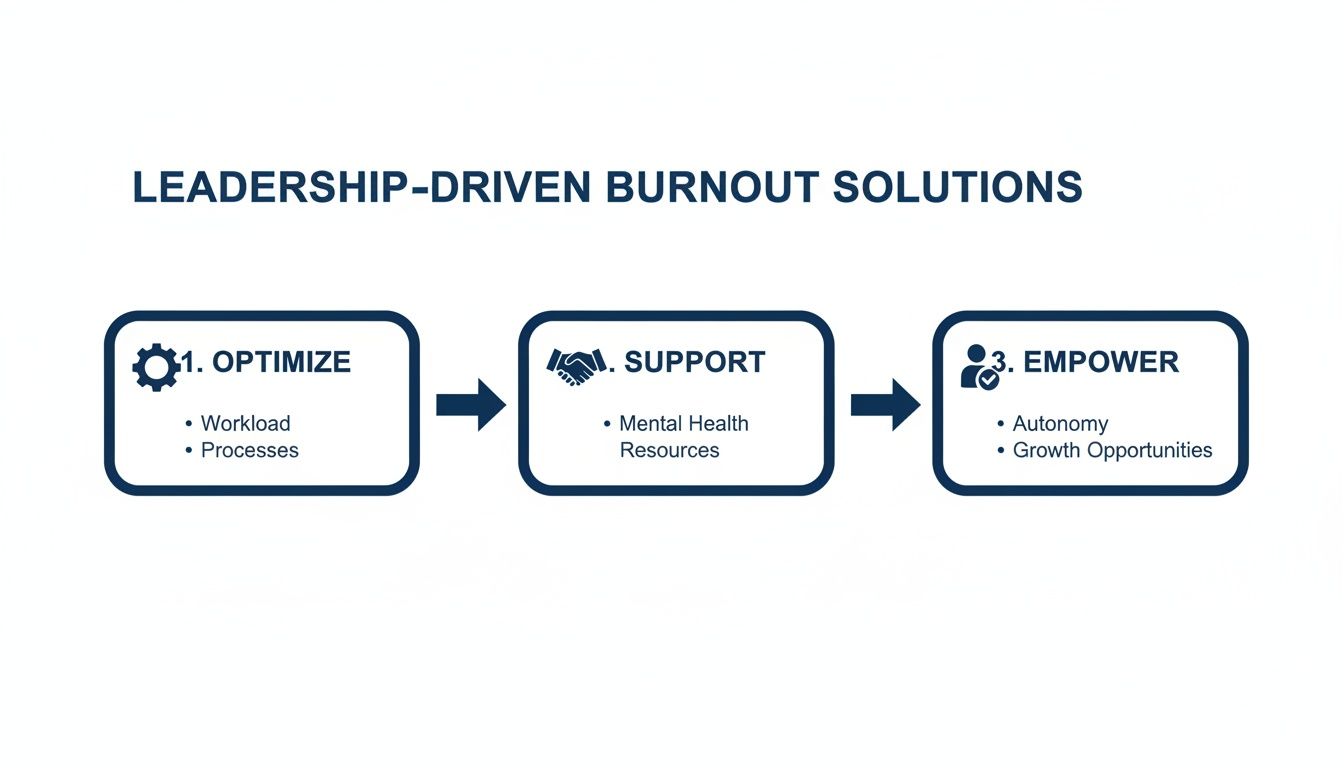
As the flowchart suggests, tech is most effective when it’s part of a broader strategy that includes organizational support and workflow optimization.
Automating the Administrative Burden
Hands down, the single biggest drain on a physician's time and energy is clinical documentation. AI-powered tools are now taking direct aim at this pain point by automating the most grueling tasks. Voice-first AI assistants can listen to a patient encounter, transcribe it in real time, draft a comprehensive clinical note, and even pull out key data points to populate the EHR.
This completely changes the dynamic of a visit. Instead of staring at a screen, typing and clicking, the doctor can maintain eye contact and have a real conversation, all while trusting the documentation is being handled accurately in the background.
To see just how different this is, let's compare the old way of doing things with an AI-assisted approach. The table below breaks down the stark contrast in workflow, time, and mental effort.
Comparison of Traditional vs AI-Powered Documentation Workflows
| Task | Traditional Workflow | AI-Powered Workflow |
|---|---|---|
| During Patient Visit | Physician types notes, clicks through templates, divides attention between patient and screen. | Physician has a natural conversation. AI ambiently listens and transcribes. |
| Time Spent During Visit | 5-10 minutes per patient of active documentation. | 0-1 minute for review or quick commands. |
| After-Hours Charting | Often requires 1-2 hours of "pajama time" to finish notes and orders. | Most notes are drafted and ready for sign-off by the end of the encounter. |
| Note Quality | Variable quality, prone to errors from multitasking, often relies on templates. | Consistent, structured, and comprehensive notes based on the actual conversation. |
| Physician Focus | Split between patient care and clerical tasks, leading to cognitive strain. | Fully dedicated to the patient, improving diagnosis and building rapport. |
The difference is clear. AI doesn't just speed up a task; it fundamentally changes the nature of the work, shifting the focus from clerical duty back to clinical care. This isn't just a minor improvement—it's a lifeline.
A Measurable Return on Investment
Implementing new technology obviously comes with a cost, but the return is tangible. Slashing documentation time isn't just a wellness perk; it’s a massive operational gain. That recovered time can be reinvested into seeing more patients, spending more quality time with existing ones, or—critically—letting physicians go home at a reasonable hour.
The data is piling up: doctors using these AI tools consistently report higher job satisfaction and lower burnout. By directly addressing the administrative tasks that 61% of physicians name as their top stressor, AI has become one of the most practical and promising physician burnout solutions available. For clinicians looking to see how these tools work in practice, learning more about dictation for doctors is a great next step.
Empowering Physicians with Resilience and Self-Advocacy Tools

While fixing the system is the ultimate goal, we can't ignore the individual physicians who are struggling right now. They need a practical toolkit to protect their well-being. This isn't about blaming doctors for a systemic problem; it’s about giving them personal armor to withstand the immense pressures of the job.
Think of it this way: a firefighter needs a fireproof suit (that’s individual resilience) just as much as a functioning fire hose and a solid team (that’s organizational support). One without the other just doesn't work. These self-advocacy and resilience tools are about equipping physicians with concrete steps to preserve their energy, passion, and sense of purpose.
These strategies are crucial for everyone, but we have to acknowledge the gender disparity in the burnout crisis. A staggering 63% of female physicians report burnout, compared to 46% of their male colleagues. This gap highlights the need for equitable support and targeted strategies. For a deeper dive into these numbers, you can find some great physician burnout insights at CTILeadership.com.
Cultivating Mindfulness and Presence
One of the first things burnout steals is your ability to be present. You're physically in the room, but your mind is racing through charts, labs, and the next patient. Mindfulness is simply the practice of gently pulling your attention back to the here and now, and it’s a powerful antidote to that constant cognitive overload.
This doesn't mean you need to find an hour for silent meditation. It can be as simple as taking three deep, intentional breaths before you walk into a patient's room. That small reset can clear the mental clutter, sharpen your focus, and help you connect more deeply with the person in front of you.
Another powerful technique is a quick "values audit." Once a week, take just a few minutes to think about why you went into medicine in the first place. Reconnecting with that core purpose can reframe a brutal day from a list of draining tasks into a series of meaningful actions, helping to bring back that lost sense of accomplishment.
Setting and Defending Boundaries
In a profession built on service, the word "no" can feel foreign. But learning to say it is essential for survival. Setting effective boundaries is the skill that separates a sustainable career from a rapid flameout.
Boundaries aren't walls you build to keep people out. They are clear lines that protect your time, energy, and well-being so you have enough left to give your patients the best care.
This means making conscious, deliberate decisions to protect your personal life:
- Create Digital Firewalls: Decide on specific times you’ll check non-urgent work messages, and then log off. Resist the urge to be available 24/7.
- Protect Your Downtime: Schedule time for family, exercise, or hobbies with the same commitment you give a patient appointment. Put it on the calendar and honor it.
- Learn to Delegate: Politely but firmly hand off tasks that don't absolutely require a physician’s expertise. This empowers your team and frees you up for the work only you can do.
The Power of Professional Support Networks
Burnout thrives in isolation. That feeling that you're the only one struggling is a powerful accelerant for emotional exhaustion and cynicism. One of the most effective physician burnout solutions is to build and lean on a strong professional support network.
This doesn't have to be complicated. Your network can take many forms:
- Peer Groups: Get together with colleagues regularly—formally or just for coffee—to talk through tough cases and share experiences in a safe space.
- Mentorship: Find a more experienced physician who can offer perspective, guidance, and a safe sounding board when things get tough.
- Professional Coaching: Work with a coach who specializes in physician well-being to develop specific coping strategies and navigate career challenges.
These connections break the cycle of isolation. They create a sense of shared humanity, validating the immense challenges of the job and reminding you that you are not alone. You can find more strategies for building these networks in our guide on preventing burnout in healthcare.
Weaving Well-Being into the Fabric of Your Organization
Let's be clear: a one-day wellness seminar or a new meditation app isn't going to solve a crisis that took decades to build. The real goal is to get past the band-aid solutions and fundamentally reshape the culture. We need to embed physician well-being so deeply into the organization's DNA that it becomes second nature.
This requires a total mindset shift—moving away from reactive crisis management and toward a proactive, unwavering commitment to supporting your clinical staff. It's about building a system of continuous improvement, where you're constantly listening, learning, and fine-tuning your approach based on what your physicians are actually experiencing.
If You Don't Measure It, You Can't Fix It
Vague goals like "improve wellness" are destined to fail. To make real, sustainable change, you have to get specific and track tangible metrics that tell you the true story of your clinical environment.
Think of these key performance indicators (KPIs) as the vital signs for your organization's health:
- Physician Satisfaction Surveys: You can't fix what you don't know is broken. Regular, truly confidential surveys are essential for getting honest feedback on workload, leadership, and stress levels.
- Turnover and Retention Rates: Nothing screams "toxic work environment" louder than a revolving door of clinicians. This number is a direct reflection of the real-world cost of burnout.
- EHR Usage Analytics: Data doesn't lie. Tracking metrics like "pajama time"—the hours spent charting after clinic—gives you a hard number for the administrative burden and shows whether interventions like AI scribes are actually helping.
Creating a Cycle of Continuous Improvement
Collecting data is just the first step. The magic happens when you use that information to drive meaningful action. A sustainable culture of well-being is built on a constant cycle of measuring, analyzing, and adapting. This ensures your strategies evolve right alongside the needs of your team.
The process is straightforward but powerful:
- Gather the Data: Consistently collect your metrics and qualitative feedback.
- Find the Patterns: Dig into the numbers. Is burnout spiking in one department? Did a new scheduling protocol tank morale?
- Launch Targeted Fixes: Use what you've learned to roll out solutions that address the specific pain points you uncovered.
- Measure Again: After a reasonable time, go back to your KPIs. Did the intervention work? What's next? Then, you start the cycle all over again.
When you take this approach, well-being stops being a special project managed by HR and becomes a core part of your operational strategy.
An investment in physician well-being is a direct investment in patient outcomes. A supported, engaged, and resilient physician workforce is the foundation of high-quality, compassionate care.
Ultimately, this profound cultural shift delivers incredible returns. While recent data shows the physician burnout rate has dipped to 53%, that figure is still a staggering 82% higher than in other professions. This isn't just a morale problem; it's a workforce crisis that threatens to deepen a projected shortage of 86,000 physicians by 2036. You can dig deeper into the latest physician burnout statistics and trends to understand the full scope of the challenge.
By building a culture that fiercely protects its clinicians, healthcare organizations do more than just improve retention. They strengthen patient safety and build a more resilient healthcare system for everyone involved.
Your Questions About Physician Burnout Solutions, Answered
When you're staring down the physician burnout crisis, it’s easy to feel overwhelmed. Where do you even begin? What really works? Here are some straightforward answers to the questions we hear most often from healthcare leaders and clinicians on the front lines.
What’s the Single Most Effective First Step to Take?
If you’re looking for the biggest impact right out of the gate, aggressively cut down the administrative burden. This is the low-hanging fruit that makes an immediate difference in a physician's day.
Start by getting a clear picture of the problem. You can’t fix what you can’t measure, so run a survey or even a simple time-motion study to see exactly how many hours your team loses to the EHR and paperwork each week. That data isn't just an eye-opener; it's the foundation for a powerful business case to justify new investments.
Once you have the numbers, implement a solution that offers immediate relief. Bringing in medical scribes or a high-quality AI documentation tool directly attacks the single most-cited cause of burnout. This gives your physicians a tangible win and shows that leadership is serious about making real change, not just talking about it.
How Can Smaller Practices Implement Solutions on a Tight Budget?
You don't need a massive budget to make a difference. Smaller practices should focus on low-cost, high-impact changes to their daily workflow.
A great starting point is to empower your medical assistants to take on more responsibility, like pre-charting for upcoming visits, handling routine patient messages, and processing prescription refills. This frees up an enormous amount of physician time and mental energy. Also, instituting a quick, five-minute "team huddle" each morning to run through the day's schedule costs nothing but dramatically improves communication and efficiency.
When it comes to technology, look for scalable AI tools with affordable monthly subscriptions instead of hefty upfront price tags. Most importantly, build a culture of genuine support. Regular, informal check-ins don’t cost a dime but go a long way in fighting the isolation that so often fuels burnout.
An effective strategy must combine individual support with deep organizational changes. Relying solely on resilience incorrectly places the burden on the physician to adapt to a broken system, which is an unsustainable and unfair expectation.
Are Individual Resilience Programs Enough on Their Own?
Absolutely not. While programs focused on individual resilience—like mindfulness training and stress management workshops—are beneficial, they are not a standalone fix. Think of them as one tool in a much larger toolbox.
These programs give physicians valuable skills to cope with the inherent pressures of medicine, which is incredibly important. But they do nothing to repair the systemic flaws that are the real source of the problem: crushing workloads, administrative overload, and clunky systems.
Resilience training is a necessary piece of the puzzle, but it must be paired with a serious commitment to fundamental organizational change. Without that two-pronged approach, you're just asking physicians to become better at surviving in a broken environment.
At Whisperit, we're focused on tackling the root causes of burnout by eliminating administrative friction. Our voice-first AI workspace automates the tedious work of documentation and drafting, giving clinicians back their time and focus. Learn how we can help create a calmer, more sustainable workflow for your team at https://whisperit.ai.