
Mastering Online Legal Document Review with AI
The image of paralegals surrounded by mountains of document boxes is a classic legal trope, but it’s one that’s quickly becoming a relic of the past. Today, online legal document review is powered by sophisticated AI, turning what was once a monumental chore into a genuine strategic advantage for teams in legal, healthcare, and compliance. Making this switch from old-school manual methods to modern, cloud-based platforms isn't just a good idea—it's essential for anyone dealing with today's massive data volumes.
The Shift From Manual Review To Intelligent Platforms

Let's be honest: manual review just doesn't scale. Modern litigation and compliance work demands a speed and accuracy that humans alone can't sustain. Legal teams are constantly under the gun to process huge amounts of information, and the risk of human error—not to mention the staggering cost—becomes a major hurdle.
This is where AI-powered analysis, automated tagging, and secure collaboration tools come in. They completely change the game. Instead of a slow, one-document-at-a-time slog, these platforms enable a smarter, more dynamic workflow from the very beginning.
Why This Matters For Modern Teams
This isn't just about shaving a few hours off a project; it's about gaining a serious competitive advantage. Think about high-stakes litigation where millions of documents are in play. A recent survey highlighted this trend, finding that 26% of firms are already planning to use AI for document review. A whopping 77% believe AI will have a massive impact on the legal field within the next five years.
Why the rush to adopt? Because the right tools can perform this work up to 80 times faster than traditional methods. You can learn more about these legal tech trends from this recent analysis.
To see the difference in black and white, here's a quick comparison of the old way versus the new.
Manual vs AI-Powered Document Review
| Feature | Manual Review | Online AI-Powered Review |
|---|---|---|
| Speed | Extremely slow, linear process | Up to 80x faster, processes thousands of documents in minutes |
| Accuracy | Prone to human error, fatigue, and inconsistency | Highly consistent with advanced pattern and concept recognition |
| Cost | High labor costs, billed by the hour | Lower overall cost, predictable subscription or project-based pricing |
| Scalability | Poor; requires adding more people for larger projects | Excellent; easily scales to handle millions of documents |
| Insights | Limited to what a human reviewer can spot and connect | Identifies hidden patterns, concepts, and relationships across data |
Ultimately, AI-powered platforms deliver a level of speed and insight that manual review just can't match, freeing up legal professionals to focus on strategy.
The core benefit here is shifting from a reactive task to a proactive strategy. You stop just searching for keywords and start uncovering concepts, identifying patterns, and building a much stronger case right from the start.
Figuring out how to make this transition is key. For a more detailed walkthrough, check out our guide on the modern document review process. When your team embraces these tools, they can finally stop drowning in administrative tasks and start focusing on the high-value legal strategy that actually wins cases.
Decoding the Features of Top Review Platforms
When you're looking at an online legal document review platform, it's easy to get bogged down by all the talk about "AI." The real trick is to cut through the marketing fluff and pinpoint the specific features that actually solve your problems. Let's be honest, basic keyword search just doesn't cut it anymore. The best systems offer far more sophisticated tools.
Picture this: you're a compliance officer digging into a potential policy breach. You could spend days sifting through thousands of emails for specific keywords, but that's a slow and often frustrating process. A much smarter approach is concept clustering. This is where the platform's AI groups documents by theme, even if they use different words. Suddenly, every email, memo, and chat related to "Project Titan" is neatly bundled together, ready for you to review.
Going Beyond Basic Search
It’s the advanced search and analysis tools that truly separate a simple document dump from a powerful investigative platform. These are the features designed to surface connections and patterns that a human reviewer would almost certainly miss.
Here are a few of the most important capabilities to look for:
- Predictive Coding: This is often called Technology-Assisted Review (TAR), and it's a game-changer. The system actually learns from your decisions. As you mark documents "relevant" or "not relevant," the AI figures out your criteria and starts categorizing the rest of the documents on its own, which can slash review time.
- Advanced Search Operators: You need the power to run complex, specific searches. Think about searching for "Project Alpha" but filtering out any mention of "budget," or isolating all documents sent between two key people during a specific week.
- Email Threading and Near-Duplicate Detection: These are your clean-up crew. They organize messy email chains into single, easy-to-follow conversations and flag documents that are virtually identical. This alone stops your team from wasting time reviewing the same information over and over.
A senior paralegal once told me, "Near-duplicate detection saved us over 100 review hours on a single case. It found dozens of draft contracts that were 99% the same, letting us focus only on the final, executed version."
From Features to Practical Application
These aren't just fancy bells and whistles; they have a direct impact on your work. A litigation team can use TAR to shrink a pool of millions of documents down to a manageable set for human eyes, saving a massive amount of time and client money.
For teams working with sensitive data, automated redaction tools can find and black out personal information or privileged content across thousands of pages in just a few minutes—a task that would take a person days.
The goal is to find a platform that matches what you actually do. Knowing what these core features are means you can ask the right questions during a demo. For a closer look at how these tools work with specific legal agreements, our guide on contract review software offers some great examples.
Ultimately, the best platform is one that turns a chaotic mountain of data into a structured, searchable, and genuinely useful asset.
How to Weave AI Review into Your Workflow
Bringing a new tool into a well-oiled legal process can feel daunting. But when it comes to online legal document review platforms, a smart rollout can completely change the game for your team. Think of it less as a replacement for your people and more as a powerful new partner. You'll see your team get faster, more accurate, and better prepared for even the most complex cases.
The first move is to map out your data management strategy. Before a single document gets uploaded, you need to nail down your project-specific tagging rules and user permissions. Picture a mid-sized firm buried in a complex litigation case—you need to decide who can see sensitive files, who gets to apply privilege tags, and what the core issues are for coding. Getting this right from the start prevents a world of confusion down the line and keeps everyone on the same page.
Building a Hybrid Human-AI Process
The real magic happens when you create a system where the tech and your team's expertise play off each other. AI is fantastic at the initial grunt work—sifting through mountains of irrelevant files, grouping similar concepts, and flagging key terms. This frees up your legal professionals to spend their time on what really matters: strategic analysis and the kind of nuanced judgment calls that only a human can make.
A great workflow often boils down to a simple, effective cycle of searching, clustering, and coding.
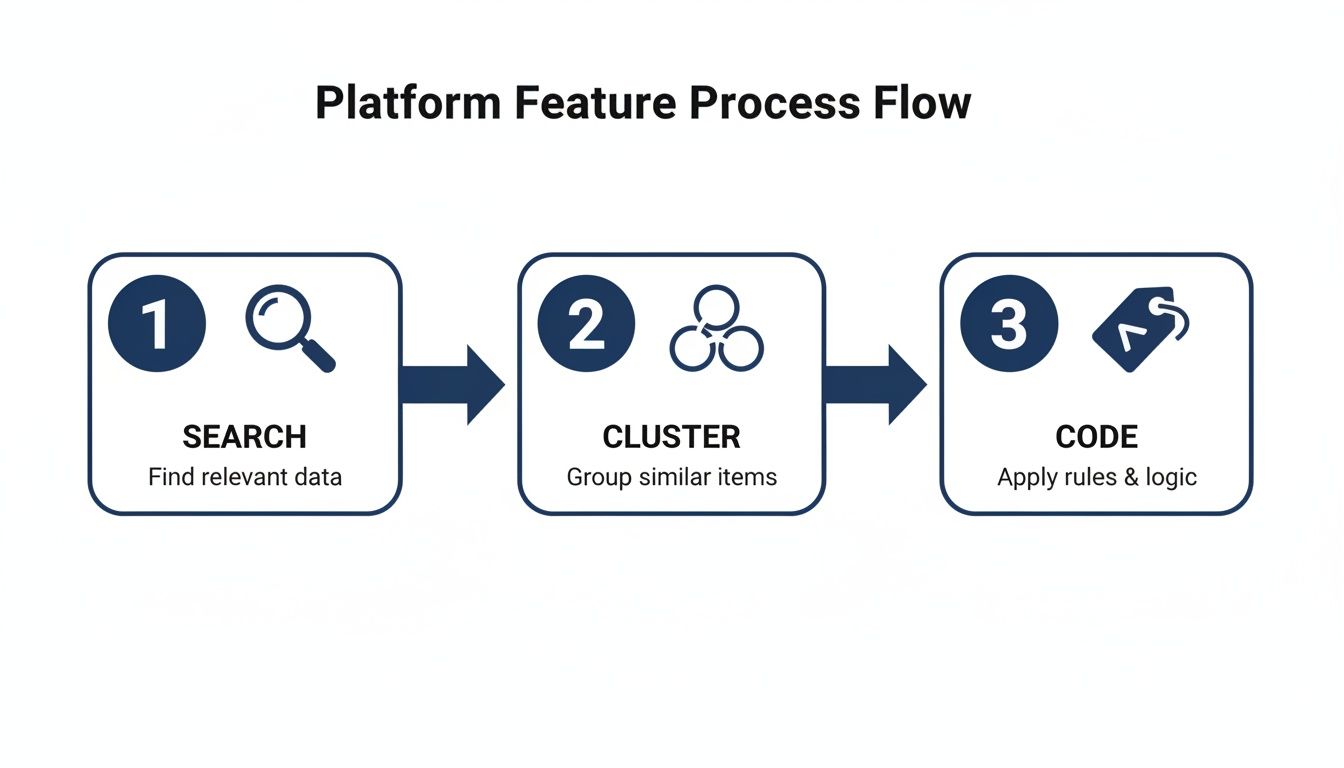
As you can see, the AI first helps you surface the relevant data and then bundles related documents together. This makes the job of applying the right codes and tags so much easier for your human reviewers.
This hybrid model is quickly becoming the new norm. In fact, corporate legal departments have more than doubled their use of these tools, jumping from 23% to 52% in just a single year. The efficiency boost is just too big to ignore. Still, human oversight is absolutely essential—AI is a powerful assistant, not an infallible judge.
Getting Your Team On Board
A smooth integration really comes down to two things: training and quality control. I always recommend starting small. Train a handful of "power users" first; they can become champions for the platform and help guide their colleagues. Run a pilot project on a smaller, less critical case to iron out any kinks before you roll it out firm-wide.
Quality control isn't just about spotting the AI's mistakes. It's about making the AI smarter. Every time a human reviewer corrects a tag suggested by the AI, the system learns from it. That means it gets more accurate with every batch of documents it sees.
This constant feedback loop is what makes the hybrid approach so powerful over time. For a real-world look at how this can be implemented, check out FMG's project on Documents Research AI.
Ultimately, the goal is to build a smarter workflow, not just a faster one. If you're looking to take your process optimization even further, our guide on designing AI agent workflows has some great strategies. By pairing intelligent technology with your skilled legal team, you build a system that delivers better results from start to finish.
Staying Secure and Compliant with Your Data
When you're sifting through legal documents online, you're handling some of the most sensitive information imaginable. This isn't a place to cut corners—data security and compliance are absolutely non-negotiable. It's not just about keeping data safe; it's about following strict laws like GDPR and HIPAA that come with massive penalties for getting it wrong.
The platform you choose has to live up to this challenge. Sure, features like end-to-end encryption are a good start, but you need to go further. A huge consideration for many firms is where the data actually lives. For maintaining regulatory compliance and data sovereignty, having your data hosted in Switzerland or the EU is often a make-or-break requirement.
What to Ask Your Tech Provider About Security
Before you even think about signing a contract, you need to grill potential vendors on their security practices. Vetting a platform’s security framework isn't just a box-ticking exercise; it's fundamental to protecting your clients and your reputation.
Here are the questions I always start with:
- Data Residency: Can you give me an iron-clad guarantee that my data will never leave a specific jurisdiction, like the EU?
- Breach Protocols: Walk me through your exact, documented plan if a data breach happens. What are the steps?
- Security Audits: Do you have regular, independent security audits done? Something like a SOC 2 report?
- Encryption Standards: Get specific. What encryption protocols do you use to protect our data both when it's moving and when it's sitting on your servers?
Getting clear, confident answers here is essential. If you want to get more familiar with what's involved, our article explaining SOC 2 compliance requirements breaks it all down.
The legal world is under constant pressure to do more with less, and that’s changing how eDiscovery gets done. We need tools that help us run accurate checks faster without ever compromising confidentiality. With corporate AI adoption now at 52%, the smart money is on secure, hybrid approaches. You use AI for its raw speed and a human expert for the critical nuance, all while keeping data safe and staying in line with GDPR.
Picture a healthcare organization reviewing patient records for a big audit. By using a GDPR-compliant platform, every piece of protected health information (PHI) is locked down in a secure, encrypted workspace, shielded from prying eyes from start to finish.
Any time you bring AI into the legal tech stack, you have to be ready to tackle the regulatory side. You can get a much better handle on these issues by reading A Practical AI GDPR Compliance Guide. It's a great way to make sure the tool you choose doesn't just make you more efficient but also strengthens your firm's commitment to protecting client data.
Driving Real ROI with Smart Review Strategies

Simply buying an online legal document review platform won’t magically solve all your problems. The real value—the return on investment you're looking for—comes from weaving its features into a smart, proactive strategy. It's about shifting your mindset from just getting through documents to managing the entire process with data.
Many of these tools come loaded with powerful analytics and reporting dashboards. Don't let them go to waste. Use these features to keep a pulse on everything from team productivity and project timelines to ballooning costs. This is where you'll find the insights that lead to better project management and pinpoint where you can become more efficient.
Create an Intelligent Feedback Loop
One of the most effective ways to maximize your investment is by creating a feedback loop. Think of it as a partnership with the AI. Every time your team corrects one of the platform's suggestions, the model learns. It gets smarter and more attuned to your specific needs with each interaction.
This turns the software from a simple tool into an evolving asset. It’s no longer just a static piece of tech; it's a dynamic system that continuously improves.
For example, imagine a legal team handling due diligence for a major merger. They can train the AI to flag very specific types of clauses or risks unique to that industry. By the next deal, the system is already much faster and more accurate, slashing review time.
This iterative approach is key. It ensures the platform's value grows over time, leading to smarter resource allocation optimization and a clear, measurable return.
We Answer Your Top Questions About Online Document Review
Switching to a new platform always brings up a few questions. And when it’s something as critical as your online legal document review process, you absolutely need solid answers before you jump in. Let’s tackle some of the most common questions we hear from legal pros just like you.
Can AI Actually Replace a Human Reviewer?
The short answer is no—and that’s a good thing. The real power comes from a hybrid approach where AI does the heavy lifting. It can sift through massive volumes of documents, culling irrelevant files and flagging the important stuff at a speed no human team could ever match.
Think of it as a force multiplier. The AI handles the scale, while your lawyers provide the final, strategic analysis. It’s not about replacing legal expertise; it's about amplifying it. The nuanced judgment and critical thinking of a seasoned attorney are still irreplaceable for that final quality control.
How Do These Platforms Deal with All My Different Data Sources?
Modern review platforms are built to handle the messy reality of today’s data. They can pull in and process information from a huge range of sources. We're talking about everything from standard Office documents and email archives (like PST files) to chat messages from platforms like Slack or Microsoft Teams.
The software is designed to automatically pull out the text and metadata from all these different file types, organizing it all into one searchable database. This is a game-changer when you're trying to piece together a story from a jumble of different communication channels.
What Should I Expect an Online Document Review Service to Cost?
Pricing can vary quite a bit between providers, but you'll often see a blend of a few key components. Typically, this includes data hosting fees, which are usually charged per gigabyte, per month, along with a license fee for each user who needs access. Some platforms might also have an initial, one-time charge for processing the data when it’s first loaded into the system.
The good news? The rise of cloud-based platforms has made these powerful tools much more affordable and accessible, putting them well within reach for firms of all sizes, not just the massive ones. Before you sign anything, always ask for a detailed pricing breakdown so you can see every potential cost upfront.
At Whisperit, we've built a voice-first AI workspace that brings your entire legal workflow together—from dictation and drafting to review and collaboration. See for yourself how you can move from intake to export in fewer steps at https://whisperit.ai.