
A Practical Guide to Medical Record Documentation Guidelines
Medical record documentation guidelines are the bedrock of modern healthcare. They're the established rules of the road for how we record, manage, and protect patient information. Following these standards ensures every record tells a complete, accurate, and chronological story of a patient's care—something that’s non-negotiable for legal compliance, proper billing, and most importantly, patient safety.
Why Medical Documentation Is So Much More Than Just Paperwork
It's easy to see medical records as just another administrative chore, but that’s a dangerous oversimplification. A patient's chart is the central blueprint for their entire healthcare journey. It's the one document that connects every doctor, specialist, and treatment decision. When that blueprint is messy or incomplete, communication breaks down, and the risk of serious errors skyrockets.
Think of it like a pilot's flight plan. Before taking off, a pilot relies on a detailed plan mapping out the route, weather, and fuel calculations. Flying without one would be unthinkable. A patient’s medical record is their clinical flight plan—it guides every decision, ensuring a safe and continuous journey from one provider to the next.
The Foundational Pillars of Good Documentation
Three core principles really hold up the integrity of every medical record. Nail these, and you transform a simple collection of notes into a powerful clinical tool. This isn't just about box-ticking; it's about protecting your patients and your practice.
- Accuracy: The record has to reflect exactly what you observed, assessed, and did. From vital signs to medication dosages, every detail must be precise. There's no room for guesswork here, as a simple misinterpretation can lead to major medical errors.
- Completeness: A partial story is a dangerous one. A complete record captures the entire clinical picture—patient history, exam findings, test results, treatment plans, and all patient communication. For more on this, check out our guide on organizing medical records.
- Timeliness: Old information is useless information. Documenting care as it happens, or as close to it as possible, ensures every decision is based on the most current data available.
This focus on structured record-keeping isn't new. The push for standardization actually started over a century ago. Back in 1918, the American College of Surgery began advocating for standardized patient data to better track treatment outcomes. By 1919, the concept of a "treatment diary" was introduced, paving the way for the detailed records we rely on today. You can read more about the fascinating evolution of medical documentation and how we got here.
At the end of the day, a well-documented medical record is the primary evidence of care. It tells a coherent story that backs up your clinical judgment, justifies billing, and stands as your single most important defense if a legal challenge ever comes your way.
The Anatomy of a Compliant Medical Record
So, what really goes into a comprehensive medical record? It's much less like a simple file and more like a detailed biography of a patient's health journey. Each entry has to build on the last, creating a coherent story that guides clinical decisions and keeps care consistent. Following medical record documentation guidelines isn't just about checking boxes; it’s about building a clear, legally sound, and clinically useful narrative.
The trick is turning those abstract requirements into a practical checklist. Every single clinical interaction, from a routine check-up to a complex surgery, needs to be documented with a specific set of components. These elements are designed to work together to give anyone who reads the chart a complete and actionable picture of the patient's condition.
Core Components of Every Patient Chart
A compliant record is built on a foundation of distinct, yet interconnected, sections. Think of them as building blocks. Each one has a specific job, from simply identifying the patient to outlining the entire course of future treatment. If you miss even one piece, you can create dangerous gaps in understanding.
Let's break down the fundamentals:
- Patient Demographics: This is the "who." It covers the patient's name, date of birth, contact information, and insurance details. Getting this right is absolutely crucial for basic identification, billing, and communication.
- Chief Complaint (CC): This is the patient’s story in their own words—the main reason they came in. It sets the stage for the entire encounter, and you should document it verbatim whenever you can.
- History of Present Illness (HPI): The HPI is where you flesh out the chief complaint. It’s a chronological account of the problem, detailing things like location, quality, severity, duration, timing, context, modifying factors, and any associated signs or symptoms.
These first few elements frame the whole visit, giving you the essential context you need before even starting a physical exam. From there, the record moves into the clinician's objective findings and professional assessments.
The flowchart below shows how the pillars of quality documentation—accuracy, completeness, and timeliness—all come together to support the real goal: exceptional patient care.
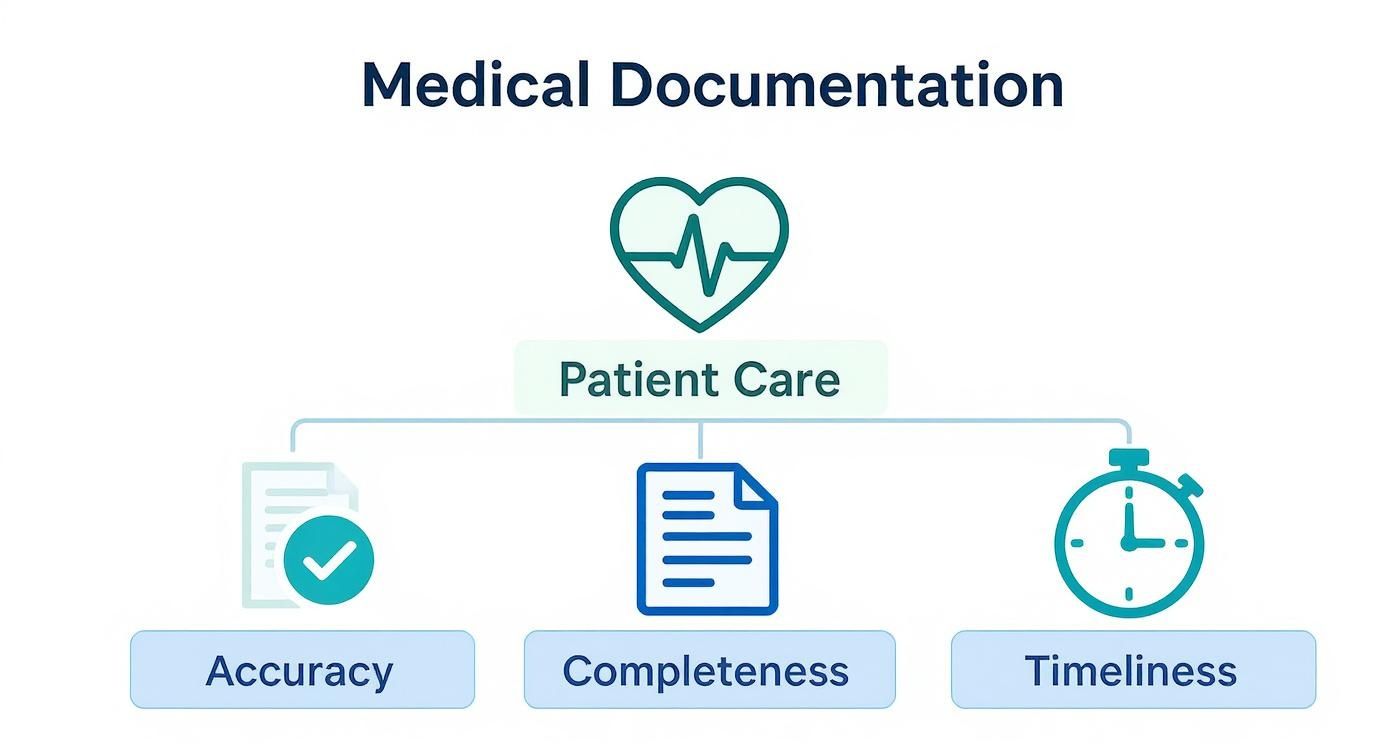
This visual is a great reminder that without a solid base of accurate, complete, and timely records, the entire structure of patient care can be shaky.
To help organize these components, here's a table summarizing what's needed and why.
Essential Elements of Medical Record Documentation
| Component | Purpose | Example Information |
|---|---|---|
| Patient Demographics | Identifies the patient and provides contact/billing info. | Name, DOB, address, phone, insurance ID. |
| Chief Complaint (CC) | States the patient's reason for the visit in their own words. | "I've had a sharp pain in my right side for two days." |
| History of Present Illness (HPI) | Provides a detailed narrative of the chief complaint. | Onset, duration, severity (1-10), what makes it better/worse. |
| Review of Systems (ROS) | Screens for other symptoms across all body systems. | Questions about cardiovascular, respiratory, GI symptoms, etc. |
| Past, Family, Social History (PMFSH) | Gives a broader context of the patient's overall health. | Past surgeries, family history of heart disease, occupation. |
| Physical Examination Findings | Documents objective findings from the clinician's exam. | Vital signs, heart and lung sounds, abdominal tenderness. |
| Assessment & Diagnosis | Synthesizes all data into a clinical conclusion. | "Acute appendicitis" or a list of differential diagnoses. |
| Plan of Care | Outlines the next steps for treatment and follow-up. | Prescriptions, lab orders, referral to a surgeon, patient education. |
This table serves as a quick reference, ensuring no critical information is overlooked during documentation.
From Examination to Action Plan
Once you've established the patient's history, the documentation shifts to your direct observations and conclusions. This is where subjective patient reports meet objective clinical data, leading to a diagnosis and a clear treatment strategy.
The next essential steps in the record include:
- Review of Systems (ROS): A systematic inventory of body systems. You get this by asking a series of questions to uncover any other signs or symptoms the patient might be experiencing, even if they seem unrelated.
- Past Medical, Family, and Social History (PMFSH): This section gives you that broader health context. It includes past illnesses, surgeries, family health patterns, and relevant social factors like their job or lifestyle habits.
- Physical Examination Findings: Here, you record the objective, observable data you gathered during the physical exam. It needs to be detailed and specific to the systems you're examining.
- Assessment and Diagnosis: This is where you put all the pieces together. The clinician synthesizes all the information to land on a diagnosis or a list of possibilities (differential diagnoses). This is the "why"—your professional conclusion based on the evidence.
- Plan of Care: This final, crucial part outlines what happens next. It details the entire therapeutic plan, including any medications, further tests, specialist referrals, and patient education.
A well-structured medical record should read like a logical argument. The HPI and exam findings are the evidence, the assessment is the conclusion, and the plan is the recommended action. Each part must logically support the next.
For anyone looking to make this process more efficient, structured tools can be a game-changer. You can see how these components are organized by exploring different electronic medical record templates built for various specialties. For a deep dive into another type of structured medical document, check out a comprehensive guide to reading and understanding pathology reports, including their organization.
Meeting Legal and Regulatory Demands
Navigating the web of legal and regulatory rules is one of the toughest parts of working in healthcare. Following medical record documentation guidelines isn't just about good clinical practice—it's a legal minefield. These rules, set by bodies like the Centers for Medicare & Medicaid Services (CMS) and laws like HIPAA, are there to protect patients, ensure fair billing, and create a legally defensible account of the care you provide.
Think of your medical records as the star witness in a courtroom. If you ever face a malpractice claim, an audit, or a board inquiry, that documentation is your first and most powerful line of defense. A record that’s incomplete, inaccurate, or late can be twisted to look like evidence of substandard care, no matter how good the actual treatment was.
This is why creating a "legally defensible" record is so critical. It’s about making sure every entry is clear, objective, and compliant, telling a story that can withstand intense scrutiny from outsiders.
The Critical Role of Timeliness
One of the first things auditors and lawyers look at is timeliness. Entries made long after the fact immediately raise red flags about the accuracy and reliability of the information.
Regulators and legal experts often live by the principle, "If it wasn't documented in a timely manner, it didn't happen." This puts immense pressure on clinicians to get their findings and actions recorded promptly.
Deadlines aren't just suggestions; they are hard-and-fast rules with real consequences. For example, the US Centers for Medicare & Medicaid Services (CMS) requires that an initial history and physical exam be documented in a patient's record within 24 hours of admission or before any surgery. You can dig into the specific CMS documentation rules to see just how detailed these requirements get.
Meeting these deadlines isn’t just about compliance—it's a patient safety issue. It ensures the entire care team has the critical information they need, right when they need it.
Key Regulations You Must Know
While the rulebook for healthcare documentation is massive, a few key regulations form the foundation of compliance. Understanding what they're trying to achieve helps turn dense legal text into practical, everyday actions.
- HIPAA (Health Insurance Portability and Accountability Act): This is the bedrock of patient privacy. The HIPAA Privacy Rule controls who can see protected health information (PHI), while the Security Rule demands safeguards to protect electronic PHI (ePHI). Every single documentation practice you have must be built to prevent unauthorized access.
- CMS Guidelines: CMS sets the rules of the road for billing federal programs like Medicare and Medicaid. Their documentation requirements are notoriously specific and almost always circle back to medical necessity. Every single service you bill for must be clearly justified by what’s written in the patient’s chart.
- The Joint Commission (TJC): As a major accrediting body, TJC holds organizations to a high standard for quality and patient safety. Their documentation standards often go beyond federal minimums, zeroing in on clear communication, safe medication ordering (including their famous "Do Not Use" list of abbreviations), and ensuring continuity of care.
Adherence to these regulations is completely non-negotiable. A single HIPAA violation or a failed CMS audit can lead to crippling financial penalties, public reputational damage, and loss of accreditation—any of which could threaten an organization's ability to operate.
Building a Compliant Documentation Culture
Compliance isn't a task for a single department; it has to be baked into your facility's culture. Every person who puts their hands on a medical record needs to understand the legal weight of their actions. This starts with solid training and is kept alive by clear, easy-to-find policies.
For clinicians, this means really knowing the rules that govern your specific practice area, including state-level regulations, which can be even tougher than federal laws. If you're looking to tighten up your internal processes, our HIPAA compliance requirements checklist is a great place to start identifying and closing potential privacy and security gaps.
Ultimately, meeting these demands comes down to making compliance a natural part of the daily workflow. When proper documentation becomes second nature, you not only steer clear of legal trouble but also deliver safer, more effective, and better-coordinated care to your patients.
Best Practices for Modern EHR Documentation
Electronic Health Records (EHRs) have brought incredible efficiency to healthcare, but they also come with their own set of traps that can easily muddy a patient's story. Getting EHR documentation right means moving beyond basic data entry. It’s about developing specific habits to make sure every note is both compliant and clinically useful.
The biggest pitfall by far is note bloat. This is what happens when clinical notes get bogged down with long, repetitive, and often irrelevant information. The main culprit? The copy-paste function. It feels like a time-saver, but it can pull outdated or flat-out wrong information into a current note, creating a confusing and potentially dangerous patient record.
Another common issue is leaning too heavily on generic templates. Sure, templates give you structure, but they can also lead to a "check-the-box" mentality. The result is a note that lacks the specific details of what’s happening with this patient, right now. A record filled with default text doesn’t tell a person's story, which makes it less valuable for ongoing care and much weaker in a legal dispute.

Leveraging EHR Features Responsibly
The trick is to use EHR tools as a starting point, not as a replacement for your clinical judgment. Think of it as blending efficiency with precision. The technology should serve the patient's story, not the other way around. Following these modern medical record documentation guidelines will make a huge difference in the quality of your digital records.
Here are a few smart habits to build:
- Edit Before You Sign: Always give auto-populated data from templates or copy-pasted sections a once-over. Get rid of anything that isn't relevant to the current visit. Keep the note clean and to the point.
- Use Templates as a Guide, Not a Crutch: Start with a template to make sure you hit all the required points, but then weave in a personalized narrative. Your assessment and plan should always be tailored to reflect your clinical reasoning for that patient, on that day.
- Document in Real-Time: Whenever you can, document while you're with the patient. This simple practice cuts down on errors and ensures the information is fresh and accurate. You’ll capture nuances you might forget hours later.
In specialized fields like medical imaging, integrating these principles with radiology workflow management best practices is key to maintaining both speed and accuracy.
"Treat every copied or templated piece of text as unverified information until you have personally confirmed its accuracy and relevance for the current patient encounter. Your signature attests to the entire note, not just the parts you typed manually."
Understanding the Inescapable Audit Trail
Every modern EHR system has an audit trail—think of it as a digital footprint. This log records every single action taken within a patient's chart: who looked at it, what they saw, what they changed, and the exact time they did it. This trail is permanent and can't be altered.
The audit trail is a constant reminder that we need to be transparent and honest in our documentation. It makes things like back-dating an entry impossible and flags any strange activity, like someone viewing records without a legitimate medical reason.
Here’s why the audit trail is so critical:
- Promotes Accountability: Knowing every click is tracked naturally encourages everyone to follow privacy rules and act responsibly.
- Ensures Data Integrity: It gives you a verifiable history of the record, proving that the information hasn't been tampered with.
- Strengthens Legal Defense: If a lawsuit ever arises, a clean audit trail is powerful evidence that care was documented in a timely and appropriate manner.
Ultimately, mastering EHRs is about finding that sweet spot. These systems offer fantastic tools for efficiency, but that efficiency can never come at the cost of accuracy, completeness, or the patient's unique story. For more strategies on enhancing your notes, check out our guide on improving clinical documentation.
Avoiding Common and Costly Documentation Errors

In healthcare, a seemingly tiny documentation mistake can set off a massive chain reaction. A misplaced decimal, a vague note, or a missed detail can snowball into claim denials, patient harm, and serious legal trouble. The best way to think about documentation isn't as a chore, but as an active form of risk management that shields both your patients and your practice from preventable harm.
Small oversights create big problems. For example, if you forget to note that a patient refused a recommended test, it can look like you neglected to order it in the first place. This section is all about spotting and fixing the most frequent documentation pitfalls before they turn into expensive headaches.
The Dangers of Vague and Inconsistent Notes
One of the most damaging habits we see is writing notes that are vague or inconsistent. Entries like "patient doing better" or "continue with current plan" are clinical dead ends. They don't offer any real information to justify your care decisions or prove medical necessity to an auditor.
Inconsistency is just as bad. If your physical exam findings in one note contradict the patient's reported symptoms in another, you've created a confusing and unreliable record. This not only makes ongoing care a challenge but also destroys the record's credibility if it ever comes under legal scrutiny.
Key Takeaway: Every note in a medical record needs to tell a clear, consistent story backed by objective facts. If another clinician can't pick up your note and instantly understand the patient's status and your reasoning, it's not complete.
To fix this, always connect your assessment to specific, objective findings. Instead of writing "patient is breathing better," document "respiratory rate decreased from 24 to 18 breaths/minute, with no audible wheezing on auscultation." That level of detail creates a clear, defensible story of the patient's progress.
Misusing Abbreviations and Copy-Paste Functions
Abbreviations and EHR shortcuts seem like great time-savers on the surface, but they're breeding grounds for error. An unapproved or ambiguous abbreviation can lead to dangerous misinterpretations, especially with medication orders. It’s exactly why organizations like The Joint Commission maintain a "Do Not Use" list of abbreviations known to cause patient harm.
The copy-paste function, a feature in almost every EHR, carries a similar risk. While it feels efficient, it often carries forward outdated or irrelevant information, creating "note bloat" that buries the patient's current condition. A copied note might incorrectly show a resolved issue as active, leading the next provider to make a poor treatment decision. You can dive deeper into this issue in our detailed article on common documentation errors in healthcare.
Failing to Document Non-Compliance and Patient Communication
What you write down is important, but what you don't write down can be just as critical. A legally sound medical record captures the whole patient interaction, and that includes their own choices and actions.
This is especially vital when it comes to patient non-compliance. You have to meticulously document every time a patient:
- Refuses a recommended treatment or test.
- Fails to take their medication as prescribed.
- Misses follow-up appointments against medical advice.
This documentation is your proof that you provided the appropriate standard of care, but the patient chose a different path. Without it, you could be held responsible for negative outcomes that were completely out of your control. The same goes for patient education—always document what you explained and confirm the patient understood. It completes the picture of the entire encounter.
Your Top Documentation Questions, Answered
Even when you've got the basics down, you're bound to run into tricky situations in your day-to-day work. These are the kinds of specific, practical questions that can leave you second-guessing your documentation choices. Let's tackle some of the most common ones head-on.
Think of it like this: knowing how to drive is one thing, but knowing what to do at a confusing five-way intersection or when you hit an unexpected detour is what makes you a confident driver. This is the same idea. We're covering those specific scenarios to ensure you navigate them correctly and stay compliant.
How Should I Correct an Error in a Medical Record?
We all make mistakes. What really matters is how you fix them, because the integrity of the medical record is paramount. The right way to do it depends on whether you're working with old-school paper charts or a modern EHR.
- Paper Records: Whatever you do, don't reach for the white-out or scribble over the entry until it's unreadable. The proper method is to draw a single, clean line through the incorrect text, leaving it legible. Beside it, write "error" or "mistaken entry," then add your initials and the date. Finally, write the correct information.
- Electronic Health Records (EHR): Hitting "delete" is never an option. EHR systems are built with audit trails for a reason. Instead, you'll use the system's built-in function to create an addendum or amendment. This keeps the original, time-stamped note intact but links it to a new, signed, and dated entry containing the correction.
This transparent approach is your best defense. It shows you had nothing to hide and simply corrected a human error.
What’s the Difference Between a Late Entry and an Addendum?
This is a common point of confusion. Both are ways to add information after a note has been signed, but they have very different jobs and need to be labeled correctly to keep the patient's story straight.
A late entry is for something that was missed entirely. You forgot to document a key piece of information, and now you need to add it to the record. You must clearly label it "late entry" and include the date and time of the event you're describing, not just the time you're writing the note.
An addendum, on the other hand, is for clarification. It adds more detail or context to something already in the record. Maybe a lab result came back that puts earlier notes in a new light. You'd label it "addendum," and it gets its own time-stamp and signature, supplementing the original entry without changing it.
Here's an easy way to remember it: A late entry adds something forgotten. An addendum clarifies something already there. Both must be dated and signed when you write them.
How Long Do We Need to Keep Medical Records?
There’s no single, one-size-fits-all answer here, as retention rules are a mix of state and federal laws. But there are some solid guidelines you can follow to build a safe and compliant policy.
Most states mandate that records be kept for five to ten years after a patient's last visit. The rules for minors are often different; the clock on retention usually doesn't start ticking until they turn 18 or 21. On top of that, federal programs like Medicare might have their own requirements. The golden rule is to find the strictest applicable rule—state or federal—and build your policy around that.
Can I Use Abbreviations in My Clinical Notes?
Yes, but you have to be incredibly careful. While abbreviations can save time, they’re also a major source of medical errors.
The only safe way to use them is to stick strictly to your organization's approved list of abbreviations. No exceptions.
More importantly, you must completely avoid anything on The Joint Commission's "Do Not Use" list. These are abbreviations that have been directly linked to dangerous, sometimes fatal, misinterpretations. When you're even slightly in doubt, just write the full term out. Clarity always trumps speed, especially when patient safety is on the line.
At Whisperit, we build tools that help professionals create clear, consistent, and compliant documentation without the administrative burden. Our voice-first AI workspace is designed to handle the complexities of drafting, unifying dictation, research, and collaboration so you can focus on your core work. Discover a calmer, more efficient workflow at https://whisperit.ai.