
Discover legal research software: Boost Efficiency
Gone are the days of spending hours buried in dusty law library stacks. Today, legal research software acts as a supercharged, digital law library, giving legal professionals instant access to case law, statutes, regulations, and secondary sources. It’s less about replacing books and more about revolutionizing how legal arguments are built, using powerful search and AI-driven insights.
Why Modern Legal Research Software Is Essential
Trying to practice law today with old-school research methods is like trying to navigate a bustling metropolis with a folded paper map. You might get there eventually, but you’ll be slow, inefficient, and likely miss the brand-new highway that could have cut your travel time in half. That’s the reality of manual research in a world where the law changes daily.

Legal research software is the Waze or Google Maps for modern legal pros. It’s designed to solve the single biggest challenge in the field: managing an overwhelming and ever-expanding universe of legal information. It turns a painstaking manual chore into a dynamic, intelligent workflow.
The Shift From Physical Stacks To Digital Precision
The core problem these platforms tackle is one of sheer scale and speed. The body of law expands constantly, making it nearly impossible to keep up by hand. Software offers a centralized, living database that’s always current, ensuring you’re not building a case on outdated or overturned precedent.
This transition from physical to digital brings immediate, tangible benefits:
- Speed: You can pinpoint relevant case law in minutes, not days.
- Accuracy: Instantly check if a case is still good law with built-in tools like citators.
- Depth: Discover nuanced arguments and subtle connections between cases that manual research would almost certainly miss.
Modern software is built around the specific workflows of legal professionals. Exploring solutions tailored for law firms shows just how deeply these platforms understand and address the unique demands of the industry. It's not just about finding documents; it's about constructing a stronger, more defensible case strategy with unshakable confidence.
To see the difference clearly, let's break it down.
Traditional vs Modern Legal Research at a Glance
| Aspect | Traditional Research (Library) | Legal Research Software |
|---|---|---|
| Speed | Slow and manual; requires hours or days of searching through physical volumes. | Nearly instantaneous; search results appear in seconds. |
| Access | Limited to library hours and physical location; resources can be checked out or unavailable. | 24/7 access from any location with an internet connection. |
| Accuracy | Prone to human error; verifying sources (e.g., using Shepard's) is a separate, manual step. | Automated citators instantly flag bad law and show case history. |
| Scope | Limited to the library's collection; may lack niche or very recent materials. | Comprehensive databases with millions of documents, updated in real-time. |
| Cost | High overhead for physical space, subscriptions, and staff time. | Subscription-based models; high ROI through massive time savings. |
This comparison makes it obvious why the shift isn't just a trend—it's a fundamental evolution in how legal work gets done.
For a competitive law firm, high-quality legal research software is no longer a luxury—it's an indispensable operational asset. It directly impacts efficiency, case outcomes, and client satisfaction.
A Growing Market Driven By Necessity
The industry’s reliance on these tools is fueling explosive growth. The global legal research software market, valued at around $5 billion in 2025**, is on track to soar past **$12 billion by 2033. That’s a compound annual growth rate of roughly 12%.
This isn't just hype. The expansion is a direct response to the massive increase in legal data, the growing complexity of cases, and the widespread adoption of cloud and AI technologies. You can learn more about these market trends and their drivers in the full report.
What Really Makes the Top Legal Research Platforms Tick?
What separates a powerful legal research platform from a simple online search bar? It’s not just one thing, but a collection of smart, purpose-built features designed to cut through the complexity of the law. These tools are the engine that powers efficiency, accuracy, and strategic thinking in any modern legal practice.

Getting a feel for these features is the first step in understanding how this software can fundamentally change your daily work. Each one is built to solve a specific research problem, whether you're starting with a broad question or hunting down the fine details of a single citation. Let's break down the must-have components of any serious legal research software.
Natural Language and Boolean Search
Think of your search bar as having two different modes: a conversation and a command.
Natural language search is your conversational mode. It lets you ask questions in plain English, just like you’d ask a senior partner down the hall. For example, you could type, "What is the statute of limitations for medical malpractice in California involving a minor?" The software is smart enough to grasp your intent and pull up relevant statutes and cases, no complex legal jargon needed.
Boolean search, on the other hand, is your command mode. This is for when you need surgical precision. Using operators like AND, OR, NOT, and proximity connectors (like /p for "in the same paragraph"), you can build incredibly specific queries. A Boolean search might look like: (malpractice OR negligence) /p (physician OR doctor) AND "statute of limitations". That level of control is absolutely critical when you need to zero in on specific results in a crowded area of law.
The Critical Role of Citators
A citator is your ultimate reality check. Imagine finding a case that perfectly supports your argument. Great, right? But what if it was overturned on appeal six months ago? Citing it wouldn't just weaken your motion; it could seriously damage your credibility with the court.
A citator is like a case's "health report." It instantly tells you if the case is still considered good law, making it one of the most indispensable tools in your research arsenal.
Platforms like LexisNexis and Westlaw integrate powerful citators (Shepard's and KeyCite, respectively) that track a case's entire history. They use simple visual cues—a red flag for negative treatment or a green plus for positive—to give you an immediate heads-up. For any serious legal work, this feature is non-negotiable.
AI-Powered Summarization and Analysis
Let's be honest, the sheer volume of text in legal documents is daunting. Slogging through a 50-page opinion just to find a couple of relevant paragraphs is a massive time sink. This is exactly where AI-powered case summarization changes the game.
With just a click, these AI tools can break down a lengthy ruling into its most important parts:
- Key Issues: What legal questions was the court actually trying to answer?
- Procedural History: How did the case even get to this court?
- Holding: What was the court's final decision?
- Core Reasoning: What was the logic that got them there?
This lets you figure out if a case is relevant in seconds instead of hours, which makes the early stages of your research so much faster. Many platforms are now also using AI to highlight the most-cited passages within a document, pointing you straight to the language that other courts have found most persuasive. Our guide on various legal search solutions offers more context on how different platforms are tackling these challenges.
These core features—advanced search, reliable citators, and smart analysis—all work together to create a research environment that is fast, precise, and genuinely insightful. They turn legal research from a reactive hunt for documents into a proactive process for building a winning case.
How AI Is Changing the Game in Legal Research
Let's get one thing straight: AI in legal research isn't about replacing lawyers. A better way to think about it is like getting a brilliant, tireless research assistant—one who can read millions of documents in seconds, understand legal context, and spot connections you might have otherwise missed. This AI doesn't argue cases; it empowers the human expert who does.
The move toward AI-driven legal research software is a huge leap from the old days of simple keyword searching. It takes the grunt work out of gathering information, freeing up legal professionals to focus on what truly matters: high-level strategy, client advocacy, and crafting winning arguments.
This shift is why we're seeing so much investment pour into legal tech. The legal AI market alone was valued at $1.9 billion in 2024 and is expected to grow at a 13.1% CAGR between 2025 and 2034. That kind of money shows real confidence in AI's ability to deliver results. You can dig deeper into the numbers with the full legal technology market research from Precedence Research.
Semantic Search: Understanding Concepts, Not Just Keywords
Traditional search engines are painfully literal. You search for "automobile accident liability," and you get results with those exact words. But what about a case that uses "motor vehicle collision" or "driver negligence"? A keyword search would blow right past it.
This is where semantic search completely changes things. Instead of just matching words, AI-powered semantic search understands the meaning behind your query. It gets the concepts and the relationships between different legal terms.
This means you can unearth highly relevant documents even if they don't use your exact phrasing. The AI knows that "automobile," "car," and "motor vehicle" are all related in this context. It casts a much wider, and smarter, net. It’s the difference between looking for a specific book title and asking an expert librarian to find you everything about a certain topic.
Predictive Analytics: Forecasting Case Outcomes
One of the most powerful ways AI is being used today is through predictive analytics. By sifting through massive amounts of historical case law, judicial rulings, and litigation data, AI can spot patterns that are simply invisible to the human eye.
Think of it as a sophisticated weather forecast for your case. The software can analyze factors like:
- The judge assigned to the case and their track record.
- The precedents and tendencies of a specific jurisdiction.
- Arguments that opposing counsel has used in similar cases.
- The historical success rates of certain legal motions.
Using this data, predictive tools can offer a statistical likelihood of a case's outcome. It’s not a crystal ball, but it provides hard, data-driven insights to guide settlement talks, litigation strategy, and client conversations. It adds a crucial layer of objective analysis to the art of legal strategy.
By drawing on historical data, predictive analytics gives attorneys a strategic edge, helping them anticipate challenges and make more informed decisions before ever stepping into a courtroom.
Generative AI: Helping with the First Draft
The newest development is generative AI, which doesn't just find and analyze information—it can help create it. These tools are quickly becoming essential for the early stages of legal writing.
For example, an attorney could prompt a generative AI tool to "draft a motion to dismiss based on the arguments in Smith v. Jones." The AI can then produce a structured, well-reasoned first draft, complete with relevant citations and legal arguments. You can learn more about these applications in our guide on using AI for legal research.
This cuts down the time spent on routine drafting dramatically. The lawyer’s job then becomes one of a master editor—refining, correcting, and adding their expert legal judgment to the AI-generated foundation. This blend of human expertise and machine efficiency is where legal work is headed.
A Practical Guide to Choosing the Right Software
Picking the right legal research software is more than just a tech upgrade. It's a strategic decision that directly affects your firm’s efficiency, security, and ultimately, its profitability. With a crowded market full of everything from established giants to nimble, AI-driven newcomers, you need a clear framework to make the right call.
The first step is to look past the shiny feature list. While powerful search and summarization tools are great, the real test is how a platform fits into your firm's day-to-day reality. A tool that wows you in a demo but grinds your existing workflow to a halt is a liability, not an asset.
That's why a smart evaluation really boils down to three key areas: security, integration, and user experience. Nailing these three ensures you pick a tool your team will actually use—and rely on—to get better results for your clients.
Fortifying Your Digital Practice with Top-Tier Security
In the legal world, data isn't just data. It’s client confidentiality, case strategy, and privileged information. A breach isn’t just an IT headache; it's a potential ethics violation and a catastrophic loss of trust. When you're vetting legal research software, security and compliance have to be your number one priority.
Start by asking vendors the tough questions about their security protocols:
- Data Encryption: Is all data, both when it's moving and when it's stored, protected with robust encryption?
- Compliance Certifications: Does the platform meet recognized standards like SOC 2 Type II, ISO 27001, or GDPR?
- Access Controls: Can you set granular user permissions to make sure attorneys only see information relevant to their own cases?
- Data Residency: Where is your data actually stored? If you have specific jurisdictional rules, options for Swiss or EU-based hosting can be deal-breakers.
A vendor’s commitment to security should be completely transparent and easy to verify. If a provider gets vague about their security posture, that’s a major red flag.
The goal here is to find a partner who treats your clients' data with the same care you do. This is a non-negotiable foundation that protects your firm, your clients, and your professional reputation.
This decision tree helps visualize the choice between a basic keyword search and a more sophisticated conceptual AI search—a key point of difference when selecting software. It shows how different research needs can point you toward very different technologies.
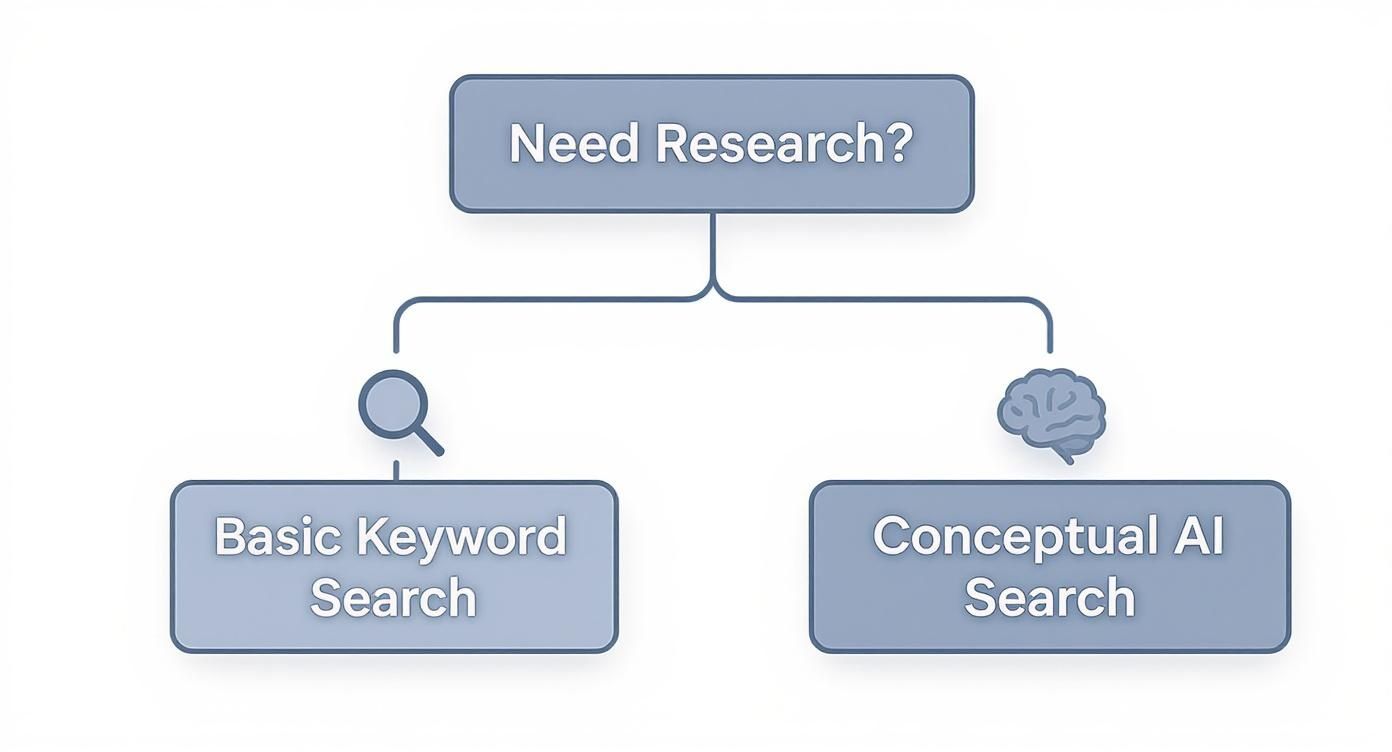
Ultimately, your choice depends on the complexity of your legal questions and whether you need a tool that truly understands legal concepts, not just keywords.
Before we move on, let's put these ideas into a practical checklist. When you're in demos or comparing platforms, it’s easy to get sidetracked. This table will help you stay focused on what really matters for your firm.
Evaluation Checklist for Legal Research Software
| Evaluation Criteria | Key Questions to Ask | Why It Matters |
|---|---|---|
| Security & Compliance | Does it have SOC 2 Type II or ISO 27001 certification? Can you control data residency (e.g., EU, Swiss hosting)? | A breach can destroy client trust and lead to ethical violations. This is non-negotiable. |
| Workflow Integration | Does it offer APIs or native integrations with our case management, billing, and document systems? | A tool that doesn't connect to your other systems creates data silos and inefficient manual work. |
| User Experience (UX) | Is the interface intuitive? How steep is the learning curve for our team? Does the platform feel fast and responsive? | Poor UX leads to low adoption. If your team won't use it, the investment is wasted. |
| AI Capabilities | Does it go beyond keyword search? Can it understand legal concepts, summarize documents, and identify key arguments? | Advanced AI saves massive amounts of time, uncovers insights you might miss, and improves the quality of your work. |
| Content & Coverage | Does the database include the specific jurisdictions, case law, and statutes we need? Is the information up-to-date? | Gaps in the database can lead to incomplete or outdated research, which is a major risk. |
| Support & Training | What does the onboarding process look like? Is customer support responsive and knowledgeable? | Your team needs to feel confident using the tool. Good support ensures you get maximum value from day one. |
Use this checklist as your guide during the evaluation process. It will help ensure you make a well-rounded decision that serves your firm’s needs today and in the future.
Ensuring Seamless Integration with Your Existing Tools
Even the most powerful research platform is useless if it’s an island. Your firm already runs on a set of tools for case management, billing, and document storage. Any new software has to play nicely with this ecosystem, not make it more complicated.
This is all about creating a frictionless workflow. Before you sign anything, confirm that the software can connect with your most critical systems. A unified workspace where information flows freely between applications is the goal, as it kills off tedious manual data entry and cuts down on the risk of human error. For smaller practices, our guide on the best legal software for small firms offers more insight on building an efficient, connected tech stack.
Prioritizing a User-Friendly Experience
Finally, don't ever underestimate the power of good design and user experience (UX). A platform can be packed with every feature under the sun, but if it's clunky, confusing, or slow, your team just won't use it. Low adoption means your investment is wasted, and any potential ROI goes right out the window.
During your trials and demos, pay close attention to the interface:
- Is it clean and easy to find your way around?
- Can you figure out the main features without needing a manual?
- How fast does the system feel when you run a search?
The software should feel like a natural extension of your thinking, not another hurdle to jump over. A great user experience drives adoption, empowers your team to work better, and makes sure you squeeze every bit of value from your investment. A platform that's easy to use is a platform that gets used. It's that simple.
Driving Adoption and Measuring Your ROI
Getting new legal research software into the firm is one thing. Making sure it actually gets used and pays for itself? That’s the real challenge. A great rollout comes down to two things: proving its value with a clear Return on Investment (ROI) and getting everyone on board to actually use it. If you miss on either, that powerful platform just becomes another expensive, dusty tool on the digital shelf.

The first step toward a positive ROI is turning the software's benefits into hard numbers. It’s not enough to hear people say "it's great." You need to connect the dots between the tool and the bottom line. When your attorneys can knock out research in a fraction of the time, that's a direct competitive edge.
Calculating Your Return on Investment
Figuring out the ROI for legal software isn't as simple as subtracting the subscription fee from your revenue. It's about putting a dollar value on newfound efficiency—how it impacts billable hours, operational costs, and even how you win cases. The whole idea is to measure the value of time saved.
A simple place to start is with the clock. If an associate who bills at $300/hour** saves just five hours a week on research, you've just unlocked **$1,500 of their time. That's time they can now spend on other billable work or high-level strategy. Now, multiply that across a team of ten associates, and you can see how the financial return starts to stack up fast.
Here are a few key metrics to build your ROI case:
- Reduced Research Hours: This is the easiest win. Track how much time research took before the new tool versus after.
- Increased Case Capacity: More efficient attorneys can handle more work without burning out or letting quality slip.
- Lower Overhead Costs: A modern, all-in-one platform can often let you cancel multiple overlapping subscriptions to older, clunkier databases, trimming your overall spend.
The goal is to show everyone that this software isn't a cost center; it's a revenue generator. By giving your attorneys back their most valuable resource—time—you're directly enabling more profitable work.
Strategies for Encouraging Firm-Wide Adoption
Even with a killer ROI on paper, a tool is useless if your team won't touch it. Getting people to change their habits requires a real strategy. It’s all about clear communication, smart training, and showing each person what’s in it for them. How well you understand your software’s effectiveness really boils down to its adoption rate. For a look at some general approaches, you can read more about measuring tool adoption.
The trick is to make the switch as painless as possible. A well-planned rollout can turn even your most tech-skeptical attorneys into the tool's biggest fans.
1. Identify and Empower Internal Champions Find a few people in the firm who are genuinely excited about the new software. Let these early adopters become your peer mentors. They can share success stories and offer practical, on-the-ground help to colleagues who are feeling stuck.
2. Conduct Role-Specific Training One-size-fits-all training sessions are a waste of time. You have to tailor the onboarding to what people actually do. Show your litigators how the AI drafts better motions and guide your transactional attorneys on how it slashes due diligence time.
3. Clearly Communicate the "What's In It For Me" (WIIFM) People need to know how this helps them, personally. Don't frame it as a top-down mandate. Instead, present it as a tool that gets rid of tedious work, helps with work-life balance, and ultimately lets them build stronger cases for their clients.
A successful rollout needs a game plan. For a deeper dive into how to structure the process, check out our guide on creating a change management plan example. It’s the playbook you need to turn a simple software purchase into an essential asset that empowers everyone on your team.
The Future of Legal Research and Emerging Trends
The world of legal research is anything but static. The tools we rely on are rapidly evolving, shifting from simple search-and-find databases into something much more like a strategic partner. If your firm wants to stay competitive, you need to understand where this technology is heading.
The next generation of legal research software is being built around a much smarter, deeper integration of artificial intelligence. We're moving past basic features like case summarization and into an era where AI is woven directly into legal drafting and strategy. Think about software that doesn't just pull up relevant cases, but helps you sketch out initial arguments, draft intricate motions, and even pinpoint weaknesses in an opponent's filings.
The Rise of Generative AI and Data Analytics
Generative AI is poised to become an indispensable drafting assistant. Instead of staring at a blank screen, attorneys can use AI to produce solid first drafts of memos, briefs, or contracts based on the research they’ve just completed. This frees up the legal expert to do what they do best: refine the work, edit with precision, and apply the kind of nuanced judgment that only a human can. You can learn more about how AI is shaping the future of law in our dedicated post.
At the same time, advanced data analytics is becoming a cornerstone of legal strategy. The platforms of tomorrow will crunch massive datasets of judicial decisions to forecast case outcomes, gauge the probability of a motion succeeding before a particular judge, and model litigation risk with startling accuracy.
The future of legal research isn't just about finding information faster. It's about using intelligent tools to transform that information into a clear strategic advantage.
This fundamental shift turns legal research from a backward-looking review of precedent into a forward-looking, predictive tool. It gives firms a data-driven edge that can make all the difference.
Niche Platforms and Global Growth Dynamics
As the market develops, we're also seeing more specialized platforms emerge, built for specific practice areas. Rather than relying on a one-size-fits-all database, firms are increasingly adopting software with highly curated content for fields like intellectual property, environmental law, or international trade. These niche tools offer a level of depth that the bigger, more general platforms just can't match.
All this innovation is happening as the global market continues to expand. While North America still leads the pack, estimated at $1.5 billion in 2023, the real story is the growth elsewhere. The Asia Pacific region is set to explode, with a projected growth rate of 8.5% CAGR through 2032, fueled by a booming legal services industry. You can explore these global legal research software market trends and forecasts at Dataintelo. Keeping an eye on these trends will help any firm not just adapt, but truly thrive in the years ahead.
Frequently Asked Questions
When you're looking into legal research software, a lot of practical questions pop up. Let's tackle the most common ones we hear from legal professionals, covering everything from cost and setup to keeping your client data safe.
How Much Should I Expect to Pay?
Most legal research tools are sold as subscriptions, but the price tags can be all over the map. You'll usually see plans tiered by the size of your firm, how many people need access, and just how deep into their database you need to go. Some platforms offer a simple flat rate for unlimited use, which is great for budgeting, while others work on a pay-per-search or pay-per-document basis.
Make sure you get a detailed breakdown from any vendor. Ask what's really included in each tier and watch out for potential add-on fees for premium content, specialized databases, or those fancy new AI tools. And don't forget to factor in the cost of training and ongoing support—it’s a crucial part of the total investment.
How Long Does It Take to Get Started?
This really depends on your firm's size and current tech setup. If you're a solo practitioner or a small firm grabbing a cloud-based tool, you could be up and running in less than a day. It's often as simple as signing up and logging in.
For larger firms that need to connect the new software with existing systems like case management or billing software, the process is naturally more involved. A full rollout could take several weeks, including moving data over, setting up all the users, and getting everyone properly trained. The key to a smooth launch is having a clear plan and a designated person to work directly with the software provider.
Key Takeaway: A successful rollout is less about speed and more about smart planning. Your vendor should give you a clear roadmap and solid training resources to make sure your team actually uses the tool from day one.
Is My Client Data Actually Secure?
Security is non-negotiable, and any reputable legal tech company knows this. The top platforms invest heavily in protecting your firm’s and your clients' sensitive information.
When you're vetting a new tool, here’s what to look for on the security front:
- End-to-End Encryption: This ensures your data is protected both in transit and when it's sitting on their servers.
- Compliance Certifications: Keep an eye out for standards like SOC 2 Type II or ISO 27001. These are independent verifications that the provider follows strict security protocols.
- Access Controls: You need the ability to control who sees what. Good software lets you set specific user permissions, so an attorney can only access information for their own cases.
Don't be shy about asking a potential vendor for their security documentation. It's your right to know.
Whisperit is the voice-first AI workspace built for modern legal work, unifying dictation, drafting, and research into a single, efficient workflow. Move from intake to final export in fewer steps and bring a new level of calm to your practice. Discover a smarter way to work at Whisperit.