
A Practical Guide to Legal Contract Management Software
Legal contract management software is a dedicated platform designed to automate and centralize the entire journey of your legal agreements. It serves as a single source of truth, moving your team away from the chaos of scattered emails and spreadsheets into a secure, organized system built for strategic work.
What Exactly Is Legal Contract Management Software

Imagine trying to manage all your contracts manually. It’s a bit like navigating a huge, unfamiliar city without a map. You might get where you’re going, but not without hitting dead ends, getting stuck in traffic, and wasting a ton of time.
That's where legal contract management software comes in. It acts as the real-time GPS for your entire legal operation. It doesn’t just store files; it's a command center that actively guides you through every step of a contract's life, from initial draft to final signature and renewal.
This technology was created to solve the all-too-common problems of traditional contract handling: agreements lost in endless email threads, critical deadlines tracked on messy spreadsheets, and version control becoming a nightmare. A proper contract management system turns what was once a reactive, administrative headache into a proactive, data-driven advantage.
From Manual Chaos To Strategic Control
The whole point of this software is to inject order, visibility, and automation into the contract lifecycle. This isn't just about making things easier; it's about reducing risk and finding hidden value in your agreements.
The global market for this technology is booming, expected to grow from USD 3.77 billion in 2026 to USD 5.64 billion by 2031. This explosive growth is happening because businesses are tired of outdated, risky processes and are actively seeking tools that improve both compliance and day-to-day efficiency.
Instead of your team digging through inboxes for the latest version of a Master Service Agreement, the software guarantees everyone is looking at the correct one. Instead of you having to manually chase down a stakeholder to sign an NDA, an automated workflow sends the reminder for you.
To really get it, let's look at a direct comparison of the old way versus the new.
Manual vs. Software-Based Contract Management
The difference becomes clear when you see the daily challenges side-by-side.
| Challenge Area | Manual Process (The Old Way) | Software Solution (The New Way) |
|---|---|---|
| Document Storage | Scattered across emails, shared drives, and filing cabinets. | A centralized, secure, and searchable digital repository. |
| Version Control | Confusion over final versions ("MSA_v4_Final_FINAL.docx"). | Automatic version tracking with a clear, immutable audit trail. |
| Key Dates | Reliant on manual calendar entries and spreadsheet tracking. | Automated alerts and notifications for renewals and obligations. |
| Approvals | Inefficient email chains, creating bottlenecks and delays. | Streamlined, automated workflows that route contracts instantly. |
| Risk & Compliance | Inconsistent language and limited visibility into obligations. | Clause libraries and reporting dashboards for proactive risk management. |
Ultimately, having a dedicated system means your team spends far less time searching and a lot more time strategizing. It provides the framework needed to manage not just the documents themselves, but the critical business relationships and obligations they contain.
For a deeper look into organizing your files, check out our guide on https://www.whisperit.ai/blog/legal-document-management.
Core Features That Drive Legal Operations
Good legal contract management software is much more than a digital filing cabinet. It's an active part of your operations, a tool designed to cut out the tedious work, enforce consistency across the board, and give you the kind of business intelligence you can actually act on.
Think of it less like a simple storage locker and more like a high-tech workshop. You have specific tools for specific jobs—drafting, tracking changes, getting approvals—and they all work together to build something solid and reliable, turning a messy, manual process into a smooth, strategic function.
Authoring and Clause Libraries
Everything starts with the draft. This is your first and best chance to get things right, and consistency is everything. Authoring tools inside the software give you a controlled space to build new agreements, usually starting with pre-approved templates. Right away, you've eliminated the risk of someone using an old version or adding rogue clauses.
The real power move here is the clause library—a central, approved collection of your most important legal language. Need a standard confidentiality clause? Instead of digging through old documents and hoping you’ve found the right one (a recipe for disaster), your team can pull the exact, up-to-date version from the library.
This combination of templates and clauses massively speeds up drafting while locking down compliance. It’s like giving a master chef a perfectly stocked pantry versus sending them to the store for every single ingredient. The final dish is just going to be better and more consistent.
Versioning and Audit Trails
Contracts are living documents, especially during negotiations. They get passed around, redlined, and revised, creating a confusing trail of different versions. Without a system, you're left asking, "Is this the final-final version?"
This is where automatic versioning and immutable audit trails come in. They create a perfect, undeniable history of the contract. Every single change, comment, and edit is logged, time-stamped, and tied to a specific person.
This feature is your safety net. If a question comes up months down the line about a specific term, you don't have to guess. You can just pull up the audit trail and see exactly who changed what, when they did it, and why. It ends the arguments before they even start.
Automated Workflows
Let's be honest: the approval process is where contracts go to die. Manually emailing an agreement to five different people and then trying to chase them all down is a painful, slow-motion nightmare. Critical deals get stuck in someone's inbox for days, holding up the entire business.
Automated workflows are the cure. You can set up custom approval chains that automatically route the contract to the right people in the right order, based on things like contract value or department. The software does the chasing for you, sending reminders if someone is taking too long. This doesn't just speed things up; it completely crushes the bottlenecks that slow your business down.
Reporting and Analytics
You can't manage what you can't see. Reporting and analytics dashboards are like the mission control for your entire world of contracts. They pull all the data from your agreements into one place and show you what's happening in a way that makes sense.
In just a few clicks, you can:
- Spot upcoming renewal dates so you're not caught off guard by an auto-renewal you didn't want.
- Track your cycle times to see how long it takes to get from a first draft to a final signature, showing you exactly where you can get faster.
- Scan for risk by searching all your contracts for specific clauses or non-standard language.
This is what proactive management looks like. For an even closer look at how technology can sharpen this process, check out our guide on contract review software.
Crucial Integrations
Lastly, your contract software can't be an island. Integrations are the bridges that connect it to the other tools your business relies on every day. Think of your CRM, email, or accounting software.
For example, connecting with a platform like Salesforce lets your sales team generate a new contract with customer data pulled directly from the CRM. No more typos or manual data entry. This creates a single, connected workspace where information flows exactly where it needs to go, making everyone's job a little bit easier.
Security and Compliance Should Be Built-In, Not Bolted-On
When you're handling legal agreements, security isn't just a nice-to-have feature; it's the bedrock of trust. In a world where a single data breach can spiral into millions in fines and destroy a company's reputation, you simply can't afford to get this wrong. Modern legal contract management software is designed from the ground up with this reality in mind, embedding security deep into its architecture.
This "security by design" approach is critical. Legal teams are leading the charge in adopting this technology, and for good reason—as contracts get more complex, so do the risks. For security officers, the ability to see and track obligations in real time isn't just a convenience; it's a powerful tool for avoiding penalties, which recently averaged a staggering $4.45 million per breach. You can get a closer look at the market trends and research on contract management software adoption over at grandviewresearch.com.
Locking Down Data with End-to-End Encryption
At the heart of any secure system is end-to-end encryption. The best way to think about it is like putting a sensitive document in a locked, tamper-proof briefcase before handing it to a courier. Only the person on the other end has the key.
If someone grabs the briefcase along the way, all they have is a locked box. The contents are completely useless to them. Digital encryption does the same thing for your contracts, scrambling the data so it's unreadable to anyone without the right credentials, whether it's just sitting on a server (at rest) or flying across the internet (in transit).
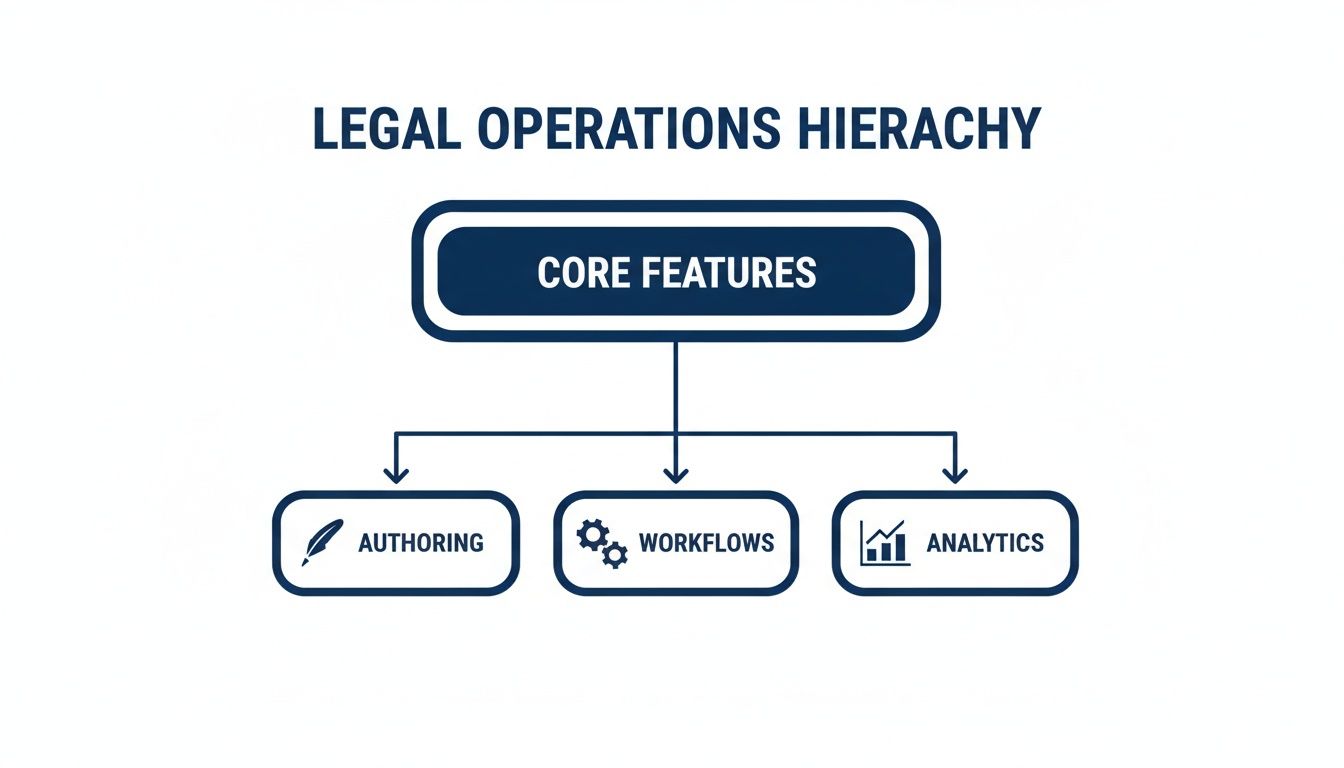
These core features—authoring, workflows, and analytics—aren't just about making things run smoother. They're also security tools, creating standardized processes and a clear line of sight into every contract's lifecycle.
Data Sovereignty and Why Hosting Location Matters
For any company operating across borders, the physical location of your data is a huge deal. Data sovereignty is the legal principle that says certain data must stay within the country it came from. This is a cornerstone of major regulations like GDPR in Europe.
That's why choosing a platform with strategic hosting options is non-negotiable. Look for providers that offer:
- EU/Swiss Hosting: Keeping your data physically within the EU or Switzerland is the most straightforward way to align with GDPR's strict privacy rules.
- Regional Data Centers: A good provider will have data centers around the world, letting you pick a location that keeps you compliant with local laws, whether it’s HIPAA in the US healthcare space or other national regulations.
This choice gives you direct control over which legal jurisdiction your data falls under—a crucial piece of any serious compliance strategy.
Here's a simple truth of modern compliance: you can't protect what you can't control. A centralized system gives you the bird's-eye view and the fine-grained controls needed to enforce your policies on every single agreement, without exception.
Building an Unbreakable Audit Trail
Meeting regulations like the Sarbanes-Oxley Act (SOX) or HIPAA is about more than just keeping contracts safe. You have to be able to prove who did what, and when they did it. This is where an immutable audit trail becomes your best friend.
An immutable audit trail is a permanent, unchangeable record of every single action taken on a contract. It logs everything:
- Who looked at or changed a document.
- What they changed, down to the specific clause.
- When it happened, with a precise timestamp.
This detailed log is the hard evidence you need to pass an audit and show that your internal controls are working as intended. When you pair this with role-based access—which ensures people can only see and do what's absolutely necessary for their job—you create a powerful defense against unauthorized access and a clear chain of accountability. You can dive deeper into this topic in our article on document management security.
Choosing and Implementing the Right Legal Tech
Picking the right legal contract management software is much more than just ticking boxes on a feature list. It’s a serious business decision that will ripple through your daily workflows, shape your long-term efficiency, and directly impact how well you manage risk.
After all, what good is a powerful platform if no one actually uses it? That’s just a failed investment.
The real goal is to find a solution that fits the way your legal team already works. You want to give them a tool that empowers them to do their best work, not saddle them with a complicated system that creates more headaches than it solves.
Defining Your Evaluation Criteria
Before you even book your first demo, you need a solid evaluation framework. This simple step keeps you from being distracted by flashy features that don’t address your core problems. Think of it as your North Star for making the right choice.
First and foremost, look at the user experience (UX). Is the interface intuitive enough for a time-crunched lawyer to pick up without needing weeks of training? A clunky system is a dead-on-arrival system; it will face immediate pushback and a low adoption rate, sinking the whole project.
Next, think about scalability. Your firm or legal department isn’t static—it will grow, and so will your contract volume. The software you choose today has to handle the workload of tomorrow without needing a complete rip-and-replace. Can it easily add more users, manage thousands more documents, and adapt to more complex workflows down the road?
Finally, never underestimate the value of great vendor support. When something inevitably goes wrong, you need a partner you can count on for a quick, knowledgeable response. Look for a vendor who offers solid training, acts as a true partner, and is invested in your long-term success.
Your Step-by-Step Implementation Roadmap
A successful rollout is all about careful planning. Breaking the process down into clear, manageable steps makes the transition smoother and helps get everyone on the same page from day one.
- Secure Stakeholder Buy-In: Start by explaining the why. Show leadership, legal staff, and other key departments how this new software will save time, cut down on risk, and make everyone’s job easier.
- Plan Your Data Migration: Figure out which existing contracts you need to bring into the new system. Your vendor should be a key partner here—many offer tools that can automatically pull key data points, saving you countless hours.
- Configure and Customize: This is where you make the software your own. Set up user roles and permissions, create your firm's standard contract templates, and build out the automated approval workflows that match your real-world processes.
- Conduct Thorough User Training: Don't just demo the features. Show your team exactly how the software solves their biggest pain points. Role-specific training is always more effective than a generic, one-size-fits-all session. For more ideas on getting your team on board, check out our thoughts on how modern technology is reshaping the legal field.
- Define and Measure Success: Before you go live, decide what success looks like. Set clear Key Performance Indicators (KPIs), like reducing the contract cycle time by 20% or ensuring 100% of new agreements are generated from approved templates.
Calculating Your Return on Investment
To justify the expense of any new software, you need to build a business case grounded in real-world returns. A good ROI calculation goes beyond simple cost savings and looks at the total value the platform brings to the organization.
Quantifying the benefits is the most powerful way to make your case. Focus on how legal contract management software turns saved time and reduced risk into measurable financial gains for the business.
Start by calculating the hours your legal team will save on administrative drudgery—things like hunting for documents, manually entering data, and chasing down approvals.
Then, add in the value of risk mitigation. Think about it: what’s the potential cost of one missed renewal date or a single compliance slip-up? Automated alerts and a central contract repository directly lower that financial exposure.
Finally, factor in improved revenue management. By never missing a renewal opportunity and ensuring all contract terms are met, the software often pays for itself.
How AI Is Changing the Game in Contract Management

For a long time, managing legal contracts was a reactive, administrative headache. But artificial intelligence is completely flipping that script, turning it into a proactive, strategic part of the business. It’s about more than just speeding things up; it's about giving legal pros tools that can think, analyze, and spot trouble before it even starts.
Think of it this way: old-school software was like a trusty calculator. It followed your instructions perfectly but offered zero insights. AI is more like having a seasoned analyst on your team. It doesn't just crunch data—it interprets it, sees patterns, and flags risks that even a careful human eye might miss.
This fundamental shift is changing the very nature of legal work. The focus is no longer on endless, line-by-line reviews. Instead, it’s about high-level oversight, freeing up experts to apply their judgment where it truly counts.
From Manual Review to Intelligent Analysis
The most immediate win with AI is its knack for reading and understanding contracts at lightning speed. An AI-powered system can tear through a 50-page agreement in seconds, pulling out key dates, obligations, and any language that deviates from your company’s standards.
It acts as a tireless first-pass reviewer, checking for inconsistencies or risky clauses without getting fatigued. A task that once took hours of intense focus is now handled almost instantly. This frees up lawyers to do what they do best: negotiate and strategize.
Even contract creation is getting an overhaul. Tools like a free AI contract generator help users draft documents far more efficiently. This isn’t just about speed; it’s about consistency. The system can suggest pre-approved clauses from a central library, making sure every new agreement is compliant from the get-go.
The Power of Predictive Insights and Voice Commands
But today's AI does more than just analyze the text in front of it—it offers predictive insights. By learning from thousands of past agreements, it can tell you which clauses are most often negotiated or which terms are likely to cause a dispute down the road.
This is a massive leap forward for risk management. Instead of just reacting to problems, legal teams can get ahead of them during the drafting stage, building stronger, more resilient agreements from day one.
The way we interact with these tools is also changing. Voice-first AI workspaces, like Whisperit, let you talk to your documents naturally. Imagine just saying, "Summarize the liability clause" or "Find all renewal dates for Q4," and getting an instant, accurate answer. This removes the friction of endless clicks and searches, creating a workflow that feels seamless.
AI isn't here to replace legal professionals. It's an augmentation tool that handles the repetitive, data-heavy tasks, freeing human experts to apply their unique skills in critical thinking, negotiation, and strategic counsel.
Tangible Business Impact and Market Growth
The move to AI in contract management isn't just a trend; it’s a market that’s growing fast for a good reason. The AI segment of this industry is set to explode from USD 359.6 million in 2023 to a massive USD 3,987.4 million by 2033—a tenfold increase.
The results speak for themselves. Legal pros using these tools report drafting contracts 30-50% faster, with predictive risk scoring catching problems long before anyone signs.
It’s also a huge win for accuracy. Studies show that around 60% of contracts have errors due to manual handling. AI can slash that number to under 5%. This helps companies claw back the 7-9% of value typically lost to missed obligations or bad terms.
By taking on the heavy lifting of data extraction and risk analysis, AI allows legal teams to focus on strategy. For a closer look at this evolving field, check out our guide on AI in contract management.
Frequently Asked Questions
Jumping into the world of legal tech can feel like learning a new language. Whether you're a partner at a law firm, a compliance officer in healthcare, or managing deals in finance, you’re bound to have questions. Here are some straight-to-the-point answers to what people most often ask when considering a new contract management system.
How Difficult Is It to Migrate Existing Contracts Into a New System?
The idea of moving years—or even decades—of contracts into a new platform sounds daunting. Most people picture endless weekends of manual data entry, but the reality is much less painful these days.
Modern contract management systems are built for this exact challenge. They usually have bulk import tools that can handle thousands of digital documents at once. What about all those old contracts sitting in a filing cabinet? That's where Optical Character Recognition (OCR) technology comes in. It scans the paper documents, turns them into digital text, and often uses AI to automatically pull out key details like dates, names, and important clauses.
The secret to a smooth transition isn't brute force; it's a little prep work. Before you start, you'll want to:
- Take inventory: Figure out which contracts are still active and need to be moved, and which ones can simply be archived. There’s no point in migrating documents you don't need.
- Lean on your vendor: The best software providers have a clear migration process and dedicated support to guide you. They can help automate the heavy lifting of extracting metadata, which saves a massive amount of time and prevents errors.
A little planning upfront can make the entire migration process surprisingly straightforward.
Will This Software Integrate with Our Current Tools?
It absolutely should. If a contract management system can't connect with the other software you use every day, it's not going to be very useful. Think of it as a central hub for all your contract-related work, not another isolated app.
The goal is to create a seamless flow of information between your most important business tools. The best platforms offer a robust API and, even better, have pre-built integrations with the software your team already knows and uses.
A system that doesn't talk to your other tech just creates more work. It leads to data silos and clunky processes. The real magic happens when your tools work together, making everyone's job a whole lot easier.
Look for key integrations that will make a real difference, such as:
- Email Clients: Connections to Microsoft Outlook or Gmail are non-negotiable.
- CRM Systems: Linking with a platform like Salesforce lets you pull customer data directly into contracts, speeding up the sales cycle.
- ERP Software: Integrating with your firm's financial system ensures billing and revenue recognition are always aligned with your contractual obligations.
This kind of connectivity keeps your data accurate everywhere, helps your team work faster, and makes it much more likely that everyone will actually use the new system.
How Can We Justify the Cost to Firm Leadership?
Getting buy-in from leadership is all about shifting the conversation from "cost" to "value." You need to build a rock-solid business case that clearly shows the return on investment (ROI). The best way to do this is by focusing on three tangible benefits.
First, there are the efficiency gains. Think about how many hours your legal team currently spends on non-billable, administrative work—searching for documents, drafting standard clauses, or chasing people down for signatures. Do the math. When you translate those wasted hours into what they’re actually worth, the financial argument becomes incredibly compelling.
Second, it’s about risk mitigation. What’s the cost of a missed renewal deadline? Or a compliance failure? These mistakes can lead to huge financial penalties, not to mention serious damage to your reputation. A good contract system acts as a safety net, with automated alerts and clear audit trails that prevent these kinds of costly errors. It's less of a software expense and more of an insurance policy.
Finally, you can frame it as revenue optimization. Poor contract management leads to money left on the table. A system that tracks all obligations and entitlements ensures you never miss a chance to renew a profitable agreement or enforce favorable terms. By showing how the software plugs these financial leaks, you can present a powerful case that any leader will understand.
Ready to see how a voice-first AI workspace can transform your legal workflows? Whisperit unifies drafting, research, and collaboration to help your team move faster and produce more consistent, high-quality work. Learn more at https://whisperit.ai.