
A Practical Guide to Mastering Legal Contract AI
So, what exactly is legal contract AI? At its core, it's an intelligent system built to help with every single stage of a contract's life—from the first draft all the way to post-signature analysis.
Think of it like a specialized GPS for navigating the often-tricky terrain of legal agreements. It’s a tool that gives legal professionals the speed, accuracy, and strategic direction they need to handle complex contracts without getting lost in the weeds. For any modern legal department, this kind of technology is quickly moving from a "nice-to-have" to a "can't-live-without."
The End of Manual Legal Work

For a moment, imagine you're on a cross-country road trip, but your only guide is an old-school paper map. You'd probably get there eventually, but the journey would be painfully slow, inefficient, and full of wrong turns. For decades, legal teams have been managing contracts in much the same way, stuck with manual processes that are not only tedious but also ripe for human error.
This traditional, paper-pushing approach creates endless bottlenecks and increases risk. More importantly, it buries highly skilled lawyers in administrative busywork instead of letting them focus on high-value, strategic challenges. A manual review of just one contract could take hours—sometimes days—and that time multiplies across an entire portfolio of agreements. That reactive, labor-heavy model simply doesn't cut it anymore.
A Clear Shift in the Legal Industry
We're now seeing a major operational shift across the legal industry. Teams are finally moving away from these outdated manual workflows and embracing a more proactive, data-driven approach. The adoption of legal contract AI isn't just a minor tech upgrade; it’s a fundamental rethinking of how legal work gets done, measured, and valued.
The market trends tell the same story. The global legal AI market is set to skyrocket from USD 2.1 billion in 2025 to USD 7.4 billion by 2035. Contract lifecycle management is a huge piece of that puzzle, expected to claim over 31% of the market revenue in 2025 alone. You can dig deeper into these numbers by checking out the latest analysis on legal AI growth from Future Market Insights.
By taking over the repetitive, low-risk tasks, legal contract AI frees up professionals to focus on what they do best: exercising judgment, building client relationships, and offering strategic advice. It helps transform the legal department from a cost center into a genuine strategic partner for the business.
Manual vs AI-Powered Contract Management A Quick Comparison
The difference between the old way and the new is night and day. This table illustrates the transformative impact of legal contract AI by comparing traditional manual processes with AI-enhanced workflows across key metrics.
| Metric | Manual Process (Before AI) | AI-Powered Process (After AI) |
|---|---|---|
| Speed | Slow, labor-intensive review cycles taking days or weeks. | Rapid analysis and drafting completed in minutes or hours. |
| Accuracy | High risk of human error, missed clauses, and inconsistencies. | Consistent, error-free analysis based on predefined rules. |
| Risk Management | Reactive; risks are often identified only after they become issues. | Proactive; potential risks are flagged automatically during review. |
| Data Access | Information is locked in static documents, making analysis difficult. | Data is structured and searchable, enabling portfolio-wide insights. |
| Strategic Focus | Legal teams are bogged down in low-value administrative work. | Lawyers focus on negotiation, strategy, and complex legal judgment. |
As the comparison shows, this isn't just about doing the same work faster. Legal contract AI is a strategic asset that sharpens accuracy, minimizes risk, and empowers legal teams to deliver far greater value to the entire organization.
How Legal Contract AI Actually Works
It’s tempting to think of legal contract AI as some kind of magic wand, but it’s much more practical than that. Think of it as a specialized toolkit with four core instruments, each built for a specific job in the contract lifecycle. These tools don't just search for keywords; they actually interpret, analyze, and generate human language, thanks to some pretty advanced algorithms that understand context, intent, and legal nuance.
At its core, this technology runs on an engine trained on a massive library of legal documents—think case law, statutes, and millions of anonymized contracts. This deep training is what allows the AI to spot patterns, grasp legal concepts, and understand the complex web of relationships between different clauses. If you're curious about the mechanics of how machines learn to read, you can dive deeper in our guide on what is natural language processing.
Automated Drafting and Generation
The first tool in the kit is all about drafting. Instead of staring at a blank page or digging through folders for an old template, a lawyer can just give the AI a few simple instructions for a new agreement.
For example, you could feed it a few key points:
- Contract Type: "Master Services Agreement"
- Parties: "Our company (service provider) and Client X"
- Key Terms: "Term of 24 months, payment net 30, governed by New York law"
In seconds, the AI produces a complete first draft. Because it draws from a library of pre-approved clauses and company best practices, the document is already aligned with your standards right from the start. This completely changes the game for routine document creation.
Intelligent Review and Risk Analysis
Once you have a draft—whether the AI wrote it or you got it from another party—the intelligent review function takes over. This is where the AI becomes a tireless paralegal with a photographic memory. It scans the entire document and cross-references every clause against your company’s established rules, often called a "playbook."
Imagine getting a 50-page vendor agreement. The AI can tear through it in less than a minute, flagging every clause that doesn't match your company’s preferred positions. It will instantly pinpoint things like a one-sided indemnification clause, an unlimited liability provision, or a non-standard confidentiality term, saving your team hours of painstaking manual review.
Precise Clause Extraction and Management
Next up is the power of extraction. Legal teams are constantly being asked to find specific information scattered across hundreds or thousands of active contracts. Manually locating every "force majeure" clause or "change of control" provision would be a nightmare.
A legal contract AI can instantly search an entire portfolio of 500 agreements and extract every single liability cap, organizing the data into a structured, usable format. This transforms static documents into a dynamic database of actionable insights.
This is a lifesaver for due diligence in M&A deals, preparing for new regulations, or just getting a better handle on your company's ongoing contractual obligations.
Strategic Negotiation Support
Finally, the AI can act as a strategic partner during negotiations. When the system flags a risky clause during its review, it doesn't just point out the problem—it suggests a fix.
By analyzing data from past successful negotiations, the AI can propose alternative, pre-approved language that has a higher chance of being accepted by the other side. This data-driven approach takes a lot of the guesswork out of the back-and-forth. It’s no surprise that more legal teams are leaning on these tools; as workloads increase, so does the intentional use of AI. In fact, some AI tools can deliver 82% time savings for legal teams on routine tasks. You can see just how much this is taking off by checking out how AI integration is surging in legal departments from Harbor's 2025 survey. It’s all about standardizing outcomes and closing deals faster.
Seeing AI in Action with Real-World Scenarios

It’s one thing to talk about what legal AI can do, but it’s another thing entirely to see how it performs in the real world. This is where the technology truly proves its worth—in the middle of the high-stakes, day-to-day challenges that legal teams grapple with.
Let's move past the theory and look at a few concrete examples. These aren't far-off predictions; they show how legal departments are using AI right now to work faster, reduce risk, and become a more valuable part of their organizations.
Accelerating Growth for a Tech Startup
Picture "InnovateNow," a SaaS startup that's growing like a weed. Their sales team is closing deals left and right, but the legal department—a single, overworked counsel—has become an accidental roadblock. Every contract needs a manual review, and the resulting delays are putting good deals on ice. The process is slow and inconsistent, and it keeps the lawyer tied up in routine work instead of focusing on bigger strategic issues.
To break the logjam, InnovateNow brought in a legal contract AI trained on their standard sales agreement and negotiation rules.
- Standardized Drafting: The sales team can now generate their own compliant contracts in minutes. They just plug in the deal-specific details—customer name, subscription level, contract term—and the AI drafts the perfect agreement.
- Empowered Sales: For small negotiations, the AI handles the first pass. It reviews the customer's redlines, accepts common changes, and only flags the unusual or high-risk requests for the lawyer to look at.
- Clear Results: The impact was immediate. The average time to close a deal dropped by a staggering 40%. Sales felt empowered, and legal counsel finally had the breathing room to tackle major partnerships and company strategy.
By essentially turning contract creation into a guided, self-service process, InnovateNow changed its legal function from a gatekeeper into a genuine business accelerator.
Dominating Due Diligence in M&A
Now consider a huge company, "Global Corp," deep in the process of a major acquisition. The target company has a portfolio of over 5,000 customer and vendor contracts. In the old days, reviewing that mountain of paper for due diligence would take a team of lawyers months and cost a fortune in billable hours.
Instead, Global Corp unleashed a legal contract AI on the entire portfolio. Its mission was laser-focused: find and analyze every single change of control, assignment, and limitation of liability clause across all 5,000 agreements.
In just one week, the AI did what would have taken the human team three months to complete. It delivered a clean, organized report that pinpointed every contract with a problematic clause—the kind of thing that could sink the deal or cause a massive headache after the merger.
The M&A team could then direct their expertise to the 5% of contracts that posed a real risk instead of getting bogged down in the 95% that were perfectly standard. The speed and precision of this review gave Global Corp a huge upper hand in negotiations and helped them sidestep major hidden liabilities. It's a perfect example of how a thorough AI legal document review can fundamentally alter a high-stakes transaction.
Proactive Compliance for an In-House Team
Finally, think about the in-house team at "SecureHealth," a healthcare company managing hundreds of vendor contracts. Keeping up with strict data privacy rules like HIPAA was a manual, never-ending battle. Audits were stressful, time-consuming, and usually happened after a problem had already emerged.
SecureHealth adopted a legal contract AI to get ahead of the game. The platform continuously scans all their executed contracts, effectively turning a static library of PDFs into a live compliance dashboard.
This gave them a few powerful advantages:
- Automated Monitoring: The AI automatically flagged any contract missing key data protection language or coming up for renewal without an updated compliance rider.
- Risk Prioritization: It scored vendors based on the risk profile found in their contracts, telling the legal team exactly where to focus their attention first.
- Proactive Alerts: Whenever a new regulation passed, the team got instant alerts about any vendor contracts that were suddenly out of compliance, allowing them to fix issues before they became expensive breaches.
By using AI for ongoing contract management, SecureHealth moved from a reactive, stressful compliance cycle to a proactive, controlled one. They could protect sensitive data more effectively and dodge massive regulatory fines.
Navigating Security and Compliance Concerns
Let's be honest: bringing any new technology into a legal practice, especially one that handles sensitive contracts, is going to raise some serious questions about security and confidentiality. As lawyers, we're not just handling data; we're protecting client secrets, intellectual property, and high-stakes negotiations. The idea of feeding that information into an AI can feel like a leap of faith.
The good news is that reputable AI providers get it. They know their entire business hinges on earning your trust. They’ve built their platforms from the ground up with security protocols that are often more robust than a firm's own internal systems. It’s less like emailing a sensitive file and more like placing it in a fortified digital vault where only you have the key.
So, what should you be looking for? The security architecture of any serious legal AI tool rests on a few core pillars. Understanding them will help you cut through the marketing noise and properly vet any potential partner.
Data Encryption: Your Digital Armor
The absolute baseline for security is data encryption. Think of it as a translator that turns your readable documents into an indecipherable code, making the contents completely useless to anyone who doesn't have the specific key to translate it back.
Top-tier legal AI platforms apply this protection at two critical stages. It's not enough to encrypt the data only when it's traveling over the internet (in transit); it must also be encrypted while it's sitting on their servers (at rest). This two-pronged approach means that even if someone could physically access the server, all they'd find is a jumble of unreadable code.
Access Controls and Data Residency
Encryption is crucial, but it's just as important to control who can access your data and where that data physically lives. This is where access controls and data residency become deal-breakers.
- Role-Based Access Controls (RBAC): This is a must-have. It gives you granular control, allowing you to decide who in your firm can see, edit, or analyze specific contracts. For example, you can ensure a junior associate working on a routine NDA can't access highly confidential M&A documents.
- Data Residency: This is all about the physical, geographic location of the servers storing your data. If you work with clients in the EU, you know that GDPR is non-negotiable. The ability to choose an EU-based or Swiss-based server isn't just a nice-to-have; it's a fundamental compliance requirement.
It's no surprise that data security is a huge concern. In fact, 37% of legal professionals point to it as a primary reason for holding off on AI adoption. This is why it’s so critical for AI providers to be completely transparent about their security frameworks and data handling policies.
Vetting AI Vendors for Compliance
When you're evaluating a potential AI partner, you need to dig into their compliance certifications. Understanding frameworks like the SOC 2 compliance requirements is key to making sure they have the controls in place to protect your data.
Don't be afraid to ask for proof. A trustworthy provider will have no problem sharing documentation for certifications like SOC 2 Type II or ISO 27001. These aren't just badges; they are independent audits that verify a company is actually following strict, established security procedures.
Building a solid security foundation is the cornerstone of any successful tech implementation. For a more detailed look at this, our guide on AI governance best practices walks through how to create a secure and ethical AI framework for your firm.
Your Step-By-Step Implementation Roadmap
Bringing legal contract AI into your workflow doesn’t have to be a massive, disruptive overhaul. The best rollouts are more like building a house: you start with a solid foundation and build up from there, one well-planned phase at a time. This approach dials down the risk, builds confidence, and shows people the value at every stage.
The goal here is to avoid boiling the ocean. Instead of a huge, company-wide deployment, a phased roadmap lets your team adapt, learn, and see real benefits quickly. It turns a potentially intimidating project into a series of manageable, successful steps.
Phase 1: Define Your Pilot Project
Your journey starts with a small, focused pilot project. The trick is to pick a high-volume, low-complexity workflow where you can score a quick, measurable win. Reviewing and executing Non-Disclosure Agreements (NDAs) is often the perfect candidate—it’s a task that eats up a ton of time but is highly standardized.
First things first, you need to define what success looks like. What's the win?
- Objective: Slash the average turnaround time for standard NDAs from two days down to just four hours.
- Key Result 1: Hit a 95% accuracy rate when the AI does its initial clause review against your company playbook.
- Key Result 2: Cut the legal team's direct touch time on each NDA by 80%.
Having concrete goals like these is everything. They give you a clear benchmark to judge the pilot's success and help you build a rock-solid business case for adopting it more widely. This first phase is all about proving the concept works and getting some momentum going.
Phase 2: Tool Selection and Team Training
Once you have a clear objective, you can pick the right tool for the job. Not all legal contract AI platforms are built the same. You’ll want to find a solution that lines up with your pilot project's needs—in this case, one with strong playbook-based review features and that integrates smoothly with your current document system.
After you've picked your tool, it's time to focus on the people. Change can be met with resistance, so you can't skimp on training and communication.
Don't just give a technical tutorial. Frame the training around the "what's in it for me" for every person on the team. Show them how the AI gets rid of the tedious stuff, freeing them up for more strategic work. You want to position the AI as a powerful assistant, not a replacement.
Successful adoption really boils down to user buy-in. When your team truly gets how this technology makes their jobs better, they’ll become its biggest champions. For a deeper look at transforming your practice, check out our comprehensive legal AI software guide.
Phase 3: Integration and Measurement
Now it’s time to hook the AI into your existing workflows. A common integration point is your document repository or email client, like Outlook. For example, a platform like Whisperit can become a central hub, automatically pulling in contracts for review and pushing the finalized versions back out without anyone having to lift a finger.
This checklist gives you a simple but crucial rundown for making sure your AI platform handles data securely during the integration process.
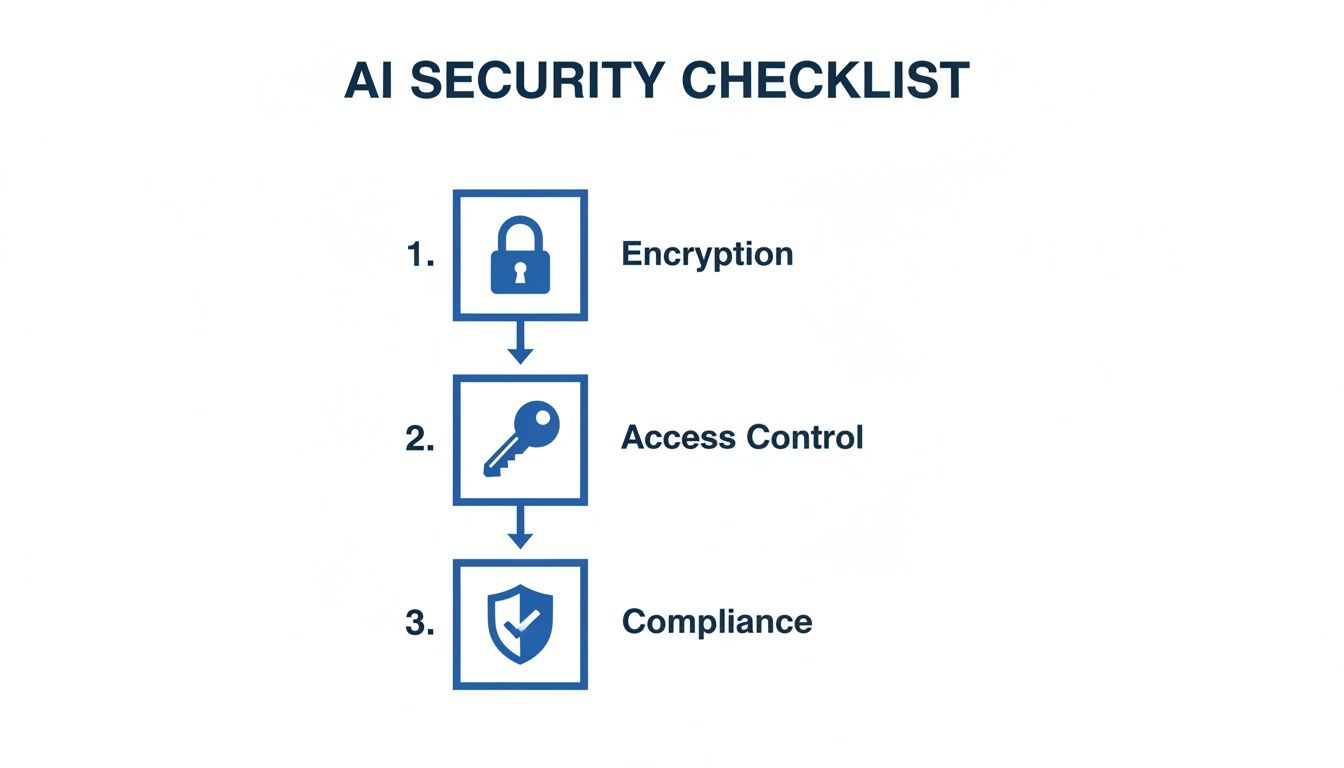
As you can see, solid encryption, tight access controls, and verifiable compliance are the bedrock of any trustworthy AI integration.
With the system live, start tracking your pilot against those metrics you set in phase one. This data is your most powerful tool for showing a clear Return on Investment (ROI). According to a recent survey, 53% of organizations are already seeing a definite ROI from their AI investments.
When you can walk into a meeting and present hard numbers—like a 40% reduction in contract cycle time or a 75% decrease in time spent on manual review—you make a very compelling case to stakeholders for expanding the AI’s role. For more on practical uses and a clear implementation roadmap, check out these 7 Secrets to Grow Your Firm Using AI for Legal.
Getting the Best Results from Your AI

A legal contract AI is a powerful piece of kit, but its real value comes from the person using it. Think of it like a top-of-the-line race car—it's got all the power in the world, but you still need a skilled driver behind the wheel to win. Getting the most out of your AI means learning how to work with it properly.
That all starts with mastering the art of the prompt. If you give it a vague or sloppy request, you’re going to get a generic, unhelpful answer almost every time. The old saying holds true: garbage in, garbage out.
The Power of Precise Prompting
Great prompting is all about being specific, giving the AI enough context to work with, and telling it exactly what format you want the output in. It's the difference between asking a junior associate to "glance over this contract" and giving them a detailed memo with clear instructions.
Here’s a practical example that shows the difference in action:
- Vague Prompt: "Review this MSA for risks."
- Effective Prompt: "You are a senior in-house counsel for a SaaS company. Review the attached Master Services Agreement from our perspective. Identify and summarise the top three risks related to liability, data security, and termination. Put your findings in a table with three columns: Clause, Risk, and Suggested Revision."
The second prompt gives the AI a role to play, a clear task, and a specific format. The result is a far more useful and actionable piece of work.
The best way to think about it is to treat the AI like a very bright, very literal-minded junior associate. Give it the background, context, and structure it needs to do the job right, and it will produce excellent first drafts and analyses.
The Irreplaceable Human in the Loop
Even with the perfect prompt, the job isn’t done when the AI spits out its response. The single most important best practice is keeping a human-in-the-loop. An AI's work is a fantastic starting point, but it should never be the final word.
Legal professionals must use their own judgment, experience, and ethical compass to check and refine what the AI produces. That means carefully reviewing the output for legal accuracy, strategic alignment, and subtle nuances before it ever goes to a client or the other side. The AI gives you a massive head start, but it doesn't remove your professional responsibility.
For a closer look at integrating these systems effectively, our guide on AI tools for lawyers offers more strategies and insights.
Training the AI on Your Playbook
To take things to the next level, many of the best legal contract AI platforms can actually be trained on your firm’s own documents and negotiation playbooks. This process essentially teaches the AI your specific risk appetite and preferred ways of wording key clauses.
By feeding the system your library of past successful agreements, you're showing it what a "good" contract looks like for your organization. Over time, it learns to draft and review documents that aren't just generally sound, but are perfectly in sync with your standards. This turns a generic tool into a true specialist assistant that knows your business inside and out.
Common Questions About Legal Contract AI
Even after seeing all the features, some very practical questions always come up before a team decides to jump in. Let's tackle the big ones head-on to help clear up any lingering doubts you might have.
Will Legal AI Replace Lawyers?
This is, without a doubt, the question I hear most often. The short answer is a hard no. Legal contract AI isn't here to replace lawyers; it's here to make them better. Think of it as the world's most efficient paralegal or a junior associate who never sleeps, handling the tedious, high-volume tasks that eat up so much of a lawyer's day.
The tech is fantastic at scanning thousands of pages, flagging clauses that don't match your playbook, and cranking out first drafts of standard agreements. What it can't do is apply genuine legal judgment, grasp the subtle nuances of a business deal, or provide the kind of strategic advice a client actually pays for.
"The role of a good lawyer is as a ‘trusted advisor,’ not as a producer of documents... breadth of experience is where a lawyer’s true value lies and that will remain valuable." - Attorney Survey Respondent, 2024 Future of Professionals Report
Ultimately, AI frees up lawyers to do what they do best: strategize on negotiations, counsel clients through complex issues, and solve problems that require a human touch and years of experience.
How Much Do These Tools Cost?
There's no single price tag, as the cost for legal AI tools is all over the map. It really depends on the vendor, your team's size, and how you plan to use it. Most providers stick to a subscription model, usually billed once a year.
You'll typically see pricing broken down in a few ways:
- Per-Seat Licensing: You pay a flat fee for every person on your team who needs access.
- Usage-Based Tiers: The price changes based on how many contracts you run through the system or which advanced features you need.
- Custom Enterprise Plans: Big firms or corporate legal departments usually negotiate a custom deal that bundles in specific integrations, extra security, and dedicated support.
Your best bet is to get detailed quotes from a few different vendors. It's not just about the sticker price; it's about the return on that investment. The initial cost is often quickly offset by massive time savings and a real reduction in contractual risk.
What Is the Learning Curve Like?
You'd be surprised. The new wave of legal AI platforms is built to be intuitive, so the learning curve is much gentler than with older legal tech. Most lawyers get comfortable with the core functions in just a couple of weeks.
The trick to a smooth rollout is to start small. Pick a simple, high-volume task like reviewing NDAs for your pilot project. Success isn't really about being a tech whiz; it's about being open to tweaking your old workflow. The real "learning" is shifting your mindset from doing the manual work to supervising the AI and refining its suggestions—which is a far more strategic use of your team's time.
Ready to transform your contract workflow from a manual chore into a strategic advantage? Whisperit is the voice-first AI workspace built for legal work, unifying dictation, drafting, research, and collaboration. Move from intake to export faster and more consistently than ever before. Discover how Whisperit can empower your legal team.