
Legal AI Chatbot Guide for Law Firms
Think of all the repetitive questions and administrative tasks that bog down your law firm every single day. Now, imagine having a virtual paralegal on your website, ready to handle them 24/7. That's essentially what a legal AI chatbot is—a specialized tool built to automate communication and administrative work, freeing up your team for the complex legal thinking they were hired to do.
What Is a Legal AI Chatbot Really

Let's cut through the jargon. At its heart, a legal AI chatbot is a problem-solver. It’s an intelligent system designed specifically to tackle the relentless administrative load that slows down modern law practices. It lives right on your website, ready to engage with potential clients the second they land on your page.
This isn't about replacing lawyers. It's about giving them a powerful force multiplier. Picture a receptionist who never sleeps, never takes a lunch break, and can field hundreds of inquiries at once without breaking a sweat. That’s the kind of immediate, practical value a legal AI chatbot delivers.
The Technology Behind The Conversation
So, what makes these bots so smart? The magic ingredient is Natural Language Processing (NLP). This is the technology that allows the software to actually understand, interpret, and respond to human language in a way that feels natural and conversational, not stiff and robotic.
The whole point is to make a potential client feel heard and helped, even when they're interacting with an AI. It's about giving them instant, accurate answers to their initial questions, which builds trust right from that first click.
This is what separates a modern legal AI chatbot from the clunky, old "if-this-then-that" bots of the past. If you're curious about the nuts and bolts, you can dive deeper into our guide on what is Natural Language Processing to see how it powers more human-like digital conversations.
The industry is clearly taking notice. The global legal chatbots market was valued at around USD 132.6 million in 2024 and is expected to climb to USD 402.0 million by 2030—that’s a compound annual growth rate of 19.5%. This isn't just hype; it's a reflection of the tangible value firms are getting from this technology. You can discover more insights about the legal AI market and see where it's headed.
Core Benefits of a Legal AI Chatbot
Here’s a quick overview of the primary advantages your law firm can gain by integrating a legal AI chatbot.
| Benefit Area | Impact on Your Firm | Practical Example |
|---|---|---|
| Operational Efficiency | Frees up staff from repetitive administrative tasks, allowing them to focus on billable hours and high-value legal work. | The chatbot automatically answers "What are your office hours?" or "Do you offer free consultations?" |
| Lead Qualification | Systematically vets incoming inquiries to ensure your legal team only spends time on promising, relevant cases. | A potential client is asked a series of pre-set questions to determine if their case aligns with the firm's practice areas. |
| Client Experience | Provides immediate, 24/7 support to website visitors, improving satisfaction and reducing the chance they seek a competitor. | A prospective client can get their initial questions answered and book a consultation at 10 PM on a Saturday. |
Ultimately, a well-implemented chatbot helps your firm run smoother, capture better leads, and provide the instant service that modern clients have come to expect.
What They Actually Do (and What They Absolutely Don’t)
To get real value from a legal AI chatbot, you have to look past the hype and see it for what it is: a practical tool for your firm's daily operations. A good chatbot isn't just a fancy FAQ page. It’s an active part of your workflow, built to handle specific, repetitive tasks with speed and accuracy.
Think of it as a digital front desk manager. Its main job is to direct the flow of information, making sure clients, potential clients, and your own team get what they need, right when they need it. This isn't about deep legal analysis; it's about smart, efficient administrative support.
What A Legal AI Chatbot Can Do
The best chatbots are designed to tackle the most common administrative headaches in a law firm. They shine when handling structured, predictable tasks that would otherwise eat up your team's precious time.
Here's what that looks like in practice:
- Automate Client Intake: No more endless email chains just to get basic information. The chatbot can run through a pre-set list of qualifying questions. For a personal injury lead, it might ask about the date of the incident, the injury sustained, and if they've seen a doctor, gathering all the essential facts before it ever hits a paralegal's desk.
- Provide 24/7 Client Service: People don't just have legal questions between 9 and 5. A legal AI chatbot can instantly answer common queries like, "What are your consultation fees?" or "What documents should I bring?" at 10 PM on a Saturday, capturing a lead you might have otherwise lost.
- Schedule Consultations Seamlessly: The bot can plug right into your firm’s calendars. After qualifying a lead, it can show them available appointment times, book the slot, and even send out automated reminders. This simple step can dramatically cut down on no-shows and the administrative busywork that comes with them.
These features are the building blocks of a more efficient practice. They ensure that by the time a person on your team gets involved, all the initial legwork is already done.
Understanding The Realistic Limitations
Knowing what a chatbot can't do is just as important as knowing what it can. Setting clear boundaries is the key to using this technology responsibly and ethically. These are tools for operational efficiency, not legal judgment.
The biggest limitation is also its most critical safeguard: a legal AI chatbot cannot and must not give legal advice. It operates on programmed logic, not genuine legal expertise or professional judgment.
Passing off a chatbot as a source of legal counsel isn't just a bad idea—it's a massive ethical red flag. Its role is strictly to gather information and provide pre-approved, factual answers, not to weigh in on a person's unique legal situation.
This distinction is everything. An instructor at The Colleges of Law puts it perfectly, noting that while AI has immense intelligence, it has zero actual knowledge. You, the human expert, provide the knowledge. The AI just works within the guardrails you set. To see how firms are putting this principle into action, check out our guide on generative AI for law firms.
Here’s a simple breakdown of where to draw the line:
| CAN DO | CANNOT DO |
|---|---|
| Qualify a lead based on pre-set criteria. | Advise a client on the strength of their case. |
| Pull a specific clause from an internal knowledge base. | Interpret the legal meaning of a contract. |
| Schedule a meeting with an attorney. | Represent a client or negotiate on their behalf. |
| Answer factual questions about your firm's process. | Offer opinions on complex, fact-specific problems. |
At the end of the day, a legal AI chatbot is a powerful assistant, not a replacement for a lawyer. Human oversight isn't just a good idea; it's non-negotiable for handling nuanced issues, building client trust, and exercising the professional judgment that will always be the domain of a human expert.
How Law Firms Are Using AI Chatbots Today

The theory behind a legal AI chatbot is interesting, but its real value shines when you see it in action. Firms are already putting these tools to work, solving real-world problems and proving this isn't just another tech fad. This is a genuine shift in how legal practices handle everything from client calls to internal processes.
We're seeing use cases pop up across the entire legal spectrum, from streamlining the endless flow of new client inquiries to helping internal teams get the information they need. Each application is designed to tackle a specific bottleneck, turning administrative headaches into a smooth, efficient operation.
Automating Client Intake For Personal Injury Firms
If you’ve ever worked in a high-volume personal injury practice, you know the phone never stops ringing. The real challenge is sorting through the noise to find the serious cases without burning out your intake team on repetitive screening questions. This is exactly where a legal AI chatbot steps in.
Imagine a chatbot on the firm's website. A potential client lands on the page, and the bot immediately starts a guided conversation, asking the essential qualifying questions:
- When did the incident happen?
- Can you tell me a little about your injury?
- Have you seen a doctor?
- Did you file a police report?
The chatbot collects these initial details and can instantly tell if the inquiry fits the firm’s practice areas. If it’s a match, the bot can schedule a consultation with a specialist right then and there. The best part? The specialist gets a full transcript before the call even begins. This frees up your staff to focus their energy on the people they can actually help.
By automating the initial screening, a personal injury firm can reduce time spent on non-viable inquiries by over 50%, ensuring that valuable staff hours are dedicated to cases with real potential.
Empowering In-House Legal Operations
This isn't just for private practice, either. In large companies, the in-house legal team is often the first stop for employees with questions about everything from company policy to compliance. Answering the same questions over and over again can pull experienced legal pros away from higher-value strategic work.
Think about an in-house legal department that puts a chatbot on the company’s intranet. The bot is trained exclusively on the company’s internal documents—the employee handbook, NDAs, HR policies, you name it.
Now, when someone needs to know the proper procedure for getting a contract reviewed, they can just ask the chatbot. It delivers instant, accurate answers pulled directly from approved sources, acting as a 24/7 self-service help desk. This one change can deflect dozens of routine emails from the legal team's inbox every single day. For a deeper dive into how different firms can use these tools, check out our guide on finding the right chatbot for lawyers.
Enhancing Client Acquisition and Marketing
Beyond day-to-day operations, AI is also changing the game in legal marketing. A chatbot is a fantastic tool for turning website visitors into clients, but it's just one piece of the puzzle. For example, many firms are now using AI-driven paid search strategies to attract hyper-targeted leads through platforms like Google Ads.
When you put these technologies together, you create a seamless client acquisition machine. The smart ad campaign brings a potential client to your website, and the legal AI chatbot is there to engage them immediately. It answers their first questions, builds trust, and smoothly guides them to book a consultation. This integrated approach ensures your marketing dollars translate directly into qualified leads, proving the right chatbot is a core part of a modern firm’s growth strategy.
Upholding Security and Client Confidentiality

For any law firm, the duty to protect client information is absolute. Bringing new technology into the fold, especially a legal AI chatbot designed to handle sensitive client questions, understandably raises concerns about security, privacy, and attorney-client privilege. These aren't just valid points—they are the most important questions you can ask.
Think of your firm's data security like a fortress. An AI chatbot is a new gate. It can make everything run more smoothly, but only if that gate is built with the strongest materials and watched by the best guards. Anything less puts the entire fortress at risk.
This is why security can never be an afterthought. It has to be a foundational requirement for any chatbot vendor you even consider. Your professional obligations demand nothing less.
Core Security Pillars for Your Legal AI Chatbot
When you're vetting a potential chatbot partner, you have to look past the slick features and get right to their security architecture. A few key components are non-negotiable for protecting client confidentiality and keeping your firm compliant with both ethical standards and privacy laws.
Make sure to verify these security measures:
- End-to-End Encryption: This is the bedrock of secure communication. It ensures that any data shared between a client and the chatbot is scrambled and completely unreadable to anyone outside your firm. It's the digital equivalent of sending a message in a locked box that only you have the key to.
- Secure Cloud Hosting: Where your data lives matters. Reputable vendors, like Whisperit, offer hosting in highly secure, compliance-focused locations such as Switzerland or the EU. This provides a powerful layer of legal and physical protection for your firm’s information, aligning with some of the world's most stringent privacy standards.
- Data Anonymization: Whenever possible, the AI should be able to process inquiries without holding onto personally identifiable information (PII). A well-built system can analyze the substance of a query to provide help without storing names, addresses, or specific case details long-term. This minimizes your firm's data footprint and reduces risk.
These technical safeguards are your first line of defense. They ensure the convenience of AI doesn't come at the cost of your clients' trust.
Navigating the Regulatory Landscape
The increasing complexity of data regulations is a huge factor driving the legal AI market, which hit a value of USD 1.9 billion in 2024 and is expected to grow fast. As you can learn more about legal AI market drivers, staying compliant is everything. Your legal AI chatbot must operate within strict regulatory frameworks to protect both your clients and your practice.
Your firm is the ultimate data controller. While the AI vendor provides the technology, you are responsible for ensuring its use complies with all applicable laws. This responsibility cannot be delegated.
This is especially critical when dealing with regulations that have a global reach. For instance, any chatbot serving individuals in the European Union must be fully GDPR (General Data Protection Regulation) compliant, which gives users specific rights over their personal data.
Likewise, if your firm handles protected health information, the chatbot and its entire infrastructure must adhere to HIPAA (Health Insurance Portability and Accountability Act) standards. This means following specific rules for data encryption, access controls, and business associate agreements. A thorough strategy is vital, and our law firm data security guide offers more steps for protecting client information.
Before you sign any contract, demand clear documentation from vendors showing exactly how their platform meets these regulatory requirements. Ask tough questions and be wary of vague answers—your firm's compliance is on the line.
Finding the Right Legal AI Chatbot Partner
Picking a vendor for a legal AI chatbot can feel like trying to find the right person in a crowded, noisy room. Everyone's shouting about innovation and efficiency, but a true partner does more than just sell you a piece of software. They should feel like an extension of your firm's strategy. The real trick is to look past the slick demos and dig into the criteria that actually matter for your daily work, your client's privacy, and your firm's future.
This isn't just a tech purchase; it’s a commitment. You’re choosing a partner who needs to get the unique pressures and ethical tightropes of the legal world. A generic chatbot you could pluck off any digital shelf just won’t do the job. You need a solution built from the ground up for legal workflows, one that plays nicely with the systems you already depend on. And this space is heating up fast. In 2023, the market for these specialized chatbots was already valued at USD 124.3 million and is expected to explode to USD 1,567 million by 2032. You can read the full research about legal chatbot market growth to grasp just how quickly firms are jumping on board.
Start With Integration: Does It Play Well With Others?
Your firm already has a pulse, and it beats through your core software—your case management system, billing platform, and CRM. If a new AI chatbot can't talk to these systems, it’s not a solution; it’s another headache. You'll end up with isolated data and your team will be stuck with manual data entry, which is exactly what you're trying to avoid.
Before you even agree to a demo, your first question should be about native integrations. Can their chatbot automatically create a new lead in your CRM after a good intake chat? Can it fetch a case update from your practice management software to answer a client's question instantly? That's the kind of deep connection that transforms a chatbot from a simple website pop-up into a genuine workflow powerhouse.
Look Under the Hood: Customization and AI Transparency
Every law firm has its own personality, its own niche, and its own way of qualifying a new case. A cookie-cutter chatbot will miss all of that. You need a partner that gives you the keys to customize everything—the conversational paths, the questions it asks, even the bot's tone of voice.
It’s just as important to understand what makes the AI tick. Don't be shy about asking vendors how their AI model was trained and what data it learned from. A vendor who values transparency won't hide behind a wall of technical jargon.
A vendor should be able to clearly articulate how you can provide your firm's specific knowledge—like practice area details or internal policies—to the AI. This ensures the chatbot provides answers that are not only accurate but also perfectly aligned with your firm's established procedures and expertise.
Don't Forget the Human Element: Onboarding and Support
The most brilliant technology in the world is worthless if your team doesn't know how to use it. A top-tier vendor won't just toss you the login details and wish you luck. They should have a clear, structured plan for getting you started, from training your staff to helping you build out those first few crucial workflows.
Make sure you ask these pointed questions about support:
- What does your onboarding process actually look like? You want a detailed roadmap, not a link to a generic FAQ page.
- What are your support hours and how fast do you respond? Legal emergencies don't stick to a 9-to-5 schedule.
- When I need help, am I talking to a person or another bot? For complex issues, you need a human expert on the other end of the line.
Finding the right legal AI chatbot partner is a big decision, but it doesn't have to be overwhelming. When you focus on what really counts—integration, customization, and solid human support—you can cut through the noise and find a partner that will truly help your firm run smarter.
Vendor Evaluation Checklist
To help you compare your options side-by-side, we’ve put together a checklist. Think of this as your practical guide to asking the right questions and making sure you’re comparing apples to apples.
| Evaluation Criterion | Key Questions to Ask | Why It Matters |
|---|---|---|
| Integration Capabilities | Does it offer native integrations with our case management system, CRM, and billing software? What's the process for custom integrations? | Without seamless integration, the tool creates data silos and manual work, defeating the purpose of automation. |
| Legal-Specific Design | Was the AI trained specifically on legal data and for legal workflows? Can it handle legal-specific terminology and intake processes? | A generic chatbot won't understand the nuances of legal practice, leading to inaccurate responses and poor client experiences. |
| Customization & Control | How easily can we customize conversation flows, intake questions, and the bot's personality? Can we feed it our firm's specific knowledge? | Your firm is unique. The chatbot should reflect your brand, voice, and specific processes to be truly effective. |
| Security & Compliance | Where is our data hosted? Does the vendor comply with GDPR, CCPA, and other relevant data privacy regulations? What are your security protocols? | Client confidentiality is paramount. A breach isn't just a technical issue; it's an ethical and reputational disaster. |
| AI Transparency | Can you explain how the AI model works in simple terms? What are its limitations? How does it handle questions it can't answer? | "Black box" AI is a risk. You need to understand how the system makes decisions to trust its outputs and explain it to clients. |
| Onboarding & Support | What does the implementation process involve? Is training included? What are the SLAs for support, and is it human-led? | A great tool is useless without great support. A strong onboarding process ensures your team actually adopts and benefits from the technology. |
| Pricing & Scalability | Is the pricing model transparent? Are there extra fees for integrations or support? Can the platform grow with our firm? | Hidden costs and a lack of scalability can turn a good investment into a long-term headache. You need a partner for the long haul. |
Using this checklist will give you a structured way to evaluate potential partners, ensuring the one you choose is truly the right fit for your firm's needs today and for years to come.
A Smart Approach to Implementation and Governance
Rolling out a legal AI chatbot isn't like flipping a switch. It’s a strategic move that demands careful planning and hands-on oversight to get it right. A successful launch means the technology slides right into your firm’s current workflow, starts adding value from day one, and grows with you responsibly.
The secret is to start small. Think of it as a controlled test run before a full-scale deployment, all wrapped in a solid governance plan. This phased approach lets you sidestep major risks and learn as you go. Instead of throwing a new tool at your entire firm all at once, you can find and fix problems in a contained environment, making sure the chatbot is firing on all cylinders before it becomes central to your operations.
Starting with a Focused Pilot Project
The best way to kick things off is with a pilot project. Zero in on one specific, well-defined problem you want to solve. For instance, you could have the chatbot focus only on qualifying new leads for your personal injury practice. Or maybe it handles internal questions about the firm's document retention policy.
This tight focus is a game-changer for two reasons. First, it makes success easy to measure. You can track real numbers, like the drop in time your team spends on initial client screenings or how many routine questions were answered without pulling a lawyer away from their work. Second, it creates a safe space for your team to get comfortable with the new tech without causing chaos.
A pilot project isn't just a test of the technology—it's a test of your process. It reveals how your team interacts with the AI, where the communication handoffs need refinement, and what training materials are most effective for widespread adoption.
The visual below breaks down the simple but critical steps you'll take when partnering with an AI vendor.
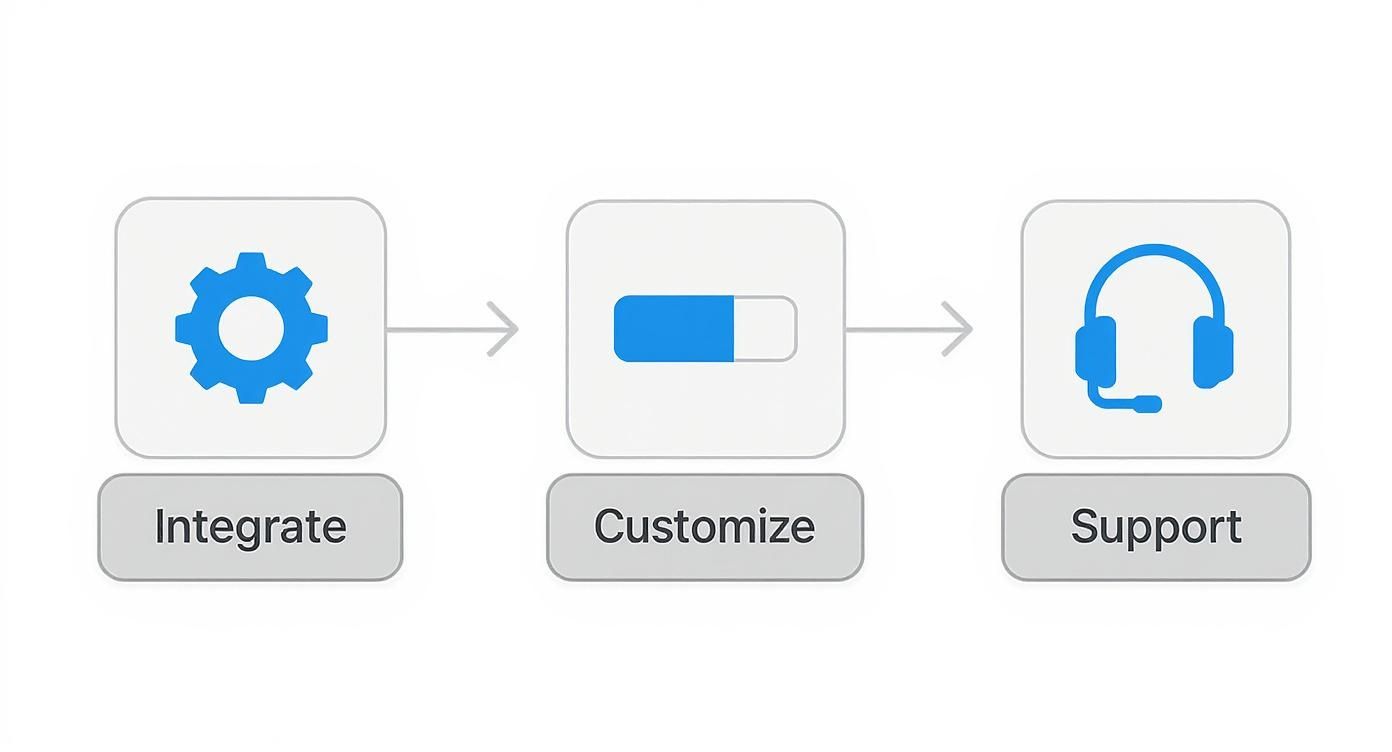
It all begins with smooth integration into the systems you already use, followed by deep customization to fit your exact needs, and is held together by ongoing support for long-term success.
Building a Robust Governance Framework
Once you’re ready to move beyond the pilot, putting a solid governance framework in place is non-negotiable. This isn’t about creating red tape; it's about building a system of accountability and continuous improvement for your legal AI chatbot. Law firms serious about making AI a strategic asset will find that reading a comprehensive guide to implementing AI in business offers some great a-ha moments for a successful deployment.
Your governance plan should spell out a few key things:
- Usage Policies: Draw up clear guidelines for your team on how and when to use the chatbot. This should include exactly what to do when a complex query needs a human and the standards for reviewing chat transcripts to ensure quality.
- Oversight Committee: Appoint a small group to be responsible for the chatbot’s performance. This team should get together regularly to look at the analytics, go over user feedback, and decide on any needed tweaks or new features.
- Continuous Feedback Loop: Set up a simple way for attorneys and staff to flag issues or suggest improvements. This feedback is pure gold—it’s the best resource you have for making the chatbot more accurate and useful over time.
A strong framework doesn't just get you off to a good start; it ensures your chatbot evolves with your firm's needs. For a deeper dive, check out these AI governance best practices. This structure transforms your chatbot from a static tool into a dynamic asset that's always learning and getting better, driving more and more value for your practice.
Got Questions About Legal AI Chatbots? We've Got Answers.
It's completely normal to have questions when considering a tool as powerful as a legal AI chatbot. In fact, it's a good sign. Smart legal professionals are always cautious, wanting to understand everything from the real cost and complexity to the big one: ethical lines. Getting these questions answered is key to feeling confident about bringing one into your practice.
Think of this technology less as a "robot lawyer" and more as an incredibly efficient assistant that works within very specific, pre-approved boundaries. The first step to using it well is knowing exactly where those boundaries are.
Can a Chatbot Actually Give Legal Advice?
Absolutely not. It shouldn't, and a properly designed one can't. A legal AI chatbot is built for one thing: getting information and handling administrative legwork. It’s not meant for legal analysis or giving counsel. Its job is to handle factual questions ("When does your office close?"), collect basic intake details, or book a consultation.
Giving legal advice is, and always will be, the job of a licensed attorney. Any reputable chatbot provider will have built-in guardrails that stop the AI from giving opinions, interpreting a legal problem, or telling someone what they should do. It’s a support tool, not a substitute for your professional judgment.
One of the most important ethical rules here is total transparency. The person on the other end must know they're talking to an AI assistant, not a human lawyer, and understand that it can only provide information, not legal advice.
How Much of a Tech Whiz Do I Need to Be to Use One?
Far less than you might think. Today's legal AI chatbot platforms are built for lawyers, not software engineers. The setup is usually handled through a straightforward dashboard where you can map out conversation paths, feed it your firm's specific information, and link it to your other software with just a few clicks.
Most providers will also walk you through the entire setup with hands-on support. The whole point is to make the technology easy to use and manage day-to-day, without you needing to learn how to code.
Ready to see how a voice-first AI workspace can boost your firm's efficiency? Discover how Whisperit brings together dictation, drafting, and case management so your team can get more done with less stress. Find out more about Whisperit.