
A Strategic Guide to Law Firms and Technology Transformation
Let's be honest, the idea of integrating technology into a law firm used to be a "nice-to-have." Not anymore. Today, the connection between law firms and technology is an absolute necessity. This isn't just about keeping up with the times; it’s a direct response to what clients are demanding—more efficiency, better value, and data-backed strategies. For any law firm that wants to thrive, technology isn't just a tool; it's the very fuel that keeps the engine running.
Why Technology is the New Cornerstone of Legal Practice

Imagine your firm is a high-performance race car. Your legal talent—the partners, associates, and paralegals—is the meticulously engineered engine. It’s powerful and designed for excellence. But even the world's best engine is useless without the right fuel. In this analogy, technology is that high-octane fuel. It’s what allows your firm to move faster, operate with more precision, and outlast the competition.
This isn't about letting software replace sharp legal minds. Quite the opposite. It’s about empowering them. Technology takes over the repetitive, administrative heavy lifting. It can sift through mountains of data to find the needle in the haystack and keep client information locked down tight. This frees up your lawyers to do what they do best: craft brilliant legal strategies, advocate fiercely for clients, and provide irreplaceable counsel.
Key Drivers for Technological Integration
The pressure to adopt new tech is coming from all sides, but it starts with the client. Clients today aren't just paying for legal advice; they're paying for results. They want transparency, predictable costs, and quick turnarounds. The traditional billable hour is being challenged, and firms that can prove their efficiency are winning the business.
On top of that, the legal market has never been so crowded. If your firm isn't modernizing, you can bet your competitors are. They're using data to manage their practices better, from staffing cases to forecasting litigation outcomes. Sticking to the old ways is no longer a viable option.
Technology is the strategic lever that allows law firms to meet modern client expectations, enhance operational efficiency, and secure a competitive edge. Adopting the right tools is a direct investment in the firm's future relevance and profitability.
This guide is designed to give you a clear, no-nonsense roadmap for navigating the intersection of law firms and technology. We'll cut through the jargon and look at the essential tools that are genuinely making a difference, from core practice management platforms to AI assistants that can draft and review documents.
You'll walk away with practical knowledge on:
- Core Legal Tech Categories: A breakdown of the different types of tools and what they actually do.
- Strategic Implementation: How to build a realistic plan for getting new tech up and running successfully.
- Security and Compliance: A critical look at protecting client data in an increasingly digital world.
By exploring the digital transformation in the legal industry, you can make smart, informed decisions that empower your team and, most importantly, deliver exceptional value to your clients.
Understanding the Core Categories of Legal Technology
Diving into legal technology can feel overwhelming. With so many tools on the market, it's easy to get lost. The trick is to stop thinking about them as individual products and start seeing them as parts of a single, interconnected system, with each piece designed to solve a specific problem your firm faces every day.
When you look at it this way, the options become much clearer. Instead of getting bogged down by brand names, we can sort these tools into categories based on what they actually do. This approach helps firms pinpoint their biggest pain points and find the right tool for the job, allowing them to build a powerful tech stack one piece at a time.
This growing synergy between law firms and technology is easy to see in the budget numbers. Tech spending at law firms hit a new high in 2025, climbing to 11.2% of total expenses by the third quarter. That's the third year in a row we've seen double-digit growth, a clear sign that firms are betting big on technology and knowledge management to stay competitive.
To help you make sense of it all, here's a quick overview of the essential legal tech categories and how they fit into a modern law firm's operations.
Key Legal Technology Categories and Their Core Functions
| Technology Category | Primary Function | Example Use Cases |
|---|---|---|
| Practice Management | Centralizing all firm operations into one platform. | Managing case files, tracking billable hours, calendaring deadlines, and handling client intake. |
| Document Automation | Generating legal documents from templates automatically. | Creating engagement letters, drafting standardized contracts, and assembling discovery requests. |
| AI-Powered Tools | Automating cognitive tasks and accelerating workflows. | Drafting initial memos, transcribing depositions, and conducting rapid legal research. |
| E-Discovery | Processing and analyzing large volumes of electronic data. | Reviewing emails for litigation, identifying key documents, and managing digital evidence. |
| Secure Hosting | Protecting client data and ensuring regulatory compliance. | Encrypting client communications, securely storing case files, and meeting GDPR standards. |
Let's break down exactly what these tools do and why they matter.
H3: Practice Management Software: The Firm's Central Nervous System
Think of Practice Management Software (PMS) as the digital command center for your entire firm. It’s the central nervous system that links everything together—from the first client call to the final invoice. It weaves case files, calendars, contacts, time tracking, and billing into a single, cohesive platform.
Without a solid PMS, crucial information ends up fragmented across spreadsheets, scattered email threads, and dusty file cabinets. This chaos doesn't just slow you down; it creates real risk. A good PMS gives every authorized person on your team a single source of truth for every case, ensuring everyone is working with the same up-to-date information.
H3: Document Automation and Management: The Digital Assembly Line
If a PMS is the nervous system, then a Document Management System (DMS) is the firm's intelligent, Fort Knox-secure filing cabinet. This is way more than just cloud storage. We're talking about sophisticated version control, powerful search tools, and precise access permissions to keep sensitive client data locked down. No more frantic searches for the final version of a contract.
Document automation takes this efficiency to another level, creating a kind of digital assembly line for your paperwork. It uses smart templates to instantly build complex legal documents by pulling client and case data automatically. This doesn't just save countless hours of tedious work; it slashes the risk of human error and keeps your firm's work product consistent and professional.
A well-implemented document automation strategy transforms a firm's most repetitive work. It frees legal professionals from tedious copy-and-paste tasks, allowing them to focus their expertise on high-value strategic work that directly benefits clients.
H3: AI-Powered Tools: The Intelligent Assistant
Artificial intelligence is no longer science fiction; it's one of the most significant forces shaping the relationship between law firms and technology. AI tools are like having an incredibly sharp and tireless assistant, ready to take on tasks that once ate up hours of a paralegal's or junior associate's day.
These tools generally fall into a few key areas:
- AI-Powered Drafting: Tools like Whisperit can generate first drafts of letters, memos, and client emails from simple voice notes or case summaries, giving attorneys a huge head start.
- Intelligent Transcription: AI can take audio from depositions, client meetings, or dictated notes and turn it into accurate, searchable text in a matter of minutes.
- Legal Research: Instead of spending days in a law library, AI platforms can sift through thousands of cases and legal precedents almost instantly, pulling out the most relevant information.
Getting familiar with the different types of technology for law firms is the first step in deciding which AI tools will make the biggest difference for your practice.
H3: E-Discovery and Secure Communications: The Digital Investigator and Vault
In today's world, the smoking gun is almost always digital. E-discovery platforms are the high-tech investigators that help legal teams dig through mountains of electronic data—emails, text messages, spreadsheets, you name it. These tools use powerful analytics to find that one crucial piece of evidence hidden in terabytes of information.
Finally, secure communication and hosting tools are the firm's virtual vault. They provide end-to-end encryption for all client communications and a secure environment for storing sensitive files. This isn't just a "nice-to-have"; it's essential for complying with data privacy regulations like GDPR and upholding the sacred attorney-client privilege. For any modern firm, this layer of security is absolutely non-negotiable.
Why Are Law Firms Finally Embracing Tech?
For a long time, the legal world felt like one of the last places untouched by the tech wave. That’s not the case anymore. The shift we're seeing isn't just a trend; it's a direct response to a perfect storm of client demands and the internal need to work smarter, not harder. The old narrative is dead. Today, firms know that modernizing isn't optional—it's essential for survival and growth.
The core of this movement comes down to one thing: productivity. While cybersecurity is always a major concern, the real driver shaping where firms invest their money is the relentless push for efficiency. It’s not just about cutting costs. It's about freeing up incredibly talented legal minds from the drudgery of administrative tasks that eat up their days. When you automate the routine stuff, your team can finally focus on what they were hired to do: craft brilliant legal strategies, build client relationships, and tackle complex cases.
The AI Tipping Point
Nowhere is this push for efficiency clearer than in the explosive adoption of Artificial Intelligence. Just a few years ago, AI was met with skepticism. Now, law firms are in an all-out sprint to weave it into their daily work.
The numbers tell a stunning story. According to one recent survey, AI adoption in law firms shot up from 47% in 2024 to an incredible 80% in 2025. And while security is important, it's productivity that's getting the budget. 66% of IT spending is aimed at making firms more efficient, while just 12% is earmarked for cyber defense. This shows a very practical mindset: firm leaders see AI's massive potential to automate workflows and, ultimately, increase billable hours. You can dig into the complete 2025 legal tech survey findings from Tabush Group for more detail.
This isn’t just hype; the business case is crystal clear. AI tools can now draft an initial client letter, transcribe hours of deposition audio in minutes, or sift through thousands of documents to find key evidence almost instantly. Each one of these tasks used to be a manual, time-sucking process. Now, they represent hours of strategic time given back to your lawyers. If you want to see how this works in practice, check out our guide on generative AI for law firms.
Getting Past the Human Roadblocks
Even with all the obvious benefits, making the switch isn't always a smooth ride. The biggest obstacles are usually human, not technical. Most firms find themselves stuck on two main issues that prevent them from fully embracing what law firms and technology can do together.
What's Holding Firms Back?
- Lack of Skills and Training: Lawyers are trained in legal theory, not software. The worry about a steep learning curve often leads to resistance, which makes finding intuitive, easy-to-use platforms an absolute must.
- Data Privacy and Security Risks: A lawyer's duty to protect sensitive client data is sacred. Understandably, fears about data breaches, maintaining confidentiality, and staying compliant with rules like GDPR are top of mind for everyone in the legal field.
The answer isn't to shy away from technology, but to choose the right tools. The best legal tech is built from the ground up to address these very fears, with user-friendly designs and rock-solid, compliance-focused security.
Modern legal platforms are designed to tear down these barriers. For instance, voice-first AI workspaces let lawyers work in a way that feels natural, without needing a crash course in IT. In the same way, solutions that offer built-in, GDPR-aligned controls and secure hosting in jurisdictions like Switzerland or the EU are designed to manage risk from day one. By choosing tools that are both powerful and approachable, firms can confidently step into the future.
How Your Firm's Size and Specialty Dictate Your Tech Needs
It’s easy to fall into the trap of thinking that when it comes to legal tech, the biggest firms with the deepest pockets always lead the pack. We often hear stories about massive, global firms spearheading tech adoption. The truth on the ground, however, is a lot more complex and, frankly, more interesting.
There's no such thing as a "best" technology strategy that works for every law firm. Think about it: the daily needs of a solo practitioner are worlds away from those of a 500-lawyer international powerhouse. In the same way, a personal injury practice built on high-volume caseloads will lean on completely different tools than a boutique firm handling intricate corporate mergers.
Getting this right is all about making smart, targeted tech investments that fit your firm, not someone else's.
Mid-Sized Firms: The Advantage of Agility
While the giant firms can certainly afford enterprise-level platforms, they often struggle with a hidden cost: institutional inertia. Just imagine trying to get hundreds of partners to agree on a single new system. It can be a colossal undertaking.
This is where mid-sized firms have a secret weapon. They're far more nimble. Free from the layers of bureaucracy that can paralyze larger competitors, they can pivot quickly, test new tools, and roll out solutions that fix very specific problems. This flexibility gives them a serious edge in both efficiency and the quality of client service.
AI Adoption: It's Not Just a Big Firm Game
The rise of generative AI paints a perfect picture of how firm size shapes tech adoption. While it's true that large firms are ahead in overall usage, mid-sized firms are catching up with surprising speed.
A firm’s technology needs are not defined by its headcount alone, but by its ambition. Growing firms—regardless of size—are the ones most aggressively adopting technology to gain a competitive advantage, often doubling their revenue over a four-year period compared to their slower-moving peers.
The numbers tell a clear story. While 87% of large practices are using AI in some form compared to 71% of solo practitioners, the real action is with generative AI. Firms with over 50 lawyers are embracing it at a 39% adoption rate—nearly double the 20% we see in smaller firms. You can dive into the full data in the 2025 Clio Legal Trends Report to see how you stack up.
Your Practice Area Is Your Tech Roadmap
Beyond your firm's headcount, what you do every day is the most critical factor in building your tech stack. Different legal fields have their own unique rhythms, documents, and client pressures, which means they need different tools to succeed.
- Civil Litigation: This specialty leads the pack in firm-level AI adoption at 27%. It makes perfect sense—these firms are swimming in documents and data. Tools for e-discovery, deposition transcription, and automated document review aren't just nice to have; they're essential.
- Personal Injury & Family Law: Both sitting at 20% adoption, these practices thrive on efficiency. They get huge benefits from case management software that can juggle a high volume of clients, automate routine communications, and instantly generate standard forms and letters.
- Corporate Law: For these firms, security and precision are paramount. They lean heavily on secure collaboration platforms, virtual data rooms for M&A deals, and sophisticated contract analysis tools that can flag risks and unusual clauses in seconds.
At the end of the day, making the right tech decisions isn’t about chasing the latest shiny object. It’s about taking a hard look at your firm’s real-world operational needs. If you’re at a smaller practice, our guide on legal software for small firms offers advice tailored just for you. The goal is always the same: find solutions that solve your specific problems and empower your team to do their best work.
Crafting Your Firm's Technology Implementation Roadmap
Knowing which legal technologies exist is one thing. Actually weaving them into the fabric of your firm’s day-to-day work is a completely different beast. It requires a clear, methodical plan to get from idea to adoption. Without one, even the most promising software ends up as expensive shelfware, leaving you with nothing but wasted money and frustrated colleagues.
Think of a technology implementation roadmap as your firm's strategic guide for this journey. It's more than just a project plan with dates and dollars. It’s a complete strategy that begins by identifying your biggest operational headaches and ends with a fully adopted tool that delivers real, measurable value.
Step 1: Assess Your Current Workflows and Pain Points
Before you can even think about solutions, you have to get an honest look at the problems. The first step is a candid audit of your current processes. Where are the bottlenecks? What repetitive, administrative tasks are eating up your lawyers' and paralegals' valuable time?
You need to gather feedback from everyone involved—partners, associates, paralegals, and administrative staff. Their insights from the trenches are pure gold. You might find out your client intake is a slow, manual mess, document drafting is wildly inconsistent across the team, or just finding a specific case file is a daily struggle. These pain points are the "why" behind any technology investment.
Step 2: Define Clear and Measurable Objectives
Once you know what’s broken, you have to define what "fixed" looks like. Vague goals like "improving efficiency" won't cut it. Your objectives need to be specific, measurable, and tied to a timeline.
For instance, a solid objective sounds like this:
- Reduce the time spent drafting standard client correspondence by 40% within six months.
- Decrease the error rate in client intake forms by 95% by the end of next quarter.
- Ensure all case-related documents are centrally stored and accessible within 30 seconds.
These kinds of concrete targets give you a clear yardstick to measure success. They also get everyone pulling in the same direction toward a shared goal.
Step 3: Evaluate Vendors with a Critical Eye
With your goals set, you can start looking at vendors. This is where your due diligence really matters. When it comes to the intersection of law firms and technology, not all platforms are created equal—especially when you factor in the strict security and confidentiality your profession demands.
A technology vendor is more than a supplier; they are a strategic partner in your firm's future. The right partner understands the unique ethical and operational demands of legal work and has built their platform to meet them.
As you navigate this, remember that crafting your cybersecurity roadmap is a non-negotiable part of the process. To compare your options systematically, a detailed checklist is essential.
Before you sign any contracts, it's critical to have a structured way to evaluate potential partners. The following table provides a checklist of key areas to probe, ensuring you cover all your bases from security to usability.
Vendor Evaluation Checklist for Legal Technology
| Evaluation Criteria | Key Questions to Ask | Importance (High/Medium/Low) |
|---|---|---|
| Data Security & Compliance | Where is our data hosted (e.g., Swiss/EU options)? Is data encrypted end-to-end? Do you comply with GDPR and other relevant regulations? | High |
| Integration Capabilities | Can the platform integrate seamlessly with our existing systems, like our email client (e.g., Outlook) and document management system? | High |
| User Interface & Experience | Is the platform intuitive and easy to navigate for non-technical users? Can we customize workflows to match our processes? | High |
| Customer Support & Onboarding | What does your onboarding process look like? What level of ongoing support is included? Are there dedicated resources for law firms? | Medium |
| Scalability & Future-Proofing | Can the platform grow with our firm? What is the vendor's roadmap for future features and updates? | Medium |
This checklist isn't just a formality; it's a tool to protect your firm and ensure the technology you choose is a genuine asset, not a future liability.
Step 4: Plan a Phased Rollout and Manage Change
Trying to launch a new system for everyone all at once—the "big bang" approach—is almost always a recipe for chaos. A phased rollout is much smarter. Start with a small pilot group of tech-savvy team members who are excited about the change. They can test the new system, give you honest feedback, and become your internal champions when it's time to expand.
This visual shows how technology adoption often happens organically, starting small and spreading as its value becomes clear.
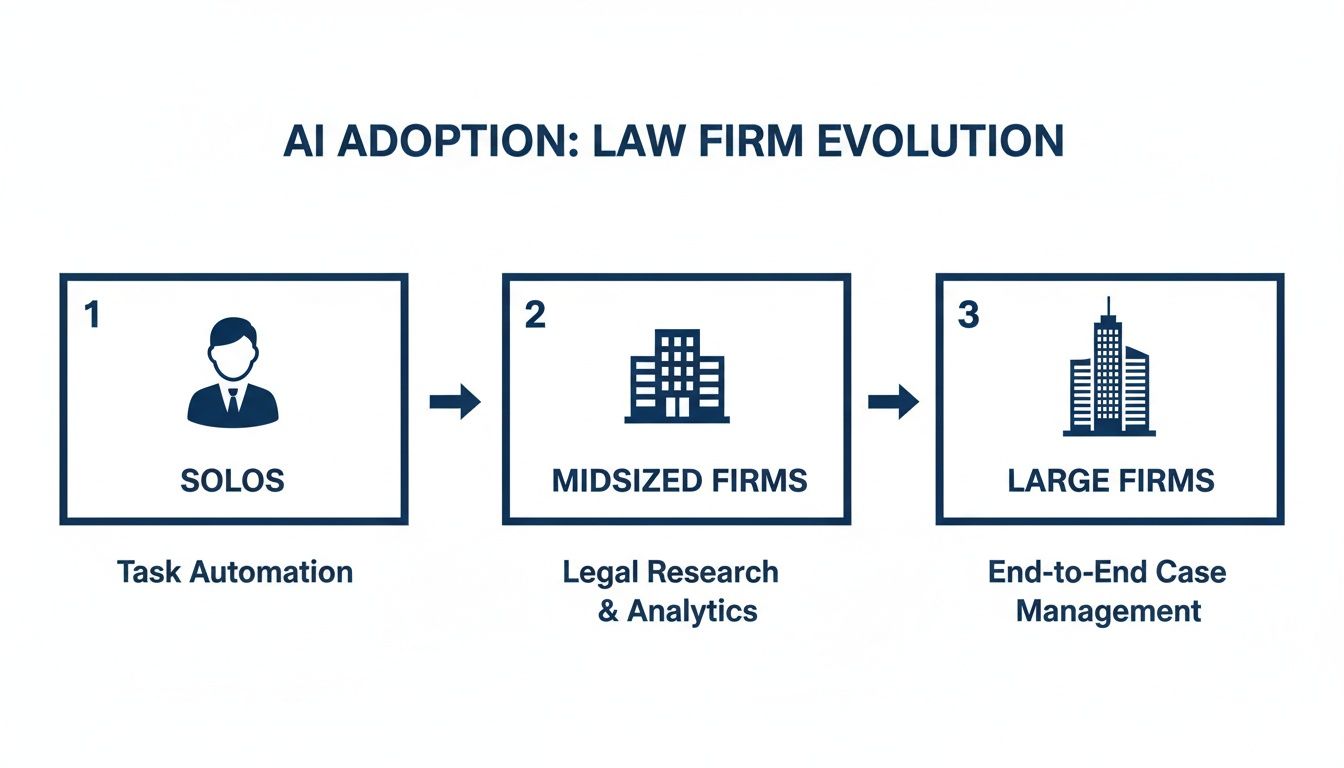
As the infographic suggests, as firms grow, their use of technology naturally becomes more structured and integrated. Your rollout plan should reflect that.
Finally, don't forget the human element. Change management is the glue that holds this whole process together. You must clearly communicate the "why" behind the new tool—how it will make everyone's job less frustrating and help the firm succeed. Provide fantastic, role-based training that focuses on real-world tasks, not just a tour of software buttons. By investing in your people as much as you invest in the technology, you set the stage for a truly successful implementation.
Navigating Security and Compliance in the Digital Age

New technology brings incredible opportunities, but it also opens a new front in a law firm’s oldest and most sacred duty: protecting client confidentiality. For lawyers, security isn’t just an IT problem; it’s an ethical mandate, plain and simple.
The good news is that you don't have to choose between innovation and security. In fact, the right tools often provide a far more secure and auditable environment than old-school paper files or locally saved documents. The key is knowing what to look for and demanding a security-first approach from any vendor you consider.
Understanding the Pillars of Digital Security
Protecting client data in a digital workspace really comes down to a few core principles. Think of these as the non-negotiables for any secure legal tech stack.
First up is end-to-end encryption. This is the digital equivalent of sending a locked briefcase via a secure courier. It scrambles your data from the moment it leaves your device until the intended recipient opens it, making it completely unreadable to anyone who might try to intercept it. It's the absolute baseline for any platform handling privileged communications.
Another critical piece of the puzzle is the audit trail. A good system creates an unchangeable log of every single action: who accessed a file, when they viewed it, and what changes they made. This digital paper trail is invaluable for compliance checks and internal security reviews. For a deeper look, our guide on law firm data security lays out more comprehensive strategies.
Choosing the Right Data Hosting Model
Where your firm’s data physically lives is one of the biggest security decisions you’ll make. Each hosting model strikes a different balance between control, cost, and convenience.
- On-Premise Hosting: You own and manage the servers right in your office. This gives you total physical control, but it also demands serious IT expertise and a hefty budget to maintain and secure properly.
- Cloud Hosting: A specialized third-party provider, like Amazon Web Services or Microsoft Azure, manages all the hardware and infrastructure. This gives you incredible flexibility and access from anywhere but means you have to do your homework to ensure the provider meets the legal industry's demanding security standards.
- Hybrid Hosting: This approach mixes both worlds, letting you keep your most sensitive data on your own servers while using the cloud for less critical applications or for backup and disaster recovery.
For firms with international clients, data residency is a massive consideration. You need to know where your data is stored. Choosing a vendor that offers secure hosting in jurisdictions with strong data privacy laws, like Switzerland or the EU, is crucial for meeting GDPR and other global regulations.
Compliance by Design
Compliance can't be an afterthought—it has to be baked right into the technology. This means looking for features like granular access controls, which let you decide precisely who can see, edit, or share specific documents, cases, or even individual data fields.
It also means thinking through how new tools fit into existing regulations. For instance, if you're using a tool that transcribes client calls or virtual depositions, you must consider the legal and compliance implications, such as understanding meeting recording laws in relevant jurisdictions.
Ultimately, navigating security in this new era is about choosing partners who truly understand the weight of your professional responsibilities. By prioritizing platforms with robust encryption, secure hosting, and built-in compliance tools, your firm can confidently embrace technology while upholding its core ethical duties.
Got Questions About Legal Tech? We've Got Answers
Stepping into the world of legal technology often brings up a lot of practical questions. Let's tackle some of the most common ones we hear from legal professionals who are looking to bring new tools into their practice.
What Is the Typical Return on Investment for Legal Tech?
Measuring the ROI on legal tech isn’t just about the bottom line—it’s about getting back your most valuable resource: time. The biggest returns come from huge efficiency gains, a dramatic reduction in errors, and happier clients who keep coming back.
Think about it this way: an AI drafting tool can easily cut the time you spend on routine documents and emails by more than 50%. That’s not just about trimming non-billable hours. It’s about freeing up your attorneys to focus on high-value, strategic work that actually moves cases forward. While the upfront costs vary, firms that get on board with the right tech often see significant revenue growth because they’re solving the most expensive bottlenecks in their day-to-day workflow.
How Do We Actually Get Our Team to Use New Software?
Great technology falls flat without great adoption. The secret is training that shows your team why a new tool makes their job better, not just what buttons to click. The goal is to make the software a natural part of their daily routine from the very beginning.
A smart approach is to start small with a pilot group of tech-savvy team members. Let them test it out, find any rough edges, and become your internal cheerleaders. When they start telling their colleagues how much time they're saving, you've got real momentum.
Your training sessions should also be tailored to specific roles. Don't give everyone the same generic tour. Show your litigators exactly how the tool helps with discovery, and show your paralegals how it automates client intake. And always choose a tech partner who offers solid onboarding and is there to help long after the initial setup.
The most effective training always answers the question, "What's in it for me?" Once your team sees how a new tool gets rid of tedious work so they can focus on high-impact legal strategy, adoption stops being a mandate and starts becoming a no-brainer.
Is AI Technology Secure Enough for Confidential Client Data?
Absolutely—but only if you partner with the right vendor. For any serious legal tech platform, security isn't just a feature; it's the foundation everything is built on. The best providers know they're handling incredibly sensitive information and design their systems from the ground up to protect it.
When you're vetting potential tools, these security features are non-negotiable:
- End-to-End Encryption: This makes sure your data is completely unreadable to anyone without authorization, whether it's being sent over the internet or stored on a server.
- Secure Hosting Options: Your vendor should offer hosting in locations with strict data privacy laws, like Switzerland or the EU, helping you stay compliant with regulations like GDPR.
- Granular Access Controls: This lets you decide precisely who can see, edit, or share specific documents and files, ensuring information is only accessible on a need-to-know basis.
A trustworthy vendor will be completely open about their security protocols and certifications. When you do your homework, you'll find that modern AI tools often provide a far more secure and auditable environment than filing cabinets and local servers ever could.
Will AI Replace Lawyers or Paralegals?
Not a chance. AI isn't here to replace lawyers; it's here to supercharge them. The technology is fantastic at handling the repetitive, data-intensive tasks that bog down most legal professionals—things like first-pass document review, digging through case law, and drafting standard client letters.
By taking that work off your plate, AI acts more like a highly efficient assistant. It frees up lawyers and paralegals to focus on the things that require uniquely human skills: strategic thinking, counseling clients, negotiating deals, and solving complex problems. The firms that figure out how to make law firms and technology work together will find their teams are more effective, not obsolete.
Ready to see how a voice-first AI workspace can transform your firm's productivity? Whisperit unifies drafting, dictation, and collaboration to help your legal team work faster and more consistently. Explore how Whisperit can streamline your workflow today.