
A Modern Guide to IT Solutions for Law Firms
Not long ago, a law firm's success was measured by the size of its law library and the height of its filing cabinets. Today, it’s all about the software. The right IT solutions are no longer a "nice-to-have"—they're the very engine of a modern, competitive practice. These tools are what allow firms to ditch the cumbersome paper-based world for digital processes that are faster, safer, and far more efficient.
Why Modern Law Firms Run on Technology

Let's be honest: a law firm today is as much a technology business as it is a legal one. The era of rooms overflowing with paper files and meticulous manual ledgers is over. In its place, we have digital workflows that are not just more convenient, but absolutely essential for survival and growth.
Every single firm grapples with the same core challenge: delivering stellar client service while keeping operations running smoothly and protecting sensitive data. Clients demand quick replies, clear communication, and straightforward billing. At the same time, your firm is handling a mountain of confidential information, navigating strict compliance rules, and trying to stay profitable. Sticking to old-school methods just won't cut it—it introduces risks and slows everyone down.
The Strategic Value of a Modern Tech Stack
Thinking of technology as just another overhead expense is a huge misstep. The right IT solutions for law firm professionals are a strategic investment. They are the engine that drives growth, keeps clients happy, and gives you a real edge over the competition. A thoughtfully built tech stack helps your firm:
- Boost Productivity: By automating the tedious, repetitive admin work, you free up your legal experts to focus on what truly matters: legal strategy and advising clients.
- Enhance Client Service: Modern tools offer secure client portals for sharing documents, enable faster communication, and provide transparent case updates, which all lead to stronger client relationships.
- Improve Accuracy and Consistency: Using templates and automated workflows drastically cuts down on human error when you’re drafting documents or managing case files.
- Secure Sensitive Data: Robust cybersecurity, encryption, and compliance-first tools are non-negotiable for protecting client confidentiality and your firm's reputation.
Think of this guide as your roadmap to modernizing your practice. We'll walk through everything from core systems like practice management software to the advanced AI workspaces that are changing the game for legal work.
Ultimately, getting your technology in order is about preparing your firm for the future. You can get a head start by exploring the fundamentals of choosing the right law firm technology for your specific needs. Let's dig in and see how the right tools can unlock your firm's true potential.
The Core Technology Every Law Firm Needs
To run a modern law firm that’s both efficient and secure, you need the right technology foundation. Think of it like building a house—you wouldn't pick out the light fixtures before the foundation is poured and the walls are framed. Your firm's IT solutions are that foundation. They need to work together seamlessly to support everything you do, from the first client call to the final invoice.
This isn't about chasing the latest shiny object. It’s about creating a reliable operational backbone that frees you up to focus on what matters: practicing law. Without these core systems in place, even the best legal minds can get bogged down by administrative chaos, disorganized files, and unnecessary security risks.
Practice and Case Management: The Firm's Central Nervous System
At the very heart of a modern law practice is the Legal Practice Management System (LPMS). This isn't just another program; it's the digital command center for your entire firm. Think of it as the central nervous system, connecting and coordinating every case file, client message, calendar deadline, and billable minute.
A solid LPMS pulls all your critical functions into one place. Choosing the best legal practice management software is a game-changer for streamlining how work gets done and making the whole firm more productive. It ensures everyone, from paralegals to senior partners, is on the same page and looking at the most current information.
This kind of integration is what keeps crucial details from vanishing into a maze of email threads and disconnected spreadsheets. It creates a single source of truth for every case, which is absolutely essential for staying organized and providing top-notch client service.
Document and Knowledge Management: Your Digital Filing Cabinet
Law firms are built on a mountain of documents. Contracts, motions, discovery, emails—managing this flood of information securely and efficiently isn't just a good idea, it's a necessity. This is where a dedicated Document Management System (DMS) steps in.
A DMS is so much more than a shared drive or a basic cloud folder. It's an intelligent, searchable library for all your firm’s documents and institutional knowledge. Key features usually include:
- Version Control: This is a lifesaver. It tracks every single change to a document, so you know you’re always working on the latest draft (and can easily pull up an old one if you need to).
- Advanced Search: Imagine finding a specific clause across thousands of documents in seconds. A good DMS lets you search by keyword, client, date, or other metadata, saving you from hours of manual digging.
- Access Controls: You can set specific permissions for who can see, edit, or share sensitive files, giving you granular control to protect client confidentiality.
A well-implemented DMS turns your firm’s chaotic collection of files into a powerful, strategic asset. It’s the digital equivalent of a perfectly organized, infinitely expandable filing cabinet.
Secure Collaboration and Communication
Let's be honest: standard email just isn't secure enough for the kind of sensitive information lawyers handle every day. The old way of doing things is over. Modern legal tech offers secure client portals and encrypted messaging platforms built specifically for the legal world.
These tools create a protected space where you can share documents, post updates, and communicate with clients without the vulnerabilities of regular email. Better yet, they provide a clear, centralized log of every interaction for a given case, which is priceless for accountability and future reference. Investing in the right technology for law firms builds a foundation of security and transparency that clients truly appreciate.
Billing and Financial Management
Getting paid on time is the lifeblood of any firm. But manual time tracking and invoicing are tedious, error-prone, and a recipe for revenue leakage. This is a problem that specialized legal billing software was born to solve.
These platforms take the headache out of the entire process. They make time tracking simple, manage retainers, handle different billing rates for different attorneys, and integrate with trust accounting rules. The result is clear, professional invoices that boost client confidence and dramatically improve your cash flow. By automating the financial side of things, you cut down on administrative work and gain real-time insight into your firm's financial health, letting you get back to practicing law instead of chasing down payments.
Here is a quick overview of these essential technology categories and what they do for your firm.
Essential IT Solution Categories for Law Firms
| Solution Category | Primary Function | Key Benefit |
|---|---|---|
| Practice & Case Management | Centralizes client data, cases, calendars, and tasks. | Creates a single source of truth and improves firm-wide organization. |
| Document & Knowledge Management | Securely stores, organizes, and manages all firm documents. | Prevents data loss, improves efficiency, and makes knowledge accessible. |
| Secure Collaboration & Email | Provides encrypted channels for client communication and file sharing. | Enhances client confidentiality and creates an auditable communication trail. |
| Billing & Financial Management | Automates time tracking, invoicing, and trust accounting. | Improves cash flow, reduces errors, and provides financial clarity. |
Ultimately, these systems are not isolated tools but interconnected parts of a larger strategy. When chosen and implemented thoughtfully, they form a cohesive tech stack that supports every facet of your firm's success.
How AI Is Reshaping the Way Lawyers Work
Artificial intelligence isn't some far-off concept anymore; it's here, and it's fundamentally changing how legal work gets done. Think of it less as a robot lawyer and more like an incredibly efficient paralegal—one that handles the tedious, administrative side of the job so you can dedicate your brainpower to strategy and client advocacy.
Imagine an environment where you can dictate a thought, draft a motion, and research a precedent without ever juggling different programs. That’s exactly what modern IT solutions for law firm professionals are making possible. These systems are smart enough to understand the context of your work, letting you use natural language to get things done.
You could simply say, "Draft a client update letter using our standard template," and the system would instantly pull up the right format and start populating the document. This kind of intuitive workflow cuts out the administrative friction that eats up so much of a lawyer's day.
The Shift to a Voice-First AI Workspace
The biggest change we're seeing is the move toward a voice-first environment. Instead of clicking through a maze of folders and menus, lawyers can use simple voice commands to manage their entire workflow. A context-aware AI navigator can field a request like, "pull up the inspection report for the Smith case," and have the file on your screen in seconds.
This creates a calmer, more focused way of working where the technology finally adapts to the user, not the other way around. It’s all about closing the gap between a thought and an action, whether that's starting a new document, finding a key piece of evidence, or firing off a quick client email.
The point of AI in the legal field isn't to replace human judgment. It's about augmenting it. By taking over the repetitive, process-heavy tasks, it frees up legal professionals to focus on the high-level strategic thinking and client counsel that truly matters.
This flowchart shows how these foundational IT solutions fit together. You can see how Practice Management, Document Management, and Secure Collaboration act as the core pillars supporting the entire firm.
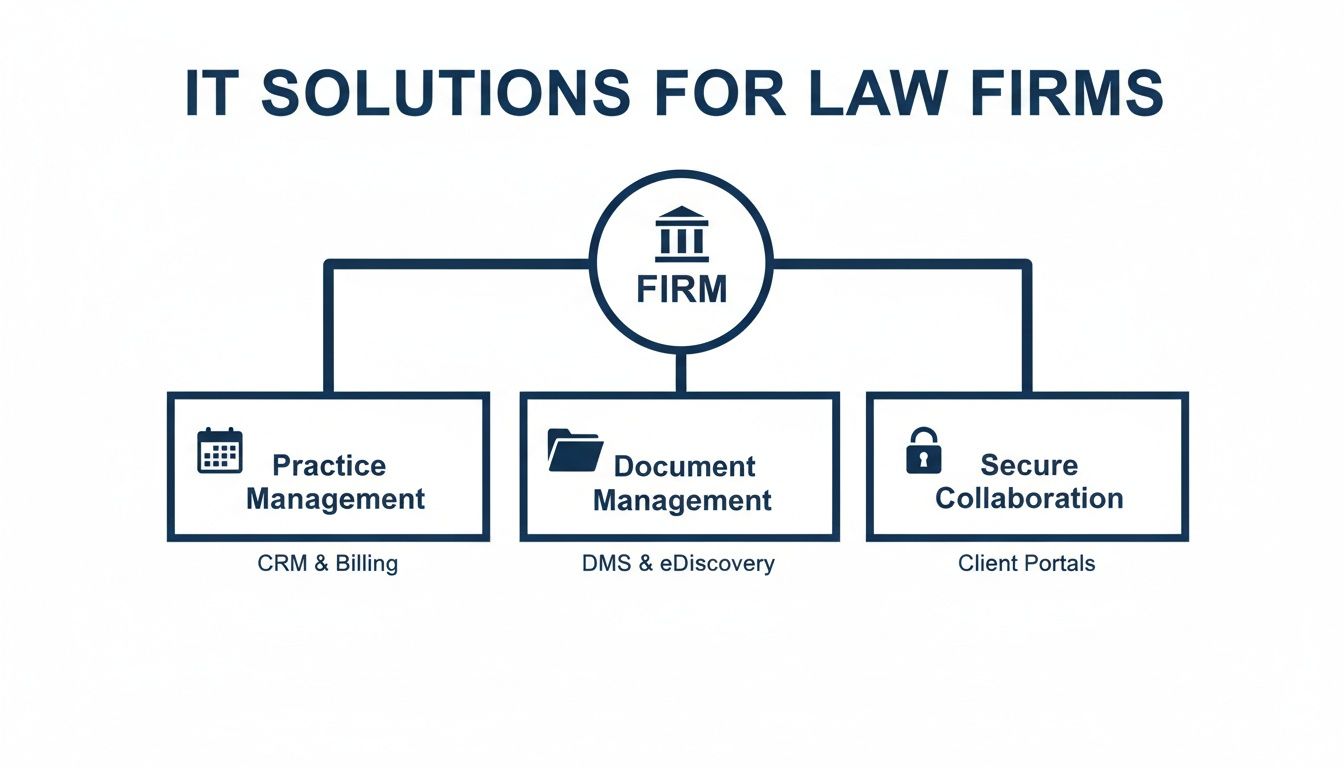
As the visual makes clear, a modern law firm's tech stack isn't just a collection of random tools. It’s a set of integrated systems designed to manage different parts of the legal workflow, all working together to support the practice.
Driving Real Efficiency and Consistency
Beyond just being convenient, AI delivers measurable improvements to a firm's work product. Features like real-time transcription and structured drafting templates don't just speed up document creation—they also enforce firm-wide standards for quality and consistency.
- Real-Time Transcription: Instantly turns your spoken words into text, cutting out the delays and costs associated with old-school dictation services.
- Structured Drafting Templates: Ensures every document, from a basic letter to a complex motion, adheres to a pre-approved format for consistent quality.
- Style Profiles: Automatically applies the correct tone, citation style, and numbering scheme, drastically reducing the time spent on manual edits and proofreading.
These tools don't just help you work faster; they help you work better and more reliably. That’s a huge advantage for growing firms trying to maintain high standards as their caseloads expand. To see how these tools are evolving, you can dig deeper into our guide on generative AI for law firms.
The pace of adoption here is staggering. According to the Tabush Group's 2025 Legal Survey, AI adoption in law firms jumped from 47% in 2024 to a massive 80% in 2025. This isn't a small trend; it's a major industry shift. The survey found that growing firms using AI nearly doubled their revenue over four years. The number one driver? Productivity, which accounts for 66% of IT spending, as integrated AI tools slash administrative overhead and are directly tied to business growth in both the US and EU markets.
Matching Technology to Your Firm's Unique Needs
Picking the right tech for your law firm isn't like buying a new printer. There’s no single "best" software out there—only what’s best for your practice. A sprawling litigation firm and a boutique family law practice operate in completely different worlds, and their technology stack needs to reflect that reality.
Think about it: a large, multi-state firm drowning in complex corporate litigation will probably pour money into sophisticated e-discovery platforms built to process millions of documents. They have the budget and the dedicated IT staff to handle enterprise-grade systems. On the other hand, a small two-attorney firm focused on estate planning has a different set of priorities. They're more likely looking for a secure client portal for sharing sensitive documents and a straightforward, cloud-based system that rolls billing and calendaring into one.
Getting this right is the first step toward a smart investment. It’s all about making sure your technology actually fits how your firm works, what your clients expect, and where you plan to grow.
How Firm Size Shapes Technology Decisions
The size of your firm is one of the biggest drivers behind your technology choices. It just makes sense. Larger firms often have the resources—both in cash and in people—to test out and integrate more complex tools. This creates a natural divide in how firms of different sizes buy and use technology.
Take AI adoption, for instance. The big players are leading the charge. A recent report found that 39% of firms with 51 or more lawyers are already using legal-specific generative AI tools. That's nearly double the 20% adoption rate you see in smaller practices. You can get more details from the 2025 industry report on AI adoption trends in law firms. Why the gap? Bigger firms simply have the infrastructure to properly vet new tech and roll it out across the board.
This means a solo practitioner will probably lean toward an all-in-one practice management solution that’s easy to get up and running. A mid-sized firm, though, might take a more modular approach, piecing together best-in-class tools for document management, billing, and e-discovery to build a custom stack.
Practice Area Specific IT Needs
Beyond headcount, your firm's practice area completely changes the game. The daily grind of a personal injury attorney looks nothing like that of a patent lawyer, and their software should reflect those wildly different workflows.
Here’s a quick look at how needs can change:
- Litigation Firms: These practices live and die by documents and deadlines. They need heavy-duty e-discovery software, powerful case management systems to track byzantine timelines, and slick trial presentation tools.
- Family Law Practices: Here, confidentiality and client communication are everything. These firms get the most value from secure client portals for sharing sensitive information and simple billing software that can easily manage retainers and unique payment plans.
- Corporate and Transactional Law: Precision and collaboration are the name of the game. These attorneys rely on advanced document management with ironclad version control, contract analysis software, and secure virtual data rooms for M&A deals.
The core idea is simple: your technology should solve the real problems your lawyers face every single day. Trying to shoehorn a litigation tool into a transactional team’s workflow is a recipe for frustration and wasted money.
Before you even start looking at vendors, you need to do some internal homework. Get a clear picture of your budget, your team's comfort level with new technology, and the specific daily headaches you're trying to fix. Whether you’re a big firm jumping into AI or a small practice searching for your first all-in-one system, this self-assessment is non-negotiable. If you're just starting, a deeper look into choosing the right legal practice management software is a great place to begin. This focused approach is the only way to ensure your investment actually helps your firm succeed.
How to Choose the Right IT Partner

Finding the right software is only half the battle. The real challenge—and the secret to getting it right for the long haul—is picking the technology partner who stands behind that software. A great vendor isn't just a salesperson; they're a true partner who is genuinely invested in your firm's success, security, and growth.
This means shifting your mindset. You're not just evaluating what a tool can do, but how the company supports it. A long list of flashy features is useless if the support team is MIA, the security is shaky, or the platform can't keep up as your firm expands. You need someone who gets the unique pressures and ethical duties of practicing law.
Think of it like hiring a key member of your team. You wouldn't just glance at their resume. You'd dig into their experience, check their references, and see if they fit your firm’s culture. Applying that same diligence when choosing an IT provider is crucial for finding the best it solutions for law firm challenges.
Evaluating Security and Compliance
For any law firm, security isn't just a nice-to-have feature—it's the bedrock of your practice. A data breach is more than an operational headache; it can shatter client trust, leading to devastating ethical and financial consequences. Your vendor's security is, for all intents and purposes, your security.
Your evaluation has to start with a deep dive into their security protocols. Don't settle for vague promises about being "secure." You need to ask for specifics and see hard proof that they take data protection as seriously as you do.
Your security checklist must include these non-negotiables:
- Verifiable Certifications: Do they hold recognized certifications like ISO 27001 or SOC 2? These aren't just acronyms; they represent independent, third-party audits of their security controls. They are proof, not promises.
- Data Hosting Location: Find out exactly where your firm's data will physically live. For firms with clients in Europe, a vendor offering Swiss or EU-based hosting is absolutely critical for GDPR compliance and data sovereignty.
- Encryption Standards: Confirm they use robust, end-to-end encryption for all data—both when it's being transferred (in transit) and when it's sitting on their servers (at rest).
Assessing Integration and Scalability
Your new software won't operate in a silo. It has to connect seamlessly with the tools you already depend on, from your email to your document management system. A tool that creates data dead-ends or forces you into clunky workarounds is a step backward.
Any potential partner should be able to clearly explain how their solution integrates with other common legal tech platforms. Ask for their list of native integrations and find out about their API (Application Programming Interface) for any custom connections you might need later.
Scalability is the other side of this coin. The solution that fits your five-person firm today should be able to support you when you grow to fifteen. A truly valuable partner provides a platform that can scale with your ambitions, not one you'll outgrow in two years.
Putting Vendors to the Test
Marketing slicks and sales pitches can make any product sound like a silver bullet. To get past the polished promises, you have to put potential vendors through a tough, real-world evaluation. This is where you separate the true partners from the product pushers.
Don't settle for the standard canned demo. Insist on a live demonstration that walks through your firm’s actual day-to-day tasks. Give them a sample workflow—like opening a new client matter, drafting a specific document, and generating an invoice—and watch how their system actually handles it.
And always, always ask for references. But don’t just take the first name they give you. Ask to speak with firms that are similar to yours in size, practice area, and tech-savviness. This is the single best way to get an honest, unvarnished look at what it's really like to work with that vendor. Digging into the specifics of legal IT support can also give you a better idea of what to expect from a service-oriented partner.
A systematic approach to evaluating vendors is the best way to find a technology partner who is truly committed to your success. Here is a practical checklist to guide your conversations and decision-making process.
Vendor Evaluation Checklist for Legal IT Solutions
| Evaluation Criteria | Key Questions to Ask | Importance (High/Medium/Low) |
|---|---|---|
| Security & Compliance | Do you hold SOC 2 or ISO 27001 certification? Where is our data hosted? Can you detail your encryption protocols? | High |
| Legal Industry Expertise | How many other law firms like ours do you work with? Can you provide references from similar firms? What's your experience with legal ethics and confidentiality rules? | High |
| Integration Capabilities | Does your solution integrate natively with our PMS/DMS/email? Do you have a documented API? What is the process for custom integrations? | High |
| Support & Onboarding | What does your onboarding process look like? What are your support hours and guaranteed response times? Is support handled by a dedicated team or a general helpdesk? | High |
| Scalability & Pricing | How does your pricing model work (per user, per case)? Are there hidden fees? Can the platform grow with us from 5 to 25 users without a major overhaul? | Medium |
| User Experience (UX) | Can we get a free trial or a sandbox environment? Is the interface intuitive for non-technical users? How much training is typically required for a new attorney? | Medium |
| Product Roadmap | What new features are you planning for the next 6-12 months? How do you incorporate customer feedback into your development? How often do you release updates? | Medium |
| Vendor Viability | How long has your company been in business? Are you profitable or venture-backed? What is your customer retention rate? | Low |
This checklist isn't just a scorecard; it's a conversation starter. The goal is to move beyond the sales pitch and understand how a vendor will truly function as an extension of your firm. A thorough evaluation ensures you find a technology partner you can rely on for years to come.
Building a Future-Proof Technology Strategy
Building a solid tech stack for your law firm is an ongoing process, not a one-and-done project. It’s about more than just having the basics like practice and document management; it's about progressing toward advanced, AI-powered workspaces that truly work for you. The real aim is to build a system where every piece of software talks to the others, creating a secure, scalable foundation that solves today's headaches and is ready for whatever comes next.
A "future-proof" strategy doesn't mean you have to jump on every new piece of tech that comes out. It's about being deliberate. The key is smart integration, making sure each new tool plugs neatly into your existing setup. This is how you get rid of frustrating data silos and clumsy manual workarounds.
When you get this right, you create a serious competitive advantage. A connected system means your entire firm becomes more productive, your work product gets better and more consistent, and your clients notice the difference.
From Planning to Sustainable Growth
The first, and most important, step is to take a hard, honest look at the technology you're using right now. Pinpoint the real bottlenecks. Where are the security risks? Where is your team wasting billable hours on administrative tasks that could be automated? Being honest about where manual processes are slowing you down or where your collaboration tools are falling short will show you exactly where to focus.
Once you have that clarity, you can start prioritizing investments that will give you the biggest bang for your buck. To keep things running smoothly and securely for the long haul, firms need to weave solid IT asset management best practices into their overall strategy. This helps manage costs and ensures you stay compliant as your tech evolves.
A forward-looking technology plan is your firm’s roadmap to sustained success. It’s about making deliberate choices that support your operational needs, secure your data, and prepare you for the next wave of legal innovation.
By carefully choosing the right it solutions for law firm needs, you give your team the freedom to focus on what they do best: practicing law. This is where platforms like Whisperit come in, pulling dictation, drafting, and case management together into a single, smart workspace. It’s a perfect example of this modern, integrated approach.
This kind of strategic thinking isn't just about keeping up; it’s about getting ahead of the curve. With a smart, scalable tech strategy, your firm can build a lasting competitive edge, deliver better results for clients, and create a more resilient, profitable practice.
Common Questions About Legal IT Solutions
Diving into the world of legal technology often kicks up more questions than answers. It's a big investment, not just in money, but in time and trust. From getting partners to sign off on the expense to making sure everyone actually uses the new tools, the whole process can feel a bit overwhelming.
Let's cut through some of that noise. Here are a few of the most common questions we hear from legal professionals, along with some straightforward, practical answers to help you build a tech stack that actually makes your life easier.
What Is the Most Important IT Solution for a New Law Firm?
If you're just starting out, your first and most critical investment should be a cloud-based Legal Practice Management System (LPMS). Don't think of it as just another piece of software; it's the central nervous system for your entire practice.
A solid LPMS pulls all your essential functions—case files, client information, calendars, billing—into one place. By starting with this kind of unified system from day one, you prevent the chaos of scattered files and disconnected workflows that can hamstring a growing firm. Make sure you pick one that can grow with you, allowing you to plug in more specialized tools as your needs change. It’s the foundation you’ll build everything else on.
How Can We Ensure Data Security with Cloud-Based Tools?
In law, client confidentiality is everything. So, when you're looking at any cloud-based tool, you have to be relentless in your security checks. This is non-negotiable.
Here's what to look for:
- End-to-end encryption for all your data, both when it's moving and when it's sitting on a server.
- Multi-factor authentication (MFA) to prevent unauthorized access.
- Independent security audits, like SOC 2 or ISO 27001 certifications. These prove the vendor isn't just grading their own homework.
- Compliance with data protection laws like GDPR, which is crucial if you have international clients.
A pro tip for firms with sensitive international dealings: look for providers that let you choose where your data is stored. Opting for hosting in a jurisdiction with strong data privacy laws, like Switzerland or the EU, can add a significant layer of legal protection and client trust. Always read the fine print on security and data agreements before you commit.
How Do We Get Reluctant Lawyers to Adopt New Technology?
This is the big one, isn't it? You can buy the best software in the world, but if your team won't use it, it's a wasted investment. Getting buy-in, especially from more skeptical partners, requires a real strategy, not just a memo.
Here are four steps that actually work:
- Involve Them Early: Bring a few influential lawyers into the selection process. When they feel like they have a say in the decision, they become your biggest champions.
- Show Them the "What's In It for Me?": Don't just talk about features. Show them exactly how the new tool will make their day-to-day work less of a grind. Frame it as a solution to their biggest headaches, like tedious administrative tasks.
- Train, Train, and Train Again: A single lunch-and-learn session won't cut it. Offer hands-on workshops, create a go-to person for quick questions, and make sure support is easy to access.
- Start Small: Launch the tool with a small pilot group of enthusiastic users. Their success stories and positive feedback will be far more persuasive than anything you could say.
What Is the Real ROI of Investing in Advanced AI Tools?
It’s easy to get fixated on time saved, but the real return on investment from AI tools goes much deeper. Yes, automating things like transcription or document review is a huge efficiency win. But the true value comes from fundamentally changing what your lawyers spend their time on.
When you free up brilliant legal minds from administrative drudgery, they can focus on high-value work—the kind of strategic thinking, client advising, and case development that actually drives revenue. They can handle more complex cases or a larger caseload without burning out. This shift from low-value tasks to high-value work is where you'll see the most significant financial impact.
On top of that, AI improves consistency and dramatically reduces the risk of human error in documents. That's not just about efficiency; it's about protecting your firm's reputation and avoiding costly mistakes. The real ROI is a combination of faster turnarounds, happier clients, and a legal team that's more productive, profitable, and focused on practicing law.
Ready to see how a voice-first AI workspace can transform your firm's productivity? Whisperit unifies dictation, drafting, and case management to help you work faster and more consistently. Explore the platform today.