
How to delegate tasks effectively: Simple steps to boost team performance
Delegating work is one of those skills that sounds simple in theory but is incredibly easy to mess up in practice. It’s not just about getting things off your plate. It’s a delicate balance of assigning the right task to the right person, with crystal-clear expectations about what success looks like.
When done right, delegation is a superpower. It develops your team's skills, builds a foundation of trust, and frees you up to tackle the high-level strategic work that only you can do.
Why Most Delegation Fails and How to Fix It
Let’s be real for a moment—delegation often blows up in our faces. You think you’re saving time by handing something off, but you end up spending twice as long chasing updates or fixing mistakes. It’s a frustrating cycle.
The problem usually isn’t your team; it’s the process. Too many of us treat delegation like a "fire-and-forget" missile, launching a task into the ether and just hoping for the best. That approach almost guarantees missed deadlines, subpar quality, and a team that feels more confused than empowered.
Truly effective delegation is a skill, a deliberate practice that you have to cultivate. It requires a fundamental mind-shift, moving from being the one who does all the work to the one who directs and enables it. The goal is to build a system where your team has the autonomy and context to deliver great work without you hovering over their shoulder.

The Real Cost of Poor Delegation
When you get delegation wrong, the damage isn't just a few missed deadlines. It creates a toxic ripple effect. Projects get stuck, morale plummets, and you quickly become the bottleneck for the entire team. This isn’t just an annoyance; it’s a direct hit to your bottom line.
A major Gallup study of 143 CEOs confirmed this, finding a powerful link between delegation skills and business growth. CEOs who were skilled delegators saw a three-year growth rate of 1,751%. That's a mind-boggling 112 percentage points higher than their less-skilled peers.
Even more, leaders who truly master delegation generate 33% higher revenue. The data is clear: learning to delegate isn't a "soft skill" — it's a core competency that drives serious business results.
From Micromanagement to Empowerment A Quick Guide
Before you can fix a broken process, you have to know what you’re looking for. Most failed delegation attempts can be traced back to a handful of common bad habits. The good news? Each one has a simple, actionable fix that can shift your team's dynamic from micromanagement to genuine empowerment.
This shift is crucial for implementing healthy workload management strategies that keep your team engaged and prevent burnout.
Here’s a look at those common pitfalls and how to turn them into wins.
| Ineffective Habit | Effective Solution |
|---|---|
| Vague Instructions ("Handle this.") | Clear Outcome Definition ("Draft a client summary, including points A, B, and C, by Friday at 3 PM.") |
| No Clear Ownership (Assigning to a group.) | Single Point of Contact (One person is explicitly responsible for the final deliverable.) |
| Micromanaging the 'How' | Defining the 'What' and 'Why' (Provide context and goals, but allow autonomy in execution.) |
| Lack of Resources or Authority | Providing Necessary Tools and Access (Ensure they have the files, permissions, and support to succeed.) |
| No Feedback Loop | Scheduled Check-ins and Reviews (Establish a rhythm for progress updates and constructive feedback.) |
By consciously moving from the left column to the right, you're not just assigning tasks; you're building a more capable, autonomous, and motivated team.
Setting the Stage for Successful Delegation
Great delegation isn't just about handing off a task—it's about building a system. Before you even think about assigning work, you need to lay the groundwork that empowers your team to succeed. This prep work is the secret sauce that turns a frantic, last-minute hand-off into a smooth, scalable process.
Think of it as creating an environment where clarity is the default. When your team has the right context, resources, and understanding from the get-go, they can run with their assignments confidently and precisely. Investing this time upfront pays off massively in the quality and efficiency you get back.
Map Your Team's Strengths and Aspirations
Knowing how to delegate tasks effectively starts with knowing who you're delegating to. Don't just pick the person with the most bandwidth. Instead, get strategic and take a real inventory of your team’s skills, workload, and even their career goals.
Look at each person through these lenses:
- Unique Strengths: Who is your detail-oriented proofreader? Who has a natural talent for client communication? Matching tasks to these innate abilities is the fastest way to get a great result.
- Current Workload: Burning out your top performers is a recipe for disaster. Keep a clear picture of everyone's capacity to make sure you're distributing work fairly and sustainably.
- Development Goals: Maybe a junior associate wants to get more experience with contract review. Giving them a smaller, low-risk piece of that work is a fantastic opportunity for them to learn and grow.
When you align a task with someone's skills and ambitions, it stops being just another item on their to-do list. It becomes a chance for them to develop, which boosts engagement and builds a more capable, well-rounded team in the long run.
A study on work motivation found a direct link between a high degree of task delegation and employees feeling they have significant variation in their work, which in turn was strongly associated with overall job satisfaction. Empowered teams are happy, productive teams.
Create a Central Source of Truth
Nothing kills productivity faster than confusion. When your team has to dig through old emails, random chat threads, and scattered folders just to find the information they need, you're losing valuable time and energy. You need to eliminate the scavenger hunt by creating a single, accessible hub for every project.
For professional and legal teams, a dedicated workspace like Whisperit’s Cases feature is perfect for this. It gives you a central command center where all the critical details for a matter—files, contacts, deadlines, and notes—live together in one organized place.
Here’s a quick look at how a centralized case overview appears in Whisperit.
Centralizing information takes the guesswork out of the equation and ensures everyone is working from the same playbook.
Standardize for Consistency and Quality
The final piece of the puzzle is standardization. By creating reusable assets ahead of time, you guarantee consistency and quality, no matter who handles the task. This is absolutely critical in fields like law, where precision and firm standards are everything.
Start building a library of resources like these:
- Drafting Templates: Create templates for common documents like client intake forms, engagement letters, or standard motions. This ensures the core structure is always right.
- Style Profiles: Define your firm's specific formatting rules, citation preferences, and tone of voice. A feature like Whisperit’s Style Profiles can automatically apply these rules, which saves a ton of time and prevents embarrassing errors.
- Process Checklists: For any multi-step process, a simple checklist ensures no critical step ever gets missed.
These tools do more than just improve the final work product; they're also incredible training aids. They provide clear guardrails that help team members work more autonomously while maintaining your quality standards. Getting your team ready is a crucial step, and you can learn more about effective methods in our guide on staff training best practices.
By setting the stage with these three elements—understanding your team, centralizing your information, and standardizing your processes—you create a resilient framework for delegation that will support your team as it grows.
Defining Tasks with Unmistakable Clarity
Ambiguity is the single greatest enemy of effective delegation. When you toss a task over with a vague "handle this client email," you're not really delegating—you're gambling. You might think you're saving time, but that time comes back to haunt you, multiplied by ten, in the form of clarifying questions, rework, and frustrating course corrections.
To truly get delegation right, you have to master the art of crafting assignments with surgical precision. This means going beyond just the "what" and really digging into the "why." Giving your team that deeper context empowers them to make smarter, more autonomous decisions because they finally understand how their piece fits into the bigger picture.
This is especially true in professional services, where context is everything. A simple request to "review this contract" becomes infinitely more valuable when it's framed as, "Review this contract for any non-standard liability clauses—this client is particularly risk-averse." That little bit of context changes the entire game.
The Anatomy of a Perfect Assignment
Crafting a clear assignment isn't about writing a novel; it's about giving someone all the essential ingredients they need to succeed. Every well-defined task should include a few core components that leave absolutely no room for guesswork.
Here are the non-negotiables:
- The Big Picture (The 'Why'): Start with the purpose. For example, "We're drafting this client update to reassure them about the project timeline after last week's delay."
- Specific Deliverables: What is the tangible output? Don't just say "research." Be specific: "A one-page summary of key legal precedents related to Case X, with full citations."
- Scope and Boundaries: Clearly define what’s included and, just as importantly, what’s not. "Focus only on precedents from the last five years; don't explore international law at this stage."
- Success Metrics: How will you both know the task was done well? "A successful summary will let us answer the partner's three main questions without needing any follow-up research."
Documenting these elements transforms a fuzzy request into an actionable, concrete plan.
Formalize Your Delegation Process
While a quick chat works for minor requests, significant tasks demand a more structured approach. It's surprising, but many firms still rely on manual, ad-hoc methods. Recent analysis shows that 81% of North American firms and 78% of UK firms continue to delegate tasks manually, even with better systems available. You can read the full research about task delegation practices to see more on these industry trends.
The fix is centralizing assignments in a dedicated workspace. Using a tool like Whisperit, you can create a new Assignment directly within a Case, which automatically links it to all the relevant files and context. Suddenly, you have a documented, single source of truth that anyone can refer back to.
This three-step process shows how to get your foundation right before you even start defining individual tasks.
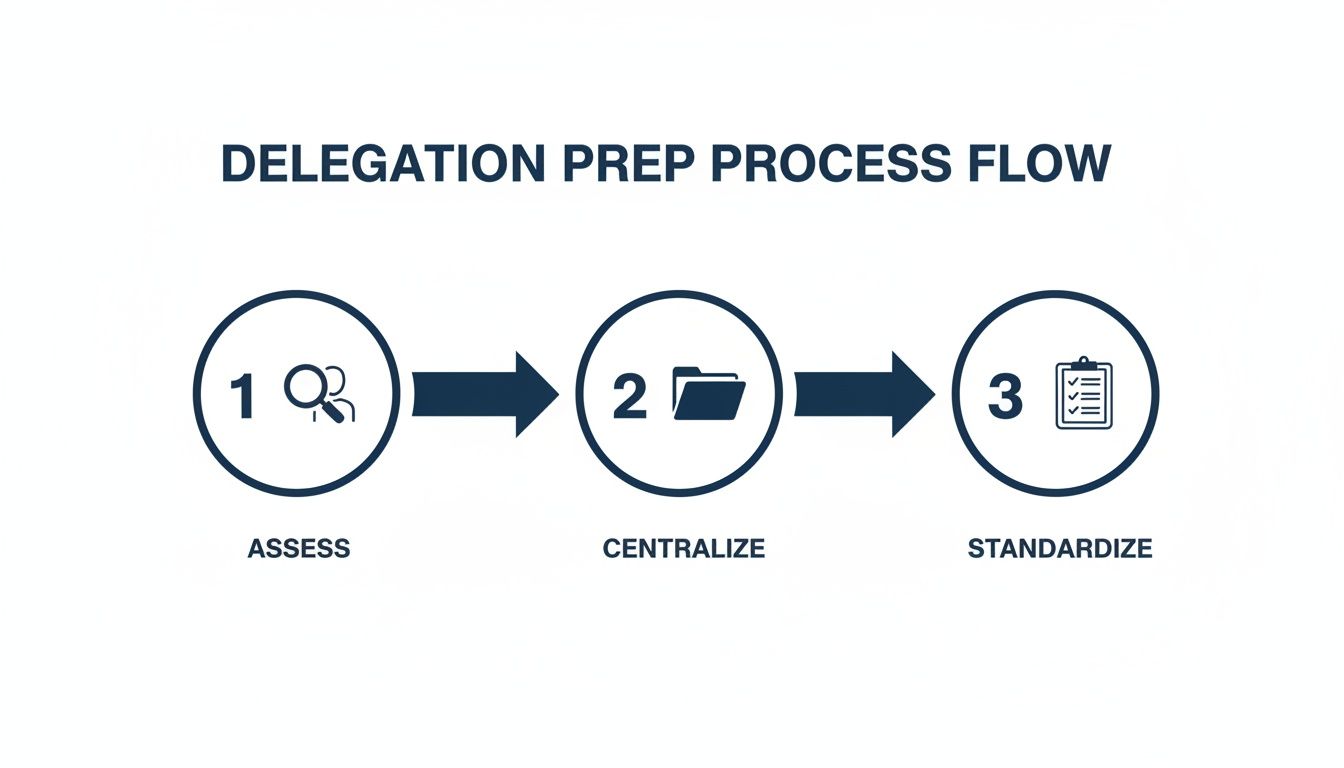
This flow—assessing team strengths, centralizing information, and standardizing procedures—creates the perfect launchpad for clear, effective delegation.
Use Templates for Speed and Consistency
You don't need to reinvent the wheel for every single assignment. Creating standardized Templates in Whisperit for your recurring tasks is a massive win for both efficiency and quality control. These templates can pre-populate the key fields of an assignment, making sure nothing critical is ever forgotten.
Think about how you could apply this:
- Client Update Brief: A template that includes fields for "Key Message," "Supporting Data Points," "Recipient," and "Desired Tone," ensuring every client communication is strategic and on-brand.
- Research Memo Request: A structured template with sections for "Central Legal Question," "Jurisdictions to Search," "Required Format," and "Deadline." It gives legal associates a perfect framework to work from.
- Document Review Checklist: A template for sifting through discovery documents, outlining the specific keywords, date ranges, and privilege tags to look for.
By standardizing the input, you standardize the output. Templates remove the mental gymnastics for both the person delegating and the person doing the work, letting them focus on high-value thinking instead of just deciphering instructions.
This structured approach is a core part of building a system that can scale. When your process is well-defined, it becomes much easier to document and teach. For a deeper dive into creating these foundational guides, you can check out our guide on how to create process documentation.
Ultimately, defining tasks with unmistakable clarity is an investment. It takes a few extra minutes up front but pays huge dividends in the form of higher-quality work, fewer interruptions, and a more empowered, self-sufficient team. It’s the real difference between just managing tasks and truly leading people.
Mastering the Communication and Feedback Loop
Handing off a task is just the starting point. The real magic of delegation happens in the conversation that follows. Building a solid rhythm for communication and feedback is what keeps projects from going off the rails, nips small misunderstandings in the bud, and turns every assignment into a growth opportunity for your team.
This isn't about hovering over someone's shoulder; it's about staying connected and clear. A great feedback loop offers support, reinforces what you expect, and creates the kind of psychological safety that allows people to truly own their work. Without it, you’re basically just crossing your fingers and hoping for the best.

Establish a Rhythm for Check-Ins
Leaving communication up to chance is a recipe for mutual anxiety. Instead of those random, "just checking in" pings that feel like micromanagement, it’s far better to set a predictable schedule for updates. This gives your team a designated time to ask questions or flag issues, and it gives you a consistent window into how things are progressing.
- For complex projects: Set up quick, regular meetings. A 15-minute sync every Tuesday can be perfect for talking through progress and roadblocks.
- For simpler tasks: Stick to asynchronous updates. In Whisperit, a team member can just drop a comment in the Assignment to say they've started or finished a key step. The system’s Notifications ping you automatically, keeping you in the loop without breaking anyone's concentration.
The trick is to agree on the how and when right from the start. This simple step respects everyone’s time and focus while keeping the lines of communication wide open.
Give Feedback That’s Contextual and Actionable
Vague feedback like "this needs more work" is just plain frustrating. To actually be helpful, your guidance has to be specific, tied directly to the work itself, and focused on what to do next. Context is everything.
Forget marking up a document and emailing it back. Instead, use tools that let you comment right where the action is. When you comment on a specific paragraph within a draft in a platform like Whisperit, your feedback is instantly clear. No more back-and-forth trying to figure out which "section three" you were talking about.
Getting this right isn't just about finishing the task; it's a core part of boosting workplace productivity through proactive employee engagement.
Effective feedback is a dialogue, not a monologue. Try framing your comments as questions to spark critical thinking: "Have you considered how opposing counsel might interpret this clause?" This coaches your team member, rather than just correcting them.
Master the Art of the Course Correction
Even with the clearest instructions, things can sometimes drift off course. How you handle these moments is crucial. The goal is to steer the ship back gently and constructively, without crushing your team member’s confidence.
If you spot a project heading in the wrong direction, don't let it fester. Set up a quick, private chat.
A simple script: "Thanks for the update on the research memo. I see we’re focusing heavily on historical precedents, but the core of this assignment is really about the recent regulatory changes. Let's quickly walk through the initial brief again to make sure we're aligned on the main goal."
This approach isn't confrontational; it’s collaborative. It frames the issue around a shared objective, turning a potential mistake into a learning moment.
Conduct Constructive Post-Project Reviews
Once a task is done, the loop isn’t truly closed until you’ve talked about both the final product and the process. This last step is often where the most valuable learning happens, helping you lock in what worked and pinpoint what to do differently next time.
A good review should touch on three things:
- What went well? Always start by acknowledging the wins.
- What was challenging? Talk openly about any roadblocks.
- What did we learn? Pull out the key takeaways for future projects.
Jotting down these insights is key. For a closer look at how to structure these conversations and keep good records, check out these meeting minutes best practices. This final conversation is what turns a finished task into a permanent upgrade for your team’s skills.
How to Let Go Without Losing Oversight
For most managers I know, the hardest part of delegating isn't teaching someone the task; it's the mental hurdle of letting go. We've all been there—that nagging fear that quality will suffer, a deadline will slip, or worse, sensitive client information gets mishandled. It's a powerful instinct, but true oversight isn't about maintaining iron-fisted control. It's about having clear visibility.
The trick is to build a framework of trust that’s supported by transparent, predictable workflows. This way, you can verify progress without constantly looking over someone's shoulder, giving your team the room to grow while you maintain the accountability you need.
Build a System of Transparent Workflows
The best cure for the urge to micromanage is creating a shared source of truth. When everyone can see the status of a project in real-time, the need for constant check-ins just melts away. This transparency doesn't just build trust; it gives your people the autonomy to own their work.
This is where a platform like Whisperit really shines. When a team member updates an Assignment or adds a comment inside a Case, that activity is logged for everyone to see. You can get a quick pulse check on any project in seconds, without derailing someone's focus with a "just checking in" email.
This shift does more than save you time—it has a huge impact on morale. Research has shown that when you give your team a high degree of delegated responsibility, they experience more variety in their work, which is a major driver of job satisfaction. You can discover more insights about these findings on employee satisfaction and see just how much empowerment matters.
Use Your Tools for Asynchronous Oversight
You don't have to be a constant presence to be an effective manager. By getting smart with your platform's built-in features, you can get all the oversight you need while letting your team actually get work done.
Here are a few ways I've learned to keep tabs on things asynchronously:
- Version History: Forget asking for the "latest draft." Just look at the document's version history. It gives you a perfect audit trail of every change.
- Activity Logs: A quick scan of an activity log shows you a chronological feed of everything that's happened on a case. It's a great high-level view of the project's momentum.
- Automated Notifications: I live by this one. Use a feature like Whisperit's Notifications to get pinged only when something truly needs your attention, like a direct question or a task ready for review. This separates the signal from the noise.
When you rely on the system for updates, you transform your role from an inquisitor to a reviewer. It’s a subtle but powerful shift that encourages your team to bring you solutions, not just status reports.
Uphold Security and Compliance with Confidence
In legal and professional services, handing off tasks with sensitive client data is a whole other level of stress. A single breach of confidentiality can be catastrophic. This is exactly why a secure, centralized platform isn't a nice-to-have; it's non-negotiable.
When delegation happens inside a controlled environment, you can extend trust without ever sacrificing security.
What to look for in a secure platform:
- Granular Permissions: Can you give someone access only to the specific files they need for a task, without exposing them to the entire case file? You should be able to.
- Centralized Data: All documents and conversations should live in one place. This stops sensitive information from ending up on personal devices or insecure email chains.
- Encrypted and Compliant Hosting: Your platform must offer serious encryption and adhere to standards like GDPR. This ensures client data is protected from every angle.
A secure framework gives you the peace of mind to delegate even the highest-stakes tasks, knowing that accountability is baked right into the process. For a deeper dive into tracking performance, check out our guide on productivity measurement tools. Remember, letting go doesn't mean losing control—it means trusting the system you've built.
Got Questions? Let's Talk Delegation.
Even with the best playbook, real-world delegation gets messy. You'll run into tricky situations and have questions. That's normal. Learning to navigate these common bumps in the road is what really levels up your leadership.
Let's dive into a few of the questions I hear most often when it comes to delegating effectively. Thinking through these ahead of time will help you build a team that’s not just productive, but genuinely empowered.
How Do I Know What’s Safe to Delegate?
This is the big one, isn't it? The core of this question is learning to see your to-do list not just as a pile of work, but as a collection of opportunities. You need to distinguish between tasks that will help your team members grow and the work that, frankly, only you can do.
Here’s a simple mental filter I use:
- Hand it off: Look for tasks that are repeatable and time-consuming. More importantly, seek out work that fits squarely into a team member's skill set or—even better—aligns with a professional goal they've told you they have. A simple task for you could be a huge career-building moment for them.
- Keep it on your plate: Anything that truly requires your specific authority or signature needs to stay with you. Think final strategic approvals, sensitive personnel matters, or navigating a high-stakes client relationship. These moments are why you're in the leadership seat.
Getting this right isn't about just clearing your own plate. It's about freeing yourself up to focus on the high-impact, strategic work that only you can do.
What Do I Do When a Delegated Task Is Going Sideways?
It’s tempting to panic and just grab the reins when you see a project veering off course. Don't. Your reaction in this moment is critical. The best move is to step in early, but to do it as a coach, not a micromanager.
Schedule a quick, private one-on-one. The goal is to figure out why things are off track, not to place blame. Was the initial request unclear? Did they hit a roadblock you didn't see coming? Are they missing a key piece of information?
This is where having everything documented pays off. Pull up the original brief—like an Assignment in Whisperit—and review it together. It gives you a neutral, objective starting point. You can simply say, "Let's walk through the brief again and see if we can spot the disconnect."
This approach turns a potential failure into a powerful learning opportunity. It shows your team that it's okay to stumble and, more importantly, that you'll be there to help them get back up, not just take over.
How Is Delegating to a Remote Team Different?
When your team is remote, you can't rely on popping by someone's desk to clarify something. This means you have to be almost surgically precise with your communication and documentation. Ambiguity is the enemy of remote work.
Your absolute first priority is a central hub for everything—a single source of truth. Without one, you'll drown in scattered emails, direct messages, and misunderstandings. All assignments, deadlines, files, and feedback need to live in one place.
Here are the core rules for making remote delegation work:
- Write. It. Down. Over-communicate every single expectation in writing. What feels obvious in your head can easily get lost in translation.
- Work on their time, not yours. Lean on asynchronous tools like comments and Notifications for updates. This respects different time zones and work styles, keeping everyone in the loop without constant meetings.
- Don't lose the human touch. Schedule regular, short video check-ins. They’re vital for morale and for talking through complex issues that just don't work over text.
For a distributed team, a transparent and well-documented process isn't a nice-to-have; it's the foundation of everything. It's how you ensure everyone, no matter where they are, feels connected, aligned, and ready to do their best work.
Ready to build a calmer, more efficient workflow for your legal team? With Whisperit, you can unify dictation, drafting, and collaboration in one secure workspace. Explore how Whisperit can transform your delegation process.