
A Guide to Ediscovery Artificial Intelligence in Law
Artificial intelligence in eDiscovery isn't some far-off concept anymore—it's an essential part of the modern legal toolkit. For legal teams staring down mountains of digital information, AI has become the go-to solution for making sense of it all. It uses machine learning and smart algorithms to analyze, sort, and review electronic data, turning what used to be a painfully manual and expensive job into a smart, efficient, and defensible process.
This technology is how you find the smoking gun buried in millions of files.
The New Reality of Legal Data and AI Discovery
Let's be honest, sifting through terabytes of emails, Slack messages, and cloud documents is the new normal for legal teams. The sheer volume of this electronically stored information (ESI) makes old-school document review completely impractical. It's too slow, too expensive, and just too easy for a human reviewer to miss something critical.
Trying to find that one key document feels like searching for a needle in a digital haystack the size of a mountain.

This is exactly where AI for eDiscovery comes in. Think of it as an indispensable partner that automates the mind-numbing work of digging through massive datasets. By watching and learning from the decisions a human lawyer makes, the AI can start predicting which documents are relevant, which are privileged, and which are important to the case—all with incredible speed and accuracy.
Why AI Is a Necessity, Not a Luxury
This move toward AI isn't just about saving a few hours. It’s about building stronger, better-informed cases from the ground up. When legal pros can get to the heart of the matter faster, they gain a massive strategic advantage. That early insight leads to smarter decisions across the board, from how you approach settlement talks to how you prepare for trial.
Just think about the practical benefits of weaving AI into your discovery workflow:
- Massive Cost Reduction: AI can filter out non-relevant documents by up to 90%. That means your expensive human review hours are spent only on the files that actually matter.
- Better Accuracy and Consistency: People get tired. Their judgment can waver after looking at thousands of documents. An AI, on the other hand, applies the exact same criteria to every single file, every single time. This consistency dramatically reduces the risk of overlooking key evidence.
- Faster Case Timelines: Finding crucial information in days instead of months helps your team hit tight deadlines and push cases forward much more quickly.
The real power of artificial intelligence in eDiscovery is its ability to amplify human expertise. It frees lawyers from the manual slog, allowing them to focus on the high-value work: legal analysis, strategy, and winning the case.
Building a Modern Legal Foundation
At the end of the day, adopting ediscovery artificial intelligence is about adapting to what evidence looks like in the 21st century. Data doesn't live in neat file folders anymore; it's spread across a messy, complex digital world. AI gives you the tools you need to navigate this environment effectively and, just as importantly, defensibly.
For any firm that takes litigation, investigations, or client data management seriously, AI is really the only practical way forward.
To get a better handle on this, it's helpful to understand the wider intersection of law and technology. To learn more, check out our guide on the synergy between law and AI in our article, which dives into how these tools are reshaping the entire legal profession. This kind of foundational knowledge will position your practice to not just survive the data deluge, but to actually thrive in it.
Understanding How AI Works in Ediscovery
At its heart, eDiscovery artificial intelligence isn't about replacing legal professionals. It’s about giving them a serious upgrade. Think of it as a force multiplier for legal expertise, allowing a small team to apply its judgment across massive datasets that would be impossible to review manually. It's like having a brilliant paralegal who can read millions of documents, instantly grasp your case strategy, and never needs a coffee break.
The process usually starts small. A senior attorney reviews and codes a sample set of documents, making judgments on things like relevance or privilege. The AI watches, learns from these expert decisions, and builds a sophisticated model of what matters for that specific case. This initial training is the bedrock for everything that comes next.
This learning is powered by a handful of core capabilities that work in concert to sift, sort, and surface the critical information buried in all that data. These aren't just abstract tech concepts; they are practical tools designed to solve real-world discovery challenges.
The Brains Behind the Operation: Core AI Capabilities
To really get how AI changes the game, you need to understand what it's actually doing. Each of these functions tackles a different piece of the discovery puzzle, from the first-pass sorting to finding those "aha!" connections hidden in the data.
- Technology-Assisted Review (TAR): Often called predictive coding, TAR is the workhorse of AI-powered review. It works a bit like the recommendation engine on your favorite streaming service. The more you tell it what you like (by coding documents as relevant), the better it gets at finding similar content you haven't seen yet.
- Document Classification: This is all about automatically sorting documents into predefined buckets. For instance, the AI can learn to identify and flag all documents containing legal advice as "Potentially Privileged." This alone can save a staggering amount of time that would otherwise be spent on a manual privilege review.
- Clustering: This is where the AI puts on its detective hat. It groups documents by the concepts and themes they share, even if they don't use the exact same keywords. Clustering is fantastic for revealing unexpected connections or entire topics of conversation you didn't even know you should be searching for.
A huge part of how AI works in eDiscovery relies on advanced AI-powered data extraction engines that can process and make sense of huge document sets. These systems don't just read the text; they understand the context and structure to pull out the information that truly matters.
Putting It All Together: The AI Learning Loop
These tools don't just work in isolation—they feed into a continuous learning cycle. An attorney codes a batch of documents, the AI learns from those calls, and then it serves up the next set of documents it thinks are most likely to be relevant. This back-and-forth process is known as Continuous Active Learning (CAL).
The goal isn't to get it perfect on the first try. It’s about creating a powerful partnership where the human expert guides the AI, and the AI, in turn, rapidly narrows the field so the expert can focus their energy where it counts.
With every document coded, the AI model gets smarter and more accurate, making the entire review process more efficient over time. It quickly learns to push the junk to the bottom of the pile while elevating the potential hot documents right to the top. This is a world away from the old-school linear review, where attorneys had to slog through documents one by one, regardless of how important they were likely to be.
To really dig into the tech that makes this possible, you can learn more about what natural language processing is and the role it plays in legal technology.
The market is certainly taking notice of this efficiency. The U.S. eDiscovery sector hit $6.56 billion** in 2024 and is on track to reach **$11.16 billion by 2030. This growth is fueled by AI that can automate up to 80% of traditional tasks and speed up reviews by as much as 90%. A recent survey backs this up, with 46% of legal professionals believing AI will have the biggest impact on eDiscovery in the next five years. You can read the full report to discover more insights about the eDiscovery software market.
How AI Actually Changes Your Ediscovery Workflow
Bringing AI into your ediscovery process isn’t just about swapping out a few tools; it’s about fundamentally changing how you approach discovery itself. Forget the old, rigid, step-by-step march through data. With AI, the process becomes a dynamic cycle where your strategy can evolve in real-time as the data reveals its secrets. You’re no longer flying blind, reviewing documents one by one—you get a bird's-eye view of the entire landscape right from the start.
This isn't merely about working faster. It's about working smarter. By embedding AI into your workflow, you gain a strategic edge that was simply out of reach with purely manual methods. You can start making informed, data-backed decisions from day one.
Gaining an Edge with Early Case Assessment
In a traditional workflow, the Early Case Assessment (ECA) phase often feels like educated guesswork. Legal teams run some keyword searches, sample a handful of documents, and hope for the best. Without a full picture of the dataset, initial strategies can be flawed, leading to nasty surprises and budget overruns later on.
AI completely flips the script on ECA. Right out of the gate, it can analyze the entire document universe, mapping communication patterns, pinpointing key players, and flagging important topics. You can almost instantly see who was talking to whom, what they were talking about, and when those conversations happened.
This kind of immediate, data-driven insight allows you to:
- Identify Critical Players: Quickly see who the central figures are based on communication volume and content, not just job titles.
- Build a Clear Timeline: Piece together a chronology of events by analyzing metadata and the content of the documents themselves.
- Scope the Case Accurately: Get a much more reliable estimate of how many documents are likely relevant, which is a huge help for budgeting and planning.
With an AI-powered ECA, you're no longer relying on gut feelings. You're building a case strategy on a solid foundation of evidence before the most expensive part of discovery even begins.
The process often follows a clear, logical flow. AI works to create order from the initial chaos of raw data by systematically classifying, coding, and clustering information.
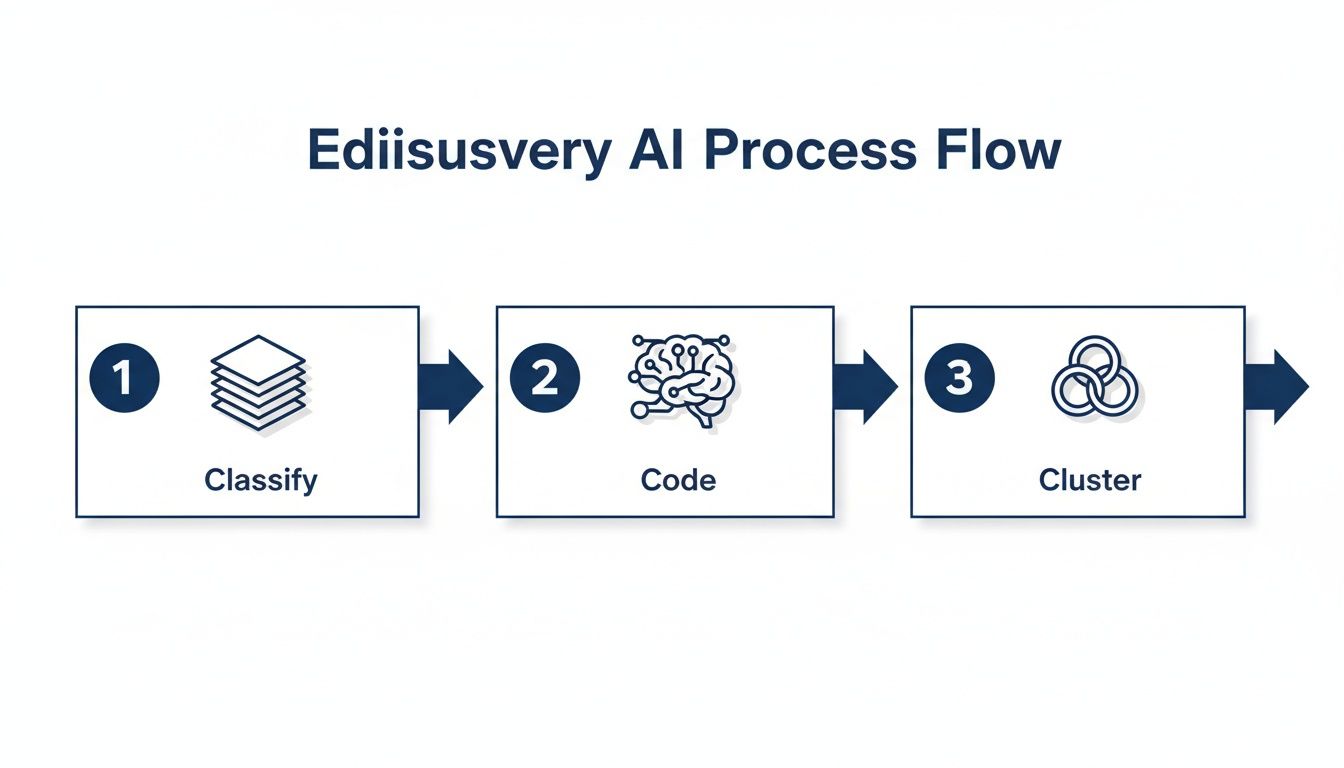
As you can see, the technology takes this massive, unstructured pile of documents and methodically organizes it, moving from broad categorization to uncovering the specific, nuanced connections hidden inside.
Transforming Document Review and Analysis
The document review stage is where AI truly shines and delivers some of the biggest returns. We all know that traditional linear review is a painstaking, expensive slog that can eat up the lion's share of an eDiscovery budget. It forces human reviewers to look at every single document, whether it’s a crucial "smoking gun" email or a lunch order.
AI turns this entire model on its head. Using Technology-Assisted Review (TAR), the system learns directly from the expertise of your senior attorneys. As these experts code a small set of documents as "relevant" or "not relevant," the AI builds a predictive model and uses it to find similar documents across the entire dataset.
This creates a powerful feedback loop. The system continuously refines its understanding and prioritizes the documents it thinks are most important for human eyes, pushing the clearly irrelevant stuff to the back of the line. This process, often called Active Learning, makes sure your review team is always spending their valuable time on evidence that actually matters. The result? A massive reduction in the number of documents that need manual review, often cutting review time by more than 50%. You can learn more about how to improve your document review process with AI in our guide.
To put the difference in perspective, let's compare the two approaches side-by-side.
Traditional vs AI-Powered Ediscovery Workflow Comparison
This table breaks down the key stages of discovery, contrasting the old manual methods with a modern, AI-integrated workflow to highlight where the biggest efficiency gains come from.
| Stage | Traditional Ediscovery Approach | AI-Powered Ediscovery Approach | Key Benefit of AI |
|---|---|---|---|
| Data Ingestion & Processing | Manual culling based on keywords and date ranges; often slow. | Automated data processing; intelligent culling based on concepts and communication patterns. | Faster Processing: Reduces irrelevant data from the start, saving time and money. |
| Early Case Assessment (ECA) | Limited analysis based on small document samples; strategic guesswork. | Comprehensive analysis of the entire dataset; identifies key custodians, topics, and timelines immediately. | Strategic Insight: Enables data-driven strategy development from day one. |
| Document Review | Linear review of every document; expensive and time-consuming. | Technology-Assisted Review (TAR) prioritizes relevant documents; human review focuses on critical evidence. | Massive Efficiency: Drastically reduces the volume of documents for human review. |
| Analysis & Investigation | Manual search for connections and patterns; relies on human memory and luck. | AI-powered analytics uncover hidden relationships, sentiment, and anomalous behavior automatically. | Deeper Understanding: Surfaces insights that would be nearly impossible to find manually. |
| Production | Lengthy QC process to check for privilege and relevance; high risk of human error. | AI assists with QC by flagging potentially privileged or inconsistent coding. | Improved Accuracy: Reduces errors and ensures a more consistent, defensible production. |
As the table shows, AI doesn't just speed up isolated tasks—it enhances every single stage of the discovery lifecycle, leading to a smarter, faster, and more defensible process overall.
Driving Real-World Cost and Time Savings
The financial impact of making this shift is huge. The eDiscovery market is growing fast, driven by the explosion of digital data in legal cases. Projections show the combined software and services market climbing from $13.1 billion** to nearly **$18.89 billion by 2026. What’s really telling is that the software segment—where the AI tools live—is growing at a faster clip of 10.7%, signaling a clear industry-wide move toward automation.
This market growth is happening for a simple reason: AI delivers a clear return on investment. By getting rid of junk data early, focusing review on the most important documents, and speeding up the entire process, law firms and legal departments can see serious cost savings. These efficiencies lead directly to more predictable budgets, quicker case resolutions, and a much stronger competitive footing in the market.
Navigating the Legal and Ethical Side of AI
Bringing powerful AI tools into your eDiscovery workflow is about more than just speeding things up; it introduces a serious layer of responsibility. The second an AI makes a call that could sway a legal outcome, you open the door to questions about fairness, accuracy, and legal validity. Every legal team needs a solid answer to the inevitable question from a judge or opposing counsel: "How do you know the AI got it right?"
That simple question is the core of defensibility. It isn't enough for an AI tool to work well behind the scenes. Its process has to be transparent, repeatable, and backed by solid statistics. If you can't explain and validate how your AI-driven review worked, you're putting the entire effort at risk of being challenged and thrown out. Getting this right means tackling these legal and ethical issues from day one.
Proving AI Reliability in a Court of Law
When we talk about defensibility in an AI context, we're talking about your ability to prove the process was reasonable and the results are trustworthy. It’s about building a clear, logical argument for why the court should accept what the technology found. This isn't just a technical challenge; it’s a legal one, rooted in long-standing rules of evidence and procedure.
To build a defensible foundation, you really need to concentrate on three key pillars:
- Process Transparency: Document every single step. This means tracking how the initial training documents were chosen, who the expert reviewers were, what guidelines they followed, and exactly how the AI model was trained and used.
- Statistical Validation: You can't just claim the AI did a good job; you have to prove it with data. This is where statistical sampling is your best friend. By checking a random sample of the AI’s decisions, you can calculate metrics like recall and precision to put a real number on its accuracy.
- Human Oversight: AI is a powerful assistant, but it doesn't replace legal expertise. You must be able to show that qualified attorneys were in the driver's seat, supervising the process, clearing up any gray areas, and making the final decisions on critical documents.
A defensible AI process is one that can be clearly explained and empirically verified. The goal is to show a court that the use of technology led to a more thorough, consistent, and accurate result than a manual review ever could.
Managing Data Privacy and Compliance Risks
Beyond the courtroom, AI in eDiscovery runs straight into a maze of data privacy laws. When your data sets are full of sensitive personal information—think financial records, health data, or other personal identifiers—your obligations get a lot more complicated. Regulations like Europe's General Data Protection Regulation (GDPR) have strict rules for how that kind of data can be handled.
AI can be a double-edged sword here. On one hand, its ability to classify data is a massive help for meeting your privacy duties. An AI can scan millions of documents to flag personally identifiable information (PII) for redaction, spotting things like social security numbers or credit card details way more effectively than a human ever could.
On the other hand, the very act of using AI to process this data requires careful oversight. You have to be certain the AI platform is secure, that data isn't being moved across borders improperly, and that access is locked down. The privacy risk doesn't just vanish because a machine is doing the work. In fact, because AI operates at such a massive scale, the potential damage from a data breach can be even greater. Knowing how to build a responsible framework is crucial, and reviewing some common AI governance best practices in our detailed guide is a great place to start.
Ultimately, using ediscovery artificial intelligence successfully is a balancing act. It requires a serious commitment to documenting and validating your process to ensure it's legally defensible, combined with a smart data governance strategy to handle your ethical and privacy duties. By mastering these points, legal teams can confidently use AI to build stronger cases without taking on unnecessary risk.
Best Practices for Implementing AI in Your Firm
Bringing eDiscovery artificial intelligence into your firm is about more than just buying the latest software. It’s a strategic shift that needs to be woven into your people, processes, and technology. If you just drop a shiny new tool into an old workflow, you’re setting yourself up for headaches and poor results. A deliberate, well-planned approach is the only way to ensure your firm doesn't just adopt the tech but builds a culture that can truly capitalize on it.
This change fundamentally redefines roles. Your team members stop being manual reviewers and become strategic AI trainers and analysts. Their expertise is what fuels the AI engine, making their judgment more powerful and scalable than ever before. But getting there takes planning, training, and a clear vision for how work gets done.

Begin with a Pilot Project
Don't try to boil the ocean with a firm-wide rollout on day one. Start small with a controlled pilot project. This gives you a safe space to test the technology, iron out kinks in your workflow, and prove the tool’s value without massive risk. Pick a case with a reasonable amount of data and, just as importantly, a team that's genuinely open to trying something new.
The real goal of the pilot is to learn. Document everything—what went right, where the friction was, and what skills your team needs to build. A successful pilot creates internal champions who will advocate for the technology and gives you hard data to make the case for a wider rollout.
Starting small builds momentum. A successful pilot project provides a tangible return on investment and a practical blueprint for scaling AI across the firm, making it easier to get buy-in from skeptical stakeholders.
That first win is invaluable. It helps foster a culture that sees technology as an advantage, not a threat, by moving AI from an abstract idea to a proven, practical tool.
Focus on People and Process First
The technology is only one piece of the puzzle. Honestly, your first and most important focus should be on getting your people ready and adapting your processes to make the new tools work.
1. Invest in Training and Upskilling Your legal team doesn't need to become data scientists, but they do need to understand how to supervise the AI. Training should cover the essentials: how to feed the model good examples, how to interpret its classifications, and how to validate its accuracy with proper sampling. This knowledge is what gives them the confidence to use the tools and defend the process.
2. Redefine Roles and Responsibilities The job of a document reviewer changes completely. They're no longer clicking through thousands of emails one by one. Instead, they become AI trainers, focusing their deep expertise on the most ambiguous and critical documents to guide the system. This is a much higher-value role that requires a total shift in mindset.
3. Redesign Your Workflows Don't wait until the middle of review to use AI. Plug it in as early as possible, like during Early Case Assessment, to get the biggest strategic bang for your buck. You need to map out the entire process: how data flows, where human experts need to intervene, and how you’ll manage quality control every step of the way. A well-designed workflow is what lets AI and your team work together seamlessly.
Select the Right Technology Partner
Choosing the right vendor is a make-or-break decision. You have to look past the flashy feature lists and find a true partner—one who gets the legal industry's non-negotiable demands for security, defensibility, and rock-solid support.
When you're evaluating AI platforms, here's what to look for:
- Security and Compliance: Does the platform have robust security, like end-to-end encryption and granular access controls? Can it help you meet your obligations under regulations like GDPR?
- Ease of Use: Is the interface actually designed for legal professionals, or does it feel like something built for engineers? If it's not intuitive, your team won't use it.
- Support and Partnership: Do they offer real training and support from people who know what they're doing? A great partner is invested in your success long after the contract is signed.
The entire eDiscovery market is being reshaped by this technology. The global sector is expected to grow from $16.68 billion** to **$25.2 billion by 2035, a jump powered almost entirely by AI's ability to handle the data deluge. As AI tools automate up to 90% of routine work like document classification, the market for these specific products is forecast to reach $26.63 billion by 2030. Read the full research about the eDiscovery market.
By building your implementation plan around your people, your processes, and a carefully chosen technology partner, you’re positioning your firm for a successful and lasting advantage. To learn more about selecting the right tools, check out our guide to legal AI software and transforming your practice. This isn't just about adopting a new tool; it's about building a smarter, more efficient legal practice from the ground up.
What's Next for Intelligent Legal Discovery?
For a long time, using AI in eDiscovery was a way for tech-savvy legal pros to get a leg up on the competition. That time is over. Today, it’s fast becoming a fundamental part of the toolkit, a core requirement for handling modern legal work. We've walked through how AI reshapes workflows, unearths the smoking gun, and builds a solid, defensible process. Its real job isn't just to make review faster—it's to enhance the strategic thinking of legal teams, making it an essential partner for anyone trying to make sense of today's overwhelming data.
As we look ahead, the evolution of AI in legal tech isn’t just continuing; it's hitting the accelerator. The next wave of innovation is already here, pushing past simple document classification and review into far more dynamic, analytical roles. These new capabilities are poised to slash the manual grunt work even further and deliver much deeper insights into the heart of a case.
Emerging AI Capabilities on the Horizon
This field isn’t standing still for a second. As the AI models powering these tools get smarter and more sophisticated, their use in eDiscovery is set to explode, opening up new efficiencies and strategic doors for legal teams ready to walk through them.
We're already seeing a few key developments take center stage:
- Generative AI Summaries: Picture this: instead of reading thousands of documents, you get an instant, concise, and accurate summary for the entire set. This isn't science fiction anymore. It’s a capability that will let legal teams get the gist of a dataset in minutes, not weeks, completely changing the game for early case assessment and internal investigations.
- Proactive Information Governance: AI is also shifting "left," getting involved long before a lawsuit is ever filed. Smart systems can now continuously monitor and classify a company's data, automatically applying retention policies and flagging potential risks. This proactive stance helps shrink the scope and cost of discovery before it even begins.
We're finally moving from a reactive to a proactive mindset. AI is becoming that strategic partner that lets legal experts step away from the tedious, manual tasks and focus on what they do best: analysis, strategy, and winning arguments for their clients.
Your Strategic Advantage in a New Era
Getting on board with these advancements isn't really a choice anymore. The firms and legal departments that bake AI-powered eDiscovery into their standard operating procedures will simply be faster, more accurate, and more cost-efficient. They’ll build stronger cases by finding the key connections buried in mountains of data and work with an efficiency their rivals can't hope to match. Adopting this forward-thinking approach isn't just about keeping up; it's about securing a decisive, long-term advantage.
Common Questions About AI in Ediscovery
It's smart to be cautious when bringing new technology into your practice. For legal professionals, any tool has to be more than just effective—it needs to be defensible, practical, and something your team can actually use. Let's tackle some of the most common questions that come up when firms consider AI for ediscovery.
Making the jump to AI-powered discovery means getting clear on how these systems work in the real world, from the courtroom to the budget meeting. Let's get right to it.
Is Using AI in Ediscovery Defensible in Court?
Yes, without a doubt. For more than a decade, courts in the United States and other major jurisdictions have consistently approved the use of AI tools like Technology-Assisted Review (TAR) and predictive coding. The legal standard has never been perfection; it's always been about a reasonable process.
The key to defensibility isn't the technology itself, but the process you build around it. You just need to be able to show—and document—that you ran a transparent, well-managed, and statistically sound workflow.
This usually boils down to three things:
- Clear Documentation: Keep a record of how the AI was trained, which subject matter experts were involved, and the exact review protocols they followed.
- Statistical Validation: Use established methods like statistical sampling to prove the AI did its job well, finding what it was supposed to find (recall) while correctly filtering out the noise (precision).
- Human Oversight: Show that qualified legal professionals were in the driver's seat, supervising the process and making the final calls on critical documents.
Do I Need to Be a Data Scientist to Use These Tools?
No, and this is a huge misconception that holds a lot of firms back. Modern ediscovery artificial intelligence platforms are built for lawyers and paralegals, not software engineers. The interfaces are designed to be intuitive, letting your team train the AI by doing what they already know how to do: reviewing documents and tagging them "relevant" or "not relevant."
All the complex algorithms and statistical models work behind the scenes. Your team’s job is to bring the legal expertise and strategic thinking. The software does the heavy lifting, freeing you up to focus on building your case.
How Does AI Pricing Work for Ediscovery?
Pricing models can be all over the map, so it’s really important to understand exactly what you're paying for. You'll generally run into a few common structures in the industry.
It's crucial to look beyond the sticker price and figure out the total cost of ownership. A platform that seems cheaper on the surface might have hidden charges for data processing or extra user seats that end up costing you more in the long run.
Here are the models you'll most likely see:
- Per-Gigabyte Pricing: This is the classic model. Your costs are based on how much data you process or store on the platform each month.
- Per-User Licensing: Some platforms charge a flat fee for each person on your team who needs access, no matter how much data you have.
- Subscription Models: These are getting more popular because they offer predictable costs. You pay a set monthly or annual fee that covers a certain amount of data, a specific number of users, and access to all the AI features.
When you're comparing platforms, always ask for a detailed price list that breaks down every potential cost—from ingestion and processing to hosting, analytics, production, and user fees.
At Whisperit, we believe powerful tools should simplify your work, not add another layer of complexity. Our voice-first AI workspace is built to fit right into your legal workflows, covering everything from dictation and drafting to collaboration and case management. By bringing your essential tasks together, we help you get from intake to export faster and with more consistency. Discover how Whisperit can create a calmer, more productive workflow for your legal team.