
Modern Contracts for Lawyers From Drafting to AI Workflows
Contracts are the lifeblood of legal practice. They're the enforceable framework for almost every business relationship, transaction, and obligation you can think of. These aren't just pieces of administrative paper; they're strategic tools that carefully allocate risk, spell out responsibilities, and ultimately, protect your client’s interests. For any legal professional today, mastering the art and science of contract work isn't just a skill—it's essential.
The Blueprint of Modern Legal Practice
Think of contracts as the architect's blueprints in the legal world. They provide the structure, rules, and boundaries for everything from a simple vendor agreement to a complex, multi-billion-dollar merger. They aren't static documents filed away in a cabinet. Instead, they are dynamic instruments that shape commercial realities and, when done right, head off costly disputes before they even have a chance to start. A lawyer's role is less about just drafting and more about being a strategic designer of relationships and obligations.
This guide is your practical roadmap to mastering modern contracts. We’ll walk through the entire lifecycle, from that first client conversation all the way to ongoing management and compliance. Understanding this journey is the key to seeing how each phase directly impacts the next.
Mapping the Contract Lifecycle
The contract process isn’t a one-and-done event. It's a continuous cycle with three core stages: drafting, negotiation, and management. Each stage demands a unique set of skills and strategic thinking to make sure the final agreement is not only legally sound but also perfectly aligned with your client’s business goals.
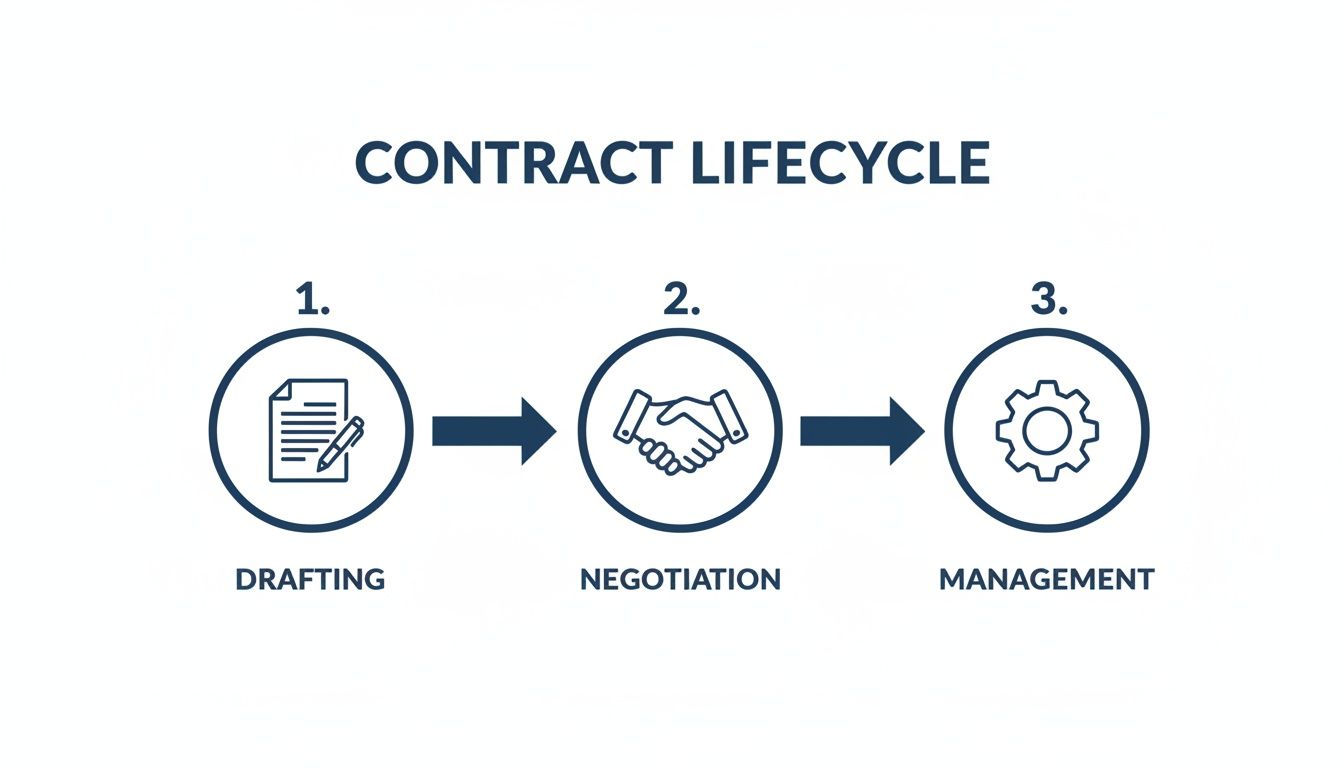
This simple flow shows how a contract evolves from an internal draft into a mutually agreed-upon, living document that needs active oversight. If you neglect any one of these stages, you risk undermining the entire agreement.
The Evolving Demands on Legal Professionals
The legal environment today puts immense pressure on lawyers to work faster and more efficiently, all without letting quality slip. Clients expect quick turnarounds, cost-effective solutions, and proactive risk management. This expectation is forcing a fundamental change in how legal services are delivered, pushing the profession away from purely manual processes and toward tech-assisted workflows.
Contracts are no longer just about legal precision; they are about operational efficiency. The challenge for modern lawyers is to balance meticulous craftsmanship with the speed the market demands.
Meeting these new demands takes more than just deep legal knowledge. It means adopting new tools and methods to handle repetitive tasks. To properly integrate new technology into your legal operations, you need a solid foundation; it helps to start with a Strategic Blueprint for Enterprise AI to build out a robust framework.
This move toward technology isn't about replacing legal expertise—it's about augmenting it. As we'll get into later, tools like Whisperit can automate routine drafting and review, freeing you up to focus on the high-value strategic advice that truly sets you apart. This evolution is critical for staying competitive and delivering real value to your clients. To learn more about this shift, you can explore our guide on the growing intersection of law firms and technology. This guide will give you the foundational understanding you need to navigate this changing world and excel in the practice of modern contract law.
Understanding the Core Components of a Contract
Every contract is more than just a piece of paper; it’s a story in the making. Each clause you draft is a critical plot point, defining the relationship, setting expectations, and most importantly, preparing for the inevitable "what ifs." We need to move past thinking of these clauses as just boilerplate. They are the levers we pull to allocate risk, shield our clients' assets, and build a solid foundation for a business relationship.
Think of a contract as the blueprint for a bridge. Sure, the core terms—price, delivery dates, scope of work—are the massive support pillars holding everything up. But the clauses we're about to discuss are the suspension cables, the guardrails, and the emergency access routes. They might seem secondary, but they're what make that bridge safe, functional, and able to withstand a storm.
The Clauses That Shift the Risk
At the heart of any serious commercial agreement are the clauses that manage and transfer financial risk. These aren’t just legal niceties; they are high-stakes provisions that dictate who foots the bill when something goes wrong. Getting these right is non-negotiable for any lawyer in this field.
Two of the heaviest hitters are:
- Indemnification: Think of this as a private insurance policy between the parties. It’s a promise from one party (the indemnitor) to cover the financial losses of the other (the indemnitee) if a specific negative event happens, like a lawsuit from a third party. For example, a software developer will almost always indemnify their client against claims that the code they wrote infringes on someone else's copyright.
- Limitation of Liability (LoL): This clause puts a cap on how much money one party can be forced to pay the other in damages. An LoL might limit liability to the total amount paid under the contract or carve out certain types of damages, like lost profits. It's a critical lever for managing your client's total financial exposure.
These two clauses are often the most heavily negotiated parts of a contract because they directly address how much financial pain each side is willing to bear. A few seemingly minor word changes here can shift millions of dollars in potential liability.
Drawing the Lines: Boundaries and Future Actions
Beyond the financial side, a solid contract has to clearly define the rules of the road and create a predictable path for handling disagreements. These clauses are all about control, confidentiality, and clarity.
A contract’s true strength is tested not when things are going well, but when they fall apart. Your dispute resolution clause is the pre-negotiated roadmap for navigating that chaos.
Let's break down a few other essential components:
- Confidentiality Clause: This is your client's shield for sensitive business information. A good one will precisely define what is considered "Confidential Information," who is legally bound to protect it, and for how long that obligation lasts.
- Term and Termination: This section lays out the contract's lifespan and the specific conditions under which either party can walk away. You need to cover termination for cause (like a major breach) and, often, termination for convenience (which allows for an exit without any fault).
- Dispute Resolution: This clause dictates how and where you’ll fight it out. Will you go to mediation first? Is arbitration mandatory and binding? Or are you heading straight to court? This is also where you specify which state's laws apply (Governing Law) and in which city or county a lawsuit must be filed (Venue).
The importance of absolute clarity in these provisions can't be overstated. A recent California Supreme Court case, Fuentes v. Empire Nissan, Inc., drove this point home. The court emphasized that while illegible print alone doesn't automatically void an agreement, it can contribute to a finding of procedural unfairness, inviting a judge to take a much closer look. This is a powerful reminder that every part of the contract needs to be crystal clear.
Ensuring your agreements are readable and straightforward is one of the best ways to prevent challenges later on. If you want to improve consistency and clarity from the start, it's worth learning more about using templates for legal documents, which can give you a well-vetted foundation to build upon.
Mastering Contract Drafting and Review
When you move from legal theory to the day-to-day practice, you quickly learn that it all comes down to two core skills: drafting and reviewing contracts. Think of drafting as constructing a fortress with words. Your goal is to build an agreement so precise and clear that it shuts down potential disputes before they ever start.
Reviewing, on the other hand, is like being a master inspector. You're systematically combing through someone else's structure, hunting for hidden weaknesses, overlooked risks, and any term that doesn't perfectly align with what your client needs. Both skills require more than just knowing the law; they demand a real-world understanding of the client's business goals. A contract isn't just a legal document—it's the operational playbook for a business relationship.
Best Practices for Drafting with Precision
The number one enemy of a solid contract is ambiguity. Vague language is the kindling for expensive litigation, creating loopholes where there should be certainty. The entire goal of drafting, then, is to achieve absolute clarity, leaving no room for anyone to "interpret" what you meant.
This means swapping out fuzzy terms for concrete specifics. Don't just say a party must act in a "timely manner"; define that period as "10 business days." Instead of referencing "industry-standard practices," spell out exactly what those practices entail.
Here are a few principles I always stick to for drafting airtight contracts:
- Define Your Terms: Always include a dedicated "Definitions" section. This is where you nail down the precise meaning of any term that could possibly be misinterpreted, from "Confidential Information" to "Effective Date."
- Maintain a Consistent Voice: Keep your terminology consistent from start to finish. If you label one party the "Service Provider" on page one, don't suddenly start calling them the "Consultant" on page ten.
- Use the Active Voice: Write directly. "The Vendor will deliver the goods" is much clearer and stronger than the passive "The goods will be delivered by the Vendor." It removes all doubt about who is responsible for doing what.
This level of precision isn't just about good writing; it's a defensive strategy. Every clearly defined term closes another potential door to a future argument.
A Strategic Checklist for Contract Review
When you're handed a contract drafted by the other side, your mindset has to shift completely. Your job is to deconstruct their work, spot the potential landmines, and make sure it fully protects your client. This is where a systematic approach is your best friend.
The most dangerous clause in any contract is the one you don't fully understand or, even worse, the one that isn't there at all. A thorough review uncovers both obvious risks and critical omissions.
Having a strategic checklist ensures nothing falls through the cracks. While every agreement is different, your review should always hit these key points:
- Alignment with Business Goals: Does this contract actually accomplish what your client wants to do? If they're aiming for a long-term partnership, do the termination clauses reflect that, or do they give the other side an easy out?
- Risk Allocation: Who is on the hook when things go wrong? You need to scrutinize the indemnification, limitation of liability, and insurance clauses to understand your client’s total exposure.
- Obligations and Deadlines: Are all duties, deliverables, and timelines spelled out clearly? Are they realistic? I find it helpful to map these out to make sure my client can actually comply.
- Red Flags and Imbalances: Keep an eye out for one-sided terms. This includes things like unilateral rights to change the agreement, overly restrictive non-compete clauses, or dispute resolution venues that are wildly inconvenient for your client.
This kind of meticulous work is time-consuming, which is a huge challenge in today's legal market. We're seeing law firms implement aggressive rate growth, but at the same time, they're facing serious productivity issues. One report revealed that while law firm rates went up, productivity actually dropped by 2.4%, and direct expenses shot up 7.6%. These economic pressures make it absolutely critical for lawyers to find more efficient ways to handle detailed work like contract review without ever sacrificing quality. For anyone interested in the numbers, you can read the full analysis from Thomson Reuters.
For a deeper dive into the specific steps involved, you might want to check out our guide on how to draft contracts effectively. This sets the stage perfectly for our next topic: negotiation, where we'll talk about how to resolve the issues you've identified.
Winning Strategies for Negotiation and Redlining
All the careful drafting in the world leads to this moment: the negotiation. This is where the contract draft gets its first real-world stress test. As a lawyer, your role shifts from being an architect to a skilled diplomat, championing your client’s interests while working with the other side’s goals.
Smart negotiation isn't about scoring points or "winning" every argument. It's about reaching the best possible deal for your client without torching the business relationship you're trying to build.
The real work starts long before the first redline is ever sent. You need a deep, practical understanding of your client's business objectives and a clear-headed view of the entire deal.
Preparing Your Negotiation Playbook
Before you even think about picking up the phone, you have to map out the terrain. This means sitting down with your client to create a clear hierarchy of what truly matters. What's a deal-breaker, and what's just nice to have?
A solid game plan should always include:
- Identifying the Non-Negotiables: These are your client's "walk-away" points. Is a specific liability cap an absolute must? Is there no deal without retaining full ownership of key IP? Get these crystal clear.
- Mapping Potential Give-and-Take: Figure out which terms are "need-to-haves" versus "nice-to-haves." This gives you bargaining chips—you can concede on lower-priority items to secure wins on the points that count.
- Anticipating the Other Side: Try to see the deal from their perspective. What are their likely goals and pain points? Knowing what motivates them helps you frame your arguments in a way that resonates.
This kind of prep work is more important than ever. The legal services market is on track to grow from USD 1.12 trillion to USD 1.86 trillion by 2034, driven largely by complex international deals. This boom means there's a huge demand for sharp negotiators who can navigate these waters. You can find more details on this growing global market on GMI Insights.
The Art of Strategic Redlining
Redlining is the language of negotiation, written right onto the document. Using track changes well is more than just deleting words; it's about communicating your position with precision and professionalism. Every edit should be a deliberate, justified move.
Redlines aren't just edits; they are a conversation. Each comment you write is an opportunity to explain your reasoning, build consensus, and move the deal forward constructively.
When you add comments, make them count. Instead of a blunt "Rejected," briefly explain why their proposed language doesn't work for your client. Better yet, offer an alternative that tries to meet both parties' underlying needs. This simple shift turns a potential fight into a collaborative problem-solving session.
Responding to their redlines requires the same mindset. Look at their changes and ask yourself, "What are they really trying to accomplish here?" Are they trying to offload a specific risk, or is there a simple misunderstanding of a business term? Getting to the root of the issue is far more productive than getting bogged down in a tit-for-tat over phrasing.
To make sure you've covered all your bases before you even start marking up a document, our comprehensive contract review checklist provides a structured approach. When you master these techniques, you're not just editing a document—you're turning potential conflicts into solid agreements that protect your client and get the deal done.
Integrating AI into Your Contract Workflow
The painstaking process of drafting a contract has always been a blend of professional pride and a major time sink for lawyers. While traditional, manual workflows are familiar, they’re quickly becoming unsustainable. Clients are demanding faster turnarounds and more predictable costs, putting immense pressure on old-school methods.
This is exactly where artificial intelligence moves from being a buzzword to a practical, powerful tool.
Bringing AI into your contract workflow isn't about letting a robot take over. It’s more like giving a master carpenter a set of precision power tools. The expertise, the strategy, and the final judgment calls are still yours, but the tedious, repetitive work gets done faster and more accurately than ever before.
Why AI Isn't Just an Option Anymore
The legal profession is at a crossroads. We've moved past talking about AI and automation as futuristic concepts; they are now a present-day reality. This isn't just a trend—it's a direct response to undeniable pressure from clients who expect more for their money. A core part of this evolution is having the right technology, which makes understanding the modern contract management system essential.
The numbers don't lie. Recent industry data shows that artificial intelligence and automation are now top priorities for law firms. A staggering 87% of attorneys see AI as critical for boosting efficiency, keeping costs in check, and ultimately, serving clients better. Yet, two-thirds of clients are pushing for faster legal work and nearly half want alternative billing models. This puts firms in a tight spot, needing to produce high-quality contracts more quickly and cost-effectively than ever.
It’s clear that adopting AI is no longer a "nice-to-have." It’s a strategic imperative for survival and growth.
How AI Actually Works in the Contract Lifecycle
So, let's get practical. How does this technology actually help day-to-day? AI tools like Whisperit are built to tackle the biggest headaches in the contract lifecycle, turning abstract benefits into real-world efficiency gains.
- Get a Head Start on Drafting: Forget starting from a blank screen or digging through old folders for a decent precedent. With intelligent templates, the heavy lifting is already done. Whisperit’s Drafting Templates let you build a library of pre-approved contracts that can be populated in seconds using simple voice commands, slashing initial drafting time from hours down to minutes.
- A Second Set of Eyes on Review: When you're reviewing a contract from another party, AI acts as your tireless assistant. It can instantly scan a document and flag non-standard clauses, risky language, or any term that deviates from your firm’s playbook. This lets you focus your expertise on the clauses that truly matter.
- Summarize and Research in Seconds: Staring down a 50-page agreement? An AI assistant is a game-changer. Tools like Whisperit's Navigator AI can provide a concise summary of dense sections, find specific definitions buried in the text, or even run preliminary legal research without you ever having to leave the document.
AI doesn't diminish the lawyer's role; it elevates it. By automating low-value tasks like formatting and boilerplate insertion, it frees up mental bandwidth for high-value strategic counsel, negotiation planning, and complex risk assessment.
Building a Smarter Workflow with Whisperit
When you weave these AI capabilities together, you get a fundamentally better way of working.
Picture this: you've just finished an intake call with a new client. During the conversation, you dictated the key deal points directly into a new matter file inside Whisperit.
From there, you simply use a voice command like, "Draft a Master Service Agreement using our standard template." Instantly, the document appears, perfectly structured. As you fine-tune the specifics, the Navigator AI is right there, ready to answer a question or insert an approved clause from your library.
Once the draft is ready, you can collaborate with your team using built-in comments and version control. When everyone signs off, the Export Layouts feature automatically applies your firm’s official letterhead and formatting. This seamless flow eliminates dozens of tiny, time-wasting steps, cuts down on human error, and ensures every contract leaving your office is consistent and professional.
To dive deeper into this, you can learn more about artificial intelligence in contract management in our detailed guide. Adopting a system like this doesn't just change a few tasks—it transforms your entire practice, making you more responsive, efficient, and profitable.
Common Questions About Modern Contract Workflows
Even with a solid grip on the fundamentals, you'll always have questions. It’s the nature of the beast. The world of contracts is constantly evolving, and staying sharp means knowing how to handle the curveballs that modern practice throws your way. Let's tackle some of the most common questions lawyers are asking about today's contract workflows.

Think of these as quick, practical answers you can put to use right away. They build on the core ideas we've already covered, giving you real-world solutions to the challenges you face every day.
What Is the Biggest Mistake Lawyers Make in Drafting Contracts?
Hands down, the single biggest mistake is ambiguity. Vague terms are the seeds of future litigation. When you leave room for interpretation, you’re basically inviting a dispute down the road. A truly solid contract is one where every obligation, deadline, and condition is spelled out with crystal clarity.
For instance, don't say a task must be done in a "reasonable timeframe." That’s a lawsuit waiting to happen. Instead, specify "30 business days." The goal is to surgically remove any and all uncertainty.
The true measure of a contract's quality isn't just its legal soundness, but its operational clarity. If the parties can't easily understand their obligations without calling their lawyers, the draft has failed.
This is where using pre-vetted language from a clause library becomes a game-changer. It helps you build in precision and consistency from the very beginning.
How Can I Review Contracts Faster Without Sacrificing Quality?
Speeding up your review process without cutting corners is all about having a system and using the right tools. First, always work from a checklist. This simple step ensures you consistently hit all the critical risk areas—liability, termination, payment terms—every single time. It makes your process repeatable and defensible.
Next, get a clear understanding of your client's business goals. Not every clause carries the same weight. By knowing what truly matters to them, you can focus your energy on the provisions with the biggest financial or operational impact.
Finally, bring in technology to do the heavy lifting. AI-powered tools can instantly flag non-standard clauses or highlight potential risks you might otherwise miss. An assistant like Whisperit's Navigator can summarize dense sections in seconds, freeing you up to focus on high-level strategy instead of getting bogged down in the weeds.
When Should I Use a Template Versus Drafting from Scratch?
Templates are your best friend for routine, high-volume agreements. Think Non-Disclosure Agreements (NDAs) or simple service contracts where the core terms don't change much. They save a massive amount of time and ensure all your firm's agreements have a consistent, professional foundation.
On the other hand, you should always draft from scratch for complex, high-stakes deals. A unique M&A transaction or a novel intellectual property license needs a bespoke document. A one-size-fits-all template just won't cut it when the nuances are that specific and critical.
But even when you're drafting a custom agreement, you can still pull in pre-approved clauses from your library. This hybrid approach gives you the best of both worlds: the precision of a custom draft and the efficiency of standardized, battle-tested language.
How Do AI Tools Help with Contract Compliance?
AI is a massive asset for compliance because it automates tasks that are both critical and notoriously prone to human error. During the drafting stage, these tools can scan an agreement to ensure it includes clauses mandated by regulations like GDPR or CCPA, and they can flag language that clashes with current laws. It’s like having an automated compliance check running in the background.
After the contract is signed, the real magic begins. AI can extract all the key dates, renewal notices, and deadlines from your entire contract portfolio. It then pushes automated alerts to your calendar or case management system.
This kind of proactive monitoring virtually eliminates the risk of missing a critical compliance deadline or getting stuck in an auto-renewal of a bad deal. It turns contract management from a reactive headache into a strategic, automated function.
Ready to turn your contract workflow from a source of friction into a competitive advantage? With Whisperit, you can unify dictation, drafting, research, and collaboration into a seamless, voice-first AI workspace. Move from client intake to a perfectly formatted final document in fewer steps and with greater precision. Discover how your firm can build a calmer, more efficient practice by visiting https://whisperit.ai today.