
Boost Your Efficiency with contract review services
Contract review used to be a line-by-line slog, a necessary evil that legal teams just had to muscle through. Today, it’s evolving into a strategic, tech-powered function that does more than just tick a box. Modern services analyze legal agreements to pinpoint risks, lock down compliance, and get deals done faster—far beyond what a human team could manage alone.
Why Contract Review Is No Longer a Manual Task
If you’ve ever been on a legal or compliance team, you know the feeling of staring down a mountain of contracts. The old-school way was to read every single word, a painstaking process that was not only incredibly slow but also dangerously prone to human error. With contract volumes and complexity exploding, that method just doesn’t cut it anymore.
Think about it like this: reviewing contracts manually is like trying to navigate a sprawling city with a folded paper map. Sure, you’ll probably get there eventually, but it’s sluggish, demands tunnel vision, and offers zero help when you hit unexpected traffic or a sudden road closure. One missed turn, and you could be seriously delayed.
The Modern Pressures on Legal Teams
Today’s business world moves at a breakneck pace, demanding a level of speed and precision that manual work can't provide. Legal professionals are constantly pushed to close deals yesterday, manage every conceivable risk, and prove their value to the company’s bottom line. Sticking to old methods just creates bottlenecks that jam up the entire organization.
The global Contract Review Service Market was valued at $8.9 billion in 2024** and is projected to reach **$18 billion by 2032. This explosive growth underscores just how urgently businesses across every industry need a more efficient and reliable way to handle their agreements.
Shifting from Chore to Strategic Function
This is where modern contract review services completely change the game. They’re like your car’s GPS, instantly scanning documents, flagging anything that deviates from your standard playbook, and highlighting potential risks you need to address. This frees up your legal experts to stop drowning in administrative muck and start focusing on what they do best: high-stakes negotiation and sharp legal judgment.
This change is part of a much bigger picture in the business world. As companies search for smarter ways to work, understanding the broader landscape of future trends in automation transforming business helps put this shift in context. The goal isn’t just to read contracts anymore; it’s about pulling out critical data and insights that drive the business forward. You can dive deeper into how tech is reshaping this space in our guide on AI document review.
At the end of the day, moving away from manual review isn't just about plugging in new software. It’s a fundamental change in how a company thinks about risk, efficiency, and staying ahead of the competition. By embracing these services, businesses are turning a once-dreaded task into a powerful engine for growth and protection.
Comparing Different Contract Review Models
Choosing the right way to review contracts isn't a one-size-fits-all decision. The path you take directly shapes how quickly you can close deals, how much you spend, and what kind of risks you’re able to catch. It’s all about finding the right balance between human expertise and machine-powered efficiency.
Generally, contract review services fall into one of three buckets: the old-school manual approach, the tech-forward AI-only method, and the popular hybrid model that blends the two. Each has its own rhythm and is built for different business needs, risk tolerance, and budgets.
We've seen a massive shift in how legal work gets done, moving away from purely manual labor toward smarter, tech-assisted processes.
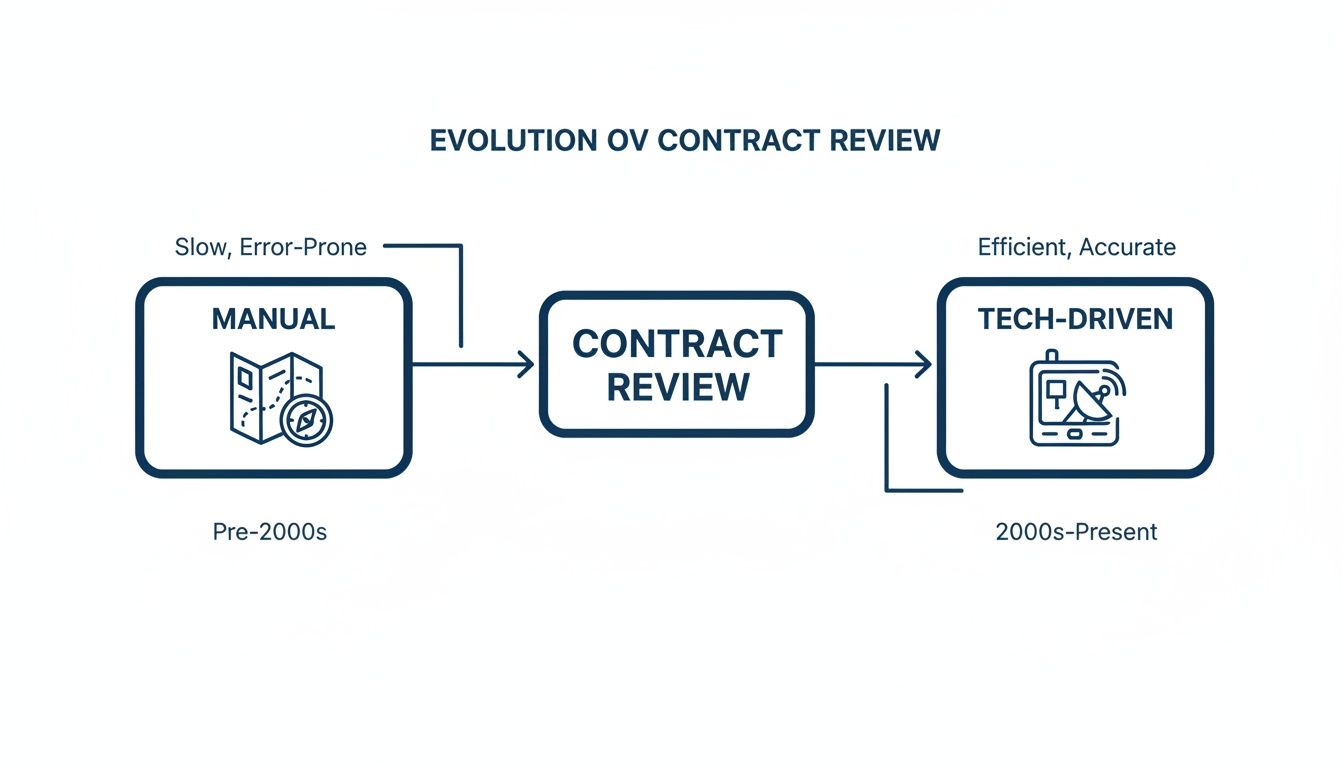
This evolution is pretty clear—technology has become a force multiplier. It turns contract review from a slow, reactive chore into a proactive, data-driven strategy.
The Traditional Manual Review
This is the classic way of doing things. A lawyer or legal pro sits down and reads a contract word for word, from beginning to end, relying entirely on their own experience and training. Think of it as a master watchmaker carefully assembling a complex timepiece by hand.
The biggest plus here is unmatched human judgment. An experienced attorney can pick up on subtle nuances in language, understand the business goal behind a tricky clause, and spot risks an algorithm would likely miss. This approach is perfect for highly unique or high-stakes agreements where context is everything.
But that level of detail comes at a cost. Manual review is incredibly slow and expensive. It’s also prone to human error—especially when you’re staring at the tenth contract of the day. One small oversight can snowball into a massive legal headache.
The Automated AI Review
On the other side of the coin, you have the fully automated model, powered by Artificial Intelligence. This method uses smart algorithms to scan, analyze, and flag potential issues in a contract in a matter of seconds. It's like having a team of paralegals who can read thousands of pages at once without ever needing a coffee break.
The main benefits are blistering speed and massive scale. AI can churn through a huge number of documents with perfect consistency, making it a fantastic choice for standardized agreements like NDAs or basic service agreements. It excels at specific jobs like:
- Finding Clauses: Instantly locating and categorizing clauses like "Limitation of Liability" or "Indemnification."
- Spotting Deviations: Comparing a third-party paper against your own company's standard templates and highlighting any differences.
- Scoring Risk: Automatically assigning a risk score to unusual or non-standard language based on rules you’ve set.
The downside? AI can lack a human’s nuanced understanding. It might get tripped up by creative wording or fail to grasp the bigger picture of a business deal. Relying only on AI is best for high-volume, low-risk contracts where getting things done fast is the name of the game.
The Hybrid Model: A Balanced Approach
This is where most modern legal teams are landing. The hybrid model smartly combines the raw speed of AI with the sharp judgment of a human expert, creating a system that’s far more powerful than either part on its own. It truly is the "best of both worlds."
In a hybrid workflow, the AI does the initial grunt work. It zips through the document, flags potential red flags, pulls out key dates and terms, and serves up a tidy summary. This first pass frees up the lawyer from the monotonous, low-value parts of the review.
Then, the human expert takes over. They can jump straight to the issues flagged by the AI, focusing their brainpower on the high-risk clauses, complex negotiations, and strategic decisions—exactly where their expertise makes the biggest impact. For a deeper look at the tools that make this possible, check out our guide on contract review software.
This balanced system delivers some serious advantages:
- Better Efficiency: Slashes the time spent on each contract without cutting corners on quality.
- Fewer Mistakes: Uses AI to handle the repetitive checks, minimizing the chance of human error.
- Empowered Experts: Frees up legal professionals to think more strategically and add more value.
By pairing machine precision with human insight, the hybrid model gives you a complete, efficient, and dependable way to handle modern contract review.
To make it even clearer, here’s a quick rundown of how these three models stack up against each other.
Comparison of Contract Review Service Models
| Feature | Manual Review | AI-Assisted Review | Hybrid Review |
|---|---|---|---|
| Speed | Slow; hours or days per contract. | Extremely fast; seconds or minutes per contract. | Fast; AI accelerates the initial review significantly. |
| Cost | High; billed by the hour for expert time. | Low; typically a subscription or per-document fee. | Moderate; balances subscription costs with focused expert time. |
| Accuracy | High for nuance, but prone to human error/fatigue. | High for consistency, but can miss contextual nuance. | Highest; AI catches standard issues, humans verify complex ones. |
| Scalability | Low; limited by the number of available experts. | Very high; can process thousands of documents simultaneously. | High; AI handles volume, allowing humans to manage exceptions. |
| Best For | High-stakes, unique, or complex agreements (e.g., M&A). | High-volume, standardized contracts (e.g., NDAs, MSAs). | Most business scenarios; a mix of standard and complex deals. |
Ultimately, the hybrid approach is often the sweet spot. It provides the speed and consistency needed to keep business moving while ensuring an expert eye is always there to handle the critical thinking.
How AI is Changing the Game in Contract Analysis
Artificial Intelligence is more than just a buzzword in the legal world—it's become the engine for the most effective contract review services out there. Think of AI as a supercharged paralegal, one that can read, understand, and analyze complex legal documents at a speed that's simply not humanly possible. This fundamentally changes how legal pros get their work done.
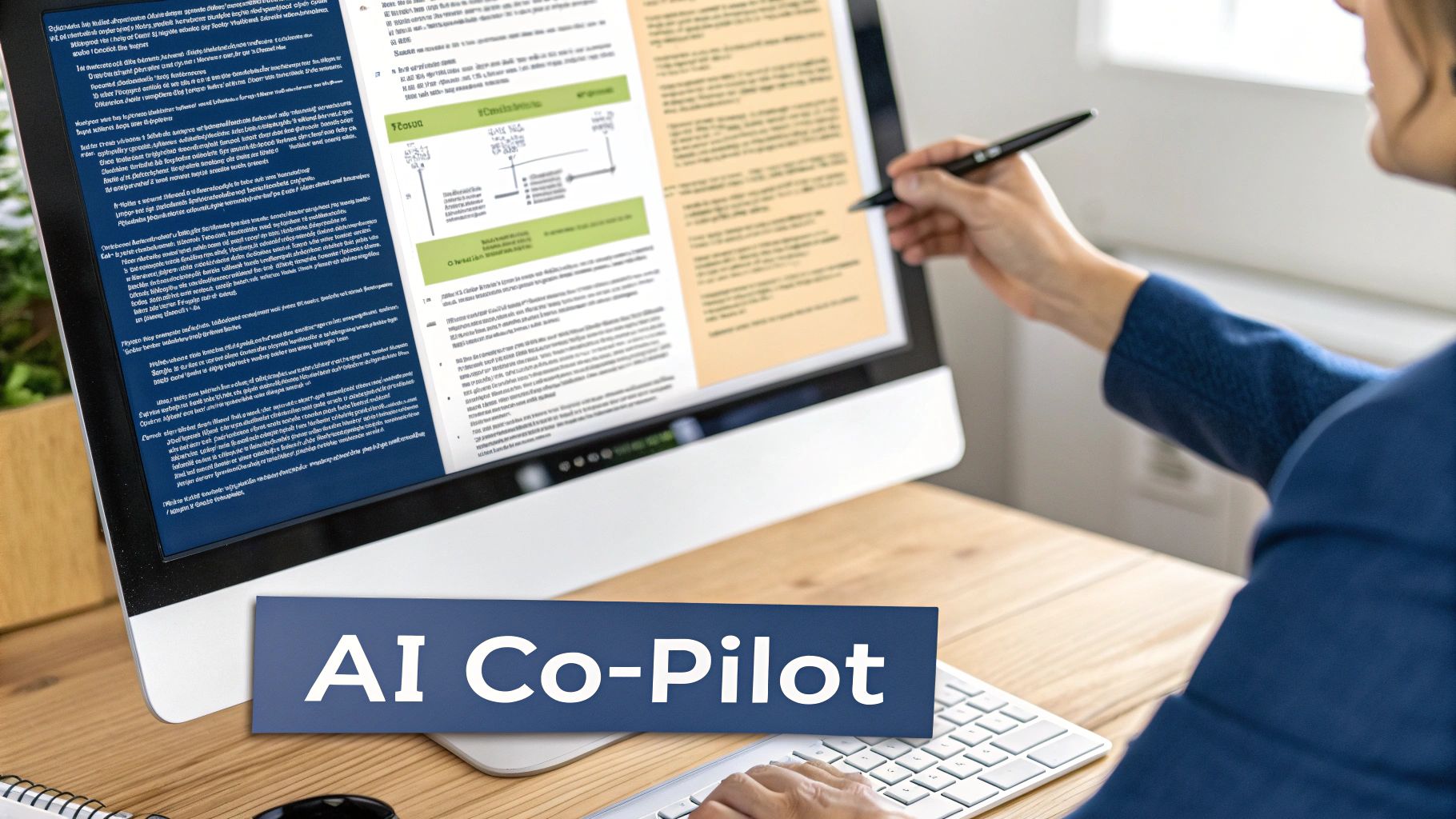
The magic behind this is a field called Natural Language Processing (NLP). It's a branch of AI that essentially teaches computers to understand human language—not just the words, but the context and intent behind them. When you add machine learning to the mix, the system gets smarter and more accurate with every single contract it reviews.
What AI Actually Does During a Review
So, what does this look like in practice? AI isn't just doing a simple keyword search. It's performing some seriously sophisticated tasks that give human experts a massive leg up. It handles all the grunt work, freeing up legal teams to focus on high-level strategy and negotiation instead of tedious manual checks.
Here are a few key things AI does:
- Clause Identification: The software instantly spots and tags specific clauses, like indemnification, limitation of liability, or confidentiality, no matter how they’re phrased. This makes it incredibly easy to jump between key sections and compare them across documents.
- Risk Scoring: Based on a company's playbook or pre-set rules, the AI can assign a risk score to unusual or problematic language. If a clause veers too far from your preferred terms, it gets flagged as high-risk, so a human knows to look at it immediately.
- Deviation Analysis: This is where AI really shines. It can take a third-party contract and compare it against your standard templates or approved clause library, highlighting every single difference in seconds. It completely eliminates the soul-crushing task of manual, line-by-line comparisons.
AI acts as the ultimate co-pilot for legal professionals. It doesn't replace their judgment. Instead, it supercharges it by providing the data and insights needed to make faster, better-informed decisions with a whole lot more confidence.
From Simple Data Extraction to Big-Picture Strategy
Beyond just flagging risks, AI is a master at turning messy, unstructured text into clean, structured data. It can pull out critical details like key dates, party names, renewal terms, and payment obligations and then pop them into a neat summary. A dense, 50-page document becomes an actionable overview in a matter of moments.
This power is driving huge investments in specialized tools. The Contract Review Platform Market is expected to jump from $2.83 billion** in 2026 to **$6.01 billion by 2032, which tells you just how serious businesses are about getting smarter with their contracts. You can learn more about the contract review market growth and its projected path.
Let’s put this into a real-world context. Imagine a corporate legal department suddenly gets hit with 100 new vendor agreements.
- An initial AI pass would take minutes, not weeks.
- It would pull all payment terms and due dates for the finance team.
- It would flag every contract that's missing a proper data privacy clause for the compliance team.
- Finally, it would give the legal team a prioritized list, pointing out the five contracts with the riskiest deviations that need to be negotiated right away.
That kind of speed and insight was pure fantasy before AI became a core part of the process. To see how this fits into the larger legal tech ecosystem, you might find our post on the role of AI in contract management helpful. By automating the repetitive, time-sucking parts of contract review, AI frees up legal experts to use their skills where they truly count.
Putting Contract Review Services into Practice: A Real-World Workflow
It's one thing to talk about contract review services in theory, but seeing how they actually fit into a lawyer's day-to-day work is where the lightbulb really goes on. We're talking about a shift from a chaotic scramble between different apps to a clean, logical process inside a single workspace.
Let's follow a real-world scenario. Meet Sarah, a corporate lawyer who has just been handed a new Master Service Agreement (MSA) from a vendor. The old way of doing things would have her day devolving into a frantic mess of app-switching. She'd be bouncing between her email, Microsoft Word, a separate legal research platform, and maybe even a clunky dictation tool.
Each time she switches windows, she breaks her concentration. That constant context-switching isn't just a minor annoyance; it's a productivity killer and a recipe for mistakes.
A Modern, Integrated Approach
Now, let’s see what happens when we put Sarah into a modern, voice-first AI workspace like Whisperit. The moment that MSA hits her inbox, her entire process changes. Instead of juggling a half-dozen tools, she can manage the whole review from start to finish in one place.
Here’s a glimpse of what her new workflow looks like:
- Drop, Drag, and Analyze: Sarah simply uploads the MSA into her workspace. The AI kicks in instantly, running a first-pass analysis to pinpoint key clauses, pull out important dates, and flag any language that doesn't match her company's standard playbook.
- Get the Gist in Seconds: Almost immediately, she receives a high-level summary. The AI calls out the heavy hitters—indemnification, limitation of liability, termination rights—so she knows exactly where to direct her expert eye first.
- Talk, Don't Type: After scanning the AI’s notes, Sarah spots a few clauses that need a rewrite. Instead of tediously typing out redlines, she just speaks them. Using simple voice commands, she can say, "In section 7.2, strike 'gross negligence' and replace it with 'willful misconduct.'" The text appears on screen, perfectly transcribed and formatted.
This screenshot shows how a modern AI workspace brings document management, analysis, and drafting tools together into one cohesive view.
The magic here is in removing the friction. Everything Sarah needs is right there, keeping her focused and efficient.
From First Draft to Final Document
This smooth, integrated process carries all the way through to the end. After dictating her changes, Sarah can apply her firm's approved Style Profile with a single click. This instantly standardizes numbering, formats citations, and ensures the tone matches her organization's brand.
An integrated system is designed to kill the "death by a thousand cuts"—all those tiny delays that grind legal work to a halt. When you bring dictation, AI analysis, and drafting tools under one roof, you can stay in a state of flow and get from intake to a final document in a fraction of the time.
This kind of seamless experience is the bedrock of smart legal workflow automation. If you want to dive deeper into how this works at a larger scale, our guide on automating your legal workflows is a great next step.
The final touch is just as easy. Sarah chooses an Export Layout, and the system automatically applies the firm's official letterhead, margins, and headers. What she gets is a polished, professional document ready to send back to the vendor. A task that used to eat up hours of her day is now done in one efficient session. This is the real power of modern contract review services—they don’t just find risks; they completely change how legal work gets done.
How to Choose the Right Contract Review Service
Picking a contract review service isn't about chasing the flashiest tech. It’s about finding a true partner—one that slots right into your team’s existing workflow, matches your risk appetite, and supports your bigger goals. With so many options out there, you need a clear plan to cut through the marketing fluff and find a solution that will actually make your team faster and more secure. A rushed choice often leads to a tool nobody uses and a budget that’s been wasted.
To get this right, you need a framework for evaluation. Think of it like building a scorecard for every potential vendor. The process should start broad by looking at your team's real needs and then drill down into a feature-by-feature comparison. This ensures the service you end up with is a perfect fit for how your team actually works.
Start with a Thorough Needs Assessment
Before you even book a single demo, you have to look inward and pinpoint your own pain points. What’s the biggest bottleneck in your review process right now? Is it the sheer volume of contracts? The slow turnaround times that frustrate the sales team? Or maybe it’s the nagging feeling that risk management is all over the place. Answering these questions honestly is step one.
Talk to the people on the front lines: the lawyers, the paralegals, and the business leaders who are constantly waiting on contracts. Map out your current process from start to finish and find where the friction points are. This internal audit gives you a practical checklist of "must-haves" and "nice-to-haves" that will become your north star during the selection process.
Evaluate Core Features and Functionality
Once you know what you’re looking for, you can start assessing the vendors. While every platform has its own unique spin, there are a few core capabilities that any serious contract review service must deliver. Your job is to focus on how these features work in the real world, not just how they look on a slide deck.
During a demo, here are the critical areas you need to grill them on:
- AI Accuracy and Reliability: How well does the AI actually spot clauses, flag weird language, and pull out key dates and numbers? Make them prove it. Ask the vendor to run one of your own complicated contracts through their system while you watch.
- Playbook Customization: Can you easily teach the system your company’s standard positions, approved clauses, and risk tolerance? If you're stuck with a rigid, one-size-fits-all playbook, it’s a massive red flag.
- User Interface and Experience: Is the platform genuinely easy to use? If your team finds it clunky, confusing, or just plain annoying, they won't use it. It doesn't matter how powerful the tech is if adoption fails.
A crucial but often-missed element is how well the platform helps with drafting, not just reviewing. A system that can combine AI-powered analysis with practical tools like real-time dictation and formatting can save your team from the endless, mind-numbing task of switching between different apps.
Scrutinize Security and Integration Capabilities
A contract review platform is going to handle some of your company's most sensitive data, so security isn’t just a feature—it’s everything. Don't be shy about digging into a vendor's security protocols. For teams handling a wide array of agreements, understanding the different platform types is key; our guide on AI contract management systems offers more perspective on this.
Be ready to ask some tough questions about their security and how they play with other tools:
- Security Certifications: Do they have credentials like SOC 2 Type II or ISO 27001? You also need to know where your data is hosted (e.g., EU or US) and confirm that it’s encrypted both when it's stored and when it's being transmitted.
- Integration Ecosystem: Will this service connect smoothly with the tools you already rely on? Look for ready-made integrations with your Document Management System (DMS), CRM, and e-signature software to avoid creating more work for your team.
Finally, before you sign anything, run a pilot program. Get a small group of your actual users to test the platform with a real sample of your contracts. This is the single best way to know if a vendor's promises hold up in the real world. A successful pilot proves that the tool not only works, but that it works for your team.
Frequently Asked Questions About Contract Review
Even after seeing all the benefits laid out, it's natural to have a few questions before you jump into a new way of reviewing contracts. Let's tackle some of the most common ones we hear from legal and compliance pros.
How Accurate Is This AI Stuff, Really?
This is the big one, and it’s a fair question. The accuracy of AI in contract review has come a long way, often hitting above 95% on routine tasks like spotting specific clauses. But—and this is a big but—its performance hinges entirely on what it was trained on and how complex your documents are.
The smartest approach is still a tag-team effort. Let the AI do the heavy lifting on the first pass, flagging potential risks and weird clauses you might miss after staring at a screen for hours. Then, have a human expert (you!) come in for the final, critical analysis. You get the incredible speed of a machine combined with the irreplaceable judgment of an experienced professional.
Think of it this way: AI doesn't replace a lawyer's expertise; it supercharges it. By taking over the tedious, low-value work, it frees you up to focus on high-stakes negotiation, strategic counsel, and interpreting those tricky grey areas where your skills truly shine.
Can These Services Actually Understand Our Industry's Contracts?
They absolutely can. Most modern platforms aren't a one-size-fits-all solution. They can be trained on your company's documents or configured for specific sectors like healthcare, finance, or SaaS. Many even come with pre-loaded models for standard agreements like NDAs and MSAs, or for specific compliance frameworks.
The key is to ask the right questions when you’re vetting a provider. Make sure you grill them on their experience with your industry's specific legal jargon and regulatory headaches. That’s how you know you’re getting a tool that will actually work for you from day one.
What Does Getting One of These Platforms Set Up Involve?
Getting a contract review platform up and running isn't as daunting as it might sound. A good provider will walk you through a pretty standard process, making sure it’s a smooth transition for your team.
It usually breaks down into four main stages:
- Discovery: First, the vendor sits down with you to get the lay of the land—how your team works now, what kinds of contracts you deal with, and what your biggest bottlenecks are.
- Configuration: Next, they customize the platform to your world. This means loading in your legal playbooks, setting up your approved clause libraries, and defining who on your team gets access to what.
- Integration: The system is then plugged into the other tools you rely on, like your document storage (think SharePoint or Google Drive) or e-signature software.
- Onboarding: Finally, they train your team so everyone feels comfortable and confident using the new system.
Depending on how complex your needs are, this whole process can take anywhere from a few weeks to a couple of months.
Ready to see how a voice-first AI workspace can revolutionize your legal workflow? Whisperit brings together dictation, drafting, and AI analysis to help you get from initial client intake to a polished final document faster than ever. Explore Whisperit today.