
A Modern Guide to Contract Review Service
Think of a contract review service as a specialized diagnostic tool for your business. Its job is to pore over legal agreements to spot hidden risks, check for compliance, and even find opportunities you might have missed. Whether it’s powered by a sharp human attorney or a sophisticated AI platform, it adds a critical layer of defense, shielding your organization from expensive mistakes and legal headaches.
Understanding the Role of a Contract Review Service
At its heart, a contract review service tackles a massive business problem: the sheer volume and complexity of contracts today. Picture your company’s agreements as a huge network of pipelines. These pipelines carry value, but they also carry obligations and risks. A single leak—one poorly phrased clause or a missed deadline—can cause a world of trouble.
This service is your expert inspection crew, meticulously checking every valve and connection. It goes way beyond a simple proofread, digging into the real-world legal and business impact of the language. The whole point is to turn dense, confusing legalese into clear, actionable business intelligence.
Why Demand is Skyrocketing
The need for this kind of specialized review has never been more intense, and a few key pressures are driving it. The market has exploded, hitting $8.9 billion** and is expected to climb to **$18 billion by 2032. This isn't just hype; it reflects a harsh reality where large companies are juggling 20,000 to 40,000 active contracts at any given time. That workload can easily swallow up nearly half of a legal team's time. You can dig into the numbers in this detailed research on Verified Market Research.
So, what's behind this massive demand? It boils down to a handful of core business challenges that almost every organization faces.
Here’s a quick look at the main drivers pushing companies to adopt these services.
Key Drivers for Adopting a Contract Review Service
| Business Challenge | How a Contract Review Service Helps |
|---|---|
| Increasing Contract Complexity | Provides specialized expertise on tricky clauses related to data privacy, cybersecurity, and global regulations. |
| Accelerated Business Pace | Offers rapid turnaround times, allowing teams to close deals faster without skipping crucial due diligence. |
| Limited Internal Resources | Frees up in-house teams from routine reviews to focus on high-value strategic work. |
| Inconsistent Risk Management | Enforces a standardized playbook across all agreements, ensuring consistent risk tolerance and compliance. |
| Hidden Liabilities & Costs | Uncovers unfavorable terms, auto-renewal clauses, and other costly obligations buried in fine print. |
Ultimately, a contract review service isn't just another expense. It's a strategic move that turns a reactive, risk-filled process into a proactive, value-adding one. It's about building efficiency while strengthening your legal posture at the same time.
A contract review service isn't just a cost center; it's a strategic function that transforms a reactive, risk-prone process into a proactive, value-generating one. It’s about creating operational efficiency while simultaneously fortifying your legal defenses.
The Two Main Approaches
The industry really offers two different ways to solve this problem. The first is the classic, human-led service. Here, experienced attorneys or paralegals manually read and analyze every word. This approach is fantastic for its deep nuance and strategic thinking, making it perfect for those one-of-a-kind, high-stakes deals.
The second is the modern, AI-powered platform. These tools use powerful algorithms to scan, analyze, and even redline contracts against your company's approved rules in a fraction of the time. This route gives you incredible consistency, speed, and the ability to scale, making it ideal for managing high volumes of standard agreements like NDAs or MSAs.
Knowing the difference is the first step in building a process that actually works. You can learn how to structure your review process with our comprehensive contract review checklist.
The Hidden Costs of Manual Contract Review
Sticking with the old way of doing things—manually reviewing contracts—might feel safe and familiar, but it carries a steep, often hidden, price. Sure, the most obvious cost is time, but the real damage goes much deeper, creating ripples that slow down your entire organization.
Every minute a skilled lawyer or compliance expert spends on routine review is a minute they aren't spending on strategic work that actually moves the needle.
It's More Than Just a Time Sink
That time drain is a bigger deal than most people think. We're not talking about a few minutes here and there. Studies show it takes a seasoned professional about 92 minutes to get through a single contract. Now, multiply that by the fact that nearly half of all enterprises (47%) are dealing with a growing pile of increasingly complex contracts. You can dig into the numbers yourself in this report on contract management statistics from aavenir.com.
It’s easy to see how this time commitment creates massive bottlenecks. Deals get delayed, partners get frustrated, and the whole business ends up waiting on a legal or compliance team that's completely buried in paperwork.
The True Price of Human Error
Beyond the delays, manual review is just plain risky. Even the most meticulous professional can miss a problematic clause or an unfavorable term when they're staring down a mountain of documents on a tight deadline. It happens.
A single oversight—like an auto-renewing subscription you didn't want or a poorly worded liability clause—can snowball into huge financial losses or legal headaches down the road.
Then there's the consistency problem. Without a central, standardized system, you have no way of knowing if every contract is being judged by the same rules.
One reviewer might flag a specific indemnity clause, while another, working on a different day, might let it slide. This lack of uniformity exposes the organization to unpredictable risks and undermines its negotiating position.
This kind of inconsistency doesn't just create risk; it makes building a scalable compliance program nearly impossible. Tackling these systemic issues is a key part of smart business process improvement methods.
Burnout and the Opportunity Cost Iceberg
Finally, let’s talk about the human cost. Forcing your highly trained legal and compliance experts to do tedious, repetitive work is the fastest way to burn them out. These are people with the skills to offer strategic guidance, negotiate tough deals, and spot legal challenges before they happen. Instead, they’re stuck being proofreaders.
This leads to the biggest hidden expense of all: opportunity cost.
What could your team accomplish if they were freed from the grind of manual review? They could be closing deals faster, building better risk mitigation strategies, or providing the proactive counsel that actually helps the business grow. A reliable contract review service is what turns that lost potential back into a real asset.
Comparing Human Expertise and AI Automation
Choosing a contract review service isn’t a simple case of man versus machine. It's more about picking the right tool for the job. You wouldn't use a Swiss Army knife to build a house, and you wouldn't bring a full construction crew to open a box. Each has its place.
The same is true here. Human legal experts and AI-powered platforms both bring incredible value to the table, but their strengths shine in different scenarios. Understanding when to use which—or how to combine them—is the key to building a smart, efficient, and risk-averse contract process.
Where Human Expertise Shines
Nothing can fully replace the nuanced judgment of a seasoned attorney. A great lawyer does more than just spot red flags; they understand the unspoken context of a deal, interpret ambiguity, and come up with creative solutions that a machine simply can't.
This human touch is absolutely critical in a few key areas:
- Strategic Negotiation: A lawyer can read the room, understand the other party's motivations, and pivot their strategy on the fly. That's an art, not a science.
- Interpreting Grey Areas: Contracts are often filled with vague language. A human expert draws on years of experience and legal precedent to figure out what a clause really means and where the risks lie.
- Handling Unique Agreements: For those one-of-a-kind contracts that break the mold, you need a human mind to navigate the uncharted territory and protect your interests.
Think about complex agreements like physician employment contracts. This is a niche area where an expert’s review is vital for navigating complicated compensation structures and non-compete clauses. The stakes are just too high for a purely automated approach. This same dynamic—balancing specialized human skill with technology—is also a hot topic in fields like document translation services.
Human-led review excels where context, creativity, and strategic thinking are paramount. It’s the best choice for bespoke, high-value agreements that carry significant organizational risk.
The Power of AI-Driven Automation
Now, let's talk about the other side of the equation. AI platforms bring something to the table that humans can't match: incredible speed, perfect consistency, and massive scale.
An AI doesn't have bad days. It never gets tired or overlooks a detail because it's on its hundredth document. It applies the same rigorous logic every single time.
Here’s where AI is a true powerhouse:
- Incredible Speed: An AI can tear through a standard contract and check it against your playbook in minutes. That same task would take a lawyer over an hour.
- Rock-Solid Consistency: By using a pre-approved set of rules (your playbook), AI ensures every contract is held to the exact same standard. No more guesswork or human variability.
- Powerful Data Insights: AI tools can analyze thousands of contracts to reveal trends, identify common sticking points, and provide data you could never get manually.
If your team is drowning in standard agreements like NDAs, MSAs, or sales contracts, AI is a lifesaver. It takes the repetitive, low-risk work off your legal team's plate so they can focus on high-stakes negotiations where their expertise truly matters. You can dive deeper into how this technology works in our guide to legal contract AI.
Comparison of Human vs AI Contract Review Services
To make the choice clearer, let’s put these two approaches head-to-head. This table breaks down the core differences to help you see which model aligns best with your specific needs.
| Feature | Human-Led Service | AI-Powered Platform | Best For |
|---|---|---|---|
| Speed | Slower; hours to days per contract, depending on complexity. | Extremely fast; minutes per contract. | AI for high-volume, quick-turnaround needs. |
| Cost | High; typically billed by the hour ($300-$1,000+). | Lower; usually a fixed subscription fee. | AI for managing costs across large volumes of standard agreements. |
| Consistency | Variable; depends on the individual reviewer's experience and focus. | Highly consistent; applies the same playbook rules every time. | AI for enforcing company-wide standards and policies without deviation. |
| Strategic Insight | High; can provide creative solutions and business-context advice. | Low to none; focuses on pattern matching and rule-based analysis. | Humans for complex, high-stakes negotiations that require strategic thinking. |
| Risk Tolerance | Best for high-risk, novel, or strategically important agreements. | Best for low-to-medium-risk, standardized, and high-volume contracts. | Humans for deals with major financial or legal exposure; AI for routine business contracts. |
| Scalability | Limited; scaling requires hiring more legal professionals. | Nearly unlimited; can process thousands of contracts without additional headcount. | AI for rapidly growing businesses or teams facing a sudden influx of contracts. |
| Data Analysis | Anecdotal; relies on the reviewer's personal experience. | Data-driven; can analyze thousands of contracts to identify trends and risks. | AI for organizations looking to leverage contract data for business intelligence. |
Ultimately, the best approach often isn't an "either/or" choice. Many of the most effective legal teams today are creating a hybrid system. They use AI to handle the high volume of routine work, freeing up their human experts to focus their invaluable time and brainpower on the complex challenges that truly move the needle.
How Modern AI Contract Review Platforms Actually Work
An AI-powered contract review service can seem like a black box, but what’s happening under the hood is really just smart technology doing what computers do best: finding patterns at a massive scale. Instead of reading a contract from start to finish like a human, these platforms use a few key technologies to understand, sort, and flag information in a matter of seconds.
The engine driving it all is Natural Language Processing (NLP). Think of it as teaching a computer to comprehend the nuances of legal language. It’s not just about recognizing keywords; NLP helps the software understand the intent behind the words. This is how it can spot a "limitation of liability" clause even if it’s phrased in a way it’s never seen before.
That NLP engine is then supercharged with machine learning (ML) models. These models are trained on gigantic libraries of contracts—we’re talking thousands, sometimes millions, of them. By analyzing this data, the AI learns the difference between a standard, acceptable clause and one that’s unusual, risky, or completely out of line with market standards.
From Document Upload to Actionable Insights
For the person using it, the process is incredibly simple. It all starts when you upload a contract. The system immediately gets to work, taking that PDF, Word doc, or even a scanned image and converting it into text it can analyze.
Once the text is ready, the AI applies what’s called a digital "playbook." This is the secret sauce. Your playbook is a custom set of rules based on your company's specific risk tolerance, negotiation policies, and pre-approved language. It’s the brain of the operation, guiding every single review.
An AI playbook acts as the single source of truth for your contracting standards. It takes the guesswork out of the review process, turning something subjective into an objective, data-driven analysis. Every agreement gets measured against the exact same yardstick, every single time.
This technology is fueling a market that's growing fast—it’s projected to hit $6.01 billion by 2032. Companies that have adopted AI playbooks are seeing dramatic results, with some speeding up review cycles by 45-90%. A well-known case is JPMorgan's COiN platform, which reportedly saved the company 360,000 legal hours in a single year. You can dig into more of the numbers in this contract review platform market report on researchandmarkets.com.
The AI-Driven Review Workflow
After the AI applies the playbook, it performs several tasks at once and serves up the results in a clean, easy-to-read dashboard. This is what makes a modern contract review service so powerful.
Here’s what happens in that workflow:
- Clause Detection and Classification: The AI scans the document and automatically identifies and tags key clauses—indemnification, confidentiality, termination, and so on. This instantly creates a structured, navigable outline of the entire agreement.
- Risk Scoring and Redlining: Each clause is then compared against your playbook. Any language that doesn’t match your pre-approved standards gets flagged, assigned a risk score (like low, medium, or high), and is often automatically redlined with a suggested revision.
- Data Extraction: The system also pulls out crucial metadata. Think party names, effective dates, renewal terms, and total contract value. This information is then organized into a quick-glance summary, so you don’t have to hunt for it.
This whole cycle, from upload to a fully analyzed contract, often takes just a few minutes. It doesn’t eliminate the need for a skilled lawyer, especially for high-stakes agreements. What it does is automate the grueling first-pass review, freeing up legal and compliance teams to focus their brainpower on strategic negotiation and genuine risk assessment. To learn more about this partnership between human and machine, take a look at our guide on AI document review.
Choosing the Right Contract Review Service
Picking the right contract review service is a big deal. It’s a decision that will ripple through your team’s daily workload and your company’s overall risk profile. To get it right, you have to look past the flashy marketing and focus on what really matters: security, flexibility, and how seamlessly a new tool will fit into the way you already work.
Ultimately, you’re not just buying a piece of software. You're bringing on a new partner for a critical business function. The goal is to find a solution that feels like a natural extension of your team—not another clunky tool everyone has to learn.
Your Evaluation Checklist
To really separate the contenders from the pretenders, you need to zero in on a few core, non-negotiable areas. These pillars will tell you everything you need to know about a provider's true capabilities and reliability.
- Security and Compliance Certifications: This is ground zero. Does the provider have certifications like SOC 2 Type II, ISO 27001, or HIPAA? Don't just take their word for it; ask to see the paperwork. For legal and healthcare teams handling sensitive information, this is an absolute must.
- Integration Capabilities: How well does this platform talk to your other essential tools? You need to know if it offers clean, native integrations with your CRM, document management system (DMS), or even daily workhorses like Outlook. A tool that operates in a vacuum just creates more manual work, defeating the whole purpose.
- AI Customization and Playbooks: Can you teach the AI what your organization cares about? A generic, out-of-the-box AI has its limits. The real power comes from tailoring the system to recognize your specific contract templates and enforce your unique business and legal standards.
The typical AI-powered workflow simplifies the process down to three core stages: getting the document in, letting the machine analyze it, and then having a human give the final sign-off.
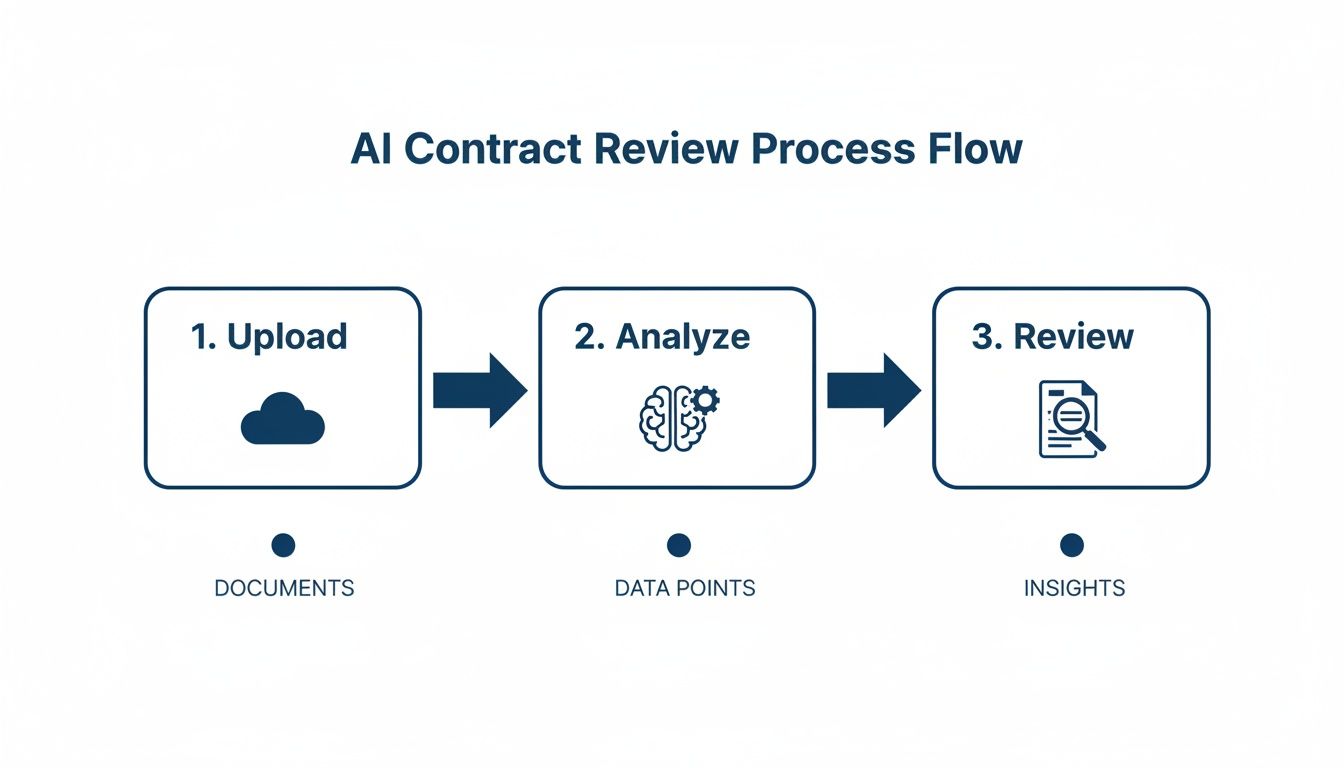
This process really underscores the technology's main strength: its ability to rapidly digest and organize dense documents, teeing them up for a focused, expert human review.
Key Questions to Ask Vendors
Once you have a shortlist, it's time to get specific. Go into those demo calls armed with pointed questions that force vendors to go beyond their scripted sales pitch. The answers you get will make it much easier to compare your options and choose with confidence. If you're just starting, it's a good idea to get a feel for the different types of contract review software out there first.
Here are a few questions you should absolutely ask:
- Data Protection: "How do you encrypt our data, both when it's moving and when it's sitting on your servers? Can we dictate where our data is stored, like keeping it in the EU or Switzerland?"
- Implementation and Training: "Walk me through your onboarding process. What kind of training and resources do you provide for my team, and what's a realistic timeline to get us up and running?"
- AI Model Transparency: "How do you update your AI models? Will we know when a change is made that could impact how our contracts are reviewed?"
- Support and SLAs: "What are your standard support hours and guaranteed response times? What kind of Service Level Agreements (SLAs) do you offer for platform uptime?"
Choosing a contract review service is fundamentally an exercise in trust. You are entrusting a provider with one of your most sensitive assets—your contractual data. The right partner will be transparent about their security, technology, and support from day one.
Proving the Value: Piloting and Measuring ROI
Switching to a new contract review service isn't something you do overnight. To really get it right and prove its value, you need a smart, measured approach. Throwing your entire contract portfolio at a new system all at once is a recipe for disaster. It’s like test-driving a car—you take it for a spin around the block before committing to a cross-country road trip.
A pilot program is the perfect way to start. Pick a specific type of contract you handle a lot of—something fairly standard. Non-Disclosure Agreements (NDAs) or Master Service Agreements (MSAs) are usually great for this. They give you a clean, manageable test case.
Before you even start the pilot, you have to know where you're starting from. Meticulously document your current process. How many hours does it take your team to get one NDA from intake to final approval? This number is your baseline, and it's the most critical piece of data you'll collect.
What to Track: The KPIs That Matter
Once the pilot is running, you need to be tracking the right things. A vague feeling that "things are faster" isn't going to cut it when you need to justify the expense to leadership. You need cold, hard numbers that tell a story.
Here are the key performance indicators (KPIs) to zero in on:
- Average Review Time: This is the most obvious one. How long does it take from the moment a contract hits the queue until it’s approved? You should see a dramatic drop here.
- Deal Velocity: How much faster are you closing deals? Measure the time from the first draft to the final signature. Speeding up legal review directly pushes this number down.
- Term Deviation: Keep an eye on how often your team accepts non-standard clauses. A good service will help enforce your playbook, leading to better consistency and fewer risky exceptions.
- Legal Team Bandwidth: This is about reclaiming time. Tally up the hours your internal team is no longer spending on routine reviews. This is time they can now spend on high-stakes negotiations or strategic advice.
Calculating Your Return on Investment
With solid data from your pilot, calculating the ROI becomes much simpler. But remember, the formula isn't just about saving money on salaries. It's about showing the total impact on the business. You're weighing the cost of the service against a combination of time saved, risk avoided, and deals won faster.
The true ROI of a contract review service isn't just in the hours saved. It's in the deals you accelerated, the hidden risks you caught, and the strategic brainpower you unlocked for your legal team. It transforms legal from a bottleneck into a business accelerator.
Let's put some numbers to it. Say your legal team gets back 20 hours per week, and their average loaded rate is $150/hour**. That's an immediate **$3,000 per week in value. Now, add the financial upside of closing deals two days sooner, and the business case pretty much makes itself.
To get the most value out of this new tool long-term, think about how it fits into your bigger picture. To build a truly world-class system, explore these 10 essential contract management best practices. It will give you a framework for making your entire contracting process smarter and more valuable.
Your Questions Answered
Even after you're sold on the idea of a contract review service, some practical questions always pop up. It's only natural. Here are the straight answers to the questions we hear most often from legal, healthcare, and compliance teams looking to make a change.
Can AI Really Replace a Human Lawyer?
Short answer: no. And that’s not the goal. Think of an AI contract review service as a tireless, incredibly fast paralegal, not a replacement for seasoned counsel.
The real power of AI is in chewing through the high-volume, repetitive work that eats up your team's time. It can instantly flag missing clauses, spot deviations from your standard playbook, and organize key terms across hundreds of documents. This frees up your lawyers to do what they do best: apply nuanced judgment, strategize for negotiations, and handle complex, one-of-a-kind legal challenges.
The most effective setup is a partnership—AI does the heavy lifting on the first pass, and your human experts step in to add the critical thinking and strategic oversight.
How Secure Is My Data with a Cloud-Based Service?
This is a big one, and it should be. Handing over sensitive contracts is a matter of trust. Reputable providers make security their top priority, building their platforms with robust protections.
Look for services that offer end-to-end encryption, secure hosting in specific jurisdictions (which is key for compliance), and adherence to major regulations like GDPR.
When you're vetting a provider, don't be shy. Ask them directly about their data segregation policies, the specific encryption standards they use, and what security certifications they hold. You need to be confident that your contract data is shielded from any unauthorized access.
At a minimum, verify that they meet tough industry standards like SOC 2 Type II or ISO 27001. These certifications aren't just acronyms; they're proof that your information is being managed responsibly.
How Long Does It Take to Get Started?
This isn't a year-long IT project. The time it takes to get up and running really depends on the platform and how much you want to customize it. Most modern SaaS platforms are built for speed and can be rolled out in just a few days or weeks, not months.
The bulk of the "work" is simply teaching the AI your rules—configuring it with your unique review playbooks and risk tolerance. A great way to start is with a pilot project. Pick one common contract type, like NDAs, to get the ball rolling. This approach gets your team comfortable with the system and shows you a tangible return almost immediately.
At Whisperit, we built our voice-first AI workspace to bring drafting, research, and collaboration together for busy legal teams. Our platform works securely with the tools you already use, creating a calmer, more focused way to work. See how it works at https://whisperit.ai.