
A Guide to Using a Chatbot for Lawyers
Picture this: a paralegal who never gets tired, fields client questions in the middle of the night, and pre-qualifies every single lead, 24/7. That's not some far-off fantasy; it's exactly what a chatbot for lawyers can do for a modern law firm. This is a practical tool available right now, designed to take on the repetitive tasks that eat up your team's time, letting them focus on actual legal work.
Your Law Firm’s Newest Digital Associate
At its core, a legal chatbot is an AI-powered program built specifically for the legal field. It's not like the generic customer service bots you see on retail websites that just answer simple FAQs. A chatbot designed for a law practice understands the unique needs and conversations of the legal world.
Think of it as the first friendly face on your firm’s website. It engages potential clients the moment they land on your page, working around the clock to make sure you never miss a lead, no matter when they reach out. The whole point is to make your operations smoother and give clients a better experience, which, in turn, helps your bottom line.
Core Functions and Immediate Benefits
The real value of a legal chatbot shines through when you look at what it actually does. It was created to handle all those high-volume, low-complexity interactions that can be a massive drain on a firm's time and resources.
Here's where you'll see an immediate impact:
- 24/7 Lead Capture and Qualification: The bot can ask a series of screening questions to see if a potential client is the right fit for your firm, all while gathering their contact info and key case details.
- Instantaneous Client Communication: It gives instant answers to common questions about your firm, what you practice, or how your process works. This small touch can make a huge difference in client satisfaction.
- Automated Appointment Scheduling: By syncing with your team's calendars, the chatbot can book initial consultations on its own. No more endless email chains trying to find a time that works.
This basic chatbot interaction shows how the conversational flow works.

While simple, it's the same fundamental principle that powers sophisticated legal chatbots, which are trained on legal terminology and specific workflows.
The legal industry is catching on fast. In 2023, the market for legal service chatbots was valued at USD 124.3 million, and it's expected to skyrocket to USD 1,567 million by 2032. That's a compound annual growth rate of 32.7%, a clear signal that this technology is changing how law firms operate.
By handling the repetitive, front-end tasks, a chatbot frees up lawyers and paralegals to dedicate their expertise where it truly matters—practicing law and building strong client relationships.
In the end, bringing a chatbot into your firm isn't just a tech upgrade. It's a strategic move to build a more efficient, responsive, and client-focused practice. The overlap between law and AI is fundamentally reshaping how legal services are delivered.
What Really Makes a Legal Chatbot Tick?
It’s easy to think all chatbots are the same. But the simple bot you see on a retail website, answering questions about shipping times, is miles away from what a law firm truly needs. A chatbot built for lawyers is an entirely different beast, powered by specific technology designed to navigate the complexities of the legal world.
At its core, a sophisticated legal chatbot relies on Natural Language Processing (NLP). You can think of NLP as the engine that allows the bot to understand how humans talk, not just what they type. It’s the difference between spotting a few keywords and actually grasping the context, intent, and urgency behind a potential client’s message.
For example, a prospective client might type, "I got into a car accident and the other guy was on his phone, what do I do?" A basic bot might get hung up on "car accident." An NLP-powered bot, however, understands the user is describing a personal injury case, recognizes the mention of texting as potential negligence, and knows the next step is to start the intake process. It's a game-changer. You can get a clearer picture of what natural language processing is and why it's so fundamental to these tools.
Beyond Just Answering Questions
While understanding language is the foundation, several other key features elevate a simple Q&A bot into a true asset for your firm. These are the capabilities that start automating real work, saving you time and preventing simple mistakes.
One of the most valuable features is intelligent lead qualification. Instead of just grabbing a name and email, the chatbot can be programmed to act as your first line of defense, applying your firm’s specific intake criteria before a human ever gets involved.
- Practice Area Matching: It can ask targeted questions to figure out if the inquiry is a fit for your firm, whether it's personal injury, family law, or another specialty.
- Conflict Checks: The bot can collect the names of everyone involved to run a preliminary check against your client database, flagging potential conflicts immediately.
- Statute of Limitations Screening: For certain cases, it can ask for the date of the incident to raise a red flag if the deadline is approaching.
This initial screening is huge. It means that by the time a lead lands on your desk, it’s already been vetted, freeing up your intake team from hours of unproductive phone calls.
Another major time-saver is automated document generation. Imagine a potential client needs to sign an NDA before they can discuss a sensitive business deal. The chatbot can ask for the key details—names, dates, the company involved—and instantly create a filled-out NDA from your firm’s template, ready for an e-signature.
What Separates the Good from the Great
The real difference between a standard chatbot and a top-tier legal AI tool comes down to integration and context. A basic bot is a standalone gadget on your website. An advanced one is woven into the fabric of your firm’s operations.
A truly effective legal chatbot doesn’t just live on your website. It integrates with your core systems, understands case context, and acts as a proactive assistant across your entire workflow.
This deep integration is what sets a platform like Whisperit apart. It’s not just a chatbot; it’s a context-aware workspace. It pulls information from your emails, documents, and case files, allowing it to handle much more complex requests. You could ask it to, "draft a client update letter using the standard template for the Smith case," and it would know exactly which case file to reference and which template to pull.
To put it in perspective, let's look at a side-by-side comparison.
Comparing Basic Chatbots with Advanced Legal AI
The gap between a generic bot and one built for the legal field is significant. Here's a breakdown of the key differences you'll encounter.
| Feature | Basic Chatbot | Advanced Legal Chatbot |
|---|---|---|
| Understanding | Relies on simple keywords and pre-set scripts. | Uses NLP to understand legal context, client intent, and nuance. |
| Lead Qualification | Collects basic contact info (name, email). | Actively screens leads based on practice area, conflicts, and custom firm criteria. |
| Integration | Operates as a standalone tool on a website. | Deeply integrates with case management software, calendars, and email. |
| Document Handling | Can provide links to downloadable forms. | Generates and populates documents like intake forms or NDAs automatically. |
| Context Awareness | Treats every interaction as new and isolated. | Remembers past conversations and understands case-specific details for ongoing matters. |
As you can see, the functionality is worlds apart.
Ultimately, a purpose-built chatbot for lawyers is about so much more than just answering questions. The essential features—NLP, intelligent screening, document generation, and deep integration—all work together to create an assistant that actively boosts your firm's efficiency and improves the client experience from the very first click.
How Law Firms Are Actually Using Chatbots
Let's move past the theory and look at where the rubber meets the road. The real value of a chatbot for lawyers comes alive when you see how it plugs into the daily chaos of a busy law practice. These aren't just futuristic toys for massive corporations anymore; they are practical, everyday tools that handle repetitive tasks and improve client service from the very first click.
Think about it. A potential client lands on your website at 10 PM on a Friday. Instead of hitting a wall with a "we'll get back to you" contact form, they're greeted by an intelligent assistant ready to help. That first touchpoint is often what separates you from your competitors.
Nailing the Client Intake Process
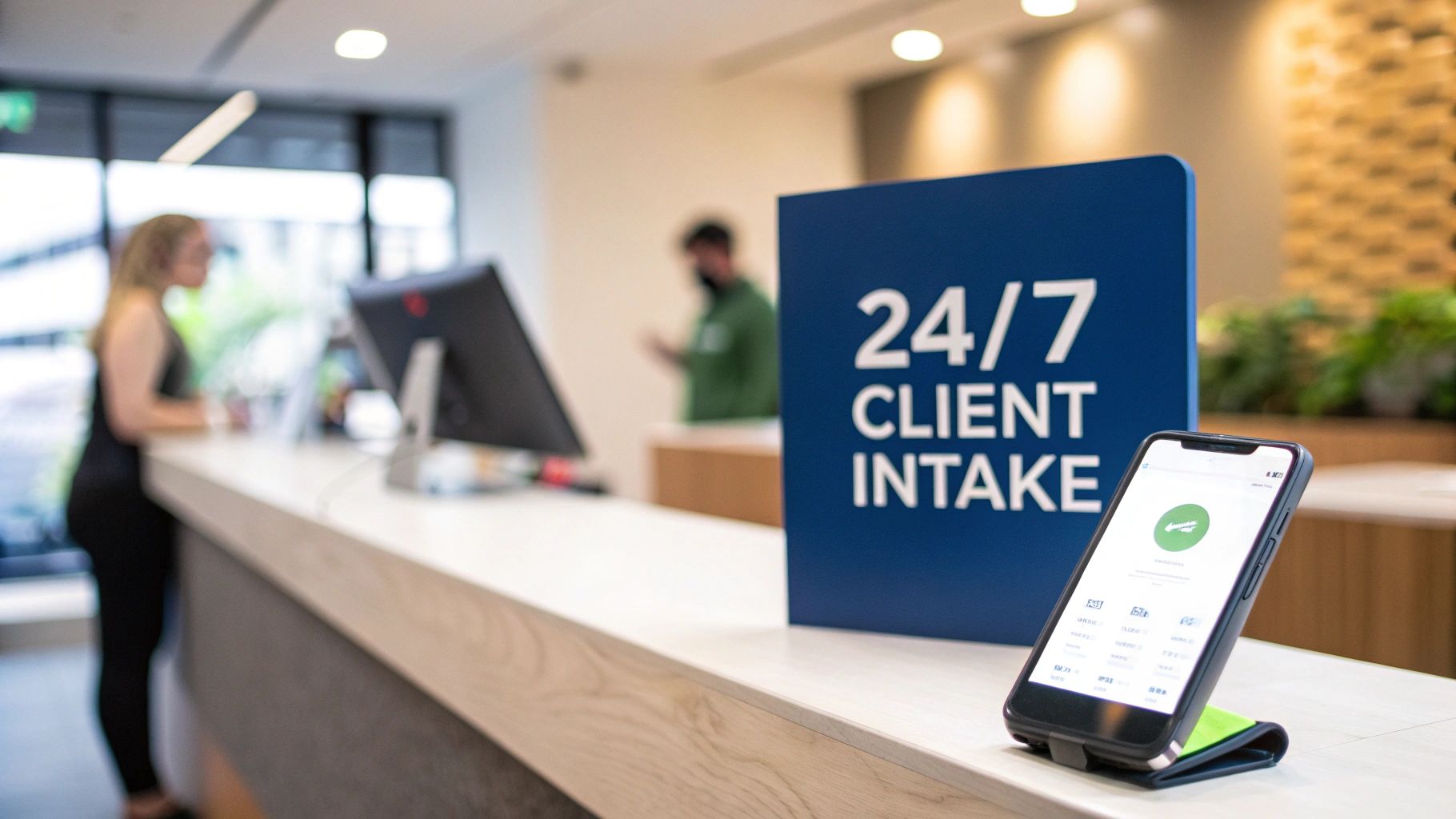
If there's one area where a legal chatbot delivers an immediate and obvious win, it's client intake. It essentially becomes your digital front desk—one that never sleeps, takes breaks, or misses a call. This ensures a potential client doesn't get frustrated and move on to the next firm in their search results.
Here’s what that looks like in the real world:
- First Contact: The bot pops up with a friendly greeting and asks a few simple qualifying questions to get the ball rolling (e.g., "Are you looking for help with a personal injury, family law, or business matter?").
- Gathering the Basics: It then walks them through a conversation to collect key contact details and the specifics of their situation. This feels much more personal and engaging than filling out a long, sterile form.
- Conflict Check Prep: The bot can even ask for the names of all parties involved, collecting the data needed for a preliminary conflict check before a human ever lays eyes on the file.
- Booking the Consultation: Finally, it taps into your firm's calendar, shows the client available time slots, and books the initial consultation right then and there.
This whole exchange happens automatically, turning a casual website visitor into a qualified lead booked on your calendar—all without your staff lifting a finger. We dive much deeper into perfecting this workflow in our guide to the client intake process.
By automating those crucial first steps of client intake, law firms can capture and qualify leads 24/7. This dramatically lowers the risk of losing potential clients to firms that are quicker to respond.
This isn't just about efficiency. It’s about delivering a better, more responsive experience for people who are often reaching out during a very stressful moment in their lives.
Handling Routine Client Questions
After a client is on board, a chatbot for lawyers continues to be a workhorse for managing routine communications. Clients always have simple, recurring questions, and answering them can eat up a surprising amount of time for paralegals and attorneys.
Just think of the common questions your team fields every single day:
- "What's the latest update on my case?"
- "Where do I upload these documents you asked for?"
- "What are your office hours again?"
- "Can you explain this line item on my invoice?"
A well-configured chatbot can give secure, instant answers to these questions. For case status updates, it can sync with your practice management software to pull real-time information, saving your attorneys from constant interruptions. This empowers clients with self-service access and makes them feel more in control, which goes a long way toward building trust.
A Helping Hand for Your Own Team
The benefits don't stop at client-facing tasks. Internally, these AI assistants can become an incredibly useful resource for your legal team, especially when it comes to preliminary research and document management.
Instead of wrestling with complex legal database syntax, an attorney can simply ask in plain English, "Find the statute of limitations for personal injury claims in Texas." The bot can pull up the exact legal code or point them to the right internal documents in seconds.
It can also help kickstart document creation. An associate could say, "Draft a standard NDA for our new client, Acme Corp." The bot pulls the firm's approved template, fills in the necessary details, and gets the document ready for a final human review.
The economic case for this is undeniable. The global chatbot market is on track to hit USD 29.5 billion by 2029, and a big part of that growth comes from massive cost savings. In fact, chatbots are projected to save businesses around $8 billion in customer support costs annually by 2025, with the legal sector being a major part of that shift.
From that first website visit to answering billing questions and drafting documents, a chatbot for lawyers is a versatile tool that boosts efficiency at almost every point in a law firm's workflow.
Navigating Security and Ethical Compliance
In the legal world, trust isn’t just a nice-to-have—it’s the entire foundation of your practice. When you bring a new piece of technology like a chatbot into your firm, you’re not just adding a tool. You’re inviting it into a space governed by some of the strictest rules of confidentiality and ethics on the planet.
For any law firm, even the hint of a security weakness can be devastating to your reputation. That's why any conversation about legal chatbots has to start and end with security. This isn't just an IT problem to solve; it's a core professional responsibility. The system has to be a digital fortress, plain and simple.
Protecting Attorney-Client Privilege
The absolute cornerstone of our profession is attorney-client privilege. So, how does that sacred trust hold up in a digital conversation? Any chatbot worth its salt must be built from the ground up to uphold this principle.
It all starts with end-to-end encryption. Think of it as a sealed, tamper-proof envelope for every single message. From the moment a potential client starts typing until that message lands securely in your system, the data must be completely unreadable to anyone else.
On top of that, strict access controls are non-negotiable. Not everyone at your firm needs to see every new client inquiry. The right platform will let you set specific permissions, making sure only authorized people can view sensitive information. This is crucial for minimizing internal risks.
Meeting Global Data Privacy Standards
Your duty to protect data doesn't stop with your client conversations; it has to comply with a web of regional and international laws. Depending on where your clients live, you could be on the hook for some seriously tough regulations.
Here are the key compliance areas you absolutely have to nail down:
- Data Residency: Laws like the GDPR in Europe often dictate that a citizen's data must be stored within a specific geographic area. Your chatbot provider must be able to guarantee data is hosted in a compliant location, like Swiss or EU-based servers for your European clients.
- Data Processing Agreements (DPAs): Regulations like GDPR and CCPA legally require you to have a formal agreement detailing how a vendor (like your chatbot provider) will handle the personal data you collect. This isn't optional; it's a legal necessity.
- Right to Erasure: These same laws give people the right to have their data deleted. Your chatbot system needs a clear, reliable process for handling these requests quickly and completely.
Getting compliance right isn’t just about avoiding hefty fines. It’s about showing your clients you take their privacy as seriously as you take their case. A breach of trust can inflict far more damage than any financial penalty.
The Importance of Audit Trails
What happens when you need to prove exactly who accessed a client's file and when they did it? This is where audit trails become absolutely essential. An audit trail is basically an unchangeable, time-stamped log that records every single action taken within the system.
This feature is indispensable for both security and compliance. If a question ever comes up about a data breach or unauthorized access, the audit trail is your definitive record. It shows who viewed what, when they viewed it, and what they did. For firms looking to build a rock-solid system, exploring established AI governance best practices can offer a great roadmap.
A comprehensive chatbot platform built for lawyers will provide the detailed logging you need to demonstrate due diligence and maintain a clear chain of custody for every digital interaction. At the end of the day, choosing a chatbot isn’t just a technology decision; it's an ethical one.
Choosing and Justifying Your Legal Chatbot
Picking a chatbot for your law firm isn't just another software purchase. It's a strategic move. Get it right, and you can unlock a new level of efficiency. Get it wrong, and you’re stuck with a tool that creates more headaches than it solves.
The real goal is to find a partner that fits your firm's needs today and can scale with you as you grow. This means looking past the slick marketing demos and digging into the practical, day-to-day features that will actually make a difference for your team and your clients.
Key Criteria for Vetting Vendors
Let's be clear: not all legal chatbots are built the same. To find the right one, you need to evaluate potential providers with the same rigor you'd apply to any other critical business decision. Think of it as conducting due diligence.
Here’s what you absolutely need to investigate:
- Integration Capabilities: A chatbot that can’t talk to your other systems is basically useless. It has to connect seamlessly with your case management software, CRM, and calendars. Always ask for a list of their native integrations and find out how their API works for any custom connections you might need.
- Customization and Flexibility: Your firm has its own voice and specific workflows. A cookie-cutter chatbot just won't cut it. You need a platform that lets you easily tweak conversation flows, branding, and intake questions without having to call in a developer for every little change.
- Support and Onboarding: What happens when things go sideways? Take a hard look at the vendor's support. Do they offer real, hands-on help to get you started? Is their customer service team responsive? A solid support system is non-negotiable.
Calculating Your Return on Investment
To get buy-in for any new technology, you have to make the financial case for it. A chatbot isn't just another line item on your expense sheet; it's an investment that should deliver a clear, measurable return.
The ROI for a legal chatbot really boils down to three things: saving time, converting more leads, and lowering the cost of bringing in new clients. Let's break down how you can actually put numbers to these benefits.
A well-chosen chatbot pays for itself by turning administrative busywork into billable hours and converting more of your website traffic into qualified leads. It’s a direct investment in your firm’s bottom line.
The security process flow below shows the foundational principles that any trustworthy chatbot vendor must follow, from encryption to compliance and auditing.
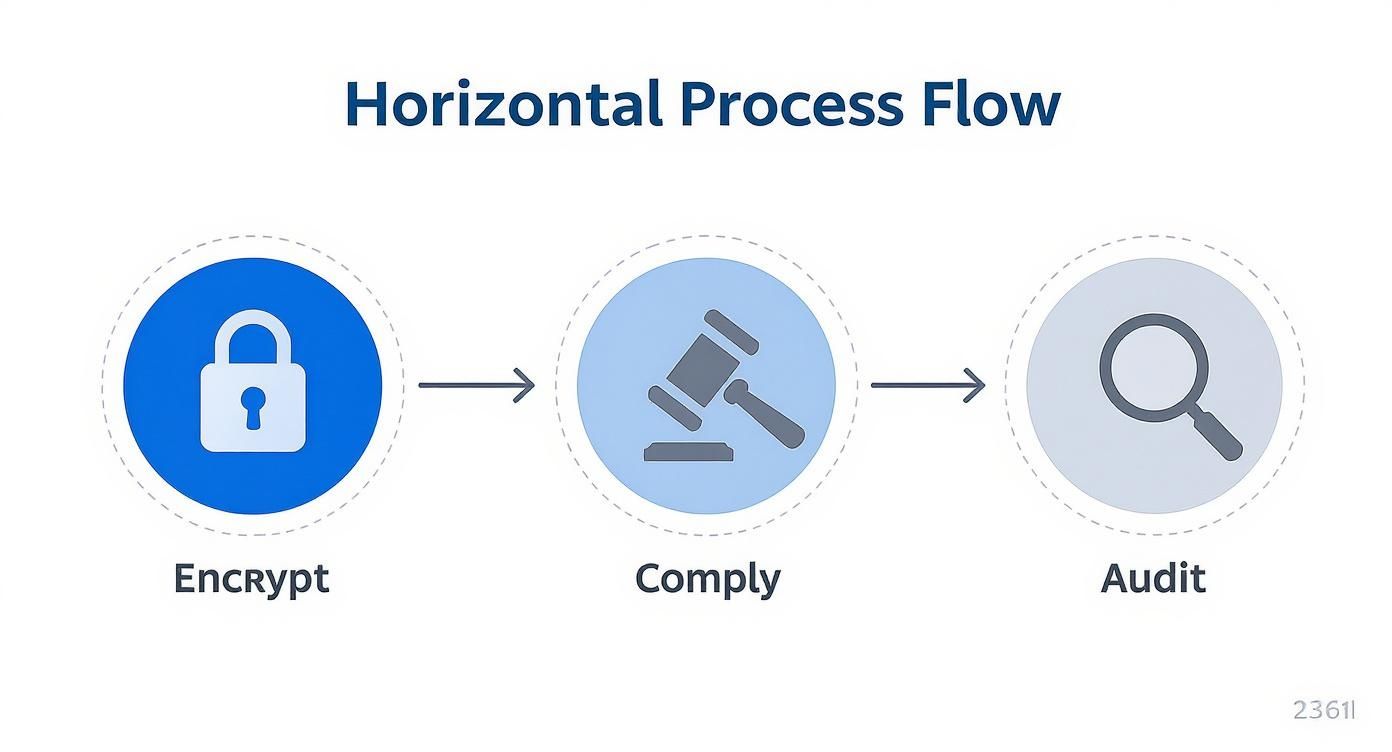
This visual is a good reminder that a vendor's commitment to security is every bit as important as the features they offer.
Framing the Chatbot as a Strategic Investment
To figure out your potential ROI, start by tracking how much time your staff currently sinks into repetitive tasks a chatbot could easily handle—things like initial client screening, scheduling consultations, and answering the same basic questions over and over. When you're looking at any new tech, understanding its effect on billable hours is key. You can often find great insights from resources focused on tools like time tracking software for lawyers.
This market is booming for a reason. The global legal chatbot market was valued at USD 132.6 million in 2024 and is expected to hit USD 402.0 million by 2030. That's a strong signal that firms see real value here.
Here’s a simple way to estimate your own return:
- (Hours Saved Per Month x Average Hourly Rate) = Monthly Efficiency Gains
- (New Qualified Leads from Chatbot x Your Conversion Rate x Average Case Value) = New Monthly Revenue
- Efficiency Gains + New Revenue - Monthly Chatbot Cost = Total ROI
This simple calculation completely changes the conversation. It's no longer about "How much does this cost?" but rather, "How much money will this make for us?" When you frame it this way, it’s easy to see how a chatbot becomes a powerful engine for your firm's growth.
Common Questions About Legal Chatbots
Adopting any new technology brings up good questions, especially in a field where precision and confidentiality are everything. As law firms start looking at a chatbot for lawyers, it’s normal to have concerns about job security, the setup process, and where the ethical lines are drawn.
Let's tackle the most common questions head-on to give you the clarity your firm needs.
Will A Chatbot Replace Our Paralegals?
Not a chance. This is probably the biggest myth out there about AI in the legal space. A legal chatbot is built to augment your team, not replace it. Think of it as a super-efficient assistant that takes over the repetitive, low-value tasks that eat up your skilled staff's time.
Its real job is to manage things like initial client screening, answering basic questions 24/7 ("What are your office hours?"), and scheduling appointments automatically. This clears the deck for your paralegals and junior associates, letting them focus on the complex, billable work that requires a human brain and a bit of empathy.
By automating the mundane, you free up your team to work at a higher level on things like deep-dive legal research, case strategy, and building real relationships with clients. The result is almost always better efficiency and higher job satisfaction, not a smaller headcount.
How Difficult Is It To Set Up A Chatbot?
The thought of setting up new tech can be intimidating, but you'd be surprised how user-friendly modern legal chatbot platforms are. Most are built with no-code or low-code interfaces, which is just a fancy way of saying you don’t need a dedicated IT department or a computer science degree to get one running.
The implementation process is usually pretty straightforward:
- Customize Conversation Flows: You’ll adjust the chatbot's scripts and questions to match your firm’s practice areas and what you need to know from a new client.
- Website Integration: Getting the chatbot on your website is often as simple as copying and pasting a small piece of code.
- Connect to Your Tools: The best vendors offer smooth integrations with major law practice management software, CRMs, and calendar systems.
Top-tier providers also include dedicated onboarding support to make sure everything goes smoothly, helping you connect the chatbot to your existing tools without causing a major headache.
Can A Chatbot Give Legal Advice?
Absolutely not. This is a critical ethical line that a properly designed chatbot for lawyers will never cross. Its role is strictly informational and administrative—it's a digital receptionist, not a legal counselor.
A well-designed chatbot must be programmed with clear, prominent disclaimers stating that the conversation does not constitute legal advice and does not create an attorney-client relationship. Its job is to collect information, explain processes, or schedule a consultation with a human lawyer.
When you're evaluating different tools, it's vital to make sure they have built-in safeguards to keep them from overstepping these boundaries. This keeps you ethically compliant and protects both your firm and your potential clients. It's important to understand the details here, and you can explore more about how these duties are preserved in our guide to the attorney-client privilege rules.
How Is This Different From A Generic Website Chatbot?
This is a really important distinction. A generic chatbot you might see on a retail website is a simple, standalone tool designed for one thing, like capturing an email address. It works with basic keywords and fixed scripts. A specialized chatbot for lawyers, on the other hand, is an integrated system built from the ground up for the legal workflow.
The differences are pretty stark:
- Legal Understanding: It’s trained to recognize legal-specific language and questions, which leads to far more relevant and helpful conversations.
- Workflow Integration: It connects directly to your case management software, calendars, and document systems, making it an active part of how you work.
- Context Awareness: The best systems can be part of a larger, context-aware workspace. They understand information from your emails and documents to act as a proactive assistant across all your work, not just as a little pop-up on your website.
For example, a workspace like Whisperit turns the chatbot from a simple Q&A tool into a genuine digital associate that understands the full context of your cases.
What Happens If The AI Makes A Mistake?
That’s a fair question, especially with all the stories about AI "hallucinating" or just getting things wrong. The key is to have a system with strong human oversight and very clear boundaries on what the AI is allowed to do. A legal chatbot should never be the final word on any substantive issue.
Its purpose is to gather data and automate routine communication using pre-approved scripts and information from your systems. For example, if it's scheduling an appointment, it's just pulling availability from a calendar—it isn't making a judgment call. If it's giving a client a case update, it's relaying information straight from your case management software.
The most reliable platforms are designed with a "human in the loop," meaning any complex or ambiguous question gets immediately flagged and sent to a member of your team. This containment strategy keeps the AI operating strictly within its administrative lane, which minimizes the risk of error and protects the integrity of your firm’s work.
Ready to see how a voice-first AI workspace can transform your firm's efficiency and client service? Whisperit unifies your dictation, drafting, and case management into a single, intelligent platform. Discover how Whisperit can empower your legal team.