
A Practical Guide to artificial intelligence contract management
Think of AI contract management as transforming your static legal documents into a dynamic, intelligent database you can actually talk to. It's a system that injects artificial intelligence into the entire lifecycle of an agreement—from creation and analysis all the way through to management and renewal. Essentially, this tech gives your contracts a brain, empowering them to flag risks, keep track of obligations, and pull up answers instantly, all without a manual page-by-page review.
From Digital Filing Cabinet to Intelligent Advisor
Traditional contract management is a lot like a library with an old-school card catalog. You know the information is in there somewhere, but finding what you need is a slow, manual slog. You have to physically dig through files, read through pages of dense legal text, and just hope you don't miss a critical date or a tricky clause. It’s a process that's not only slow but also wide open to human error, offering zero proactive insights.
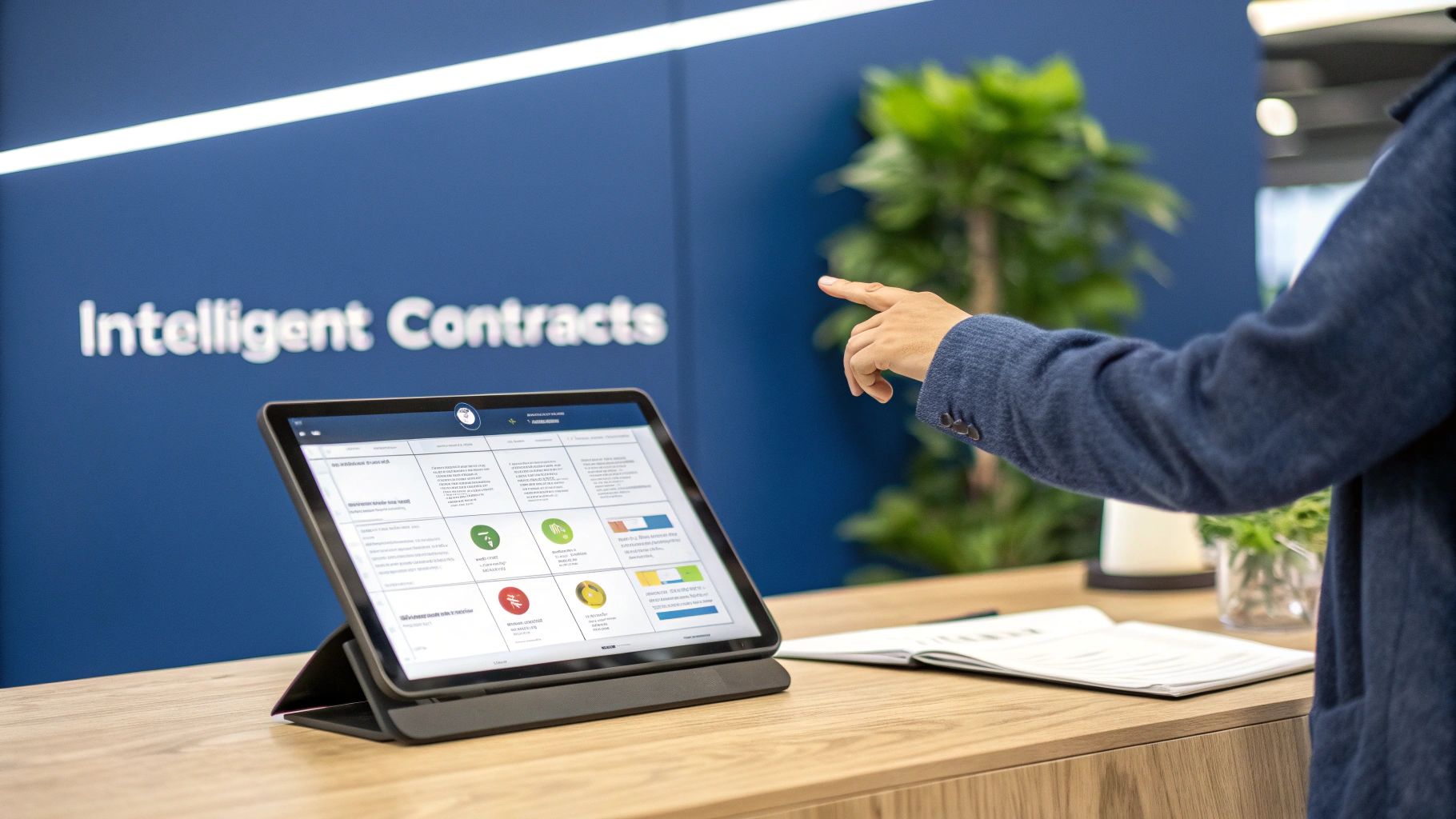
Artificial intelligence contract management completely flips that script. Instead of just storing digital files, an AI-powered system actively reads, understands, and organizes the content within them. Imagine upgrading that library with a brilliant digital librarian who has memorized every single book and can answer any question you throw at them in seconds. That’s the leap we're talking about.
The Core Problem AI Solves
Let's be honest: manual contract lifecycle management (CLM) is riddled with predictable problems that create very real business risks. As a company's contract portfolio grows, these issues don't just add up; they multiply.
- Human Error: It happens to the best of us. A missed renewal date, an overlooked obligation, or inconsistent language can easily lead to costly penalties or getting stuck with unfavorable terms. Even a single misplaced comma can change a contract's entire meaning.
- Lack of Visibility: When contracts are scattered across emails, siloed in shared drives, and buried in physical filing cabinets, getting a clear picture of your company's total risk or obligations is nearly impossible.
- Crippling Inefficiency: Legal and procurement teams burn countless hours on low-value administrative work—like searching for a specific clause or manually tracking key dates. This pulls them away from the strategic work that really matters, like high-stakes negotiation and forward-looking risk analysis.
AI tackles these problems head-on by bringing smart automation to every stage of a contract's life. It shifts contract management from a reactive, administrative burden into a proactive, strategic asset.
AI tools can help streamline and automate processes at several points in the contract lifecycle. While AI can’t take over all contract management, with proper human oversight and involvement, it can aid greatly in the drafting, negotiation, and monitoring of a contract portfolio.
Shifting from Manual to AI-Powered Management
Making the move to an AI-driven system is a massive operational upgrade. This isn't just about doing the same old tasks a bit faster; it's about unlocking entirely new capabilities that were simply out of reach before. The table below really drives home the difference between the old way and the new.
Manual vs AI-Powered Contract Management
This table breaks down the core differences, highlighting how AI fundamentally changes the game in terms of efficiency, accuracy, and strategic contribution.
| Feature | Manual Contract Management | AI-Powered Contract Management |
|---|---|---|
| Data Extraction | A time-consuming, manual task requiring someone to read and copy-paste key details. | Instant and automated extraction of clauses, dates, parties, and obligations. |
| Risk Analysis | Relies entirely on the reviewer's expertise and attention to detail; inconsistent across teams. | Automatically flags non-standard clauses, identifies missing terms, and assigns risk scores. |
| Obligation Tracking | Dependent on calendar reminders and spreadsheets, which are easily missed or outdated. | Proactively monitors deadlines and sends automated alerts to stakeholders. |
| Search & Retrieval | Limited to file names or basic keyword searches, often yielding irrelevant results. | Allows for natural language queries, like asking, "Show all contracts renewing in Q4." |
As you can see, the shift is from a system of record that requires constant manual labor to a system of intelligence that actively works for you, providing insights and safeguarding against risk. It’s a genuine step-change for any organization managing a significant number of agreements.
How the Technology Actually Works
To really get what makes artificial intelligence contract management tick, you have to pop the hood and see what’s running the show. This isn't one single piece of "magic" tech; it's more like a super-smart team of specialists working together. Each one has a specific job: reading, understanding, and then acting on the information locked away in your legal documents.
This teamwork is what turns a folder full of static PDFs into a living, breathing database you can actually talk to. Let's pull back the curtain on the core components and see how they work in tandem to bring real automation and intelligence to your contract process.
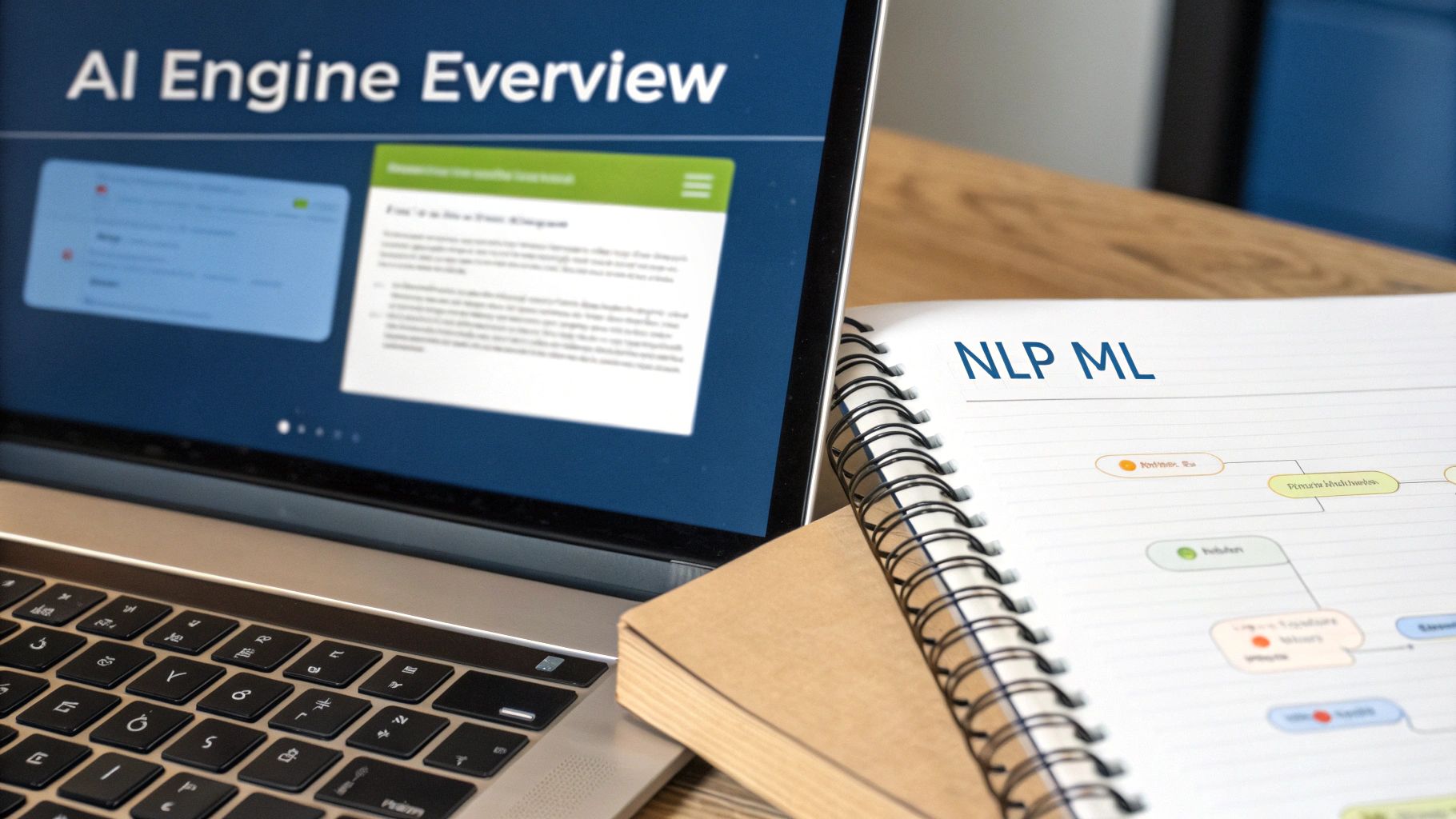
The Language Expert: Natural Language Processing
At the absolute core of any AI contract platform, you'll find Natural Language Processing (NLP). This is the part of the system that can actually read and make sense of human language. It’s what separates a smart system from a simple CTRL+F search.
Think about it. If you need to find every "limitation of liability" clause across a thousand agreements, a basic search tool would probably miss any variations like "liability cap" or "indemnification limits." NLP, on the other hand, gets the concept and pulls them all out for you. This knack for understanding legal nuance is the foundation for everything else. If you want to go deeper, our guide on what is Natural Language Processing is a great place to start.
With NLP in place, the system can handle some seriously heavy lifting:
- Clause Extraction: It automatically identifies and pulls out key details like terms, dates, party names, and critical obligations from dense contracts.
- Sentiment Analysis: It can even get a feel for the language, flagging clauses that might be unfavorable or risky for your side.
- Summarization: It can generate quick, accurate summaries of long agreements, so you can get the gist without reading every single word.
The Pattern Seeker: Machine Learning
If NLP is the team member who reads everything, Machine Learning (ML) is the strategist who learns from all that reading. ML algorithms are trained on huge volumes of contracts, which teaches them to spot patterns, flag strange deviations, and even make predictions. This is what turns a contract repository into a proactive tool that helps you manage risk.
For instance, an ML model can analyze thousands of your past agreements to figure out what a "perfect" master service agreement looks like for your company. The next time a new draft lands on your desk, the AI can instantly scan it and compare it to that gold standard.
The system doesn't just look for certain words; it understands the context. It can flag a clause that, while technically fine, is a major departure from what you've agreed to 95% of the time in the past.
This is where the system’s real intelligence comes alive. The AI learns what’s normal for your business and uses that baseline to call out potential problems before they escalate. For a more technical look at the models driving this, this LLM guide offers some great background on how these complex systems operate.
The Diligent Assistant: Robotic Process Automation
Last but not least, you have Robotic Process Automation (RPA). This is your tireless assistant, the one who handles all the repetitive, manual tasks that drive everyone crazy. RPA connects the dots between the insights from NLP and ML and turns them into action.
Think of RPA as the digital glue. Once NLP extracts a renewal date and ML flags it as critical, RPA steps in and gets to work.
It can automatically:
- Add the contract renewal deadline to the right person’s calendar.
- Set up a reminder notification to go out 90 days before the deadline.
- Route the agreement to the legal team for a closer look if certain risk factors are present.
This kind of automation ensures nothing ever slips through the cracks. When you combine these three technologies, AI contract management platforms create a smart, seamless workflow that completely changes how you handle your most critical documents.
Where AI Contract Management Makes a Real Difference: Legal and Healthcare
The true power of AI in contract management isn't just theoretical. When you apply it to high-stakes, heavily regulated fields like legal and healthcare, you see its impact immediately. For these teams, where a single misplaced comma can have massive consequences, AI is more than a convenience—it's a critical upgrade to how they manage risk, protect revenue, and serve their clients and patients.
The move away from manual contract wrangling is picking up speed. The entire Contract Lifecycle Management (CLM) market, with AI as its engine, is on track to hit USD 3.69 billion by 2032. This isn't just hype; it's driven by real results. Experts predict that by 2027, AI will handle 50% of procurement contract management. Companies already on board are seeing AI platforms pull out metadata in 44% of cases and identify key clauses 39% of the time, saving their people from mind-numbing, error-prone manual reviews. You can dig into more of these trends over at Aavenir.
Giving Legal Teams a Strategic Edge
For in-house legal teams, AI turns contract management from a defensive, document-guarding chore into a strategic function. The technology takes over the most tedious parts of contract review, freeing up lawyers to focus on the high-level work that actually requires their unique skills.
Think about it. Instead of spending a week redlining a new sales agreement, a lawyer can let an AI platform do the initial heavy lifting. The system instantly cross-references the draft against the company's approved templates or a "perfect" version, flagging every deviation, risky phrase, or missing clause that could create liability down the road.
This shift unlocks some serious advantages:
- Faster Deal Cycles: A review that used to bog down a deal for days can now be done in a few hours, sometimes even minutes. Legal is no longer the bottleneck; they're helping the business move faster.
- Smarter Negotiations: Imagine walking into a negotiation armed with insights from every contract your company has ever signed. AI can surface common ground, pinpoint which terms are frequently accepted, and even flag clauses that have caused problems in the past.
- Rock-Solid Consistency: AI acts as a tireless gatekeeper, ensuring every single agreement aligns with company policy. It puts an end to the "human error" that lets inconsistent language slip into contracts across different departments. We explore this further in our guide on AI-driven due diligence.
When you automate routine work like finding clauses and tracking obligations, you empower your legal team to think bigger. They can spend their time on sophisticated negotiation strategies, proactively heading off risks, and giving the business the high-level strategic advice it really needs.
Locking Down Compliance in Healthcare
In healthcare, every contract is tied to patient safety and regulatory compliance. The sheer number of agreements—from provider contracts and payer agreements to crucial Business Associate Agreements (BAAs)—creates a massive administrative headache and a huge amount of risk.
AI contract management is the perfect tool for creating a fortress of compliance. Take HIPAA, for example. It's a non-negotiable part of daily operations. An AI platform can be trained to scan every single agreement for the specific clauses that deal with Protected Health Information (PHI), data security, and breach notification protocols.
This kind of proactive oversight helps healthcare organizations in a few key ways:
- Stay Ahead of HIPAA: The system can automatically flag any BAA that doesn't meet federal standards or your own internal policies, catching compliance gaps before they become real problems.
- Untangle Provider and Payer Agreements: AI can quickly dissect complex reimbursement terms, service level agreements (SLAs), and performance metrics, making sure they line up with the organization's goals and all regulatory rules.
- Make Audits Painless: When an auditor comes knocking, you can instantly pull up every relevant contract and clause with a simple search. A process that once took weeks of stressful searching becomes a quick, manageable task.
Ultimately, by taking over these vital but repetitive functions, artificial intelligence contract management gives legal and healthcare professionals the tools to work with more speed, precision, and strategic insight than ever before.
Seeing It in Action: Practical AI Use Cases
Theory is great, but the real power of artificial intelligence contract management clicks into place when you see how it solves real-world problems. This is where the abstract ideas of automation and analytics become tangible tools that save time, slash risk, and create a far smarter way of working.
Let's walk through a few scenarios where AI takes complex, headache-inducing tasks and makes them simple.

Making Mergers and Acquisitions Due Diligence Bearable
Anyone who's been through an M&A deal knows the due diligence phase is a frantic, high-stakes scramble. Legal teams are buried under mountains of the target company's contracts, desperately hunting for hidden liabilities, oddball clauses, or change of control provisions that could poison the deal. It's slow, tedious, and ripe for human error.
AI flips the script entirely.
Instead of a small army of lawyers reading line by line for weeks, an AI platform can ingest and analyze the entire contract portfolio in a matter of minutes. It instantly scans every document, flagging risks based on rules you define. Think of it as a specialized search engine that can pinpoint every agreement lacking proper indemnification or containing unfavorable termination rights.
The speed is impressive, but the precision is what really matters. Studies have shown AI can hit a 94% accuracy rate when spotting risks in documents like NDAs, a significant jump from the 85% accuracy of even seasoned lawyers. With vendors reporting 30-50% reductions in routine contracting work, this isn't a small improvement—it's turning weeks of manual review into hours of strategic, AI-guided analysis.
How to Measure Success (KPIs):
- Due Diligence Time Reduction: Track the drop in hours or days needed to complete the contract review phase.
- Risk Identification Rate: Compare the percentage of critical risks flagged by AI versus those found manually.
Proactively Managing Obligations and SLAs
Missed deadlines and forgotten obligations are the silent killers of business value. That auto-renewal clause you forgot about can lock you into another year with a bad vendor. A single missed Service Level Agreement (SLA) can trigger financial penalties and erode customer trust. Let's be honest: tracking all of this in a spreadsheet is just asking for trouble.
This is where AI shines, acting as a tireless watchdog for your entire contract portfolio. The system automatically pulls out every key date, deliverable, and performance metric, then assigns them to the right people. Proactive alerts are sent out long before a deadline ever looms.
Imagine an AI monitoring a supplier's performance against the SLAs in their contract. If their service levels dip, the system can automatically flag it for the procurement team, arming them with the data they need to enforce the terms or renegotiate. This proactive oversight is a core benefit of modern contract review software, stopping value leakage before it starts.
AI Prompt Example: "Show me all vendor contracts with performance-based SLAs that are at risk of being breached this quarter."
Automating the Nightmare of Regulatory Compliance
Keeping up with the alphabet soup of regulations—GDPR, CCPA, HIPAA—is a massive undertaking. Manually checking that every single one of your thousands of contracts aligns with these complex, ever-changing rules is practically impossible. A single outdated data processing addendum can expose your business to crippling fines.
An AI system can be trained on specific regulatory libraries, turning it into your automated compliance officer. It continuously scans your contract repository, checking each agreement against the latest legal standards. If a contract contains language that clashes with GDPR's data residency rules, for example, the AI flags it for legal review instantly.
This approach transforms compliance from a stressful, periodic audit into an ongoing, automated background process. It gives you a vital safety net, ensuring your contracts evolve right alongside the regulatory landscape.
How to Measure Success (KPIs):
- Compliance Adherence Rate: Monitor the percentage of contracts that are fully compliant with key regulations.
- Time to Fix Non-Compliant Clauses: Measure how quickly your team can identify and resolve problematic language once the AI flags it.
How AI Strengthens Security and Compliance
Let’s be honest: the thought of feeding your most sensitive contracts into an AI system can be nerve-wracking. When you centralize critical documents, security isn't just a feature—it becomes the absolute foundation of trust.
But modern artificial intelligence contract management platforms are built from the ground up to protect your data. In fact, they often provide far more robust security than you’d ever get from managing files manually across scattered email inboxes and shared drives. Instead of a risk, think of AI as your new security and compliance superpower—a tool designed to create a secure, transparent, and auditable home for your most important business relationships.
Fortifying Your Data with Core Security Measures
A top-tier AI contract platform is less like a smart database and more like a digital fortress. It has to be. These systems deploy multiple layers of defense to guarantee the confidentiality, integrity, and availability of your contractual information. These aren't just nice-to-have add-ons; they are baked into the very architecture of the platform.
Here are the key security pillars you should expect:
- End-to-End Encryption: Your data is essentially scrambled and made unreadable both when it’s stored on a server (at rest) and while it’s being sent over the internet (in transit). This makes the information completely useless to anyone who might intercept it.
- Granular Access Controls: Not everyone in the company needs to see the terms of your latest M&A deal. Role-Based Access Controls (RBAC) let you get incredibly specific about who can view, edit, or approve certain documents based on their job, department, or seniority. It’s a fundamental security practice known as the “principle of least privilege.”
- Immutable Audit Trails: Every single thing that happens to a contract is logged—every view, every comment, every redline, every signature. This creates a permanent, unchangeable history of the document’s entire life. This log is your best friend during an audit or a legal dispute.
These foundational pieces ensure that while the AI can access your data to generate insights, the information itself remains locked down, tracked, and under your complete control.
A well-designed AI platform doesn't trade security for intelligence; it centralizes and strengthens it. Moving away from insecure email attachments and uncontrolled shared drives gives you a single, fortified source of truth where every action is tracked and every document is protected.
Turning AI into a Compliance Ally
Beyond just locking data down, AI actively improves your ability to stay compliant. It acts like a tireless, automated compliance officer that constantly scans your entire contract portfolio to enforce internal policies and meet external regulations. Compliance shifts from a reactive, manual chore to a proactive, automated safeguard.
You can train the AI to recognize and flag specific terms and clauses relevant to different regulatory frameworks. For a deeper dive into potential vulnerabilities, you can learn more about artificial intelligence security risks and how to protect against them.
Here’s what that looks like in the real world:
- Automated GDPR and Privacy Checks: The system can instantly spot clauses related to personal data, data residency, and consumer rights. If a contract deviates from GDPR requirements or your own internal privacy policy, it gets flagged immediately—catching a potential liability before it ever becomes one.
- Enforcing Internal Governance: Does your company have "gold standard" templates or pre-approved clauses? You can teach the AI what those are. From then on, it will automatically compare every new and existing contract against your standards, flagging any non-compliant language for review.
- Simplifying Audit Readiness: The next time an auditor comes knocking, you won't have to scramble for weeks. With a few quick commands, the AI can pull every relevant contract, clause, and audit log in seconds. It turns a high-stress fire drill into a routine task.
Your Roadmap to Successful Implementation
Bringing in any new tech can feel like a huge undertaking. But with a solid plan, what seems like a daunting project becomes a series of clear, manageable steps. Shifting to artificial intelligence contract management isn't about flipping a switch overnight; it’s a deliberate, phased approach that builds momentum and proves its worth while getting your team on board.
This journey starts not with the software, but with a hard look at your own processes. Before you even think about vendors, you need to know what your biggest contract headaches are. Are you losing money because renewal dates are slipping through the cracks? Is your legal team a constant bottleneck holding up the sales cycle? Pinpointing these specific problems gives you a clear purpose and a way to measure success right from the start.
Start Small and Prove the Value
Once you know what you need to fix, fight the temptation to do everything at once. The smartest move is to launch a focused pilot program. Pick one high-impact contract type—maybe it's your standard Non-Disclosure Agreements (NDAs) or Master Service Agreements (MSAs)—and let a small, dedicated group put the AI solution to the test.
This approach pays off in a few big ways:
- Lower Risk: You get to test the tech and the vendor partnership in a controlled setting.
- Faster Wins: A successful pilot delivers tangible results quickly, which is exactly what you need to get buy-in from other stakeholders.
- Valuable Feedback: Your first users will give you the real-world insights needed to fine-tune everything before a company-wide rollout.
A phased implementation allows you to learn and adapt as you go. Starting with a clear, solvable problem builds confidence and creates internal champions who will advocate for scaling the solution across the organization.
After a successful pilot, you can start expanding the system to other departments and contract types methodically. This gradual rollout makes sure every team gets the right training and the system is set up for their specific needs, avoiding the chaos that comes with a "big bang" launch. Seeing how other law firms are using technology can often provide a great blueprint.
Choosing the Right Partner and Managing Change
Who you choose as your vendor is one of the most important decisions you'll make. A great partner does more than just sell you software; they bring expertise and support to the table for the entire journey. When evaluating vendors, use a detailed checklist and focus on the criteria that match your long-term goals.
Protecting your sensitive contract data is non-negotiable. This diagram shows the foundational security flow—encryption, access control, and audit trails—that any serious platform must have.
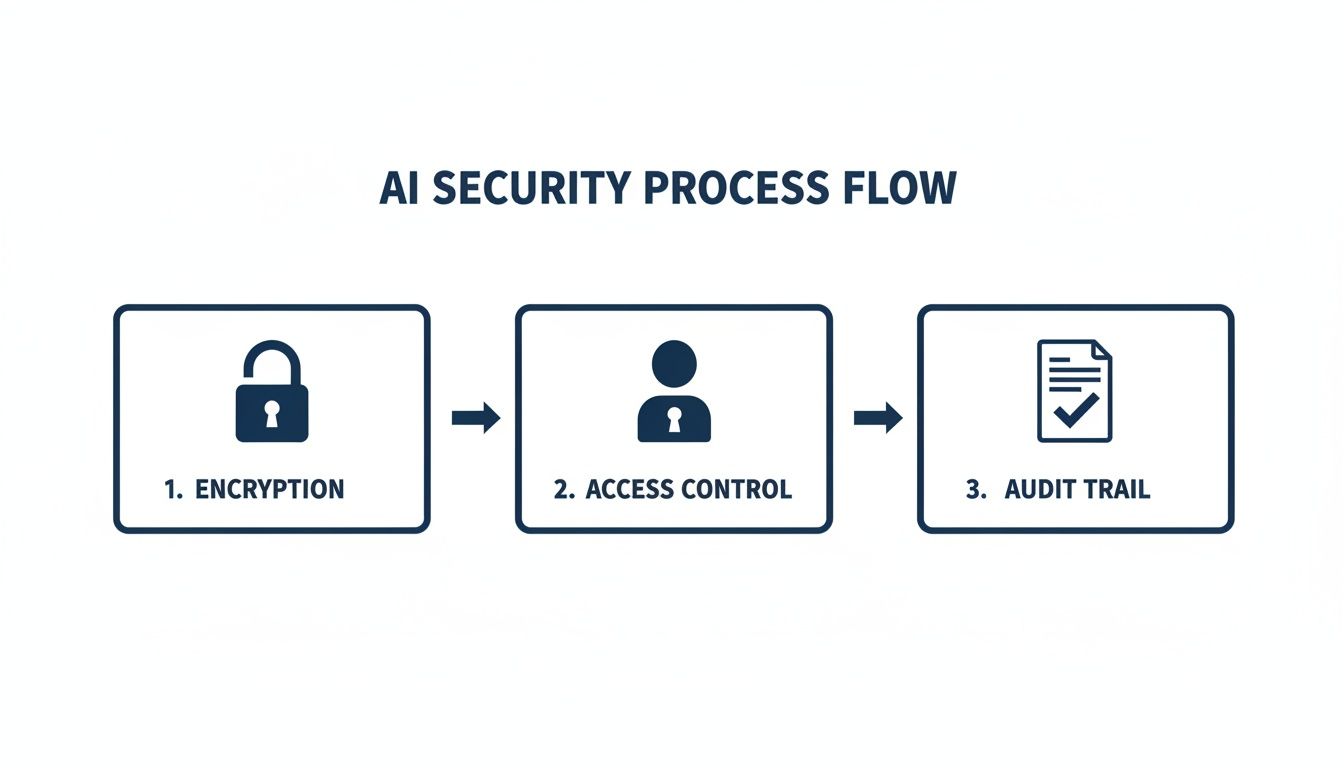
As you can see, a secure AI platform is built on layers of protection, keeping your data safe whether it's stored, being sent, or being accessed.
Finally, don't underestimate the human side of this. You need to manage the change effectively. Communicate the "why" behind the new system—explain how it will get rid of tedious work and free up your teams to focus on more strategic thinking. Offer hands-on training for different roles, celebrate the early wins, and create an open channel for feedback. That’s how you ensure the transition is a smooth one.
Common Questions About AI Contract Management
Even with a clear plan, jumping into a new technology like artificial intelligence contract management is bound to bring up some practical questions. How does it really handle the messy, human elements of legal language? What’s the true cost, and will it actually play nice with the software you already use every day? Let's tackle some of the most common questions we hear from teams vetting these systems.
Answering these helps close the gap between understanding the tech on paper and feeling confident enough to bring it into your workflow.
How Does AI Handle Complex or Non-Standard Contract Language?
This is a big one. It's one thing for AI to find a standard indemnification clause, but what about a bespoke clause you negotiated from scratch? Advanced AI systems use Natural Language Processing (NLP) models that have been trained on millions of legal documents. This teaches them to understand context and nuance, not just hunt for keywords.
While they can instantly recognize standard clauses, the real magic is how they're designed to flag unusual or non-standard language for human review. It essentially raises a hand and says, "Hey, this looks different—you should probably take a closer look."
This "human-in-the-loop" approach gives you the best of both worlds: the raw speed of automation combined with the critical judgment of an experienced legal professional.
The AI acts as a super-fast junior associate, handling 90% of the standard review so that human lawyers can focus their expertise on the 10% of unique, high-risk language that truly requires their strategic input.
Is Implementing AI Contract Management Expensive?
While there's definitely an initial investment, modern SaaS platforms have made this technology far more accessible than it used to be. Many vendors offer flexible pricing based on things like user count or contract volume, so you're not forced into a one-size-fits-all package. A great way to start is with a small pilot project to demonstrate ROI quickly and build a business case for a wider rollout.
When you compare the subscription cost to the hidden costs of manual management—like auto-renewing contracts you meant to cancel, steep compliance penalties, or expensive legal hours spent on administrative tasks—the long-term value of an AI solution often pays for itself many times over.
Can AI Integrate with My Existing Software?
Absolutely. In fact, if a platform can't integrate with your other tools, you should see that as a major red flag. Leading solutions are built with integration in mind. Look for platforms with robust APIs and, even better, pre-built connectors for the tools your business runs on, like your CRM (Salesforce), ERP systems, and even email clients like Outlook.
Seamless integration ensures contract data flows where it needs to go without manual entry. This breaks down the frustrating data silos between departments and creates a single source of truth for all things contract-related, making everyone's job a whole lot easier.
Will AI Replace Lawyers or Contract Managers?
Not a chance. Think of it as a force multiplier, not a replacement. AI is designed to automate the repetitive, low-value tasks that bog down legal professionals—things like digging for specific clauses, tracking down key dates, and managing renewals.
This frees up your team to focus on the high-level strategic work they were actually trained for: complex negotiation, nuanced risk analysis, and building strong client relationships. Ultimately, it empowers your legal team to work faster and more accurately, elevating their role from administrative gatekeepers to indispensable strategic partners.
Ready to transform your legal workflow from manual chaos to intelligent calm? Whisperit is the voice-first AI workspace that unifies dictation, drafting, and collaboration, allowing your team to move from intake to export in fewer steps. Discover how Whisperit can bring clarity and speed to your practice.