
Unlocking Creativity with AI Powered Writing Tools
So, what are we really talking about when we say "AI-powered writing tools"? Forget the basic spellcheckers you're used to. These are intelligent collaborators designed to help you draft, refine, and perfect your content.
Think of it as having a digital co-pilot for writing. This isn't about replacing the writer; it's about giving them a powerful assistant.
What Exactly Are AI-Powered Writing Tools?
Imagine having a co-pilot who has read and understood millions of books, articles, and documents. That’s essentially what an AI writing tool is. It's there to help you navigate the entire writing journey, from sparking that initial idea all the way to polishing the final draft.
The technology behind these tools is called Natural Language Processing (NLP), but you don't need a degree in computer science to use it. Put simply, NLP is what lets the software understand, interpret, and generate text that sounds human. It’s the engine that turns a short command—like "write a follow-up email to a new client"—into a clear, professional message.
From Data to Drafts
So how do these tools get so smart? They are trained on massive amounts of text and code. By sifting through all this information, they learn the patterns, grammar, sentence structures, and subtle stylistic details of how we communicate. This deep learning process is what allows them to help with so many different writing tasks.
They can help you:
- Generate Content: Create anything from a single sentence to a complete article based on your prompts.
- Rephrase Text: Take a clunky or confusing sentence and rewrite it for better clarity, a different tone, or a more engaging style.
- Summarize Information: Condense lengthy reports or articles into short, easy-to-digest summaries, saving you a ton of reading time.
- Check for Errors: Spot and fix grammar, spelling, and punctuation mistakes far more accurately than older tools.
This infographic gives a great visual of how these tools work as a collaborative partner in your writing process.
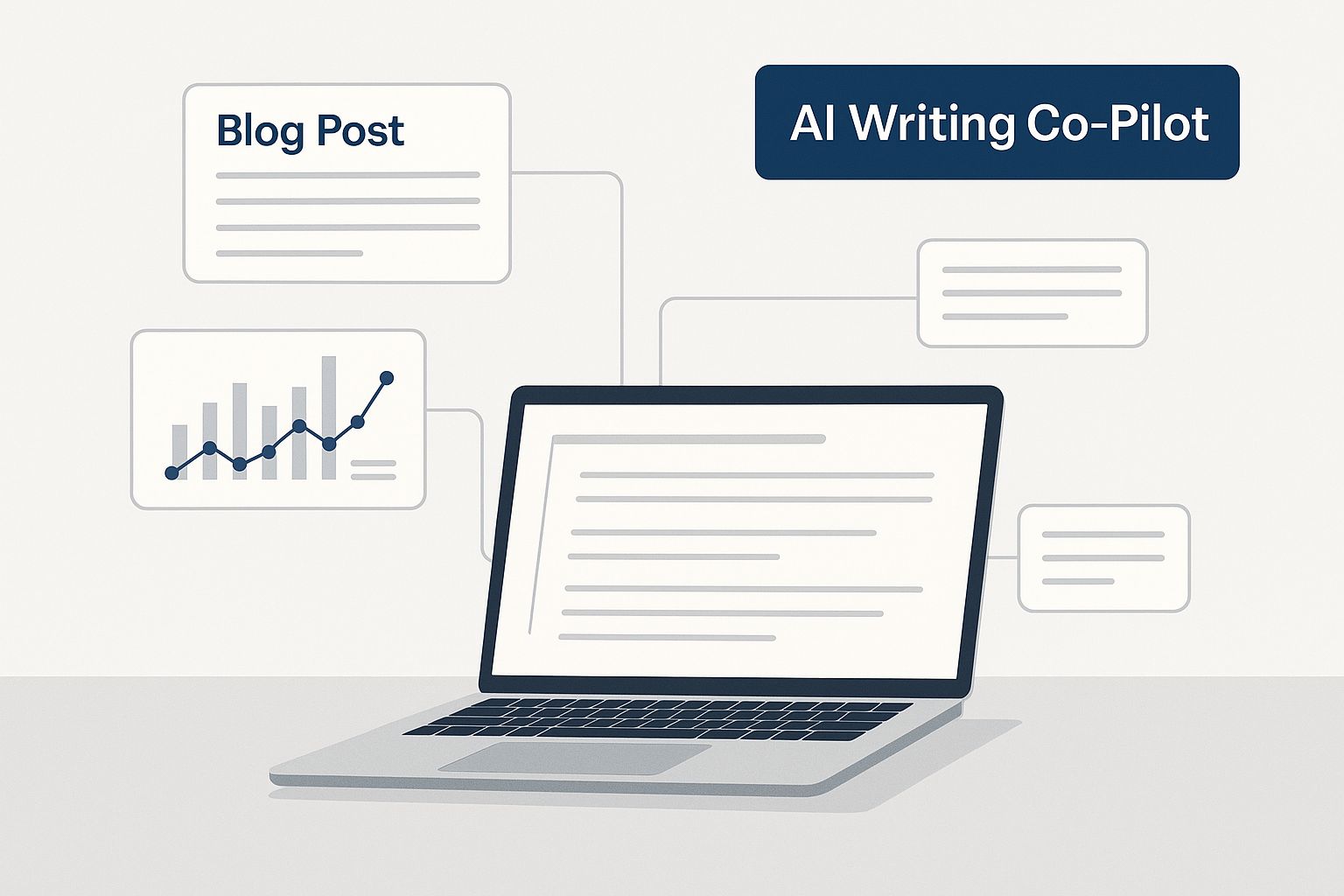
As the visual suggests, the tool acts as a central hub, pulling from different data sources to help you create better content. This growing reliance on AI assistants is driving some pretty incredible market growth.
In fact, the global AI writing assistant market is expected to skyrocket from $65.12 billion to an incredible $2,020.72 billion by 2035. That's a compound annual growth rate of 36.65%. This explosive growth is coming from businesses everywhere looking for a more efficient way to create great content. You can dig into more details about this trend in the full report from Market Research Future.
What Can AI Writing Tools Actually Do?
To get a real handle on what today's AI writing tools bring to the table, it helps to think of them as having three distinct, yet interconnected, roles. Each one tackles a specific part of the writing process, almost like having a specialized assistant on your team. This is what sets them apart from the simple grammar checkers of the past.
At the heart of it all is some pretty sophisticated tech that allows these tools to understand language patterns, context, and even intent. This is the magic that separates modern AI from older, clunkier writing software. You can get a deeper look into the mechanics in our guide on what is natural language processing: https://www.whisperit.ai/blog/what-is-natural-language-processing.
The AI as a Creator
First up, let's talk about the AI's role as a Creator. This is the feature most people think of first. You feed it a prompt—it could be a simple topic, a messy list of bullet points, or even just a question—and it generates original text from scratch. It’s like handing a rough brief to a staff writer and getting a solid first draft back in minutes, not hours.
For instance, you could take a few scattered notes from a team meeting and ask the AI to flesh them out into a well-structured blog post. The Creator function does the initial heavy lifting, turning your raw ideas into coherent sentences and saving you a ton of time. This isn't just for long-form content, either; specialized tools like an AI-powered LinkedIn post generator can whip up social media content in the right format and tone.

The AI as an Editor
Next, picture the AI stepping in as an Editor. And I don't just mean catching typos. This function is all about refining your existing text for tone, style, and clarity. Imagine you've written a dense, technical report, but now you need to explain the key takeaways in a casual company-wide newsletter.
An AI editor can rephrase the entire piece, making it more engaging and easier to digest without watering down the essential information. It's great at suggesting better word choices, trimming down those long, rambling sentences, and helping you maintain a consistent voice across all your communications.
The AI as a Strategist
Finally, the most powerful AI writing tools can act as a Strategist. This is where the tool helps you optimize your content to actually achieve its goal. It goes beyond the words themselves and looks at performance.
It can analyze your writing for readability, give you an estimated reading time, and offer concrete suggestions to make it more audience-friendly. For anything published online, this is a game-changer. The Strategist function can provide SEO feedback, suggest relevant keywords, and analyze your content's structure to improve its chances of ranking on Google. This is how you make sure your great writing actually gets seen.
To pull it all together, here's a quick look at how these features function in practice.
Key Features of AI Writing Tools
This table summarizes the core functionalities you'll find in most AI-powered writing tools and how they fit into the content creation process.
| Feature Category | Primary Function | Common Use Cases |
|---|---|---|
| Content Generation | Creates original text from prompts | Drafting blog posts, writing emails, creating social media updates, brainstorming ideas |
| Paraphrasing & Rewriting | Rephrases existing text for clarity or tone | Simplifying complex topics, adjusting formality, avoiding repetitive language |
| Grammar & Style Checking | Corrects errors and enhances writing style | Proofreading documents, ensuring brand voice consistency, improving readability |
| Summarization | Condenses long documents into key points | Creating executive summaries, generating meeting notes, quickly understanding reports |
| SEO Optimization | Analyzes content for search engine performance | Identifying keywords, optimizing headings and meta descriptions, checking readability scores |
| Tone & Voice Analysis | Adjusts text to match a specific emotional tone | Crafting empathetic customer service replies, writing persuasive marketing copy |
Ultimately, these tools are built to enhance what you do, not take over.
The real power of these tools is in how they augment human skill. By taking care of the tedious, time-consuming parts of writing, AI clears the way for you to focus on big-picture strategy and creative thinking.
How AI Tools Are Boosting Business Productivity

The real power of AI-powered writing tools isn’t just about writing faster. It’s about completely reshaping how businesses get work done. These tools create real-world gains in efficiency and output, letting teams shift their focus from just churning out content to actually driving growth.
Think about your average marketing team. Before an AI assistant, their week was a mad dash to meet deadlines. Countless hours were sunk into drafting social media updates, hammering out first drafts of blogs, and tweaking ad copy. It's the kind of repetitive work that drains creative energy.
Reclaiming Time for High-Impact Work
Now, imagine that same team with an AI writing tool in their toolkit. The AI now handles the heavy lifting of that initial draft. It can spit out a dozen social media captions in minutes or build a solid blog outline from a handful of keywords. This simple change frees up the human writers to do what they do best.
Suddenly, the team has the bandwidth to focus on high-level campaign strategy, dig into customer research, and fine-tune the creative vision—the very things an AI can't touch. They're no longer staring at a blank page. Instead, they’re acting as editors, strategists, and creative directors, guiding the AI’s output to perfection.
This isn’t just a nice idea; it's happening everywhere. AI writing tools are now standard issue in many businesses, with 82% of companies using them for content creation. The impact is huge. Organizations are seeing an average 59% reduction in the time it takes to create content. The result? A staggering 77% increase in content volume in just six months.
From Content Mills to Strategic Hubs
By automating the routine parts of writing, businesses can scale their content without having to scale their headcount. A single writer paired with a capable AI assistant can now manage the content for multiple channels, keeping the brand voice consistent across blogs, emails, and social media.
This efficiency isn't just for marketing. In HR, for example, a simple tool like a free offer letter generator can slash the time it takes to create and send crucial hiring documents.
The core advantage is strategic. AI writing tools elevate human writers from simple producers to high-value thinkers, enabling them to invest their time in work that drives real business growth.
This newfound efficiency is becoming a cornerstone of how modern businesses operate. When you combine human creativity with AI's incredible speed, you build smarter, more agile workflows. If you're looking to apply this idea more broadly, our guide on the best workflow automation tools explores other ways to maximize your team's productivity.
Specialized Uses in Legal and Medical Fields
AI-powered writing tools aren't just for marketers and business generalists. They are carving out a serious role in highly specialized, regulated industries. In worlds like law and medicine, where absolute precision and compliance are non-negotiable, these tools are becoming essential. They help manage mountains of complex information and, crucially, slash the risk of human error.
Imagine a bustling law firm. The team spends an unbelievable number of hours drafting contracts, motions, and emails. A single, tiny inconsistency in a 100-page document can open the door to huge legal risks. AI tools, specifically trained on legal language and precedents, can spot and fix these issues automatically.
Precision and Compliance in Legal Tech
For legal pros, think of AI as the ultimate proofreader—one that never gets tired or bored. It can rip through thousands of documents in minutes, checking that a specific clause is worded the same way every time. It can also condense massive case files into a short, sharp brief that highlights the most important points.
This kind of support frees up legal experts to do what they do best: build a winning strategy.
Here are a few ways it's already happening:
- Contract Drafting: AI can instantly generate standard contracts that follow the firm's templates and legal requirements, cutting drafting time from hours to minutes.
- Document Analysis: It can quickly summarize depositions or discovery documents, pulling out the critical pieces of information you need right now.
- Legal Research: It acts as a powerful assistant, helping find relevant statutes and case law from enormous databases to kickstart the research process.
The biggest win in the legal field is risk reduction. By automating the repetitive, mind-numbing work of drafting and review, AI dramatically lowers the chance of costly mistakes born from simple fatigue or oversight.
Clarity and Efficiency in Healthcare
Medicine has its own documentation nightmare. Accuracy is life-or-death, but so is clarity, especially when talking to patients. An AI writing assistant can take a doctor's dense, technical notes and translate them into plain language for a patient's discharge summary. This simple act closes a major communication gap and helps people get better.
On top of that, the administrative load is a huge driver of physician burnout. AI is making a real difference here. For instance, medical speech recognition lets a doctor simply speak their notes, and the AI transcribes them perfectly into the patient's electronic health record.
This doesn't just save a ton of time; it ensures every detail is captured accurately, right when it happens. To see how this works in practice, you can explore our detailed guide on the role of medical speech recognition.
How To Choose The Right AI-Powered Writing Tool
With so many AI writing tools out there, picking the right one can feel overwhelming. The secret is to cut through the noise and focus on what you actually need it to do.
Start by asking a simple question: What's the main job I need this tool for? Are you trying to draft in-depth articles, whip up quick social media posts, or make sure your technical documents are airtight? Your answer is the single most important filter.
A content marketer chasing SEO rankings will need a tool that understands keywords and search intent. A lawyer, on the other hand, needs something with rock-solid security and templates built for legal precision.
First, Define What You Really Need
Before you even start looking at brand names, map out what a "win" looks like for you. Think about these core elements to build your personal checklist.
- Your Main Job-To-Be-Done: What's the number one task you'll give this tool every day? Is it drafting blog posts, summarizing long reports, writing emails, or something else entirely?
- Workflow Integration: Does it need to play nicely with the other software you use? Think WordPress, Google Docs, or whatever project management tool your team lives in. Smooth connections are a huge time-saver.
- Budget and Pricing: Are you looking for a free option to get started, or are you ready for a subscription with all the bells and whistles? Some tools even offer a pay-as-you-go model.
Once you have clear answers, you can evaluate your options with purpose. For a closer look at specific platforms, check out our guide on the best AI tools for content creation.
Compare The Market And Key Features
The AI writing space is crowded, but a few major players shape the industry. OpenAI is a big one, holding a 28% market share and often serving as the engine behind tools for specialized fields like law and healthcare. Right behind are Anthropic at 17% and Microsoft at 14%, which is weaving AI into its everyday office software. Knowing who powers what gives you a better sense of the technology you're adopting. You can learn more about the rise of AI writers to see how the market is evolving.
Choosing the right tool is a personal decision. A powerful, standalone platform might be perfect for one person, while a simple browser extension for quick proofreads is all another needs.
Here's a breakdown of what to weigh when you're making your choice.
Criteria for Selecting an AI Writing Tool
A comparison of key factors to consider when choosing an AI writing tool to ensure it meets your specific requirements.
| Selection Criterion | What to Look For | Why It Matters |
|---|---|---|
| Accuracy & Quality | Consistently high-quality, factual, and coherent output. Minimal "hallucinations." | The tool should be a reliable assistant, not a source of errors that you have to spend time correcting. |
| Ease of Use | An intuitive interface that feels natural to you and doesn't require a steep learning curve. | You'll only use a tool if it fits seamlessly into your workflow. Complicated software often gets abandoned. |
| Customization | The ability to set custom tones, styles, or build templates for your specific needs. | A generic voice won't work for everyone. Customization lets you make the AI's output sound like you. |
| Security & Privacy | Clear data privacy policies, especially regarding how your inputs are used and stored. | This is non-negotiable for professionals handling sensitive client or patient information. |
| Integration | Compatibility with your existing software stack (e.g., CRM, CMS, word processors). | Good integration prevents the headache of constantly copying and pasting between different applications. |
| Pricing & Value | A pricing plan that matches your usage level and provides a clear return on investment. | Don't pay for features you'll never use. The best value comes from a tool that solves your specific problems affordably. |
The right tool isn't necessarily the one with the most features. It's the one that fits your workflow so well that it feels like a natural extension of your own skills.
Ultimately, a side-by-side comparison based on these factors will lead you to an AI assistant that genuinely helps you work better, not just faster.
Weaving AI Smartly Into Your Workflow
To get the most out of AI-powered writing tools, you need to stop thinking of them as vending machines for content. A much better approach is to treat your AI as a creative partner—a very fast, but sometimes naive, assistant.
The best human-AI collaborations are built on a handful of smart practices that keep the final work high-quality, accurate, and truly yours. Think of it like a pilot’s pre-flight checklist that you run through for every single writing project.
It all begins with learning how to write a great prompt. If you give the AI vague instructions, you're going to get generic, uninspired results back. Instead, you need to be crystal clear. Provide detailed context, tell it who the audience is, define the exact tone you're aiming for, and feed it the key points or keywords it needs to include. A detailed prompt is the flight plan for your AI co-pilot.
The Human Touch in an AI World
Even with the most perfectly crafted prompt, what the AI gives you back is just a first draft. It's a solid starting point, but it's not the finish line. This is where your expertise, your critical eye, and your unique voice become absolutely essential.
No matter what, your process must include these non-negotiable steps:
- Fact-Check Everything: AI tools can, and often do, make things up with complete confidence. This is often called a "hallucination." It's your job to verify every single statistic, name, date, or factual claim against trustworthy sources before you even think about publishing.
- Edit for Your Voice: The AI has no idea what makes your brand's personality unique. You have to go in and inject your specific style, sense of humor, and perspective into the text. This is what transforms a generic article into content that actually connects with people.
- Be Open and Honest: Be transparent about how you're using AI. Whether it’s for an internal company policy or a public blog post, being upfront about your process builds trust and manages expectations with your audience.
Thinking about these tools as "augmentation" rather than "automation" is the right mindset. The real goal is to responsibly combine the AI's incredible speed with your strategic oversight, creating work that's both efficient and excellent.
By following these guidelines, you can build a smooth digital document workflow that makes you more productive without letting your quality slip.
Remember, the final sign-off is always on you. You're the one ensuring that every piece of content that goes out the door is polished, accurate, and a genuine reflection of your brand. That careful, deliberate integration is what separates smart AI use from lazy automation.
Still Have Questions? Let's Clear a Few Things Up
Even after you get the hang of AI-powered writing tools, a few practical questions almost always pop up. Let's tackle some of the most common ones so you can feel confident putting these assistants to work.
Can AI-Generated Content Pass a Plagiarism Check?
This is the big one, and for good reason. The short answer is yes, but it's not that simple.
AI models are built to create statistically unique sentences, so they aren't just copying and pasting from the web. Because of this, the text they produce will almost always sail through a standard plagiarism checker.
But here’s the catch: the AI learned from all that existing online content, so it can sometimes sound a little too close to its sources without meaning to. The best way to handle this is to treat the AI draft as just that—a draft. Always run it through a good plagiarism tool, but more importantly, rework the text to inject your own voice, expertise, and fresh ideas. That's how you guarantee it's truly original.
Will Using an AI Writing Tool Hurt My SEO?
This is a common fear, but you can relax. Search engines like Google don't penalize content just because an AI helped write it. What they care about now, more than ever, is high-quality content that genuinely helps the reader. It's the final product that matters, not the tool you used to create it.
If you try to use an AI writer to churn out hundreds of generic, low-effort articles, you can bet your rankings will take a hit. But if you use it as a partner to research topics, outline ideas, and polish a piece of content that truly serves your audience, it can be a massive boost to your SEO efforts.
The goal isn't just to automate content creation. It's to use AI to create better content for the human beings on the other side of the screen.
How Secure Is the Information I Type In?
Data security is a huge deal, especially if you're working with confidential business information. The truth is, security levels can differ wildly between tools. It is absolutely critical to read the data privacy policy of any tool before you start feeding it sensitive material.
Many free or consumer-focused tools might use your prompts to train their models, which is a non-starter for most professionals. If you're in a field like law or healthcare, you need to look for enterprise-grade ai powered writing tools that offer serious security features. Think end-to-end encryption, clear data-handling policies that align with GDPR, and a commitment not to use your data for training.
Whisperit is the voice-first AI workspace built for legal work, offering Swiss/EU hosting and GDPR-aligned controls to keep your sensitive data secure. Unify dictation, drafting, and research by visiting the official Whisperit website.