
A Guide to AI Legal Research Tools
AI legal research tools are specialized software built to help legal professionals dig through enormous legal databases, pinpoint relevant case law, and automate the grunt work of research—all at a speed that's impossible to match by hand. This isn't just about faster keyword searching; it's a fundamental change in how we find and understand legal information, delivering far more accurate and context-aware results.
From Law Books to Language Models

Picture a lawyer buried in a law library, surrounded by towers of dusty books, manually flipping through thousands of pages for one crucial precedent. For generations, this was the reality of legal work—a slow, expensive, and error-prone process. With the sheer volume of modern case law and statutes, you could never be 100% certain you hadn't missed a key ruling that could decide your case.
This is the exact problem that AI legal research tools were built to solve.
The Shift to Conceptual Understanding
Old-school legal databases were pretty literal. They found what you typed, relying on exact keyword matches. Modern AI platforms, however, act more like a seasoned research assistant who understands what you mean, not just what you say.
They use sophisticated algorithms, including natural language processing, to grasp the context behind your query. So, instead of just hunting for the phrase "breach of contract," the AI can identify documents discussing related ideas like "failure to perform" or "non-compliance with terms," even if your exact words never appear.
This transition from keyword matching to conceptual analysis is the single most important upgrade AI brings to legal research. It uncovers relevant information that would otherwise remain hidden, providing a more complete picture of the legal landscape.
A New Foundation for Legal Work
This big step forward is powered by the same kind of technology found in many mainstream AI applications: large language models. If you're curious about the mechanics, it's worth checking out A Plain English Guide to AI Language Models to see how they work under the hood.
The legal world is taking notice. The global legal AI market, valued at USD 1.9 billion in 2024, is expected to explode to USD 7.4 billion by 2035. This isn't just a shiny new tool; it's a foundational change in how law is practiced in the modern era.
How AI Legal Research Actually Works

When you get right down to it, AI legal research tools are like having a brilliant, infinitely fast legal associate who can read and connect ideas, not just words. They don't just scan for keywords; they dig into the meaning behind the text, understanding the intricate web of concepts, relationships, and precedents buried in millions of documents. This isn't magic—it's a symphony of powerful technologies working together.
The first piece of the puzzle is Natural Language Processing (NLP). Think of NLP as the technology that teaches a computer to understand human language, with all its context and subtlety. It’s what allows you to ask a question in plain English, whether it's a simple phrase or a detailed case scenario, and have the tool grasp what you're actually looking for.
This is the fundamental shift away from the old way of doing things. Instead of just matching the exact words you typed, the AI understands the legal principles you're trying to explore.
From Keywords to Concepts
That brings us to the second pillar: semantic search. We've all been frustrated by traditional search engines that are painfully literal. You search for "automobile accident liability," and you get documents with that exact phrase, missing countless relevant results.
Semantic search is different. It hunts for meaning. The AI knows that "car crash responsibility," "driver negligence in a collision," and "fault in a motor vehicle accident" are all part of the same conceptual family. It’s this ability to connect ideas, not just match text, that uncovers critical cases and statutes a keyword search would completely overlook. If you want to dive deeper into this, our guide on semantic search vs. keyword search breaks it all down.
The Learning Engine
Finally, machine learning (ML) is what makes the whole system smarter over time. Picture a junior associate who gets sharper with every case they work on—that’s ML in a nutshell. The more data the AI processes, the better it gets at its job. It learns to:
- Spot hidden patterns in judicial reasoning.
- Anticipate which documents will be most helpful based on past queries.
- Fine-tune its understanding of legal jargon as it varies from one court to another.
These three technologies—NLP for understanding, semantic search for finding, and machine learning for constant improvement—are the engine of modern AI legal research. They work in tandem to give you results that are not just faster but profoundly more relevant.
For example, when you ask an AI tool to give you the gist of a 50-page judicial opinion, it’s using NLP to read and comprehend the entire document. It then pinpoints the most crucial sentences—the holding, the court's reasoning, the key facts—to create a concise summary. It's no wonder that a recent report found 74% of legal professionals are already using AI for exactly this kind of document analysis.
These systems are designed to turn overwhelming walls of text into clear, actionable intelligence, helping you build better arguments with more speed and confidence than ever before.
How AI Actually Helps Your Practice
It’s one thing to understand the mechanics of AI legal research tools, but it’s another to see how they can genuinely reshape a law practice. The benefits aren't just small tweaks here and there; we're talking about a fundamental shift in how you work, improving your efficiency, accuracy, and even your strategic edge.
Think about it. These tools automate the most draining, time-consuming parts of legal work. This frees you and your team to focus on the things that actually require human intellect and intuition: building a compelling argument, advising clients, and ultimately, winning cases.
What if you could shrink the time spent researching a complex motion from a full day down to less than an hour? This isn't just a hypothetical scenario; it’s happening right now in firms that have embraced this technology. All that saved time translates directly into a more productive practice, letting your team take on more clients or dive deeper into high-stakes strategic planning.
The legal world is already moving in this direction. A recent report from NexLaw.ai found that 79% of law firm professionals are already using AI tools in their day-to-day work, showing just how mainstream this shift has become.
A Serious Boost in Efficiency
The first thing you’ll notice is the incredible speed. An AI can sift through millions of documents—case law, statutes, scholarly articles—in the time it takes you to grab a coffee. A human team could spend weeks on the same task.
This newfound speed touches nearly every part of your workflow:
- Faster Document Review: Instead of manually reading through thousands of discovery documents, AI can pinpoint the relevant clauses and data points almost instantly.
- Quick Summaries: You can get the gist of a long, dense judicial opinion in a concise, easy-to-read summary.
- Drafting Head Start: The AI can generate a solid first draft of a legal memo or brief in minutes, giving you a strong foundation to build on.
Ultimately, this efficiency means quicker results for your clients and far fewer non-billable hours spent on tedious, foundational research. To see how these pieces fit together, check out our strategic guide to the AI legal assistant for modern law practices.
Better Accuracy and Less Risk
Let’s be honest: humans make mistakes. It’s unavoidable. In legal research, overlooking a single key precedent can derail your entire case. AI tools drastically reduce this risk by running exhaustive searches that a person simply couldn't replicate. They don't get tired, they don't skim, and they can spot conceptual links that a simple keyword search would never find.
Think of AI as a powerful safety net. It ensures your legal arguments are built on the most solid, comprehensive, and current foundation possible. This doesn't just make your case stronger; it protects you from the risk of a critical oversight.
To really understand the difference, let’s look at a side-by-side comparison. The table below shows just how stark the contrast is between the old way of doing things and the new AI-powered approach.
Traditional vs AI-Powered Legal Research A Comparison
| Metric | Traditional Research Method | AI Legal Research Tool |
|---|---|---|
| Time to Completion | 10-15 Hours (avg.) | 1-2 Hours (avg.) |
| Cost | High (billable hours) | Moderate (subscription fee) |
| Risk of Missing Precedent | Moderate to High | Very Low |
| Scope of Search | Limited by keywords | Comprehensive and conceptual |
| Consistency | Varies by researcher | Consistently thorough |
As you can see, the improvements aren't minor. The data makes a compelling business case for adoption, highlighting tangible gains in time, cost, and overall reliability.
Choosing the Right AI Legal Research Tool
Picking the right AI legal research tool feels a lot like hiring a new associate. You can’t just go by the resume; you have to see what they can actually do. With a growing number of platforms popping up, the key is to zero in on the features that will actually make a difference in your day-to-day work and give you a solid return on your investment.
It's easy to get lost in a checklist of features. But what do they mean in practice? A platform might advertise "semantic search," but what does that do for you? It means the tool thinks conceptually, not just in keywords. If you're researching a case about a "faulty braking system," a good semantic search will also surface rulings on "defective calipers" or "failed master cylinders"—connections a traditional keyword search would almost certainly miss. That's the kind of practical advantage you should be looking for.
Core Capabilities to Evaluate
When you're sizing up different AI legal tools, focus on the functions that eat up the most hours in your practice. Start by looking at these fundamentals:
- Automated Case Summarization: This is a huge time-saver. Instead of spending 30 minutes wading through a dense opinion, the AI can give you the core holding, key facts, and judicial reasoning in a matter of seconds.
- Argument Analysis: Some of the more sophisticated tools can scan a brief or motion, pull out its central legal arguments, and then find cases that either support or oppose them. This is incredibly helpful for anticipating counterarguments and shoring up your own position.
- Judicial Analytics: This is all about data-driven insights. You can get a breakdown of a specific judge's history—how they’ve ruled on similar motions, their go-to citations, and even the type of language they prefer. It’s a real strategic edge.
Focusing on these high-impact features ensures you’re solving the biggest bottlenecks in your research process. It’s not about finding a tool with the longest feature list; it’s about finding one with the right features that bring real efficiency.
Beyond the Basics: Essential Considerations
Once you've confirmed the core research functions are solid, a few other factors will tell you if a tool is really the right fit for your firm. These are the details that separate a good tool from a great one.
First, take a hard look at the user interface (UI). A powerful tool is worthless if it’s a pain to use. You want a clean, intuitive design that your team can pick up without needing weeks of training. Always take advantage of free trials and demos to get a real feel for the platform. For a broader overview of what's out there, our guide to legal artificial intelligence software offers more context.
Next up is the scope and quality of the database. Does the platform draw from a comprehensive, up-to-date library of cases, statutes, and secondary sources that are relevant to your jurisdiction? This is especially critical for specialized practices. For instance, a firm in Mumbai would need a dedicated AI Legal Research Tool for India to effectively navigate its unique legal framework.
Finally, don't overlook integration capabilities. The best tools don't exist on an island. They should connect smoothly with your existing case management software, document editors, and other firm-wide systems. This creates a unified workflow, preventing the constant, time-wasting task of jumping between different applications. The goal is for the AI to feel like a natural part of your process, not just another platform to manage.
Integrating AI into Your Legal Workflow
Bringing a new piece of technology into a law firm is more than just buying a license. If you simply drop powerful ai legal research tools into your team's laps without a clear plan, you're setting yourself up for confusion, low adoption, and wasted investment. The key is a smart, deliberate approach.
The goal isn't to disrupt your firm's daily operations but to weave these new tools into them seamlessly. This means getting ahead of the common roadblocks: user training, data security concerns, and ethical questions. The most successful rollouts I've seen always start small, prove their worth in a controlled setting, and then expand from there.
Launching a Pilot Program
Instead of trying to get everyone on board at once, start with a focused pilot program. Pick one practice area and a small, dedicated team. This gives you a sandbox to test the tool, gather honest feedback, and build a powerful internal case study. The best candidates for a pilot are tech-friendly teams with a heavy research workload, like litigation or intellectual property.
In this initial phase, don't try to do everything. Focus on a couple of high-impact tasks. For instance, have the pilot team use the AI tool exclusively for their initial case law research or for summarizing lengthy deposition transcripts. This makes it easy to measure real-world improvements in speed and efficiency.
A well-executed pilot program does more than just test software; it creates internal champions. When colleagues see a team saving hours on research and building stronger arguments, adoption becomes a pull, not a push.
Building Practical Training and Protocols
Forget generic, one-size-fits-all training sessions—they rarely stick. Your training needs to be grounded in the real world of your attorneys. Build your sessions around an actual case or motion they're working on. When they learn how to use the tool in the context of their own work, the value clicks into place almost immediately.
This process flow infographic shows the basic steps of using AI legal research tools, from searching and summarizing to analyzing the results.
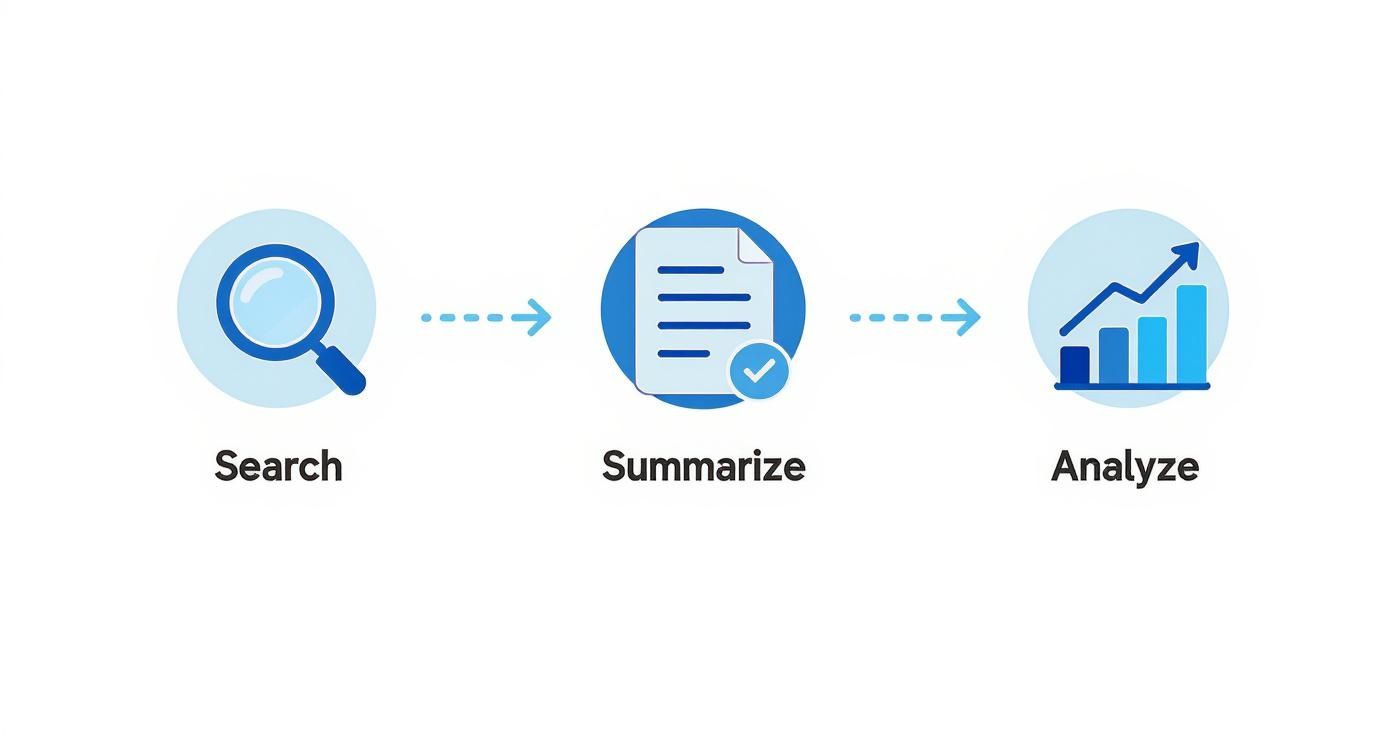
As you can see, this isn't just a search engine. Each step logically builds on the last, helping you turn a mountain of data into sharp, actionable insights for your case.
Alongside hands-on training, you absolutely must establish clear protocols for ethical use and data security. Every single person on your team needs to understand their responsibility to double-check AI outputs and protect client confidentiality. Your guidelines should be unambiguous and cover:
- Fact-Checking: Make it a non-negotiable rule that all AI-generated citations and legal assertions are verified against primary sources. No exceptions.
- Confidentiality: Forbid entering any sensitive or client-identifying information into the platform unless you are 100% certain it meets your firm's security and privacy standards.
- Oversight: Reinforce that AI is a research assistant, not a lawyer. The final legal analysis and judgment always rests with the attorney.
By taking a structured approach—starting with a pilot, delivering relevant training, and setting firm rules—your firm can bring AI tools into its workflow smoothly. You'll sidestep the common pitfalls and start tapping into their true potential to elevate your practice.
Your Questions About AI Legal Research, Answered
Jumping into new technology always brings up questions, and that’s a good thing. When it’s something as fundamental as legal research, you need to be completely confident in your tools. Let's tackle the most common concerns and questions legal professionals have about AI legal research tools.
We'll get straight to the point, addressing everything from reliability and security to whether making the switch actually makes financial sense. My goal here is to clear up any lingering doubts so you can see exactly where this technology fits into your practice.
Can You Really Trust AI Legal Research Tools?
Yes, but with a crucial caveat: they work best under professional supervision. The leading AI platforms are trained on enormous, verified legal databases, which makes them remarkably good at digging up relevant case law and statutes. Their true strength is their speed and sheer scope—they often spot precedents a human researcher might overlook.
But let's be clear: AI is meant to enhance a lawyer's expertise, not replace it. Think of it as the most brilliant research assistant you've ever had. It can find the documents, but the final interpretation, the strategic thinking, and the application of that knowledge still belong to you, the legal expert.
How Do These Tools Handle Client Confidentiality?
Top-tier AI legal platforms are built from the ground up with security in mind. They rely on end-to-end encryption, secure cloud infrastructure that meets standards like SOC 2, and tight access controls to keep sensitive information locked down. When you’re looking at any tool, make sure you review its data privacy policies and security certifications.
A critical feature to look for is a "closed" or "private" environment. This guarantees that any documents you upload for analysis are never, ever used to train the public AI model. It’s a non-negotiable for protecting client confidentiality and upholding your ethical obligations.
If you want to dig deeper into the frameworks that ensure AI is used responsibly, you can find a lot more information on AI governance best practices and see how modern platforms handle this responsibility.
What's the Real ROI on an AI Legal Research Tool?
The return on investment shows up most obviously in one place: time. By slashing the hours spent on research, lawyers are free to take on more billable work or dedicate their energy to the kind of high-level strategy that wins cases. That shift alone is a huge value driver.
Of course, pricing models vary—some are monthly subscriptions, others are based on usage—but the ROI goes well beyond just saving time. It also means:
- Minimizing Risk: You drastically lower the chances of missing a key precedent that could derail your entire case.
- Building Stronger Cases: You get access to a much wider array of supporting arguments and documents.
- Boosting Your Firm's Reputation: You can deliver faster, more thorough work, which clients always notice.
Are AI Legal Tools a Good Fit for Small Firms?
Absolutely. In many ways, AI can be the great equalizer for smaller practices. Many AI companies now offer flexible, scalable pricing plans specifically for small firms and solo practitioners, putting these powerful tools within reach for everyone.
For a smaller team, the efficiency gains are even more profound. AI lets you compete head-to-head with larger, better-resourced firms. It levels the playing field, giving you access to the kind of sophisticated research power that used to require a massive budget and a dedicated support staff.
Ready to see how a voice-first AI workspace can transform your legal workflow? Whisperit unifies dictation, drafting, and research to help you move from intake to export in fewer steps. Start your free trial today.