
AI for Legal Research A Practical Guide
At its core, AI for legal research is simply software designed to make the painstaking process of digging through legal databases faster and more intuitive. Think of it as a highly intelligent assistant, built to help legal pros pinpoint relevant case law, statutes, and documents in a fraction of the time it used to take.
This isn't about replacing lawyers. It's about equipping them with better tools so they can work smarter, not harder.
The New Reality of Legal Research with AI

Welcome to a new era in legal work. The conversation around AI can get lost in hype, but for legal research, its value is incredibly practical. It's a smart assistant built to automate the most grueling parts of sifting through massive volumes of legal information.
Imagine traditional research is like wandering through a colossal library, pulling dusty books off shelves, hoping to stumble upon the one precedent you need. Now, picture having a guide who has already read every book and can instantly hand you the exact page you're looking for. That’s the difference AI makes.
Unlocking Efficiency and Deeper Insights
The true power of AI for legal research comes from its ability to solve some of the oldest headaches in the legal profession. It goes way beyond simple keyword searches to actually understand the context and intent behind your query, which means the results you get are far more relevant.
AI directly tackles these common challenges:
- Slashing Research Time: An AI platform can tear through thousands of documents, cases, and statutes in minutes—a job that could easily take a human researcher days or even weeks.
- Minimizing Human Error: When you’re manually reviewing mountains of files, it’s easy to miss something crucial. Automation drastically reduces the risk of overlooking a key piece of information.
- Uncovering Hidden Connections: These sophisticated algorithms can spot subtle patterns and links between cases that a person might never notice.
This isn't just a small step forward; it's a fundamental shift in how legal work gets done. By handling the low-value, repetitive tasks, AI gives legal professionals their time back to focus on high-level strategy, client advice, and building a winning argument.
This adoption is part of a much bigger picture. To get a sense of the scale of this change, it helps to understand the AI revolution in business and how it's reshaping entire industries.
From Early Days to Widespread Adoption
The legal field is in the middle of a massive tech upgrade. Just look at the numbers: one Legal Industry Risk Index report found that AI adoption jumped from 22% to a staggering 80% in a single year. That’s more than a threefold increase, showing we've moved past curiosity and into strategic, firm-wide implementation.
This shift is changing how law firms operate from the ground up, making technology a non-negotiable part of a successful practice. Powerful tools are no longer a luxury for big firms—they’re essential for staying competitive.
You can explore our own guide on how AI for law is creating new opportunities for legal teams of all sizes. This isn't some far-off trend; it’s happening right now, setting a new standard for what it means to practice law.
How AI Is Reshaping Daily Legal Workflows

Let's move beyond the theoretical and look at how this technology is actually changing the day-to-day grind for legal professionals. AI for legal research isn't some far-off concept anymore; it's a practical tool that’s already embedded in the modern legal workflow, delivering some serious efficiency gains.
The real story is in the "before and after." Tasks that once ate up weeks of manual effort can now be knocked out in a fraction of the time. This shift allows lawyers and paralegals to spend less time on tedious legwork and more time on the high-value strategic thinking that actually wins cases.
Automated Case Law Analysis
Think back to the old way of finding relevant case law. It was a tedious slog of crafting complex keyword searches, wading through hundreds of irrelevant results, and hoping you didn't miss that one obscure but critical precedent.
Now, AI-powered platforms get what you’re asking for. A lawyer can pose a complex question in plain English, like, "Find cases in the Ninth Circuit where a software patent was invalidated due to prior art." The AI understands the intent behind the query and instantly pulls up a prioritized list of relevant decisions. A key part of this magic is the system's ability to use advanced AI text classification to accurately categorize and interpret legal documents.
This is worlds away from just matching keywords. The technology actually grasps the legal concepts and relationships at play. To get a better handle on this, check out our guide on https://www.whisperit.ai/blog/semantic-search-vs-keyword-search, which breaks down the core differences.
Intelligent Document Review
The change in document review, especially during e-discovery, is nothing short of dramatic. Traditionally, this meant armies of attorneys manually combing through thousands—sometimes millions—of documents, searching for that one "smoking gun."
It was an incredibly expensive, mentally draining process where a single moment of lost focus could mean overlooking a case-critical piece of evidence.
Today, AI tools can tear through an entire document trove in minutes. They can:
- Pinpoint Relevant Documents: The AI flags files connected to key topics, people, or events with remarkable accuracy.
- Detect Privilege: It can automatically identify and redact privileged information, saving a huge amount of time.
- Uncover Key Themes: AI can even analyze communication patterns to highlight the core themes emerging from a massive dataset.
This isn't just a niche trend. According to a recent Thomson Reuters report, 77% of legal professionals now use AI for document review, and 74% lean on it for legal research. This boost in productivity is estimated to save lawyers nearly 240 hours annually—that's about six full work weeks.
By taking over these foundational tasks, AI for legal research isn't just making workflows faster; it's making them smarter. This newfound efficiency frees up legal experts to do what they do best: build compelling arguments, advise clients, and develop winning strategies. The focus finally shifts from just finding information to using it.
Choosing the Right AI Legal Research Tools
Now that we've seen how AI can reshape legal workflows, the next step is figuring out which tools are actually worth your time and money. It's easy to get lost in a sea of marketing buzzwords. The trick is to ignore the hype and focus on a simple question: what specific, high-value problem in my practice am I trying to solve?
Think of it like building a specialist’s toolkit. You don’t need one massive, overly complicated machine that claims to do everything. Instead, you need a curated set of instruments, each perfect for the job at hand.
Platforms for Natural Language Search
This is usually the entry point for most legal professionals dipping their toes into AI. These platforms are a massive leap from the old-school keyword searches we’re all used to. They use Natural Language Processing (NLP) to understand what you’re actually asking, not just the specific words you type.
Instead of wrestling with Boolean operators and rigid search strings, you can ask a complex question in plain English, almost like you're talking to a senior associate. A query like, "What's the precedent for dismissing a case in California superior court because of improper service?" will pull up direct, on-point results.
These tools are great for:
- Conceptual Search: Finding documents based on legal ideas, even if they don't use your exact terminology.
- Case Summarization: Generating quick, digestible summaries of dense judicial opinions.
- Identifying Key Precedent: Sifting through thousands of cases to find and rank the most influential ones for your argument.
This alone can be a game-changer. Some estimates suggest AI can slash the time spent on research for a typical litigation matter from over 17 hours down to just 3–5 hours.
Predictive Analytics Tools
Ready to go a level deeper? That's where predictive analytics comes in. These tools are less about finding what the law is and more about forecasting what might happen next. They comb through enormous datasets of past case outcomes, judicial rulings, and even the tendencies of specific judges to spot patterns.
A predictive analytics tool is like having a data-savvy strategist on your team. It gives you objective insights to sharpen your case strategy, helping you move from simply reacting to precedent to actively anticipating outcomes.
For example, a tool might analyze a particular judge’s track record on intellectual property cases to predict how likely they are to grant an injunction. This kind of insight is invaluable for setting realistic client expectations, evaluating settlement offers, and making smarter litigation decisions.
E-Discovery and Document Management Software
For anyone involved in litigation, the document dump during discovery is a familiar nightmare. AI-driven e-discovery platforms are built to tackle this head-on, automating the most grueling parts of the review process. What once took a team of associates weeks can now be handled far more efficiently.
These systems can tear through millions of documents—emails, contracts, Slack messages, you name it—and intelligently flag them for relevance, privilege, or key topics. They can uncover hidden relationships between people and even detect sentiment, helping you find that one critical "smoking gun" document in a fraction of the time.
As legal professionals explore these powerful capabilities, understanding the full spectrum of legal search solutions is crucial for building an efficient, modern practice.
To make sense of these options, it helps to see them side-by-side. Each category serves a distinct purpose, and the best choice depends entirely on the task you're facing.
Comparison of AI Legal Research Tool Categories
| Tool Category | Core Function | Primary Use Case | Example Task |
|---|---|---|---|
| NLP Search Platforms | Understands and answers complex legal questions posed in plain English. | Foundational case law and statutory research. | Asking, "Find federal cases where a motion to dismiss was granted in a breach of contract dispute." |
| Predictive Analytics | Analyzes historical data to forecast case outcomes or judicial behavior. | Litigation strategy, risk assessment, and settlement negotiations. | Assessing the probability of a favorable ruling from a specific judge on a motion for summary judgment. |
| E-Discovery Platforms | Automates the review, categorization, and analysis of massive document sets. | Document-heavy litigation, internal investigations, and compliance audits. | Identifying all privileged communications between a CEO and in-house counsel within a 2TB dataset. |
Ultimately, the goal isn't just to buy "AI," but to invest in a solution that solves a real-world bottleneck in your firm's day-to-day operations. Whether it's foundational research, strategic foresight, or document analysis, there's a tool built for the job.
A Step-By-Step Guide to Implementing AI
Bringing AI for legal research into your practice doesn't have to feel like a massive undertaking. With a structured approach, you can turn a potentially overwhelming transition into a series of manageable steps.
The key is to start small by identifying a real problem and building from there. This ensures the technology serves your team, not the other way around.
Think of it like renovating a house. You wouldn't tear down all the walls at once. Instead, you'd pick one room—maybe the kitchen that causes the most daily headaches—and get it just right before moving on to the rest of the house.
Start With Your Biggest Pain Points
Before you even look at a single software demo, take a hard look at your firm’s current operations. Where are the biggest bottlenecks? Where does work grind to a halt? Pinpointing these friction points is the most crucial first step, as it gives your AI adoption a clear purpose.
Don't just guess. Talk to your associates, paralegals, and support staff to get a ground-level view of their daily frustrations.
Common hang-ups where AI can offer a quick win include:
- Time-Consuming Research: Are junior associates burning too many billable hours on foundational case law research that could be done faster?
- Document Review Overload: Does the e-discovery process consistently bog down your litigation teams and drive up client costs?
- Drafting Inconsistencies: Is it a constant battle to make sure every motion, contract, or brief adheres to firm standards and formatting?
Once you’ve zeroed in on the biggest time-sink, you have a clear target. This focused approach helps ensure your first AI project delivers a measurable return, which makes getting buy-in for future initiatives a whole lot easier.
Select the Right Tool for the Job
With your problem clearly defined, you can start evaluating potential tools. When you're looking at different AI platforms, try to see past the flashy marketing and focus on the practical, day-to-day reality of using the software.
Here are three factors that should be at the very top of your checklist:
- Data Security and Confidentiality: This is non-negotiable. Any vendor you consider must offer robust encryption, comply with data privacy regulations like GDPR, and be completely transparent about how they handle your data. Client confidentiality is everything.
- Integration with Existing Systems: A shiny new tool that doesn’t play well with your current document management or practice management software will just create new headaches. Look for tools that promise seamless integration.
- User-Friendliness: If the software isn't intuitive, your team simply won't use it. The best tools are designed to fit naturally into a lawyer’s workflow, not force them to learn a complex new process from scratch.
This infographic gives a good overview of the core processes that many modern AI legal tools can help with.
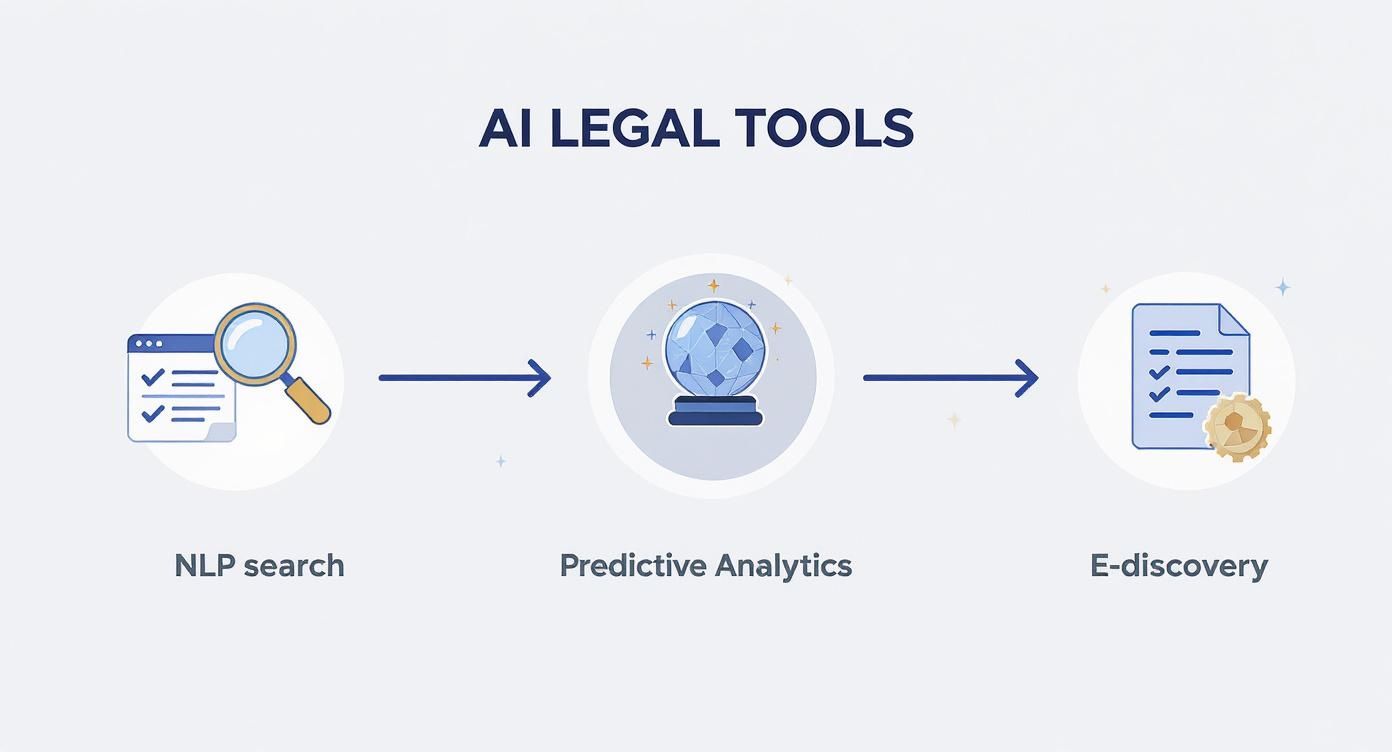
From understanding complex queries with NLP to managing document discovery, these are the areas where you’ll see the biggest efficiency gains.
Run a Pilot Program and Train Your Team
Once you’ve chosen a promising tool, resist the temptation to roll it out to the entire firm at once. Instead, start with a small, controlled pilot program. Pick a few tech-savvy team members and have them test the software on a real, but low-stakes, project.
This approach lets you:
- Iron out any technical kinks in a low-pressure environment.
- Gather honest, real-world feedback on the tool’s performance.
- Create internal champions who can later help train their colleagues.
After the pilot proves successful, you can shift your focus to effective training. And this isn't just about showing people which buttons to click. It’s about building confidence and showing them how the new tool will make their specific jobs easier, not threaten them.
Frame the training around solving the very same pain points you identified in step one. When your team sees that the AI is there to get rid of their most tedious tasks, adoption rates will climb naturally. For a deeper dive into managing technology implementation, you can explore our detailed guide on AI governance best practices.
Building a culture that embraces AI for legal research is a gradual process. By starting small, proving the value, and focusing on the human side of the change, you set your firm up for a smooth and successful transition. The goal, after all, is to make AI a trusted ally in delivering better, faster legal services.
Navigating Ethical Duties in the Age of AI

The incredible potential of AI for legal research comes with a serious set of professional responsibilities. Bringing these tools into your practice isn't just a tech upgrade; it’s a commitment to upholding your ethical duties. At the end of the day, AI is an instrument designed to assist—not replace—a lawyer's professional judgment.
The core idea is simple: the technology serves you, but you remain accountable for the final work product. Every summary, citation, or insight an AI generates should be seen as a starting point, never the final word.
The Unbreakable Rule of Human Oversight
The most important duty you have is maintaining strict human oversight. AI tools can, and sometimes do, produce incorrect or misleading information—a problem often called "hallucinations." Trusting an AI's output without independently verifying it yourself is a huge professional gamble.
It helps to think of your AI research tool as a brilliant but brand-new junior associate. You wouldn't dream of filing their draft memo with the court without first reading it, checking their sources, and applying your own legal expertise. The exact same standard applies to AI.
This isn't just about catching typos or bad citations. It’s about making sure the legal reasoning holds up, the strategy fits the client's goals, and the work you produce meets the highest standards of our profession.
Protecting Client Confidentiality at All Costs
Your duty to maintain client confidentiality gets even more critical when you're using cloud-based AI platforms. Typing sensitive case details into an unsecured or public AI model is a massive ethical misstep.
Before you partner with any AI vendor, you have to be certain they offer enterprise-grade security and have a crystal-clear policy stating that your data will not be used to train their public models.
This responsibility covers every shred of information. To truly protect sensitive data, you need a firm grasp of attorney-client privilege rules and how they apply in a digital context. It’s the only way to ensure every interaction with an AI tool honors the trust your client has placed in you.
The core responsibility remains unchanged: a lawyer must take reasonable steps to prevent the inadvertent or unauthorized disclosure of information relating to the representation of a client. This duty is absolute, regardless of the technology used.
A recent survey highlighted this caution, finding that while 31% of lawyers now use generative AI at work, many firms are holding back on wider adoption. Their primary concerns? Ethics, accuracy, and data privacy. For a deeper dive into these trends, you can review the full report on the legal industry.
Addressing Algorithmic Bias and Professional Competence
Finally, there’s the duty of technological competence. This means you need to make a real effort to understand how your tools work, especially their limitations. One of the biggest limitations to be aware of is algorithmic bias.
AI models learn from enormous datasets of existing legal documents. If that historical data contains biases—and it often does—the AI can easily repeat or even amplify those biases in its results.
Upholding your ethical duties requires a proactive mindset:
- Always Verify: Don't trust the output blindly. Double-check every key citation and legal point.
- Safeguard Data: Only work with platforms that have ironclad security and transparent data privacy policies.
- Understand the Tool: Take time to learn about the potential for bias in the specific AI you're using.
By making these principles part of your workflow, you can use AI for legal research to enhance your practice while staying true to the ethical standards that define the legal profession.
What's Next for AI-Augmented Legal Expertise?
If you think AI in legal research is impressive now, just wait. We're moving far beyond tools that just find information. The next wave of AI is about helping lawyers anticipate, strategize, and resolve conflicts with a level of precision we’ve never seen before. This isn't some far-off sci-fi concept; it's the natural evolution for a profession grounded in data and sharp analysis.
The future here isn't about replacing lawyers with algorithms. It’s about creating a new kind of legal professional—one who is augmented by AI and can deliver faster, more strategic, and ultimately more valuable counsel to their clients.
The Rise of Predictive Justice
One of the most exciting frontiers is the boom in predictive analytics. Today's tools can already give us a decent forecast of judicial behavior, but future systems will dig much, much deeper. Picture an AI that can sift through thousands of jury verdicts in a specific county to model the most likely outcomes for your case.
This kind of power completely changes how you approach litigation strategy. It gives you data-driven answers to the tough questions:
- What’s the actual statistical probability of a motion to dismiss succeeding?
- Looking at historical settlement data, what’s the smartest opening offer?
- How will a particular argument land with a jury in this specific venue?
Suddenly, a lawyer isn't just relying on gut instinct and past experience. They're validating their strategic choices with hard data, bringing a powerful new layer of objectivity to the table.
The goal isn't to let a machine make the final call. It's about using its incredible analytical power to sharpen human judgment. Think of AI as the most insightful consultant in the room, handing you a much clearer map to navigate the legal maze.
Better Dispute Resolution and Access to Justice
AI's impact will be felt far beyond the courtroom. It’s set to play a huge part in making dispute resolution smoother and more efficient. We're already seeing AI-powered mediation platforms that can analyze arguments from both sides of a business dispute, pinpoint areas of common ground, and help everyone reach a settlement faster—and with far lower legal bills.
This efficiency has a ripple effect on a much bigger issue: access to justice. Let's be honest, for many people and small businesses, the cost of good legal advice is a massive hurdle. In the near future, simpler AI tools could guide individuals through common legal problems, like a dispute with a landlord or a small claims case, helping them understand their rights and draft the right paperwork.
This isn't about diminishing the role of lawyers; it's about extending the reach of the law itself.
For legal professionals, the message is crystal clear: you have to keep learning and adapting. It's not a choice anymore. By getting comfortable with these powerful tools, you're not just staying competitive—you're raising the bar for the entire profession. The future of law belongs to those who see AI for legal research not as a threat, but as an essential partner in the practice of law.
Answering Your Questions About AI for Legal Research
As AI tools become more common in the legal field, it's only natural to have a few questions. Let's tackle some of the most common ones I hear from legal professionals to get a clearer picture of how this technology actually fits into day-to-day practice.
The conversation usually kicks off with job security, but it quickly moves to practical concerns like reliability and cost. Getting a handle on these areas is key before you decide to bring AI into your firm.
Will AI Replace Lawyers or Paralegals?
The short answer? No. The consensus across the industry is that AI is here to assist, not replace, legal professionals. Think of it this way: AI is fantastic at the repetitive, data-heavy lifting that eats up so much of your billable time, like sifting through documents or pulling initial case law.
By automating that groundwork, it frees you and your team up to focus on the high-value work that truly requires a human mind. We're talking about strategic planning, client counseling, complex negotiations, and courtroom advocacy—skills where human experience, empathy, and ethical judgment are irreplaceable.
Think of AI for legal research as the most efficient research assistant you’ve ever had. It does the legwork, so you can focus on building the winning strategy.
How Reliable Is AI-Generated Legal Information?
This is a big one, and for good reason. Top-tier AI legal platforms are actually quite reliable when it comes to finding and summarizing existing case law and statutes. That's because they're trained on vast, curated legal databases, which keeps them from pulling information from questionable online sources.
But—and this is a big but—generative AI can still make mistakes or "hallucinate" information that isn't real. The absolute golden rule is this: you must always maintain professional oversight. Use AI as a powerful tool to get you to a starting point faster, but you, the human expert, must always verify every critical citation and interpretation before it goes anywhere near a client or a court filing.
It’s a powerful tool, not an infallible oracle. This "human-in-the-loop" model ensures you maintain accuracy and uphold your professional duties. You're not outsourcing your brain; you're just getting to the core of the issue much faster.
How Can a Small Firm Afford to Start Using AI?
Getting started with AI is much more accessible than many small firms think. The trick is to avoid boiling the ocean. Don't try to find one tool that does everything. Instead, start by tackling one specific, high-impact problem.
First, figure out your biggest bottleneck.
- Are you buried in discovery?
- Is that initial case research eating up all your time?
- Is drafting standard documents causing delays or inconsistencies?
Once you've zeroed in on that one pain point, you can look for specialized, subscription-based tools designed to solve it. Many AI platforms offer free trials or have pricing that scales with your usage, so you can test the waters without a huge financial commitment. By starting small and proving a clear return on investment in one area, you'll find it's much easier to justify adding more AI tools down the road. This targeted approach makes adopting AI for legal research a smart, manageable step for firms of any size.
Move from intake to export in fewer steps with Whisperit, the voice-first AI workspace built for legal work. Unify your dictation, drafting, and research into one calm, efficient workflow. Discover how Whisperit can transform your practice.