
A Modern Guide to AI Document Analysis in Law
Imagine a paralegal who can read, understand, and organize thousands of documents in mere minutes. That, in a nutshell, is the power of AI document analysis. It’s technology built to automatically pull out key information, categorize files, and summarize legal texts, turning a mountain of unstructured data into insights you can actually use.
The goal here isn't to replace legal experts, but to give them a powerful new tool.
How AI Document Analysis Is Changing Legal Work
Anyone in the legal field knows the biggest challenge: the sheer volume of information. Case files, contracts, discovery documents, and client emails create a constant flood of data that takes a massive amount of time and effort to manage. Plowing through all this material by hand is not just slow—it’s also a recipe for missed details and human error, the very things that can make or break a case.
Think about traditional document review like trying to find one specific book in a giant library with no catalog system. You'd find it eventually, but it would be a slow, frustrating grind. AI document analysis is like having an expert librarian who has already read every book, knows what’s inside, and can instantly point you to the exact page you need. This isn't science fiction; it's a practical tool that gives firms a real strategic edge today.
From Manual Drudgery to Strategic Advantage
The real magic of AI document analysis is its ability to chew through high-volume, repetitive tasks with incredible speed and accuracy. This frees up legal professionals from the grunt work of finding information, letting them focus on what they do best: thinking critically, advising clients, and building a winning argument. If you're curious about the bigger picture, we explore how these technologies are reshaping the industry in our guide on law and AI.
This shift is made possible by a few core technologies working together.
At the heart of AI document analysis are a few key technologies that work in concert to make sense of complex legal information.
Here’s a quick breakdown of what they are and what they do for you.
Core AI Technologies in Legal Document Analysis
| Technology | What It Does for You | A Practical Legal Example |
|---|---|---|
| Optical Character Recognition (OCR) | Turns scanned documents, PDFs, and images into text the computer can actually read and search. | Digitizing a 500-page scanned contract so you can search for specific terms like "indemnification" or "liability." |
| Natural Language Processing (NLP) | This is the "brain." It helps the AI understand the meaning, context, and relationships between words, not just the words themselves. | Identifying the tone in an email chain (e.g., angry, cooperative) to gauge intent during e-discovery. |
| Entity Extraction | Automatically finds and tags key pieces of information like names, dates, organizations, and contract values. | Pulling out all company names, key dates, and monetary figures from dozens of financial agreements in a due diligence review. |
| Text Summarization | Condenses long documents into short, coherent summaries, highlighting the most important points. | Creating a one-page summary of a lengthy court ruling or a complex deposition transcript. |
| Document Classification | Sorts documents into predefined categories based on their content. | Automatically organizing a new batch of discovery documents into folders like "Contracts," "Emails," and "Invoices." |
These technologies don't just "read" text; they understand it. This allows for sophisticated work like spotting a specific clause across hundreds of contracts or pinpointing key evidence in a massive trove of emails.
This transition from basic data grabbing to true understanding is why the Document AI market is set to explode. Projections show it growing from USD 14.66 billion in 2025 to USD 27.62 billion by 2030. This isn't just about speed; it's about the demand for smarter systems that can help professionals make better decisions in high-stakes fields like law.
The Technology Powering AI Analysis
To really get what AI document analysis can do, it helps to peek under the hood. While the results can feel like magic, they’re actually driven by a set of distinct, powerful technologies working in concert. Think of it like a sophisticated assembly line, where each station performs a specialized task to turn a raw document into a finished, insightful product.
This process transforms what can feel like an overwhelming flood of documents into a clear strategic advantage for legal teams.
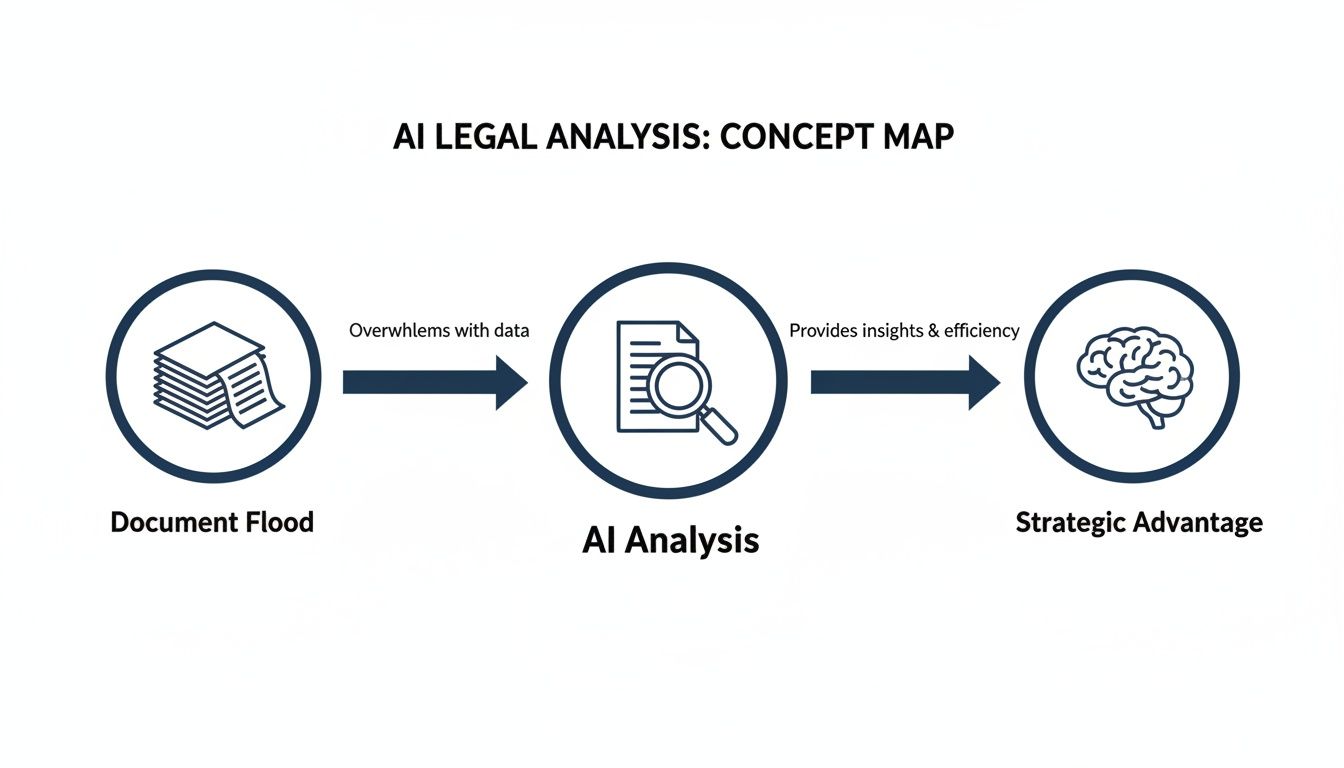
As you can see, AI acts as a powerful filter, turning a chaotic influx of information into actionable intelligence and strategic focus.
Step One: Making Paper Digital with OCR
The whole journey kicks off with Optical Character Recognition (OCR). A surprising amount of crucial legal paperwork still exists as scanned PDFs or even physical paper. To an AI, these are just images—unreadable collections of pixels. OCR is the initial translator, converting these images into machine-readable text.
Imagine you have a 100-page scanned contract. Without OCR, you can't search for a specific clause or copy-paste a section. After OCR runs, the entire document becomes a searchable, editable digital file. This foundational step makes everything else possible.
Step Two: Understanding Language with NLP
Once the text is digitized, Natural Language Processing (NLP) takes over. This is the real "brain" of the operation. It's the technology that allows the AI to comprehend language in a way that mimics how a person does. NLP goes way beyond just recognizing words; it deciphers context, grammar, and the relationships between concepts.
It's the difference between merely reading the words "termination for convenience" and understanding that this phrase represents a specific, critical contractual right. For a great deep dive into the core concepts and intelligent automation behind these solutions, check out this guide on Document AI.
By interpreting the nuances of legal language, NLP allows the system not just to process text but to derive meaning and intent from it. This capability is essential for any meaningful AI document analysis.
With a solid grasp of the text's meaning, the AI can move on to more specialized tasks that deliver direct value. You can also learn more about the specifics in our article about what is https://www.whisperit.ai/blog/what-is-natural-language-processing.
Finding the Needles in the Haystack
After understanding the general content, the AI can get much more targeted. It can start pulling out specific, high-value information. These techniques are what turn a readable document into a source of structured, actionable data—and this is where the real power of automation shines.
Three key techniques make this possible:
- Entity Extraction: Think of this as giving the AI a high-powered scanner to find and tag specific bits of information. It automatically identifies and categorizes key data points like names of people, company names, important dates, monetary values, and addresses.
- In Practice: During a due diligence review, entity extraction can instantly pull every single renewal date and liability cap from a batch of 50 vendor contracts, creating a neat table for quick comparison.
- Sentiment Analysis: This technology gauges the emotional tone behind the written word. It can determine whether the language in an email, memo, or deposition transcript is positive, negative, or neutral.
- In Practice: In eDiscovery, sentiment analysis can flag a chain of internal emails with an increasingly negative or hostile tone. This could indicate knowledge of wrongdoing and point investigators toward crucial evidence.
- Document Classification: This function acts like an automated filing clerk. The AI reads a document and, based on its content, assigns it to a predefined category. This ensures that huge volumes of incoming files are organized consistently and correctly right from the start.
- In Practice: A law firm receives a data dump of 10,000 documents for a new case. Classification AI can automatically sort them into folders like "Financial Records," "Employee Contracts," "Board Minutes," and "Client Communications" in a fraction of the time it would take a human team.
Together, these technologies form a powerful engine for legal insight. They take unstructured, often chaotic, document collections and transform them into an organized, searchable, and understandable knowledge base, giving legal teams the tools they need to work faster and more strategically.
Putting AI Document Analysis Into Practice
It’s one thing to understand the theory behind the tech, but it’s another thing entirely to see it deliver real results. The true power of AI document analysis shines when it takes those mundane, time-sucking legal tasks and turns them into efficient, strategic advantages. So, let’s move from concepts to concrete examples and see how these tools are solving real-world problems for legal teams right now.
This is where the investment in AI really pays for itself—not in buzzwords, but in measurable gains for your firm's most critical workflows. These aren't pie-in-the-sky ideas; they are practical applications with a clear and compelling return.

Uncovering Crucial Evidence in eDiscovery
Electronic discovery, or eDiscovery, is arguably the killer app for AI in the legal field. Think about it: in any complex litigation, you’re staring down a mountain of millions of documents—emails, memos, spreadsheets, you name it. Trying to review that volume of data by hand isn’t just slow, it's a recipe for disaster.
AI completely changes the game here. Using classification and entity extraction, the system can chew through terabytes of data at a speed no human team could match. It identifies the relevant files, flags privileged communications, and singles out the "hot documents" that could make or break a case. This approach, often called Technology-Assisted Review (TAR), has been shown to cut review time by upwards of 70%.
By finding the needle in the digital haystack, AI helps legal teams build a stronger case, faster. It acts as a safety net, ensuring a critical piece of evidence isn't overlooked due to simple human fatigue.
If you want to go deeper on this topic, our guide on eDiscovery and artificial intelligence breaks down these powerful tools in much more detail. Ultimately, this lets lawyers focus on what they do best: building a winning legal strategy.
Streamlining Contract Review and Management
Every legal department is swimming in contracts. Reviewing each one for weird clauses, hidden risks, and key obligations is tedious, repetitive work. AI-driven contract analysis automates much of this, bringing a massive improvement in both speed and consistency.
Here's how that plays out in the real world:
- Deviation Detection: The AI takes a new contract and instantly compares it against your firm's approved templates or a custom rulebook. It flags any clause that strays from the standard language, so your lawyers can zero in on the parts that actually need their attention.
- Obligation Extraction: The system automatically pulls out key dates, deadlines, and responsibilities. This data can then be pushed directly into a contract lifecycle management (CLM) platform, which helps prevent missed renewals and ensures everyone stays compliant.
- Risk Analysis: Using NLP, the AI can spot potentially dangerous language—like vague liability clauses or one-sided indemnity terms—and even assign a risk score to the entire document.
This automated first pass frees your team from the mind-numbing task of reading boilerplate text over and over. They can instead jump straight to negotiating the tricky points and assessing high-level risk.
Accelerating Due Diligence for M&A
In the world of mergers and acquisitions, speed is everything. The due diligence process demands a lightning-fast but exhaustive review of the target company's documents, from financials and IP agreements to employee contracts.
AI document analysis puts this process on fast-forward. It can summarize key financial data from dense reports, pinpoint change-of-control clauses buried in customer contracts, and verify regulatory compliance across the board.
By surfacing potential red flags and key deal points in hours instead of weeks, AI gives the deal team the insights they need to make smart decisions under pressure. That kind of efficiency doesn't just save money; in a competitive M&A environment, it can be the difference between winning and losing the deal.
Managing Security and Accuracy With Confidence
For any legal professional, the moment you consider technology that touches client data, a series of non-negotiable questions pop up. It’s all about confidentiality, security, and reliability. When you're looking at AI document analysis, those concerns don't just get louder—they’re amplified. You need absolute certainty that your firm's and your clients' information is protected and that the AI's output is solid enough for high-stakes legal work.
This is about more than just ticking a security box. It’s about upholding your ethical and professional duties to the letter. The right platform has to be a fortress, not just a tool.

Building a Digital Fortress for Client Data
Your firm's entire reputation is built on trust and the ability to protect client confidentiality. So, any AI document analysis tool you bring into the fold must have security woven into its very architecture, not just bolted on as an afterthought. When you're handling sensitive legal files, a deep understanding of data loss prevention isn't optional; it's fundamental.
Here are the security features that should be completely non-negotiable in your search:
- End-to-End Encryption: Your data needs to be scrambled and unreadable from the second it leaves your system until you get it back. This applies whether it’s in transit over the internet or sitting on a server.
- Strict Data Residency: Where your data is physically stored matters—a lot. Look for platforms that offer hosting in jurisdictions with ironclad privacy laws, like Switzerland or the EU, to ensure your information is governed by world-class regulations like GDPR.
- Granular Access Controls: You must have the power to decide exactly who can see, edit, or share specific documents and cases. Not every user on your team needs the keys to the entire kingdom.
These features come together to create a secure, isolated bubble where the AI works exclusively on your firm's data. This setup is crucial for preventing any information from being exposed to public models or wandering into the wrong hands.
The Human-in-the-Loop Model for Unquestionable Accuracy
As powerful as AI is, it isn't perfect. In the legal world, "close enough" is a recipe for disaster. This is where the human-in-the-loop model becomes your most important safety net. It’s not about blindly trusting the machine; it’s about using its incredible speed to supercharge the irreplaceable judgment of a legal expert.
Think of it like this: the AI does the first, grueling pass. It tears through thousands of documents, pulls out key dates, flags unusual clauses, and summarizes dense reports in minutes. This initial sprint saves hundreds of hours. Then, the legal professional steps in. You review, validate, and apply the critical context that only a human can provide to the AI-surfaced information.
This hybrid approach beautifully combines the raw speed of a machine with the strategic oversight of a seasoned lawyer. It ensures the final work product is not only turned around quickly but also meets the rigorous standards of accuracy and ethical responsibility that define legal practice.
This collaborative model is quickly becoming the gold standard in regulated fields where precision is everything. In the high-stakes world of finance and legal compliance, structured documents like contracts and invoices are a massive focus for AI, making up a huge 56.5% of the market. Human-in-the-loop systems are what make it possible to ensure accountability when accuracy is on the line.
Setting Realistic Expectations for AI Performance
It’s also critical to have an honest conversation about what AI can and can't do. No system is 100% perfect right out of the box. The performance of any document analysis tool depends heavily on two things: the quality of the documents you feed it and the clarity of the instructions you give it.
A successful rollout requires proper setup, clear definitions of what you need the AI to find, and a solid process for validating its results. For complex tasks like AI-driven due diligence, running a small pilot project is a great way to fine-tune the system and get a real-world baseline for its performance. You can read more about how to approach this in our guide to using AI in due diligence.
Choosing the right platform can feel daunting, but a structured evaluation process makes it much clearer. It helps you cut through the marketing noise and focus on what truly matters for your practice.
How to Evaluate an AI Document Analysis Platform
Here's a practical checklist to help your team assess potential vendors and ensure you're choosing a partner that's as committed to security and compliance as you are.
| Evaluation Criteria | Why This Is Critical | Key Questions to Ask Vendors |
|---|---|---|
| Data Security & Encryption | Protects client confidentiality and firm reputation. Non-negotiable for legal ethics. | Do you use end-to-end encryption for data in transit and at rest? What specific encryption standards do you follow? |
| Data Residency & Sovereignty | Ensures data is stored in a jurisdiction with strong privacy laws (e.g., EU, Switzerland) and complies with regulations like GDPR. | Where will our data be physically stored? Can we choose the region? |
| Access Control & Permissions | Prevents unauthorized access and ensures only relevant team members can view sensitive case files. | How granular are your user permissions? Can we set access levels on a per-case or per-document basis? |
| Compliance Certifications | Provides third-party validation that the platform meets industry standards (e.g., SOC 2 Type II, ISO 27001). | What security and privacy certifications do you hold? Can you provide the relevant audit reports? |
| AI Model Transparency | Clarifies if your data is used to train public models, which could expose confidential information. | Is our data used to train your models? Is our environment completely isolated from other customers? |
| Human-in-the-Loop Functionality | Acknowledges that AI isn't perfect and builds in workflows for legal professionals to easily review and validate AI outputs. | How does your platform support human review and correction? Can we easily track changes and approve AI suggestions? |
| Accuracy & Validation Metrics | Moves beyond vague claims and provides concrete data on the tool's performance with real-world legal documents. | Can you provide accuracy benchmarks for tasks relevant to our practice? How can we test the system with our own documents? |
By using this framework, you can make an informed decision and find a tool that genuinely enhances your workflow without introducing unnecessary risk.
Ultimately, by embracing a model of collaboration—where AI handles the volume and humans provide the verification—your firm can innovate with confidence. You gain a powerful efficiency advantage without ever compromising the security and accuracy your clients depend on.
A Practical Plan for Adopting AI in Your Firm
Bringing new technology into a law firm often feels like a massive undertaking. But adopting AI document analysis doesn’t have to upend your entire workflow. The secret is to think strategically, start small, and let early wins build momentum for you. Instead of a firm-wide overhaul, think of it as a phased rollout that proves its worth at every stage, ensuring a smooth transition without overwhelming your team.
The whole process starts with picking the right battle. A successful rollout depends on choosing a single, high-impact area where AI can make a clear, immediate difference. This gives you a solid business case from day one and helps build the internal support you'll need to expand later.
Start with a High-Impact Pilot Project
The best way to get started is with a focused pilot project. Look for a workflow that’s notoriously tedious, repetitive, and absolutely critical to your firm’s success. For many firms, the initial stages of contract review are the perfect candidate. It’s a classic bottleneck where a simple human error can introduce huge risks, and the benefits of automation are easy to see and quantify.
Here's a straightforward, three-step approach for your pilot:
- Define a Clear Goal: What, exactly, are you trying to fix? Get specific. An objective like "we want to reduce initial contract review time by 40%" or "ensure 100% consistency in flagging non-standard indemnity clauses" is concrete and measurable.
- Select a Small, Controlled Dataset: Don't try to boil the ocean. Pick a limited set of documents to start—maybe 25-50 similar contracts from one practice area. This keeps the scope manageable and makes it much easier to evaluate how well the AI is performing.
- Assemble a Dedicated Team: Grab a small group of lawyers and paralegals who are actually excited about trying new tech. Their hands-on feedback is pure gold for fine-tuning the system, and they’ll become your best advocates when it's time to show the rest of the firm.
A well-run pilot project is more than just a tech test; it's an internal case study. It proves the real-world value of AI document analysis and turns skeptics into champions by showing them how it makes their work-life better.
Once the pilot is done and you have the results, you’ll have a powerful, data-backed story to tell about how this technology actually works in your firm, with your documents.
Prepare Your People and Your Data
With a successful pilot in your back pocket, it's time to think about a wider rollout. This means getting both your tech and your team ready. On the data side, you’ll want to make sure your documents are reasonably organized and accessible. Modern AI is pretty good at handling messy data, but a little prep work goes a long way.
Honestly, though, the human element is the most important piece. Managing change and setting realistic expectations are crucial. Your team needs to hear—over and over—that AI is a tool to make them better, not to replace them. It’s about automating the grunt work so they can focus on strategy and high-level analysis. Good communication and training are non-negotiable.
The market for these tools is growing up fast. North America currently leads the Document AI market with a 47.60% share, largely because so many businesses have gone digital and face strict regulations in fields like finance and healthcare. This widespread adoption gives us a great roadmap for best practices, especially around security. You can get the full picture by exploring the report on intelligent document processing from Fortunebusinessinsights.com.
Measure Success and Scale Thoughtfully
To justify putting more resources into AI, you need to define what success looks like and then measure it obsessively. The metrics you track should tie directly back to the goals you set in the beginning.
Think about tracking Key Performance Indicators (KPIs) such as:
- Time Savings: The average number of hours cut from document review per case.
- Cost Reduction: Hard dollars saved by reducing the need for manual review or outside counsel.
- Accuracy Improvement: A measurable drop in missed clauses or data entry errors.
- Team Satisfaction: Direct feedback from your legal pros on how the tool improves their day-to-day.
With this kind of data in hand, you can make a smart, informed decision about where to point the AI next. Maybe you expand from contracts to eDiscovery, or you apply it to due diligence. Each successful step builds on the last, creating a cycle of efficiency that spreads throughout your firm. If you're looking for a broader view of the options out there, check out our legal AI software guide that is transforming law practice.
Common Questions About AI in Legal Document Review
Let's be honest—adopting any new technology in the high-stakes world of law brings up some serious questions. When that technology is AI, the questions get even sharper. Here, we'll tackle the most common concerns we hear from legal professionals, giving you straight answers to help you move forward with confidence.
How Secure Is My Client Data with an AI Platform?
This is always question number one, as it should be. The security of client data is non-negotiable. The simple answer is that any platform worth its salt must be built like a digital fortress from the ground up, operating on a zero-trust security model.
When you're evaluating a tool, look for these critical security layers:
- End-to-End Encryption: Your data has to be unreadable to anyone else, both when it's moving across the internet and when it’s sitting on a server.
- Strict Data Residency: Where is your data stored? Platforms that offer hosting in places like Switzerland or the EU are bound by some of the planet's toughest privacy laws, including GDPR.
- Granular Access Controls: You need absolute control. The system must let you decide precisely who can see, touch, or edit specific files, keeping sensitive information locked down.
Most importantly, the AI itself must work exclusively within this secure bubble. Your confidential information should never, ever be used to train public AI models or leave your firm's private workspace. Always ask to see a provider’s security credentials, like SOC 2 Type II or ISO 27001 certifications.
Will AI Replace Lawyers or Paralegals?
In a word, no. AI is here to augment your team, not replace it. Think of it as the most powerful assistant you've ever had—one that can handle the tedious, high-volume tasks that burn through valuable hours, freeing up your human experts for the strategic work that wins cases.
It’s a force multiplier. An AI can sift through ten thousand documents and pinpoint the fifty most relevant ones in minutes. But it's the attorney who takes that curated list, connects the dots, and builds a compelling legal strategy. An AI can generate a first draft from case notes, but it’s the paralegal who refines it with critical context and a human touch.
The uniquely human skills—critical thinking, ethical judgment, advising clients, and creative legal strategy—are irreplaceable. AI just makes your team faster and more efficient, allowing them to focus on that higher-value work.
Do I Need to Be a Tech Expert to Use These Tools?
Absolutely not. The whole point of a well-designed AI tool is to make powerful technology feel simple. The complexity should be hidden behind an intuitive, clean interface. If you can use modern office software or a smartphone, you’re more than ready.
The best platforms are built to fit right into your current workflow. You shouldn't have to become an AI engineer; the technology should adapt to how you work, whether that's through simple voice commands or a clear, easy-to-navigate dashboard. Your focus should stay on the legal task—drafting a motion, reviewing a contract, or finding that key piece of evidence—not on fiddling with the software.
How Is the Accuracy of the AI Work Verified?
Trust but verify. This is the core principle behind any professional AI workflow, often called a "human-in-the-loop" system. It’s the perfect blend of machine speed and human expertise.
The process is refreshingly simple. The AI does the heavy lifting first—maybe it pulls every key date from a 100-page contract, summarizes a long deposition, or flags non-standard clauses in a lease agreement. But its output is never the final word.
The AI presents its findings in a way that makes it incredibly fast for a human to check. For example, it might show you the dates it extracted and highlight exactly where it found them in the original document. You can confirm accuracy with a quick glance. This combination of AI speed and human validation ensures the work product is not just efficient but also meets the rigorous standards of the legal profession.
Ready to see how a voice-first, context-aware AI workspace can transform your legal practice? Whisperit unifies your dictation, drafting, research, and collaboration into a single, secure platform built for the demands of modern law. Learn more and discover a calmer, more efficient workflow at https://whisperit.ai.