
Your Guide to an AI Contract Management System
An AI contract management system is a platform that uses artificial intelligence to help create, manage, and analyze legal agreements. It essentially turns contracts from static, dusty documents into active, searchable sources of information. This shift helps businesses leave behind the slow and risky manual processes of the past in favor of smarter, automated workflows.
From Manual Piles to Intelligent Platforms
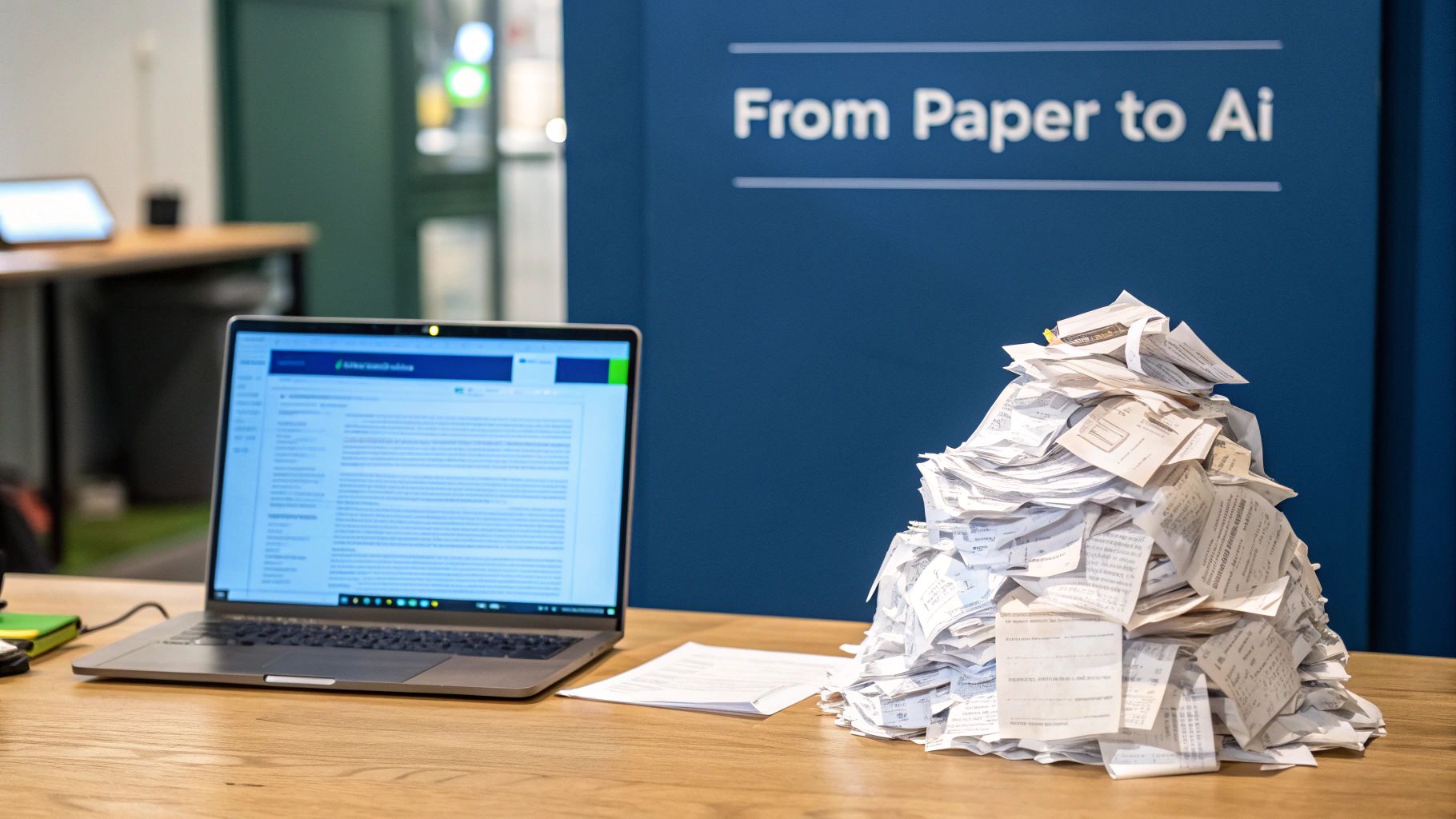
Think about trying to find a specific clause buried in a literal mountain of paper contracts. For years, that was just how contract management worked—a slow, error-prone process that depended on filing cabinets, spreadsheets, and hoping someone remembered the details.
This old-school approach wasn't just clunky; it was a real business risk. Finding a single agreement could take hours, and trying to understand your obligations across thousands of them was practically impossible. Missed renewal dates, forgotten compliance duties, and inconsistent terms were just the cost of doing business.
The Search for a Better Way
The fundamental problem was scale and access. Imagine a brilliant librarian in charge of a massive library. They're an expert, but they can still only search one shelf at a time. That's a lot like a legal team manually reviewing documents one by one—thorough, but incredibly limiting.
As businesses expanded, their contract volumes exploded. The "library" of agreements quickly became an unmanageable archive. This created a serious need for a new kind of system—one that could not only store information but actually understand it. This evolution from manual to intelligent systems is a core part of broader business improvements, like healthcare business process automation.
An AI contract management system is like giving that librarian a super-powered search engine. It doesn't just find the right book; it reads every page, understands the context, and cross-references information across the entire collection in an instant.
The Rise of Intelligent Automation
Bringing in an AI contract management system is a genuine turning point. It tackles the built-in weaknesses of manual work by applying smart automation to every stage of a contract's life. For any company looking to modernize, getting a handle on the basics of a digital document workflow is the perfect place to start.
This technology offers a clear answer to the age-old problems of inefficiency and risk. By automating the grunt work and delivering deep insights, it frees up legal and business teams to be strategic advisors instead of just paper-pushers. The platform doesn’t just store contracts; it unlocks the valuable data trapped inside them, paving the way for faster, smarter, and safer business.
What Is an AI Contract Management System?
Let's start by getting one thing straight: an AI contract management system is not just a glorified digital filing cabinet. Your standard contract repository is passive—it holds documents, but it can’t tell you a thing about what’s inside them. It’s organized, sure, but it’s not smart.
Now, imagine that same filing cabinet suddenly had a brain. And a team of super-sharp virtual assistants working 24/7. That's the real difference. An AI contract management system isn’t just a place to store agreements; it's an active intelligence layer that reads, understands, and even learns from them, turning your static contracts into dynamic business assets.
This massive leap forward is powered by a combination of two key technologies. The first is Natural Language Processing (NLP), which is what allows the software to decipher the complex, often-tricky language of legal documents. The second is Machine Learning (ML), which lets the system get smarter and more accurate over time as it processes more of your contracts.
From Static Files to Active Intelligence
A traditional system can help you find a contract. An AI-powered system can tell you what’s in that contract and why it matters to your business. It's a fundamental shift in capability.
Think about it this way: what if you needed to find every single non-standard renewal clause buried in thousands of vendor agreements? Manually, that’s a soul-crushing task that would take a legal team weeks, creating a huge bottleneck. With an AI system, you can get a comprehensive report highlighting those risks in minutes.
An AI contract management system does for your legal agreements what a powerful analytics platform does for your sales data. It moves you from simple record-keeping to proactive, data-driven decision-making, revealing patterns and insights that were previously hidden.
This ability to analyze and pull insights at scale is precisely what sets these platforms apart. They completely change how legal and business teams interact with their contracts, transforming an administrative headache into a rich source of business intelligence. This change is not just a niche trend; it's fueling massive market growth.
The AI in Contract Management System market was valued at USD 359.6 million in 2023 and is projected to skyrocket to USD 3,987.4 million by 2033—that's a compound annual growth rate of 27.2%. This explosive expansion shows just how fast companies are jumping on board to get more value from their legal documents.
Manual vs AI-Powered Contract Management
The difference between the old way and the new way is stark. This table breaks down the practical distinctions between slogging through contracts by hand versus letting an AI do the heavy lifting.
| Aspect | Manual Contract Management | AI Contract Management System |
|---|---|---|
| Data Extraction | A painstaking, error-prone manual process of copy-pasting key dates, values, and clauses. | Automated, instant extraction of hundreds of data points with high accuracy. |
| Risk Analysis | Relies on individual lawyers spotting issues; inconsistent and impossible to scale across all contracts. | Systematically flags non-standard clauses, high-risk terms, and missing provisions across the entire portfolio. |
| Searchability | Limited to searching by document title or basic metadata. "Find me all contracts with a 90-day termination clause" is impossible. | Deep, content-based search. You can ask complex questions about the substance of your contracts and get instant answers. |
| Efficiency | Extremely slow. A single contract review can take hours; a portfolio review can take weeks or months. | Drastically reduces review times from hours to minutes, freeing up legal teams for strategic work. |
| Strategic Value | Primarily an administrative function focused on storage and retrieval. | A source of business intelligence, providing insights into obligations, risks, and opportunities. |
In short, while manual methods keep you bogged down in administrative tasks, an AI system elevates your team to a more strategic, proactive role within the business.
Core Technologies at Work
To really get a feel for how an AI contract management system delivers these results, it helps to understand the engines running under the hood. These aren't abstract, futuristic concepts; they are practical tools solving real-world headaches in the contract lifecycle every day.
Here’s a quick rundown of the key AI elements:
- Natural Language Processing (NLP): This is the core engine that reads and makes sense of human language. It’s what allows the AI to pinpoint specific clauses, pull out key data like dates and party names, and even understand the risk level of certain legal phrases.
- Machine Learning (ML): If NLP is the reader, think of ML as the star student. With every contract it analyzes, the system learns your company’s unique terminology and clause preferences, becoming sharper and more tailored to your specific needs over time.
- Optical Character Recognition (OCR): This is the tech that turns old scanned documents and image-based PDFs into text the AI can actually read. OCR is the crucial first step for bringing all those legacy contracts hiding in filing cabinets into your new intelligent system.
Together, these technologies work to automate the most time-consuming parts of managing contracts. To see how these tools come together in practice, check out our complete guide on using AI for legal documents. By taking over the tedious work of data extraction and analysis, these systems free up your legal experts to focus on what they do best: providing high-value strategic advice.
Core Features That Transform Legal Operations
What really sets an AI contract management system apart is its ability to actively work with your agreements. These aren't just digital filing cabinets; they turn static documents into dynamic, intelligent assets. Instead of just rattling off a list of features, let's walk through a contract's lifecycle to see how these tools make a real difference at every step.
Everything starts with the system taking in a document and actually understanding what it says.
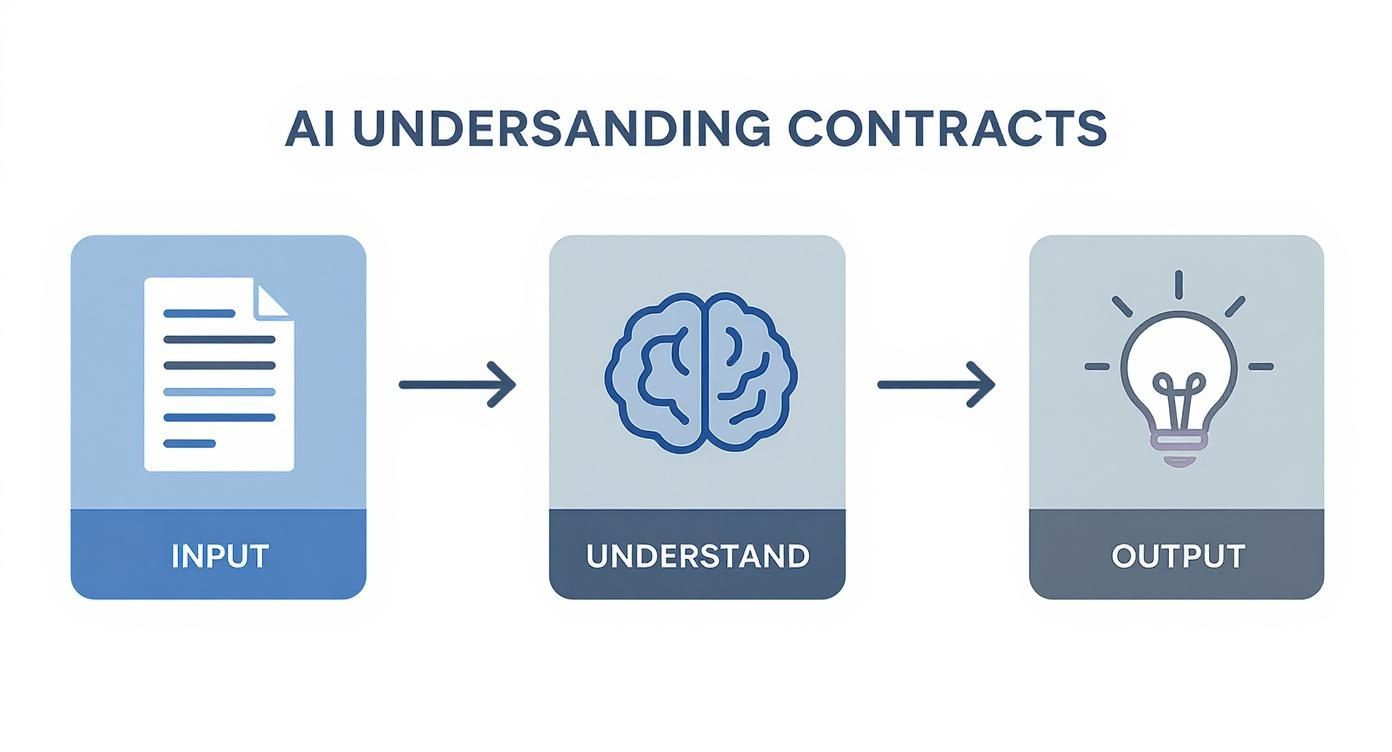
This simple flow—read, understand, act—is the engine driving every other feature. It’s what turns dense legal text into structured, usable data.
Intelligent Ingestion and Data Extraction
The first stop for any contract is getting it into the system. In the old days, this meant hours of manual data entry, a process that was not only mind-numbing but also a magnet for human error. With an AI contract management system, this is all automated and remarkably accurate.
When you upload a contract—whether it's a pristine Word doc or a grainy scanned PDF—the AI gets straight to work. It uses Optical Character Recognition (OCR) to turn any images of text into readable data. From there, its Natural Language Processing (NLP) engine reads the document like a junior associate, identifying and pulling out hundreds of critical data points automatically.
And we're not just talking about the basics, like party names and dates. A good AI can pinpoint:
- Key Dates: It goes beyond start and end dates to find crucial deadlines like notice periods for termination or auto-renewal dates that can sneak up on you.
- Obligations and Deliverables: The system can spot specific duties for each party, from payment terms and service level agreements (SLAs) to reporting requirements.
- Critical Clauses: It isolates and tags the big ones—indemnification, limitation of liability, confidentiality—so you can find them in seconds later on.
This automated extraction reclaims countless hours for your team and, more importantly, builds a reliable, structured database of your company’s commitments from the very beginning.
AI-Powered Search and Analytics
Once your contracts are digitized and their data is extracted, they become part of a fully searchable library. This is where an AI platform really leaves a simple cloud drive in the dust. You can graduate from basic keyword searches to asking complex questions in plain English across your entire contract portfolio.
Think about asking questions like:
- "Show me all client agreements that auto-renew in the next 90 days."
- "Which vendor contracts have a limitation of liability clause over $1 million?"
- "Find all agreements governed by New York law that are missing a force majeure clause."
The system understands what you’re asking and pulls up precise answers instantly. This capability shifts contracts from being a source of hidden risk to a wellspring of strategic insight, letting you analyze obligations and find opportunities across the entire business.
By turning unstructured legal text into a queryable database, AI provides a level of visibility that was previously impossible. It’s like having an always-on legal analyst who has memorized every word of every contract your company has ever signed.
Automated Risk Scoring and Clause Analysis
Let's be honest: not all contract language is created equal. Some clauses are ticking time bombs, while others are just standard boilerplate. An AI system can be trained on your company's own legal playbook to automatically score the risk level of incoming contracts.
When a third-party paper comes in, the AI compares its language against your approved templates and clause library. It can immediately flag:
- Non-standard language that strays from your preferred terms.
- High-risk clauses that might expose the company to unnecessary liability.
- Missing clauses that are non-negotiable for compliance or protection.
This proactive analysis helps legal teams triage their work and focus on the biggest risks, speeding up reviews and ensuring consistency. It's a cornerstone of effective legal document automation, as it tackles one of the most tedious parts of the job head-on.
Dynamic Approval Workflows
Finally, when a contract is ready for sign-off, the AI steps in to manage the often-chaotic approval process. Forget about those endless email chains where the latest version gets lost. The system uses smart, rule-based workflows.
Based on the contract's type, value, or risk score, the platform automatically sends it to the right people for review. It ensures everyone from department heads to finance and legal signs off in the correct order. The system gives you a real-time view of the contract's status, sends out polite nudges to prevent delays, and creates a clean audit trail of every single action taken.
Unlock the Strategic Value of Your Contracts
An AI contract management system does far more than just file away your documents. It fundamentally changes your entire portfolio of agreements, turning them from a static administrative headache into a dynamic source of strategic intelligence. This is a game-changer, shifting contract management from a back-office chore to a boardroom priority that directly impacts risk, efficiency, and revenue.
To really get what this means, let's look at the three main ways an intelligent system unlocks real strategic value for your business. These aren't just features; they're direct lines from the technology to tangible business growth.
Proactive Risk Mitigation
For most companies, managing contract risk is a purely reactive game. A problem pops up—a missed deadline, a compliance slip-up, a nasty clause that suddenly comes into play—and the legal team has to drop everything to put out the fire. An AI system flips that entire model on its head, acting as a tireless watchdog for your entire contract library.
Instead of waiting for something to go wrong, the AI constantly scans every single agreement to spot hidden liabilities and potential compliance gaps before they ever become real problems. It can flag non-standard language that deviates from your playbook, identify conflicting obligations between different contracts, and alert you to upcoming renewal dates that might auto-renew on unfavorable terms if you're not paying attention.
Think of it this way: It's the difference between having a smoke detector and having a fire marshal who inspects your building every single day. One tells you there's already a fire; the other helps you prevent the fire from ever starting.
This proactive approach dramatically cuts down on your legal exposure and the risk of financial penalties. By giving leadership a clear, real-time dashboard of contractual risk across the whole company, it enables smarter, more confident decision-making.
Supercharged Operational Efficiency
The second pillar of strategic value is a massive injection of speed and efficiency into your operations. We all know how painfully slow manual contract review cycles can be. They create bottlenecks that hold up sales deals, slow down procurement, and leave business teams feeling frustrated. An AI contract management system smashes through these logjams with smart automation.
The effect on speed is frankly incredible. Recent data shows that AI can lead to 400% faster contract reviews when compared to the old manual way. A manual review that used to take, on average, 92 minutes per agreement can be cut down to just a few minutes with AI. This can save legal professionals an estimated 4 to 6 hours per week. That's time your highly skilled team gets back to focus on high-stakes negotiations and strategic advice instead of administrative grunt work. You can dig deeper into these efficiency gains and learn how AI is reshaping contract management on concord.app.
This isn’t just about getting things done faster. It’s about re-deploying your most valuable assets—your people—to the kind of work that truly moves the needle for the business.
Uncovering Strategic Business Intelligence
This might be the most powerful advantage of all: turning your contract repository into a searchable goldmine of business intelligence. For decades, all the priceless commercial data inside contracts—pricing terms, supplier commitments, sales promises, negotiation history—has been trapped in unstructured text, making it impossible to analyze at scale.
An AI system sets that data free. By extracting and structuring the information from every contract, it lets you ask critical business questions and get data-backed answers in seconds.
- For Sales: "Show me all enterprise clients with contracts renewing in the next six months and tell me what discounts they originally negotiated."
- For Procurement: "Which of our suppliers consistently miss their service-level agreements (SLAs), and what are our contractual rights to fix the situation?"
- For Finance: "What are our total committed revenues for the next quarter, based on all active customer agreements?"
Finding the answers to these questions used to take a team weeks of painstaking manual research. With an AI system, these insights are on-demand, revealing hidden revenue opportunities, potential cost savings, and negotiation leverage you never knew you had. This is how the legal department transforms from a cost center into a strategic partner that actively drives business growth.
Navigating Security and Compliance With AI
Let's be honest: handing over your company's most sensitive legal documents to an AI platform requires a huge leap of faith. An ai contract management system is only as good as its ability to protect the information it handles. That's why security and compliance aren't just nice-to-have features; they're the bedrock of any trustworthy platform.
You have to ask the tough questions about how a vendor is safeguarding your data. The best platforms meet these concerns head-on with a layered security strategy that protects your information at every turn.
Core Security Safeguards
Think of digital security like protecting a bank vault. You wouldn't just have a strong door; you'd also have guards, cameras, and strict rules about who can go inside. In the world of AI contract management, these defenses translate into specific technical features.
Here are the non-negotiables to look for:
- End-to-End Encryption: This scrambles your contract data, making it unreadable both while it’s being uploaded (in transit) and while it’s sitting on a server (at rest).
- Role-Based Access Controls (RBAC): This is absolutely critical. It lets you define exactly who can do what. Your sales team can view their specific contracts, for example, but only the legal department gets the power to edit or approve them.
- Comprehensive Audit Trails: This is a detailed, unchangeable log that records every single action taken within the system—who viewed a document, who made an edit, and when it was approved. It’s your single source of truth for accountability and compliance.
These safeguards work in tandem to create a secure bubble around your contracts, shielding them from prying eyes and accidental leaks.
Hosting Models and Data Residency
Where your data physically lives is another major piece of the puzzle. Every organization has a different risk tolerance, so modern platforms offer flexible hosting options to match your company's specific security and regulatory needs.
The main models you'll encounter are:
- Public Cloud: Hosted on massive, reliable infrastructure like AWS or Azure. You benefit from their world-class security, but you're sharing the infrastructure with other companies.
- Private Cloud: A dedicated cloud environment just for your organization, giving you an extra layer of isolation and control.
- On-Premise: Hosted on your own servers. This offers maximum control and is often the choice for organizations in highly regulated fields like finance or healthcare.
For businesses operating in Europe, data residency is a huge deal. Platforms like Whisperit offer Swiss or EU hosting to ensure your data never crosses the geographic lines set by GDPR. If your system handles sensitive contract data, you need to get data privacy right; check out this detailed GDPR compliance checklist to keep your processes on the right track.
A vendor's commitment to security is best demonstrated through independent verification. Certifications are not just badges; they are proof that a third-party auditor has rigorously tested the platform's security controls.
Verifiable Compliance and Certifications
At the end of the day, talk is cheap. Trust needs to be earned and, more importantly, verified. The most reputable vendors don't just say they're secure; they prove it by undergoing strict, independent audits.
The gold standard here is SOC 2 (Service Organization Control 2) certification.
Achieving SOC 2 means a provider has demonstrated to an outside auditor that its systems are designed to keep client data secure, available, and confidential. For a closer look at what this involves, you can explore the key SOC 2 compliance requirements vendors have to meet. When you're evaluating an ai contract management system, always ask for this kind of verifiable proof.
Choosing and Implementing Your AI Solution
Bringing an AI contract management system into your organization is a big move, but one that can pay off enormously in saved time and reduced risk. Getting there successfully, though, isn't about just buying software; it’s about having a smart, well-thought-out plan. This guide will walk you through the steps to get from "we should look into this" to a smooth, company-wide rollout.
The first step isn't watching vendor demos—it's looking inward. Before you can find the right tool, you have to get crystal clear on the specific problems you're trying to solve. Nail this part, and you'll end up with a solution that actually fits your unique needs.
This thoughtful approach is more important than ever. The global market for contract management software was valued at USD 2.83 billion and is expected to hit USD 5.65 billion by 2030, growing at a 12.7% clip each year. As more companies jump on board, a solid implementation plan isn't just nice to have; it's a real competitive edge. You can dig into the numbers in this market analysis from Grand View Research.
Assess Your Needs and Define Success
Start by pinpointing your biggest headaches. Is your legal team buried under a mountain of manual reviews? Are you losing money because renewal dates are slipping through the cracks? Is the lack of a central contract repository creating blind spots and risk?
Talk to everyone who deals with contracts—legal, sales, finance, procurement, you name it. Use their feedback to paint a clear picture of what a "win" looks like for your business.
- Quantitative Goals: Set concrete targets. Think: "cut down contract review time by 50%" or "eliminate 90% of our missed renewal deadlines."
- Qualitative Goals: Don't forget the less tangible wins, like "finally have a single source of truth for every agreement" or "let the sales team generate standard contracts on their own."
This upfront work becomes your scorecard for evaluating vendors. It ensures you’re making a decision based on real business needs, not just slick features.
Evaluate Key Vendor Criteria
Once you know what you’re looking for, you can start sizing up potential AI solutions. It's easy to get wowed by marketing jargon, so try to focus on what it will be like to use the platform every single day.
An AI platform's true power isn't just in its algorithm; it's in how seamlessly it fits into your team's existing workflow. The goal is to find a tool that empowers your people, not one that forces them to completely change how they work.
Here are a few critical things to look at:
- Ease of Use: Is the interface intuitive? If a system requires a ton of training, your team will never embrace it.
- Integration Capabilities: Can it talk to your other critical tools, like Salesforce, your ERP, or e-signature platforms? A system that lives on an island just creates more work.
- Quality of Support: What does the onboarding process look like? Will you have a dedicated person to help you get started and make sure you’re successful?
Implement with a Strategic Rollout Plan
You’ve picked your system—now comes the most important part. A rushed implementation is a common mistake that can sink the whole project. A thoughtful rollout is what separates a frustrating experience from a transformative one.
First, start small with a pilot program. Pick a small, enthusiastic group of users to test it out. This lets you iron out any wrinkles, get honest feedback, and create a team of internal champions who can help get everyone else excited.
Next, plan your data migration carefully. This is a golden opportunity to clean house—archive old agreements and make sure the contract data you're importing is clean and accurate. Finally, don't skimp on change management. Communicate the "why" behind the new tool, provide great training, and celebrate early successes to build momentum.
For more insights on this topic, explore our legal AI software guide for transforming law practice.
Frequently Asked Questions
Even when the benefits are clear, moving forward with an AI contract management system brings up some very practical questions. Let's tackle the most common ones people ask, so you can evaluate the technology with confidence.
How Accurate Is The AI At Pulling Out Contract Data?
It's impressively accurate. Modern AI systems routinely hit over 95% accuracy for standard clauses and key data points. This isn't just a shot in the dark; it's the result of powerful Natural Language Processing (NLP) and Machine Learning (ML).
The AI comes pre-trained on massive legal datasets, but the real advantage is its ability to learn from your specific contracts. Every time your team makes a correction, the system gets smarter and better tuned to your company's unique language and contract styles.
Plus, the best platforms always include a "human-in-the-loop" option. This gives you the best of both worlds: the incredible speed of AI for the bulk of the work, with a final layer of human oversight for the most critical details.
Can This Kind Of System Connect With The Software We Already Use?
Absolutely. In fact, integration is one of the most important features of any modern AI contract platform. These systems are built to be a central hub, not another siloed piece of software.
You'll find that most have ready-made integrations for the tools you probably use every day:
- CRM systems like Salesforce
- ERP platforms like SAP or Oracle
- E-signature tools like DocuSign
For any unique or homegrown software your business relies on, vendors usually offer a robust API (Application Programming Interface). This gives your IT team the tools they need to build custom connections, ensuring contract information flows exactly where you need it across your entire technology stack.
Is It A Huge Hassle To Get All Of Our Old Contracts Into The New System?
Not at all. The vendors have worked hard to make this process—often called contract ingestion—as painless as possible. Most platforms let you bulk upload thousands of documents at once, including old scanned PDFs.
The AI uses a technology called Optical Character Recognition (OCR) to turn those scanned images into digital text that it can actually read.
From there, the system automatically gets to work. It analyzes, tags, and organizes all of those legacy contracts, pulling out key information like effective dates, parties, and renewal terms. This process alone saves hundreds of hours of mind-numbing manual data entry.
While any large migration project needs a bit of planning, the AI handles the vast majority of the heavy lifting for you.
Ready to see how a voice-first, context-aware workspace can change your legal operations? Whisperit brings together dictation, drafting, and teamwork to help your team get from intake to export in fewer steps. Learn more at whisperit.ai.