
AI Contract Management That Transforms Legal Workflows
At its heart, AI contract management is about bringing intelligent automation into the world of legal agreements. Think of it less as a digital filing cabinet and more as a super-powered paralegal that can help you create, negotiate, and look after contracts from start to finish. It’s a system designed to actively analyze, manage, and optimize every agreement your business touches.
What Is AI Contract Management and Why Is It Essential?

Here’s an analogy: managing contracts the old way is like trying to navigate a new city with a paper map. You can see the streets, but you have no idea about traffic, construction, or a better route that just opened up. AI contract management is your GPS—a smart, live guide that not only shows you the way but also anticipates problems and suggests better options in real-time.
This technology directly tackles a huge headache for legal and compliance teams: the sheer volume and complexity of modern contracts. Manually reading every line of every agreement is painfully slow and a recipe for mistakes. In fact, many legal teams find themselves spending an average of 3.2 hours on a single manual review, which quickly becomes a major bottleneck for the entire business.
The Problem With Traditional Methods
The old way of doing things—think shared drives, spreadsheets, and overflowing inboxes—just doesn't cut it anymore. It's impossible to get a clear picture of your risks and obligations when critical details are buried deep inside static documents.
This leads to some common, and costly, problems:
- Massive Inefficiency: Hours are wasted on manual data entry and back-and-forth reviews. That's time your legal experts could be spending on high-value strategic work.
- Unseen Risks: When you have hundreds or thousands of agreements, manually tracking every single renewal date, compliance term, and obligation is a hopeless task. Things inevitably fall through the cracks.
- Zero Insight: Static files can't be searched or analyzed effectively. This means you can't spot recurring issues, identify negotiation trends, or get a high-level view of your contract portfolio.
How AI Provides a Solution
AI-powered platforms use sophisticated technologies like Natural Language Processing (NLP) to read and understand legal language much like a person would, only thousands of times faster. If you're curious about the nuts and bolts, you can learn more about it in our guide on what is natural language processing. This ability is what turns a mountain of static legal documents into a dynamic, intelligent resource.
Instead of just storing documents, AI systems provide real-time insights, automate tedious reviews, and convert legal agreements into a searchable, intelligent database. This turns contract management from a reactive administrative task into a proactive strategic function.
This shift is a perfect example of smart AI automation for business, applying powerful technology to a critical business function. The numbers tell the same story. The global contract management software market, which is increasingly driven by AI, hit USD 2.83 billion in 2024 and is expected to more than double to USD 5.65 billion by 2030. That kind of growth shows just how badly businesses need solutions that can make them more efficient while also protecting them from risk.
The table below breaks down the fundamental differences between the old and new approaches.
Traditional vs AI Contract Management At a Glance
| Aspect | Traditional Contract Management | AI Contract Management |
|---|---|---|
| Document Storage | Passive storage in folders or basic systems. | Active repository with searchable, structured data. |
| Data Extraction | Manual data entry; slow and error-prone. | Automated extraction of key dates, clauses, and metadata. |
| Risk Analysis | Manual, inconsistent, and relies on human review. | Automated risk scoring based on clause analysis and past data. |
| Review Process | Time-consuming, manual redlining and version control. | AI-assisted redlining, clause suggestions, and collaboration. |
| Searchability | Limited to file names or basic text search. | Deep, semantic search across the entire contract portfolio. |
| Insights & Reporting | Requires manual compilation in spreadsheets. | Real-time dashboards and automated reporting on key metrics. |
As you can see, the move to an AI-driven system isn't just an upgrade—it's a complete change in how a legal team operates and adds value to the business.
Understanding the Core AI Capabilities
So, what’s really going on inside an AI contract management platform? It’s not just one thing; it's a few key technologies working together that turn static documents into powerful business tools.
It All Starts with Understanding the Language
The foundation of any smart contract system is Natural Language Processing (NLP). The best way to think about NLP is like a brilliant paralegal who can read and understand legal text at lightning speed. It sifts through pages of dense contracts in seconds, figuring out the context, nuances, and how different clauses relate to each other.
This is the engine that powers automated data extraction. Forget having someone manually hunt through a 50-page agreement for the renewal date or liability cap. NLP finds that information instantly, tags it, and turns it into structured data you can actually search and use. This single function is the building block for everything else. We dive much deeper into this process in our guide on AI document review.
Moving from Understanding to Spotting Risk
Once NLP has pulled out all the key data points, machine learning (ML) takes over. If NLP is the paralegal who reads everything, ML is the veteran attorney who has seen thousands of deals. ML models are trained on huge volumes of past contracts, so they get incredibly good at spotting patterns, flagging unusual terms, and even predicting potential issues.
For instance, when a new contract comes in from a third party, an ML model can give it a "risk score." It does this by checking the new agreement's language against your own standard templates and a history of similar deals.
The system will flag clauses that are:
- Off-Standard: Any language that strays from your company's approved playbook.
- High-Risk: Things like unlimited liability or one-sided indemnification clauses.
- Vague: Wording that’s unclear and could easily cause a dispute down the road.
This lets your legal team stop putting out fires and start preventing them by focusing on the contracts that actually need a human expert’s attention.
Drafting and Negotiating on Autopilot
The latest piece of the puzzle is generative AI. Think of this as a sharp junior associate who can draft, suggest, and edit language on command. While NLP reads and ML analyzes, generative AI creates.
When you get redlines back from the other side, generative AI can instantly propose approved alternative wording from your clause library. It can also generate an entire NDA from scratch just by pulling a few details from an intake form. The result is a much faster, less painful drafting and negotiation process.
When you put these technologies together, an AI contract platform becomes more than a digital filing cabinet. It actively reads your contracts, understands what they mean for the business, and helps you manage them from creation all the way to renewal.
This shift is driving massive growth in the legal tech space. The market for AI-powered Contract Lifecycle Management (CLM) is expected to hit USD 3.69 billion by 2032. This isn't surprising when you see how companies are using it: 44% are using AI for metadata extraction, 39% for clause extraction, and 38% for contract analytics. As you can discover insights about contract management statistics on Aavenir.com, these are the tasks that free up legal professionals to do more strategic work.
In the end, it’s a team effort. NLP pulls out the data, machine learning assesses it for risk, and generative AI helps you write and refine the actual text. This is what turns the administrative headache of contract management into a real source of business intelligence.
How AI Actually Changes Your Day-to-Day Legal Work
It's one thing to talk about the tech, but it’s another thing entirely to see how AI contract management actually lightens the load on a Tuesday afternoon. That's when the real value clicks. Let's get out of the abstract and walk through a few common scenarios where AI turns hours of mind-numbing manual work into minutes of focused, high-value review.
This all works thanks to a few key technologies working together behind the scenes. First, Natural Language Processing (NLP) acts like a speed-reader, making sense of the legal text. Then, Machine Learning (ML) steps in to spot patterns and flag potential risks. Finally, Generative AI can help draft or suggest new language based on what it's learned.
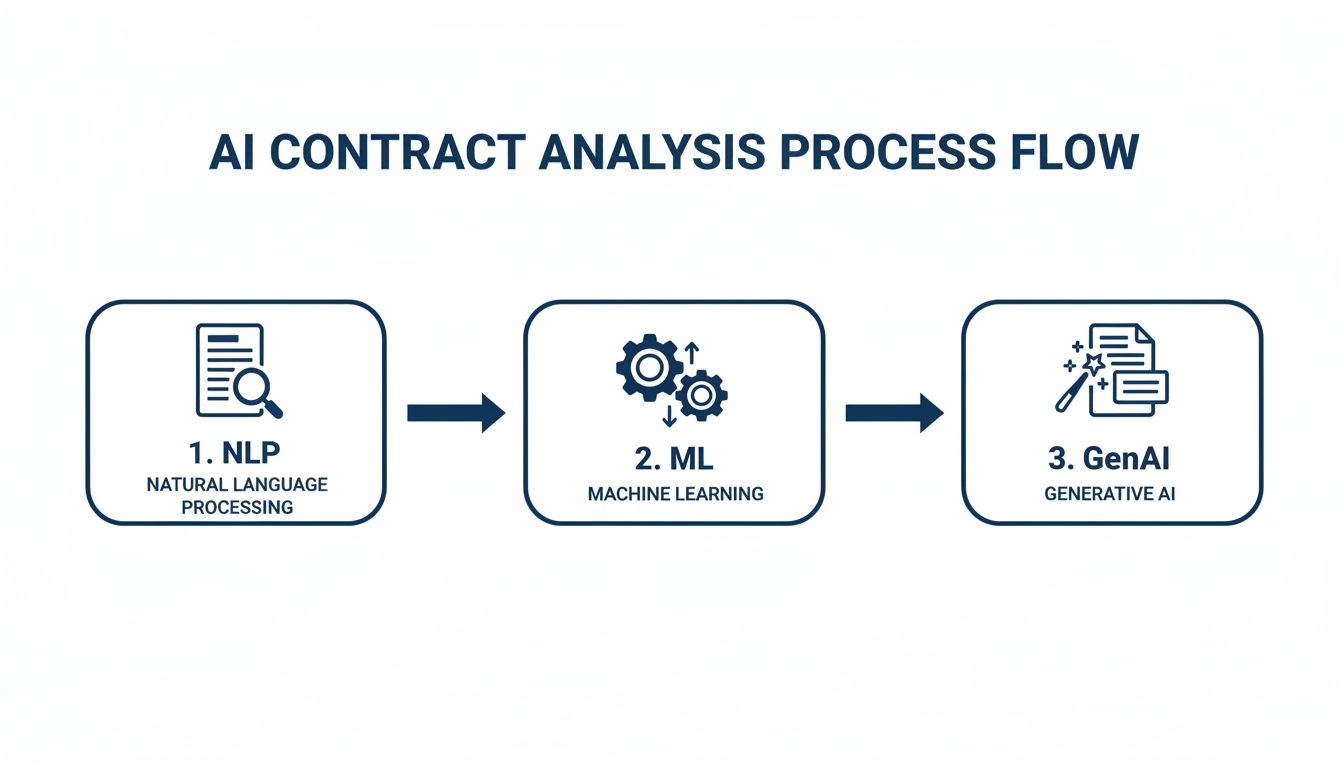
This process isn't just about storing documents. It’s about turning a static library of PDFs into an intelligent, active system that works for you.
From Initial Call to First Draft in Minutes
The life of a contract usually starts with a client call or a request from the sales team. The old way? You'd scribble notes, then hunt down the right template and start the tedious process of copying and pasting names, dates, and deal terms. It’s slow, boring, and a breeding ground for embarrassing typos.
AI flips this workflow on its head. Instead of manual data entry, the system can pull information directly from an intake form or even the transcript of a meeting.
From there, it gets to work instantly:
- It spots the key details: The AI identifies and extracts names, company info, addresses, and other crucial party information.
- It populates your template: All that extracted data is automatically dropped into the correct fields of your approved MSA, NDA, or other standard agreement.
- It serves up a draft for review: In seconds, you have a complete first draft ready for a lawyer’s eyes.
Just this first step alone can shave hours off the process for every single agreement, letting your legal team respond to the business with speed and precision.
Making Contract Negotiations Smarter, Not Harder
Negotiation is where deals slow to a crawl. The back-and-forth of manual redlining—painstakingly comparing versions, checking every change against the company playbook, and drafting counter-offers—can drag on for weeks. It’s a huge source of friction.
Think of AI as a negotiation co-pilot. When the other side sends back their redlines, the system doesn’t just wait for you to read them. It gets to work.
The AI doesn’t just show you what changed; it tells you what those changes mean. It compares their proposed clauses against your approved legal playbook, instantly flagging anything that deviates from your standard positions. It then scores the risk and can even suggest pre-approved fallback language from your clause library.
This lets you stop wasting time on minor wording tweaks and focus your energy on the handful of high-risk changes that actually matter. You're no longer a line editor; you're a strategic advisor.
Keeping an Eye on Contracts After They're Signed
Once signed, most contracts get filed away and forgotten—until a renewal deadline is missed or a critical obligation is breached. This reactive approach is a recipe for trouble, leading to costly auto-renewals and compliance headaches. An AI platform acts as a vigilant watchdog for your entire contract portfolio.
The system is always on, monitoring your agreements like a digital paralegal who never sleeps.
- Tracking Obligations: The AI pulls out key dates, deliverables, and compliance requirements, then automatically assigns tasks and sends reminders to the right people.
- Sending Renewal Alerts: You’ll get a heads-up on upcoming renewal or termination deadlines well in advance, giving you plenty of time to decide whether to renegotiate or walk away.
- Monitoring for Compliance: The platform can even scan for regulatory updates and flag existing contracts that might need to be amended, helping you stay ahead of compliance issues.
By automating these post-signature duties, AI ensures you get the full value you negotiated. To see how these pieces fit together, our guide on legal workflow automation software dives deeper into tailoring these systems to your team's needs. Ultimately, this turns your contract portfolio from a dusty archive of hidden risks into a powerful strategic asset.
Measuring the Real-World ROI of AI Contract Tools
When you're thinking about bringing in any new technology, it all boils down to one question: what’s the payoff? With AI contract management, the answer isn't just about shaving a few hours off someone's workload. The return on investment (ROI) is a powerful mix of direct cost savings, dramatically lower risk, and a complete change in how your legal team contributes to the business.
Measuring this impact starts with the numbers you can easily see—the tangible metrics that make an immediate difference on the balance sheet. These are the wins that build a powerful case right from the start.
The Tangible Financial Gains
The most obvious ROI comes from plugging the leaks in your current process. Think about manual contract reviews, for instance. They're a classic bottleneck. A recent market analysis showed that cutting down the 3.2-hour average review time for a single agreement was a top reason Chief Legal Officers were investing in AI in 2024. When you automate that first pass, you speed up the entire deal cycle, which means your sales team can close deals and bring in revenue that much faster.
Then there's the silent profit killer: revenue leakage. This is what happens when a contract auto-renews without anyone noticing, or when a chance to renegotiate better terms is missed simply because a deadline slipped through the cracks.
An AI platform acts as a constant watchdog, tracking every renewal and expiration date across your entire portfolio. It prevents millions in accidental spending and helps you lock in revenue that might otherwise have vanished.
This proactive oversight also applies to compliance. The system automatically flags risky language or missed obligations, helping you sidestep the kinds of hefty fines and penalties that can seriously damage your bottom line.
The Strategic Business Impact
Beyond the hard numbers, the strategic value is where AI contract management truly shines. It helps shift the legal department from being seen as a cost center to becoming a genuine strategic partner that helps grow and protect the business.
This is where the real long-term value is unlocked:
- Superior Risk Mitigation: AI gives you a bird's-eye view of risk across every single contract. It spots problematic clauses and patterns long before they have a chance to turn into costly disputes.
- A Stronger Compliance Posture: By enforcing standard language and keeping an eye on regulatory changes, the system ensures you're always aligned with both internal policies and external laws.
- Empowering Your Legal Team: Freeing your lawyers from tedious administrative tasks allows them to focus on high-stakes negotiations and strategic advice. You can explore this concept further in our guide on resource allocation optimization.
Building a Simple Business Case
To make the case for investing, you don't need a complex formula. Start by estimating the hours saved on each contract review and multiply that by how many contracts you handle each year. Next, pinpoint a recent example of a missed renewal or a compliance slip-up and calculate the direct cost. When you combine those concrete savings with the undeniable strategic benefit of reduced risk, the argument for adoption becomes crystal clear.
The global trend is already pointing in this direction. North America currently holds 45.9% of the AI contract market, and the wider CLM software market is expected to grow at a 12.9% CAGR through 2034. As you can learn more about AI contract market trends on Market.us, the message from the industry is loud and clear: investing in this technology is no longer just an option—it’s a competitive necessity.
Navigating Security, Privacy, and Compliance Concerns

Let's be honest. The idea of handing over your company's most sensitive documents to a third-party platform can be nerve-wracking. For any legal team, protecting that information isn't just a good habit—it’s a fundamental, non-negotiable duty to your clients and your organization.
Fortunately, any enterprise-grade AI contract management platform worth its salt is built with this exact concern at its core. These systems are designed from the ground up with a security-first mindset, layering protections to defend your information at every turn. It’s about more than just preventing a breach; it's about giving you the control and transparency needed to satisfy tough regulations and keep client trust intact.
Foundational Security Features You Should Expect
A truly secure platform goes far beyond a simple password. It's built on a multi-layered defense strategy. When you're looking at different solutions, there are a few features that should be considered table stakes, not optional upgrades.
Think of these as the essential pillars of security:
- End-to-End Data Encryption: This is critical. It means your contract data is scrambled and unreadable both while it’s moving across the internet (in transit) and while it's sitting on a server (at rest). It’s the digital equivalent of shipping your documents in a sealed, unbreakable lockbox.
- Granular Access Controls: Not everyone on the team needs to see every single contract. Role-based permissions let you dial in exactly who can view, edit, or approve specific documents, ensuring information is accessible strictly on a need-to-know basis.
- Comprehensive Audit Trails: A detailed log should track every action taken inside the system—who looked at a document, what they changed, and when they did it. This creates an immutable record that is absolutely vital for compliance audits or internal investigations.
These features all work in concert to build a secure environment where your data is protected from unauthorized eyes, both inside and outside your organization.
Meeting Global Compliance and Data Residency Rules
If you do business internationally, navigating regulations like GDPR in Europe is a top priority. A huge piece of that puzzle is data residency—the rule that certain data must physically be stored within a specific geographic area. Top-tier AI platforms get this, offering dedicated hosting in secure Swiss or EU data centers to help you meet those strict requirements.
Beyond just storage, the right system actually turns AI from a potential compliance headache into a powerful compliance asset. By automatically flagging deviations from standard clauses, the AI helps you maintain policy consistency across thousands of agreements. You can get a better sense of these challenges by reading our resources on data privacy compliance challenges.
AI contract management doesn't just store your data securely; it actively enhances your compliance posture. The system works as a digital compliance officer, tirelessly checking new and existing agreements against your established rules and external regulations.
This proactive approach helps you catch potential issues before they balloon into expensive violations. For those in highly regulated industries like healthcare, this isn't just nice to have; it's essential. When it comes to building and using HIPAA compliant AI tools, it's clear that the right architecture is the foundation for meeting these exacting standards.
At the end of the day, a modern AI contract platform should be a fortress for your data. By combining robust security protocols with intelligent compliance monitoring, it transforms a source of anxiety into a source of confidence, safeguarding your firm’s most critical information.
Your Roadmap to a Successful AI Rollout
Bringing AI contract management into your organization isn't like flipping a switch; it's more like building a bridge. New technology only pays off when people actually use it. That means a thoughtful, human-centered plan is just as critical as the software itself. The whole point is to make the transition feel like a natural upgrade, not a frustrating overhaul.
The best way to do this is to start small. Forget about a massive, company-wide launch on day one. Instead, run a focused pilot program with a small, motivated group. This could be a single department, like the sales team, or you could focus on one type of agreement, like your standard NDAs. This lets you prove the system’s value, get honest feedback, and smooth out any wrinkles in a low-stakes setting.
Start with a Pilot and Build Momentum
The secret to a great pilot is picking the right people and setting clear, achievable goals. Zero in on a specific, painful bottleneck in your current process—maybe it's the agonizingly slow pace of first drafts or the constant use of outdated clauses—and measure exactly how the AI improves it.
Your pilot program should be designed to:
- Deliver a quick win: Show a tangible improvement in speed, accuracy, or risk reduction in just a few weeks.
- Find your internal champions: Identify enthusiastic users who get it. They’ll become your best advocates when it's time to expand.
- Get practical feedback: Collect real-world insights to fine-tune your training and plan the full rollout.
A successful pilot gives you a powerful internal success story. When other teams see their colleagues closing deals faster and dodging compliance bullets, they won’t need convincing—they’ll be asking for it.
Focus on People, Not Just the Platform
Let's be honest: technology that fights against how people already work is doomed. The best AI contract platforms are designed to meet your team where they are, integrating seamlessly with tools they live in every day, like Microsoft Word and Outlook. This approach minimizes disruption and makes learning the new system feel intuitive.
A successful implementation isn’t measured by how many features the software has. It’s measured by how many people use it every single day. The focus must be on making the tool an indispensable part of their routine, not just another chore.
To get there, you have to build a supportive environment. Offer clear, concise training, host open Q&A sessions, and empower your internal champions to help their peers. The easier you make it for people to see the direct benefits in their own work, the faster your new system will just become "the way we do things."
Choosing the Right Partner for the Journey
Finally, remember that you’re not just buying software; you’re starting a long-term relationship. The right vendor should feel like an extension of your own team, offering much more than just a login.
Look for a partner who provides:
- Hands-On Onboarding and Support: You want a dedicated team that will guide you through setup and be there to answer questions quickly.
- A Shared Vision for the Future: They should have a clear commitment to innovation and a product roadmap that shows they understand where legal work is headed.
- Uncompromising Security: This is non-negotiable. Look for enterprise-grade security, end-to-end data encryption, and options for data residency to meet your specific compliance needs.
By taking this measured, people-first approach, you can ensure your investment in AI contract management delivers real value from day one and sets your legal operations up for success for years to come.
Answering Your Questions About AI Contract Management
It's natural to have questions when bringing any new technology into the fold, especially in the legal world where accuracy and security are paramount. Let's tackle some of the most common concerns we hear from legal professionals about AI contract management.
Will AI Replace Lawyers in Contract Management?
Not a chance. The best way to think about AI is as an incredibly smart and fast paralegal, not a replacement for seasoned legal counsel. The point of AI contract management is to take over the tedious, time-consuming tasks that bog down a lawyer's day—things like digging for key dates, flagging non-standard clauses, or manually tracking renewal deadlines.
This frees up legal experts to do what they do best:
- Devising complex negotiation strategies.
- Applying nuanced legal analysis to tricky situations.
- Building and strengthening client relationships.
By taking on the administrative grunt work, AI amplifies a lawyer's ability to provide strategic advice, work faster, and be more accurate.
AI is an assistant, not an alternative. It allows legal experts to focus their skills where human judgment is irreplaceable, shifting their role from tactical reviewer to strategic advisor.
How Secure Is Our Sensitive Contract Data?
This is a critical question, and the answer is that any worthwhile platform is built from the ground up with enterprise-grade security. When you're looking at different tools, you need to see a robust, multi-layered approach to protecting your firm's most confidential information.
Look for non-negotiable features like end-to-end encryption for data both in transit and at rest, strict role-based access controls (so only the right people see the right things), and comprehensive audit logs. Compliance with international standards like SOC 2 and GDPR is also a must. For firms operating globally, it's crucial to find a platform that offers secure data hosting in specific regions like the EU to meet stringent data residency laws.
How Long Does It Take to Implement an AI System?
The days of year-long, painful software rollouts are largely behind us. Modern, cloud-based AI contract management platforms can get you up and running in weeks, not months.
A smart way to start is with a phased approach. Kick things off with a small pilot group or focus on a single, high-volume use case, like managing all your NDAs. This lets your team score an early win, prove the value of the tool, and build excitement for a wider rollout. The trick is to partner with a provider who offers fantastic onboarding support and has a system that people can actually figure out how to use without a PhD in computer science.
Ready to transform your legal workflows and empower your team? Whisperit is the voice-first AI workspace built for legal work, unifying dictation, drafting, and collaboration to move from intake to export in fewer steps. See how Whisperit can accelerate your practice.